
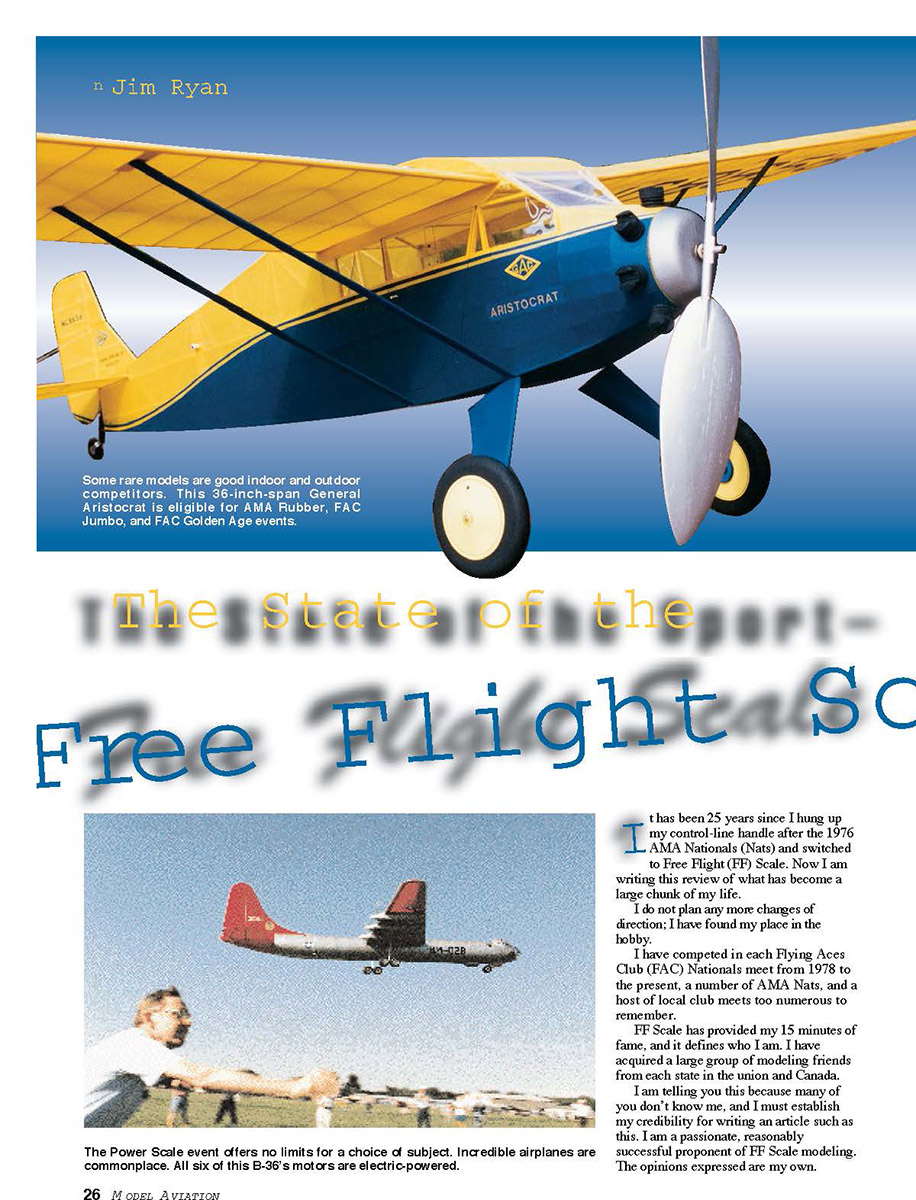
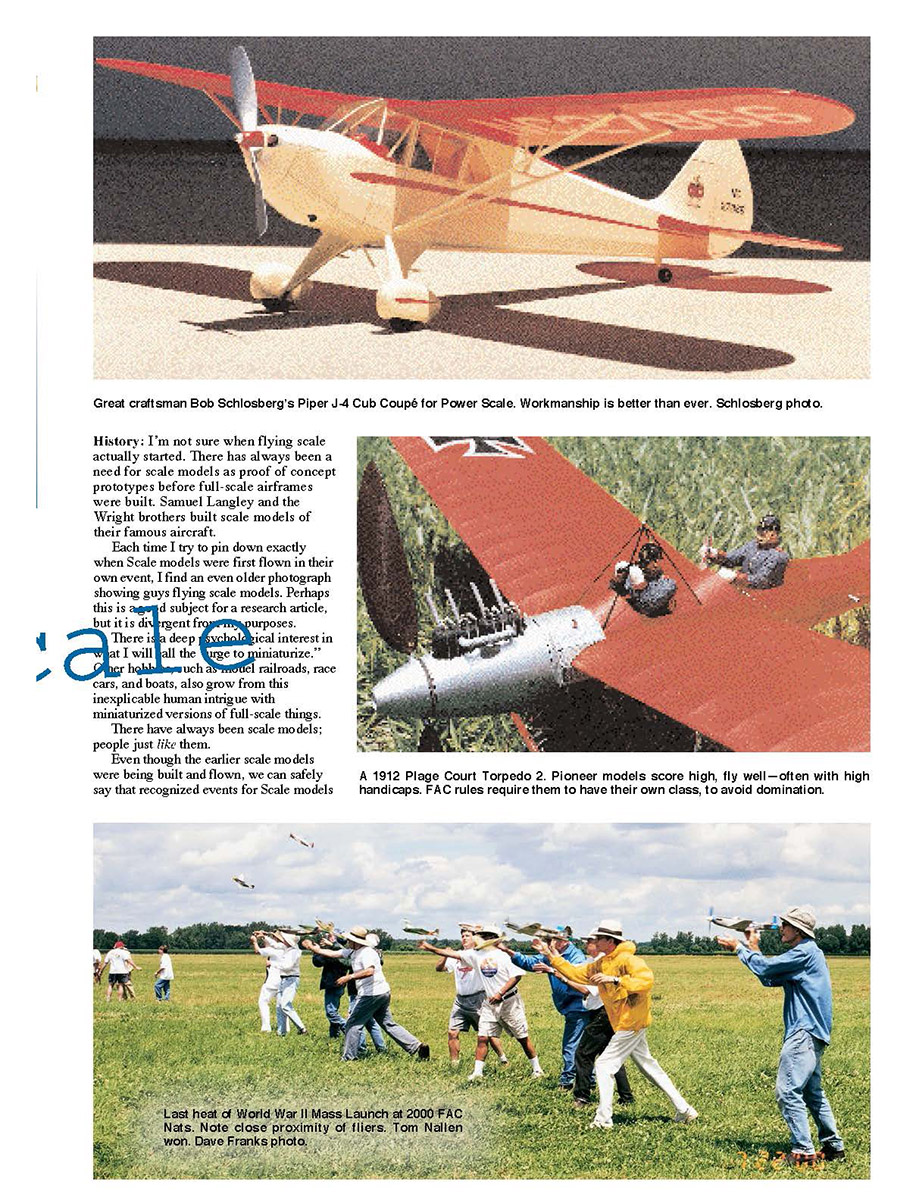
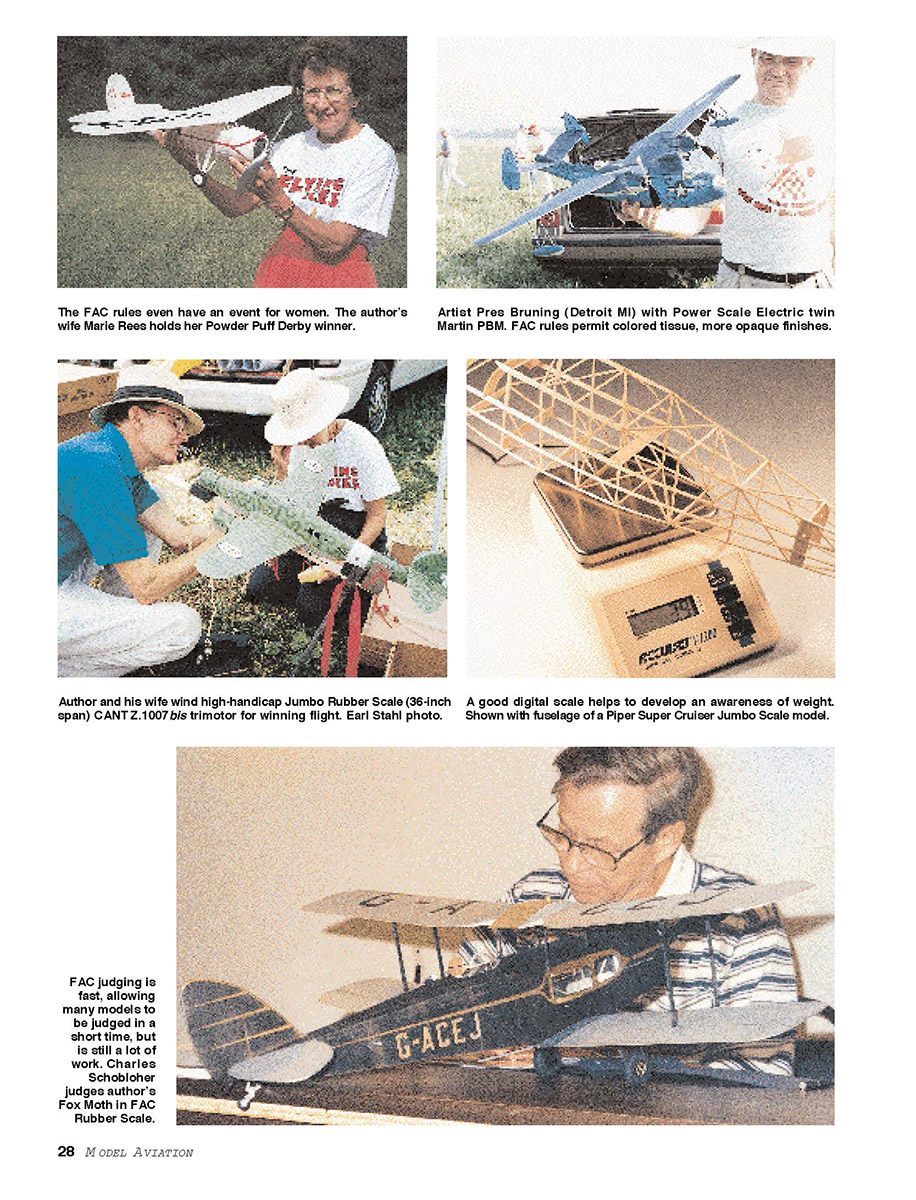
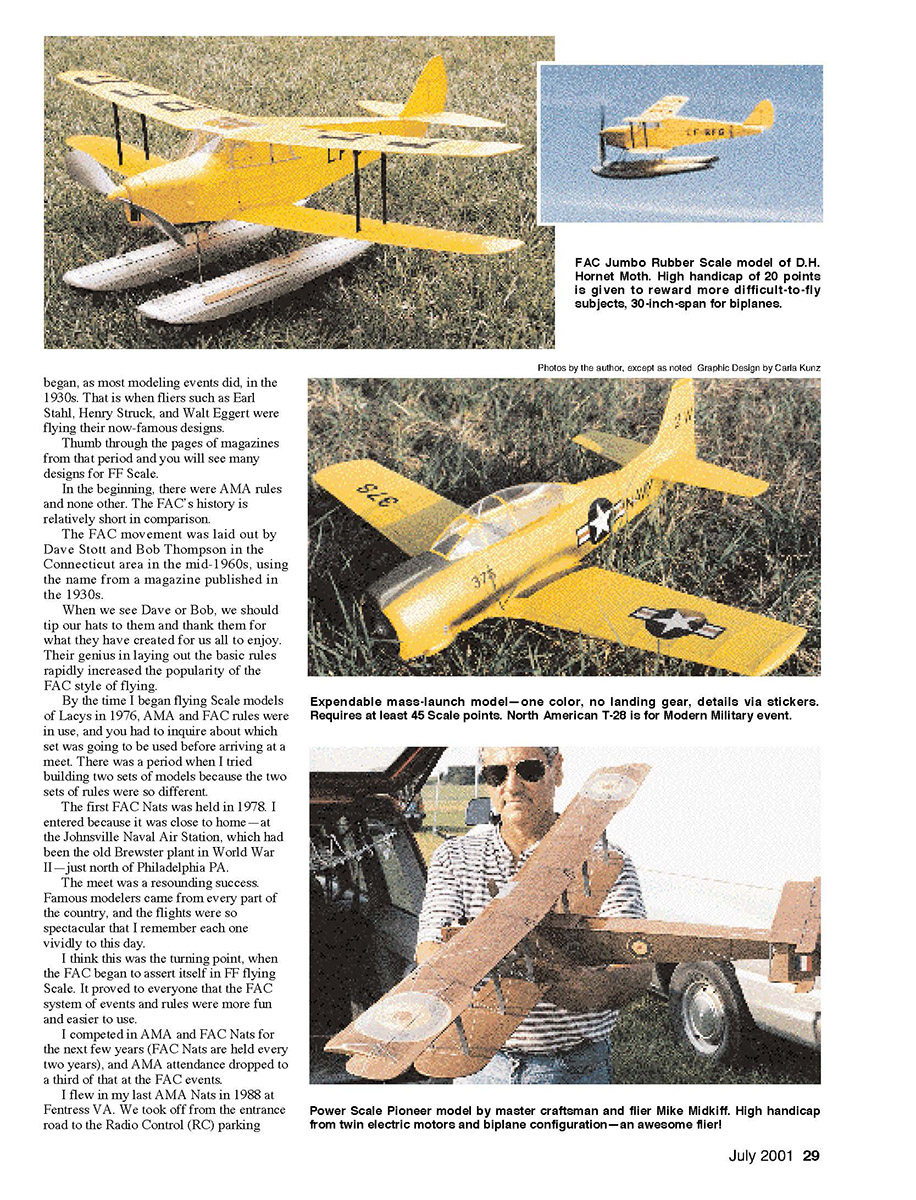
The State of the Sport—Free Flight Scale
Jim Ryan
Introduction
It has been 25 years since I hung up my control-line handle after the 1976 AMA Nationals (Nats) and switched to Free Flight (FF) Scale. Now I am writing this review of what has become a large chunk of my life.
I do not plan any more changes of direction; I have found my place in the hobby.
I have competed in each Flying Aces Club (FAC) Nationals meet from 1978 to the present, a number of AMA Nats, and a host of local club meets too numerous to remember.
FF Scale has provided my 15 minutes of fame, and it defines who I am. I have acquired a large group of modeling friends from each state in the union and Canada.
I am telling you this because many of you don't know me, and I must establish my credibility for writing an article such as this. I am a passionate, reasonably successful proponent of FF Scale modeling. The opinions expressed are my own.
History
I'm not sure when flying scale actually started. There has always been a need for scale models as proof-of-concept prototypes before full-scale airframes were built. Samuel Langley and the Wright brothers built scale models of their famous aircraft.
Each time I try to pin down exactly when scale models were first flown in their own event, I find an even older photograph showing guys flying scale models. Perhaps this is a good subject for a research article, but it is divergent from our purposes.
There is a deep psychological interest in what I will call the urge to miniaturize. Other hobbies, such as model railroads, race cars, and boats, also grow from this inexplicable human intrigue with miniaturized versions of full-scale things.
There have always been scale models; people just like them.
Even though earlier scale models were being built and flown, we can safely say that recognized events for Scale models did not spring up until after World War II. The first organized Scale contests in the U.S. that I can find were in the late 1940s and 1950s. The Flying Aces Club had a set of rules that included scale events which were popular. Later, the National Model Airplane Championships added Scale as a category.
Scale modeling began, as most modeling events did, in the 1930s. That is when fliers such as Earl Stahl, Henry Struck, and Walt Eggert were flying their now-famous designs.
Thumb through the pages of magazines from that period and you will see many designs for FF Scale.
In the beginning, there were AMA rules and none other. The FAC's history is relatively short in comparison.
The FAC movement was laid out by Dave Stott and Bob Thompson in the Connecticut area in the mid-1960s, using the name from a magazine published in the 1930s.
When we see Dave or Bob, we should tip our hats to them and thank them for what they have created for us all to enjoy. Their genius in laying out the basic rules rapidly increased the popularity of the FAC style of flying.
By the time I began flying Scale models of Lacys in 1976, AMA and FAC rules were in use, and you had to inquire about which set was going to be used before arriving at a meet. There was a period when I tried building two sets of models because the two sets of rules were so different.
The first FAC Nats was held in 1978. I entered because it was close to home — at the Johnsville Naval Air Station, which had been the old Brewster plant in World War II — just north of Philadelphia, PA.
The meet was a resounding success.
Famous modelers came from every part of the country, and the flights were so spectacular that I remember each one vividly to this day.
I think this was the turning point, when the FAC began to assert itself in FF Scale. It proved to everyone that the FAC system of events and rules were more fun and easier to use.
I competed in AMA and FAC Nats for the next few years (FAC Nats are held every two years), and AMA attendance dropped to a third of that at the FAC events.
I flew in my last AMA Nats in 1988 at Fentress, VA. We took off from the entrance road to the Radio Control (RC) parking area, by stopping traffic long enough for our airplanes to get safely above the cars.
Attendance was down to eight or ten in each class. That was it; I switched entirely to FAC flying.
I did attend an AMA Nats at Muncie, IN in 1998, because I was in town for another reason. The same handful per event were present.
The Rules
These define the events. They indirectly determine what types of airplanes will be flown, how popular the events will become, and how long they will last.
I will go into some detail, hoping to bring to light the advantages and disadvantages of all the rules used today for FF Scale. To a newcomer, these are the rules you will be up against in the sport.
The AMA rule book (Competition Regulations) lists three events for FF Scale:
- Peanut Scale — 501, 505
- Rubber Flying Scale — 503, 507
- Outdoor Gas Flying Scale — 504
The alternate numbers are for the Indoor and Outdoor events, which are otherwise the same. A printed score sheet defines the way scoring is done, and the general rules for each event are listed by each event category in the rule book.
Rule books may be purchased from AMA; they cover each event flown in this great hobby.
Peanut Scale (AMA)
- Size: maximum 13-inch wingspan or maximum nine-inch fuselage length.
- Flights: nine permitted; each attempt is counted as an official flight. The two best flights are averaged to become the flight score.
- Bonus: 10-second bonus if the model can rise off ground (ROG).
- Important rule: No flight time plus the bonus may exceed the total Scale score. If you get a low Scale score, no amount of fantastic flying will save you.
- Judging: Scale judging forms have blocks for workmanship, color-and-markings, details and accessories, flying surfaces, covering, landing-gear length, dihedral and outlines of flying surfaces, bonus points for type of aircraft, and minus points for any deviations from scale. A total of 10 categories are evaluated.
- Scoring: Add the second through ninth scores, subtract the minus points, and multiply by the workmanship points. That figure is added to the flight score for a total score.
- Data pack: Competitors must submit a data pack listing scale, omitted parts, a photo (preferably color), and an accurate, approved three-view drawing.
- Practical implications: These rules favor certain types of models. Winning subjects typically have long landing gear, fly well with scale wing dihedral, fly controllably without stabilizer or rudder enlargement, have few details so they can be shown to be "all there," and have as high a handicap as possible. Handicap awards points for multimotors, multiwings, seaplanes, and other items that make the airplane harder to fly.
Rubber Flying Scale (AMA)
- Judging categories (seven): wing shape/indicated structure/dihedral; tail surfaces; fuselage/cowling/engine; landing gear; struts and rigging; static details and accessories; finish and color-and-markings; and workmanship. Totals equal 100 points.
- Flights: All flights must ROG except for biplanes, seaplanes, and autogiros (hand-launched). Four flights; the best two are averaged up to a maximum of 90 seconds.
- Scoring: Total points equal the sum of flight and Scale scores.
- Data pack: Similar to Peanut Scale but limited to six 8½ x 11-inch sheets.
- Balance: Better balance of building and flying exists here — 100 points max for Scale and 90 points max for flying. No handicap rule, so a wider choice of airplane types is possible. Requires considerable work on indicated structure, surface finish, opacity, engine details, and rigging.
Gas Flying Scale (AMA)
- History: Roots deep in modeling history; fewer people fly gas-powered models today. Most fliers use electric or CO2 motors now.
- Scoring: Uses Unified Scale Judging Regulations (same as CL and RC Precision Scale). Eight categories and a maximum of 450 points, including drawing presentation, photo presentation, and written description.
- Flight scoring: Flight not timed; judged on realism of takeoff, flight, and landing approach (not touchdown). Thirty points for each area, 60 flight points max. Best flight of four attempts is multiplied by five and added to the Scale score.
- Practical issues: Judges must evaluate flight characteristics, which is difficult in windy or inclement weather. Scale judging can feel like overkill for a model light enough to be FF.
FAC Events and System
The FAC rule book lists many categories, including:
- Scale, World War II Scale, Modern Military 1945-up, Bendix Race, Shell Speed Dash, Golden Age Military, Thompson Race, Greve Race, AT-6 One Design, Fairchild 24 One Design, Aerol Race, Goodyear Midget Racers, Modern Civilian 1945-up, and Flying Horde.
Timed and judged events include:
- FAC Rubber Scale, Pioneer Scale, FAC Peanut Scale, FAC Power Scale (one engine), FAC Power Scale (multiengine), Powder Puff Derby (for women), High Wing Peanut Scale, Golden Age Civilian, Jumbo Scale, Giant Scale, Dime Scale, and No-Cal Profile Scale.
There are more possibilities, but these events have stood the test of time. (Other events such as Old-Time Commercial Rubber and Jimmie Allen were omitted from this article as they are not Scale models.)
Mass Launch
A new and hugely popular category in FAC is the Mass Launch. Key points:
- The event director inspects models as pilots file out to fly, assuring models meet a minimum (e.g., 45 points).
- Models are given two minutes to wind, then all are flown simultaneously from a line, spacing fliers at six-foot intervals.
- If entrants exceed roughly 10, heats are flown and combined for finals.
- No repairs are allowed — rubber included — and the last competitor down is the winner.
- Multiple fliers may be designated out per round in early elimination stages to speed the contest.
- Mass Launches can be flown with as many as 50 airplanes, creating dramatic crowd appeal.
FAC Culture and Scoring
- Kanones (top guns): Each first-place victory is recorded at FAC-GHQ. Victories accumulate ranks from Lieutenant to Air Marshall; at 16 victories you may be awarded the Blue Max Medal.
- Entries: Each flier may enter two airplanes in judged events, but only one score counts.
- Builder rule: The builder-of-the-model rule applies. Neither undercambered wings nor folding propellers are allowed.
- Launch: All flights are hand-launched. Landing gear may be represented as retracted unless an event specifies extended gear.
- Scoring categories: Handicap (0–45 points), Construction Details (0–30), Color and Markings (0–20), and Workmanship (0–12.5).
- Flight allowance: Three official flights exceeding 20 seconds are allowed; only the highest counts. Maximum flight time is two minutes, with a tiered point system:
- 0–60 seconds — one point per second
- 61–90 seconds — 1/2 point per second
- 91–120 seconds — 1/4 point per second
- Two-minute maximum equals 82.5 points max for flight.
- Commonality: All Rubber Scale events use the same system.
Power Scale Changes
- Power Scale rules changed because models could easily achieve maximum times.
- Handicap points are added to flight time before flight points are calculated.
- Complexity points (handicap divided by 10) were added to reduce ties.
Practical Advice
- Many events impose detail limits such as wingspan; always check the rule book before building.
We have looked at both sets of rules in detail, and the rules tell the story: FAC is where the action is today in FF Scale.
The Skills
A friend told me you have to be proficient in 65 skills to build one FF Scale model. Although that is an exaggeration, he was not far off the mark.
However, it should be challenging if you are to stay interested. People stay with things in which they have invested personal effort. I'm not trying to scare you off—quite the contrary—but it will take some work to learn the skills.
There are no ARFs here, and not much cash is required; just learn things one at a time, while relaxing and enjoying yourself. That is what a hobby is all about.
No one wakes up in the morning and says, "I'm going to be National Champ in Free Flight Scale." You are drawn into it gradually by an interest in realistic-looking models that fly by themselves.
Your goal—stated as simply as I can put it—is to strive to make the best-looking model you can and fly it for as long as it can.
Getting Started
- Join the community: Get plugged into what others are doing; learn from others. Send $15 to FAC Commander Lin Reichel, 3301 Cindy Ln., Erie, PA 16506, and start getting the bimonthly newsletters. They give you full-size plans by other members and news focused on FF Scale.
- Join AMA: You need liability insurance coverage to fly in most meets. Order the AMA rule book at the same time.
- Buy tools: A good weighing scale is highly recommended. Digital electronic scales readable to 0.1 gram and capable of weighing up to 400 grams are ideal (typically $100–$200). With a good scale you develop an awareness of weight, which is critical in FF.
Wood Selection
- Learn wood characteristics: Pounds-per-cubic-foot charts help, but different parts of a balsa sheet vary in density. Stiffness and strength are subtle; for a given density you want the greatest strength from the wood fibers.
- Know which parts of an airframe need which strengths. Most plans leave these choices to the modeler.
Covering and Finishing
- Covering is a major skill. Tissue is the main scale surface used; plastics are usually too heavy and can look fake.
- Mentors help: Hands-on covering lessons save time. FAC squadrons can connect you with experienced modelers.
- Covering methods: Popular methods include dope, white glue, and glue stick. A video by Larry Kruse, How to Cover Models...with Tissue and Dope, can help.
- Painting: Colored tissue is permitted in FAC events, but paint is often needed for lettering, stripes, camouflage, or clear coating. Airbrushing is preferred to brushing; airbrushing coats only outer tissue fibers and is lighter.
- Equipment: Invest in an airbrush and compressor and learn to use them for good-looking Scale models.
Detailing
- Details can dramatically affect Scale scores while adding minimal weight: panel lines, rivets, wire rigging, registration numbers, and engine details.
- Rapidograph pens or indelible markers are useful for panel lines.
- Pilot figures are not scored but add visual appeal.
Building the framework is only half the job; covering, painting, and detailing complete the model.
Judging
- Volunteer as a Scale judge at a local meet. It will improve your models and let you see what others are building and how they present them.
- Judges are fellow modelers; never protest a score—it's not done in the FAC.
The Tactics
An entry-level modeler can participate in FAC flying almost immediately. Once you can fly an airplane for roughly one minute, you can enter mass-launch events.
These events are intoxicating while your craftsmanship develops to allow entry into the more intense judged Scale events.
By far the most important tactics to learn are the use of propellers and rubber:
- Motor and prop sizing
- Winding approaches
Fliers who master these are most likely to win in mass-launch events. I have seen incorrectly trimmed or overweight airplanes win simply because the flier got propeller and rubber right for the conditions.
When you walk up to the launch line, you must assess:
- Is it windy?
- Is it light air with thermals or a cold downer day?
- How skilled are the fliers beside you?
As rounds proceed, consider how many winds will outlast others without breaking the motor while winding. Charts exist for how many winds a given size and length of rubber will take — a good starting point. Mentors and networking are invaluable.
Trimming and Testing
- Flight trimming requires repetition: fly until dark and make incremental adjustments.
- Start with calm weather for initial trimming.
- Build adjustability into the airplane: downthrust, sidethrust, adjustable elevator and rudder, and ballast options.
- After trimming, experiment with motors and props to optimize performance.
- Record-keeping is essential: log dates, atmospheric conditions, rubber lengths and weights, prop sizes and pitches, surface settings, and flight times. This helps recreate successful settings or rebuild after a flyaway.
Teamwork and Physical Demands
- Bring a partner or flying buddy to help with winding, timing, spotting, retrieving, and making sure timing clips are turned in.
- To win high-point awards requires a lot of work at home, at the trim field, and during meets. Plan to build and test 12–15 events carefully.
- Contest flying involves a lot of walking — 40–50 flights can add up to 10–12 miles over a weekend. Stay in shape and be prepared for hot weather and long days.
- The 2000 FAC Nats (Geneseo, NY) had 34 events during three days of flying; there is little time for tinkering at the meet if you aim to win big.
The Future
Where are we going with FF Scale? I say more of the same.
- FAC membership is rising, and attendance at Geneseo and local meets is increasing.
- A strong group of talented younger fliers (20–40 age group) has joined the club, helping assure the future of this type of flying.
- There will be a demographic bump down the road because many fliers are in older age groups, but the activity will continue.
Recently, successful entries by professionals with strong graphic and artistic skills have raised the standard. Artists bring high personal standards that benefit Scale modeling. After 25 years of the FAC movement, craftsmanship continues to improve.
You owe it to yourself to come to Geneseo the Thursday night before a Nats. You won't be disappointed.
We are in what I believe to be the Golden Age of FF Scale. We are building better and flying longer than ever before. Flying Scale models is very much a "now" thing rather than a nostalgia event, and I am glad I am here to be part of it.
Transcribed from original scans by AI. Minor OCR errors may remain.

