
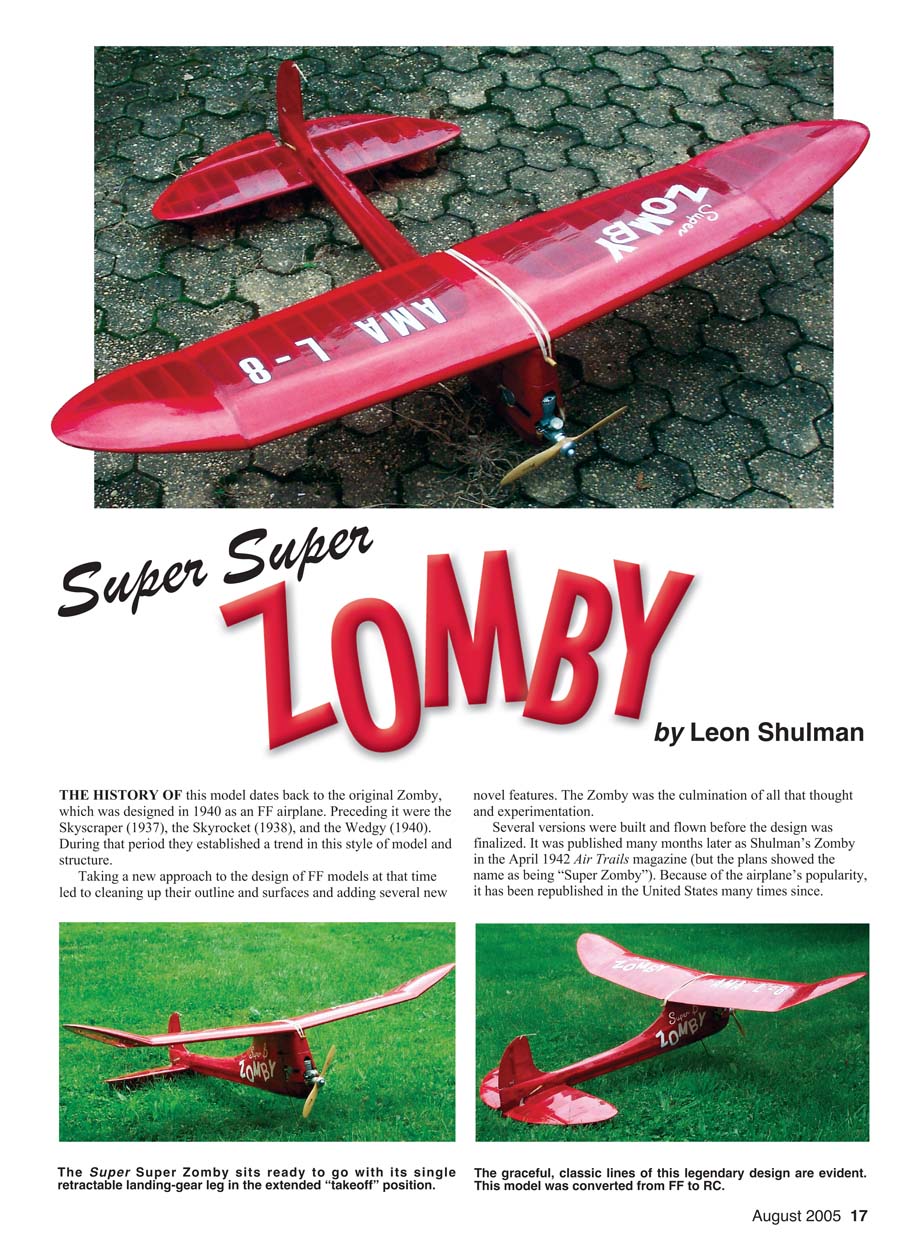
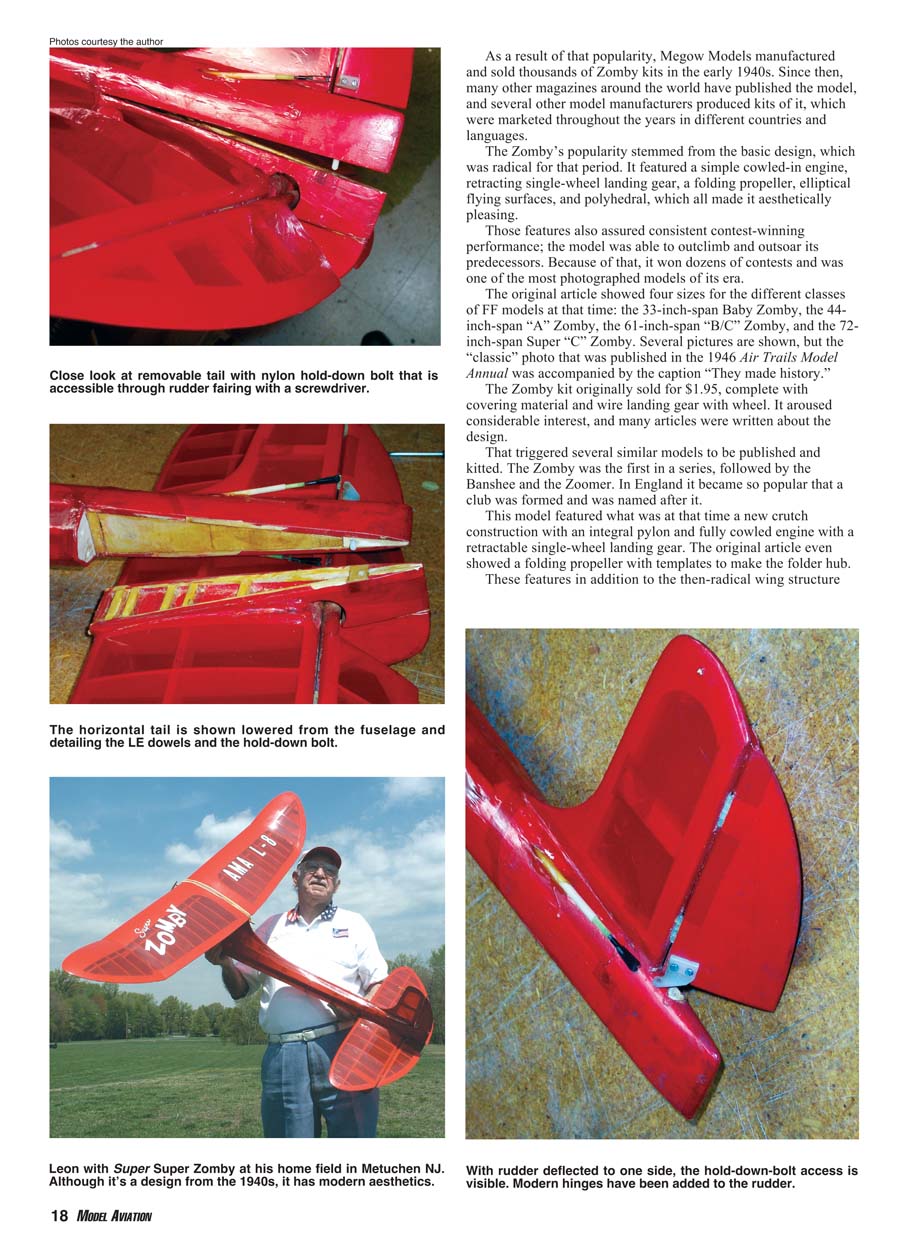
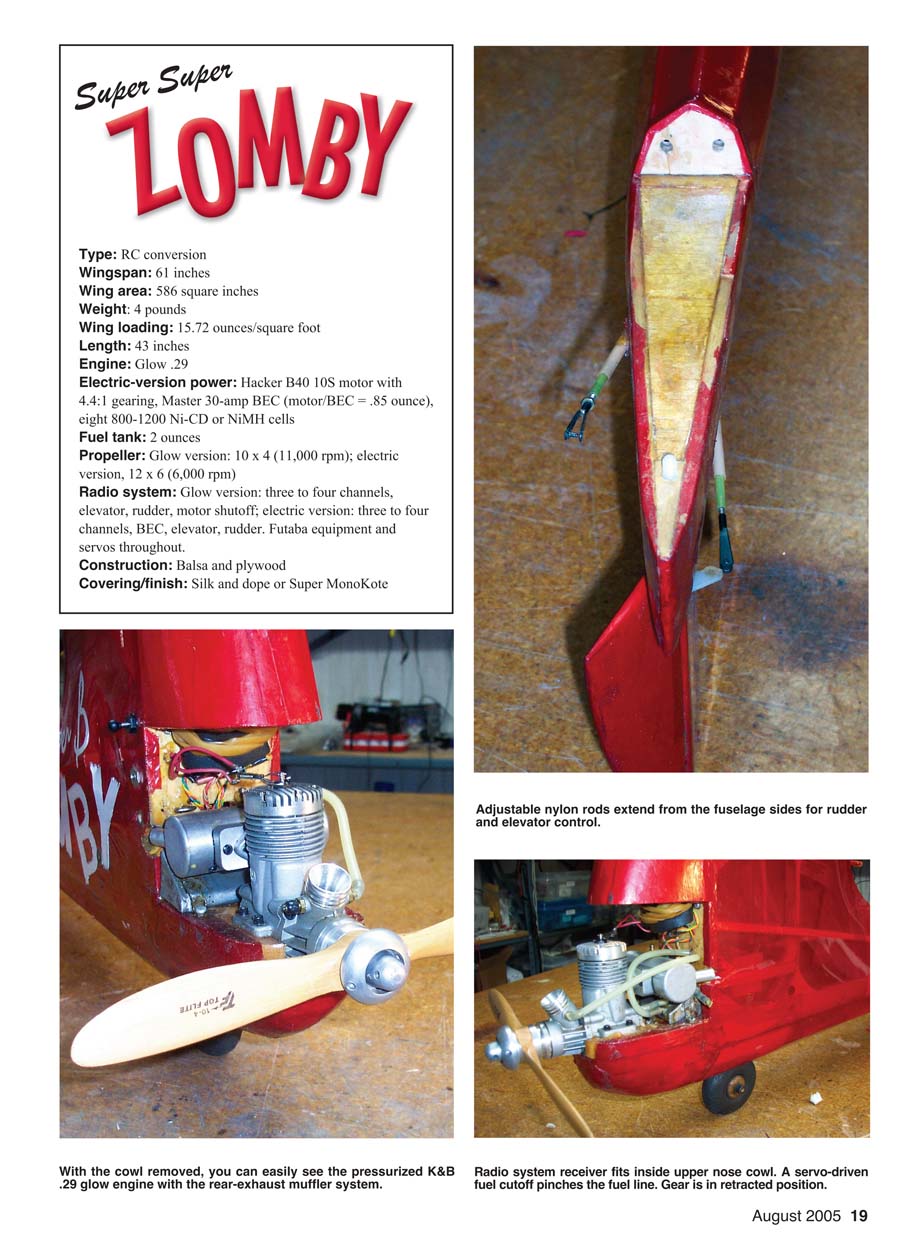
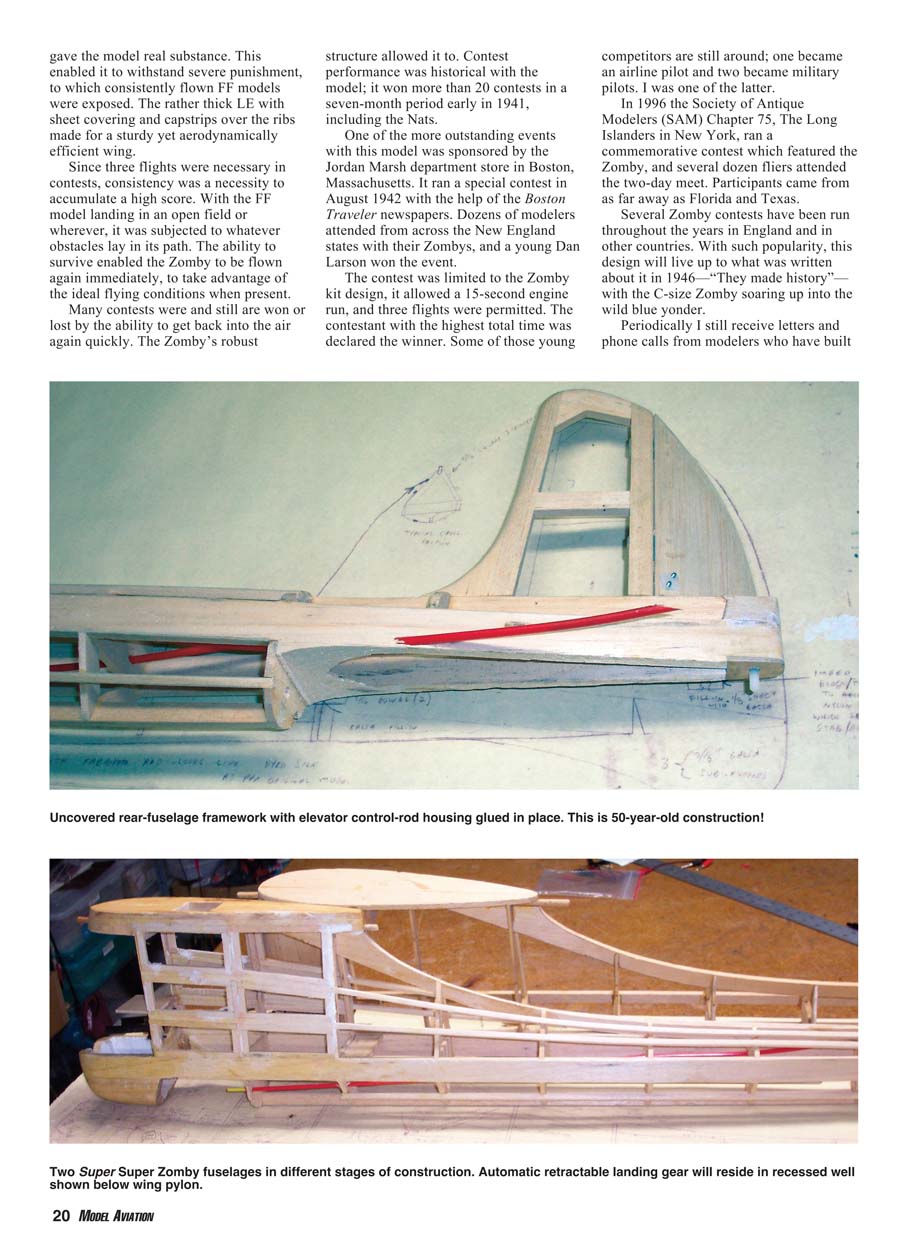
Super Super Zomby
by Leon Shulman
THE HISTORY OF this model dates back to the original Zomby, which was designed in 1940 as an FF airplane. Preceding it were the Skyscraper (1937), the Skyrocket (1938), and the Wegdy (1940). During that period they established a trend in this style of model and structure.
Taking a new approach to the design of FF models at that time led to cleaning up their outline and surfaces and adding several new novel features. The Zomby was the culmination of all that thought and experimentation.
Several versions were built and flown before the design was finalized. It was published many months later as Shulman's Zomby in the April 1942 Air Trails magazine (but the plans showed the name as being "Super Zomby"). Because of the airplane's popularity, it has been republished in the United States many times since. As a result of that popularity, Megow Models manufactured and sold thousands of Zomby kits in the early 1940s. Since then, many other magazines around the world have published the model, and several other model manufacturers produced kits of it, which were marketed throughout the years in different countries and languages.
The Zomby's popularity stemmed from the basic design, which was radical for that period. It featured a simple cowled-in engine, retracting single-wheel landing gear, a folding propeller, elliptical flying surfaces, and polyhedral, which all made it aesthetically pleasing.
Those features also assured consistent contest-winning performance; the model was able to outclimb and outsail its predecessors. Because of that, it won dozens of contests and was one of the most photographed models of its era.
The original article showed four sizes for the different classes of FF models at that time: the 33-inch-span Baby Zomby, the 44-inch-span "A" Zomby, the 61-inch-span "B/C" Zomby, and the 72-inch-span Super "C" Zomby. Several pictures are shown, but the "classic" photo that was published in the 1946 Air Trails Model Annual was accompanied by the caption "They made history."
The Zomby kit originally sold for $1.95, complete with covering material and wire landing gear with wheel. It aroused considerable interest, and many articles were written about the design.
That triggered several similar models to be published and kitted. The Zomby was the first in a series, followed by the Banshee and the Zoomer. In England it became so popular that a club was formed and was named after it.
This model featured what was at that time a new crutch construction with an integral pylon and fully cowled engine with a retractable single-wheel landing gear. The original article even showed a folding propeller with templates to make the folder hub.
These features in addition to the then-radical wing structure gave the model real substance. This enabled it to withstand severe punishment, to which consistently flown FF models were exposed. The rather thick LE with sheet covering and capstrips over the ribs made for a sturdy yet aerodynamically efficient wing.
Since three flights were necessary in contests, consistency was a necessity to accumulate a high score. With the FF model landing in an open field or wherever, it was subjected to whatever obstacles lay in its path. The ability to survive enabled the Zomby to be flown again immediately, to take advantage of the ideal flying conditions when present.
Many contests were and still are won or lost by the ability to get back into the air again quickly. The Zomby’s robust structure allowed it to. Contest performance was historical with the model; it won more than 20 contests in a seven-month period early in 1941, including the Nats.
One of the more outstanding events with this model was sponsored by the Jordan Marsh department store in Boston, Massachusetts. It ran a special contest in August 1942 with the help of the Boston Traveler newspapers. Dozens of modelers attended from across the New England states with their Zombys, and a young Dan Larson won the event.
The contest was limited to the Zomby kit design, it allowed a 15-second engine run, and three flights were permitted. The contestant with the highest total time was declared the winner. Some of those young competitors are still around; one became an airline pilot and two became military pilots. I was one of the latter.
In 1996 the Society of Antique Modelers (SAM) Chapter 75, The Long Islanders in New York, ran a commemorative contest which featured the Zomby, and several dozen fliers attended the two-day meet. Participants came from as far away as Florida and Texas.
Several Zomby contests have been run throughout the years in England and in other countries. With such popularity, this design will live up to what was written about it in 1946—“They made history”—with the C-size Zomby soaring up into the wild blue yonder.
Periodically I still receive letters and phone calls from modelers who have built the Zomby in their past and several times since their youth. I can't help but feel that this design "tugs" at the hearts of old-timers with fond memories.
Late in 1946 I wanted to build another Zomby. I chose the B/C size with the 61-inch wingspan since it was easier to transport yet had the characteristics of a real soarer. In 1954 when I was into RC, I included movable elevators and rudder as well as engine speed control. I dubbed that version the "Super Super Zomby" for ease of reference. At this time the models were gasoline powered, but I later modified it for electric power; both versions are shown on the plans.
Super Super Zomby
By Leon Shulman
Type: RC conversion
Wingspan: 61 inches
Wing area: 586 square inches
Weight: 4 pounds
Wing loading: 15.72 ounces/square foot
Length: 43 inches
Engine: Glow .29
Electric-version power: Hacker B40 10S motor with 4.4:1 gearing, Master 30-amp BEC (motor/BEC = .85 ounce), eight 800-1200 Ni-CD or NiMH cells
Fuel tank: 2 ounces
Propeller: Glow version: 10 x 4 (11,000 rpm); electric version, 12 x 6 (6,000 rpm)
Radio system: Glow version: three to four channels, elevator, rudder, motor shutoff; electric version: three to four channels, BEC, elevator, rudder. Futaba equipment and servos throughout.
Construction: Balsa and plywood
Covering/finish: Silk and dope or Super MonoKote
CONSTRUCTION
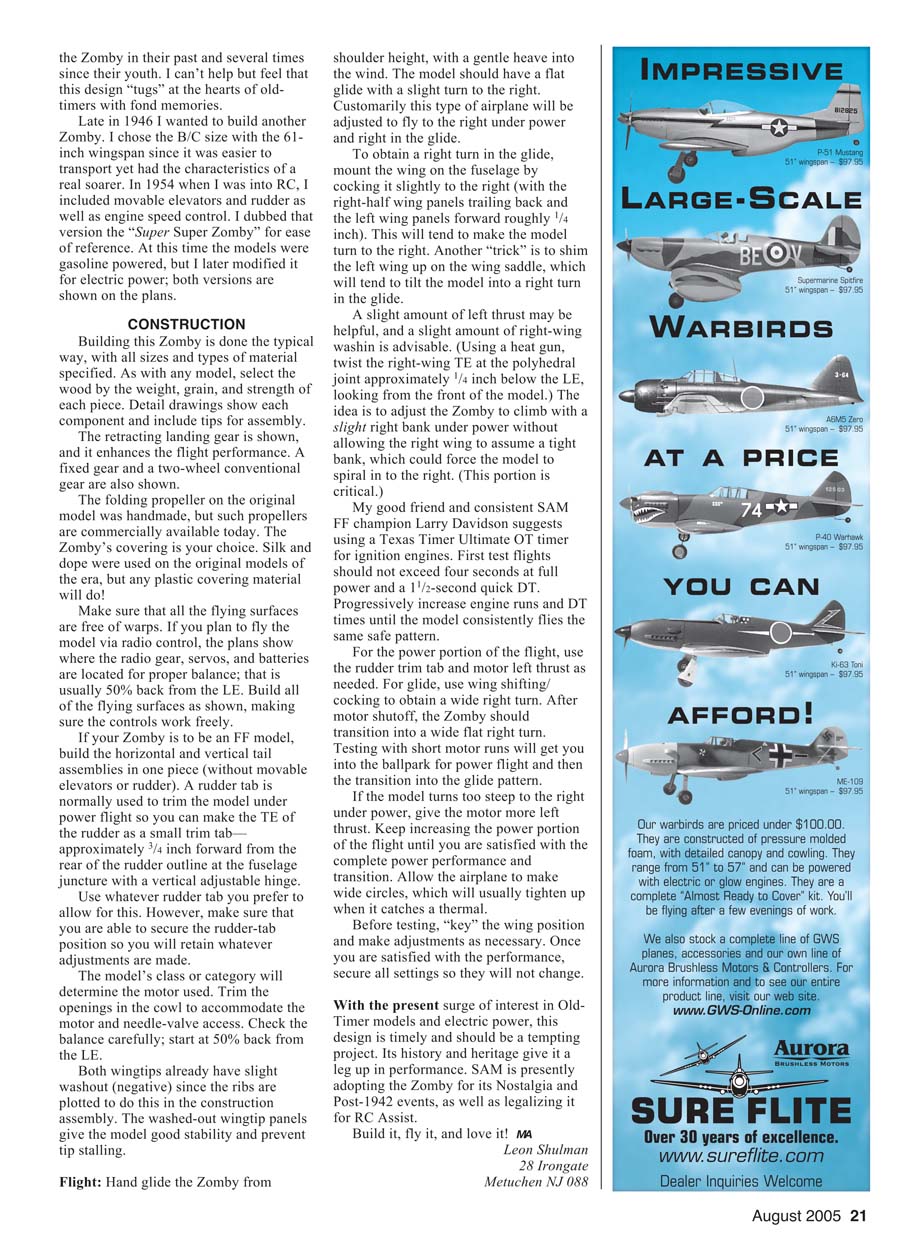
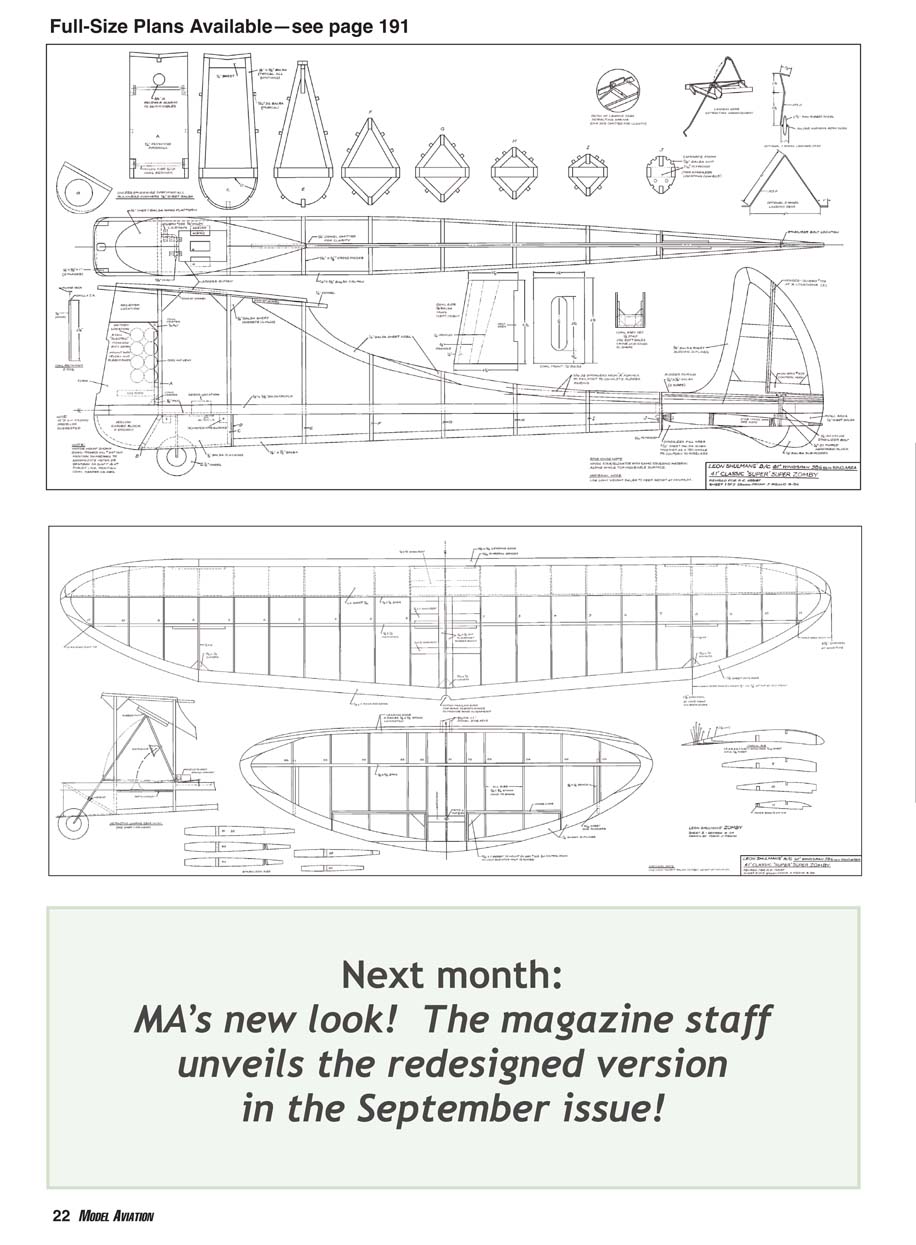
Building this Zomby is done the typical way, with all sizes and types of material specified. As with any model, select the wood by the weight, grain, and strength of each piece. Detail drawings show each component and include tips for assembly.
The retracting landing gear is shown, and it enhances the flight performance. A fixed gear and a two-wheel conventional gear are also shown.
The folding propeller on the original model was handmade, but such propellers are commercially available today. The Zomby's covering is your choice. Silk and dope were used on the original models of the era, but any plastic covering material will do!
Make sure that all the flying surfaces are free of warps. If you plan to fly the model via radio control, the plans show where the radio gear, servos, and batteries are located for proper balance; that is usually 50% back from the LE. Build all of the flying surfaces as shown, making sure the controls work freely.
If your Zomby is to be an FF model, build the horizontal and vertical tail assemblies in one piece (without movable elevators or rudder). A rudder tab is normally used to trim the model under power flight so you can make the TE of the rudder as a small trim tab—approximately 3/16 inch forward from the rear of the rudder outlet at the fuselage juncture with a vertical adjustable hinge.
Use whatever rudder tab you prefer to allow for this. However, make sure that you are able to secure the rudder-tab position so you will retain whatever adjustments are made.
The model's class or category will determine the motor used. Trim the openings in the cowl to accommodate the motor and needle-valve access. Check the balance carefully; start at 50% back from the LE.
Both wingtips already have slight washout (negative) since the ribs are plotted to do this in the construction assembly. The washed-out wingtip panels give the model good stability and prevent tip stalling.
Flight: Hand glide the Zomby from shoulder height, with a gentle heave into the wind. The model should have a flat glide with a slight turn to the right. Customarily this type of airplane will be adjusted to fly to the right under power and right in the glide.
To obtain a right turn in the glide, mount the wing on the fuselage by cocking it slightly to the right (with the right-half wing panels trailing back and the left wing panels forward roughly 1/4 inch). This will tend to make the model turn to the right. Another "trick" is to shim the left wing up on the wing saddle, which will tend to tilt the model into a right turn in the glide.
A slight amount of left thrust may be helpful, and a slight amount of right-wing washin is advisable. (Using a heat gun, twist the right-wing TE at the polyhedral joint approximately 1/4 inch below the LE, looking from the front of the model.) The idea is to adjust the Zomby to climb with a slight right bank under power without allowing the right wing to assume a tight bank, which could force the model to spiral in to the right. (This portion is critical.)
My good friend and consistent SAM FF champion Larry Davidson suggests using a Texas Timer Ultimate QT timer for ignition engines. First test flights should not exceed four seconds at full power and a 1-1/2-second quick DT. Progressively increase engine runs and DT times until the model consistently flies the same safe pattern.
For the power portion of the flight, use the rudder trim tab and motor left thrust as needed. For glide, use wing shifting/cocking to obtain a wide right turn. After motor shutoff, the Zomby should transition into a wide flat right turn. Testing with short motor runs will get you into the ballpark for power flight and then the transition into the glide pattern.
If the model turns too steep to the right under power, give the motor more left thrust. Keep increasing the power portion of the flight until you are satisfied with the complete power performance and transition. Allow the airplane to make wide circles, which will usually tighten up when it catches a thermal.
Before testing, "key" the wing position and make adjustments as necessary. Once you are satisfied with the performance, secure all settings so they will not change.
With the present surge of interest in Old-Timer models and electric power, this design is timely and should be a tempting project. Its history and heritage give it a leg up in performance. SAM is presently adopting the Zomby for its Nostalgia and Post-1942 events, as well as legalizing it for RC Assist.
Build it, fly it, and love it! MA
Leon Shulman 28 Irongate Metuchen NJ 088 Full-Size Plans Available—see page 191
Transcribed from original scans by AI. Minor OCR errors may remain.

