
Swash Plate: E-flite Blade CX
By Frank Granelli
I have been flying RC for 36 years but never had much of an opportunity to fly an RC helicopter. Maybe that is why I can't fly an RC helicopter. My flight simulator proves this every time I try.
Until E-flite's Blade CX arrived, I had more control-line (CL) stunt (precision aerobatics) time (three minutes on Bob Hunt's World Championships airplane and four minutes at the Texas AMA Grand Event) than I had successful helicopter time. The Blade changed all that.
Twin-rotor helicopters have become popular among RC fixed-wing stick mixers because almost any experienced RC pilot can safely fly one of these models and have fun doing it. If you normally use your left hand (Mode 2) for more than an occasional throttle change, you are ready for the Blade CX to open up the world of rotary flight to you.
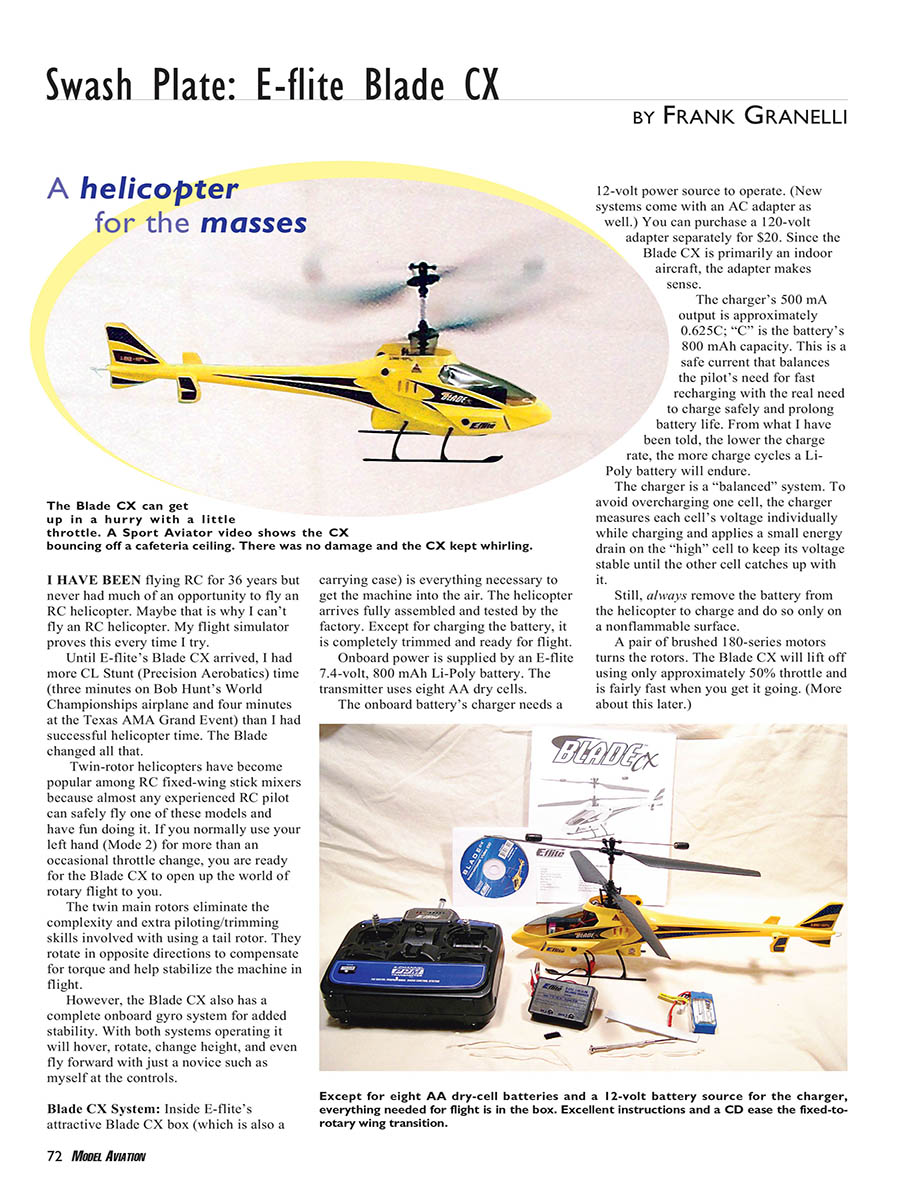
The twin main rotors eliminate the complexity and extra piloting/trimming skills involved with using a tail rotor. They rotate in opposite directions to compensate for torque and help stabilize the machine in flight.
However, the Blade CX also has a complete onboard gyro system for added stability. With both systems operating it will hover, rotate, change height, and even fly forward with just a novice such as myself at the controls.
Blade CX System
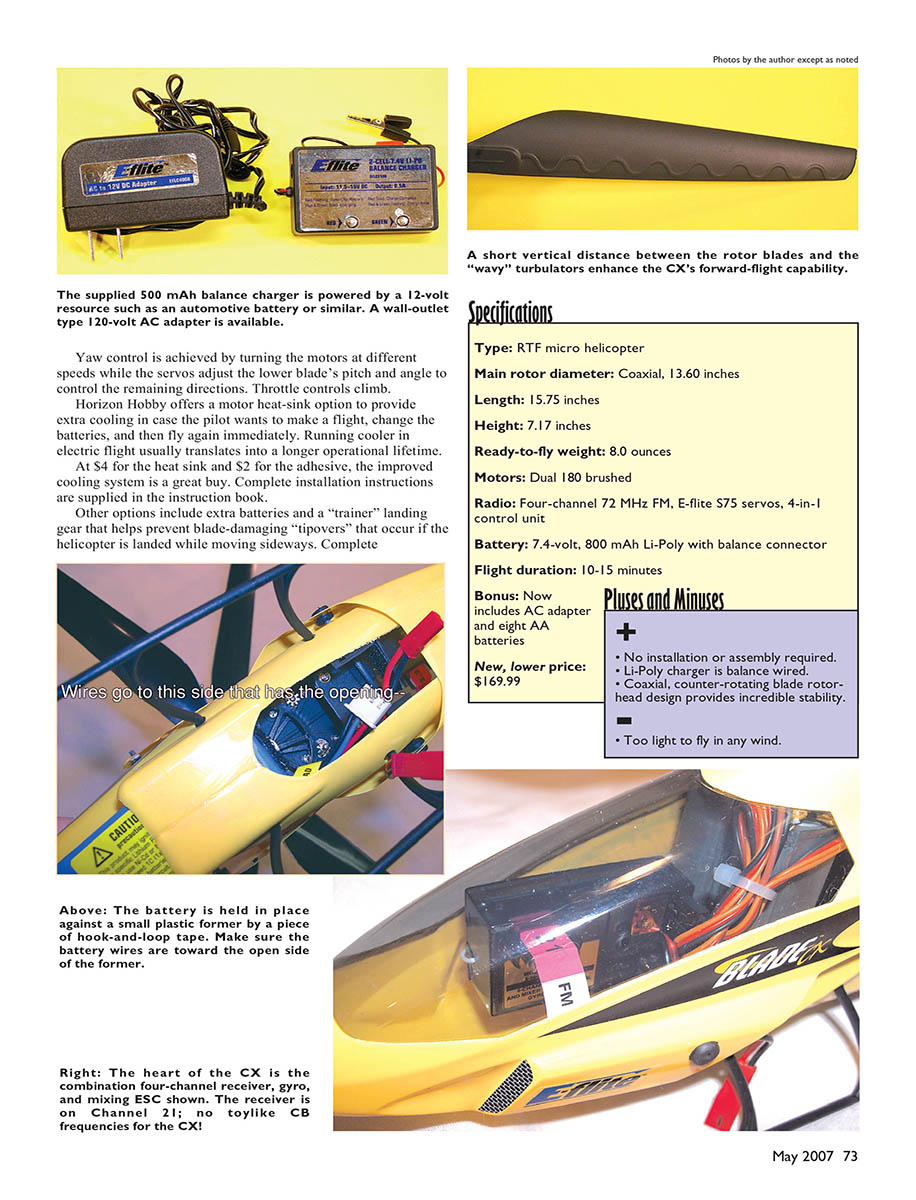
Inside E-flite's attractive Blade CX box (which is also a carrying case) is everything necessary to get the machine into the air. The helicopter arrives fully assembled and tested by the factory. Except for charging the battery, it is completely trimmed and ready for flight.
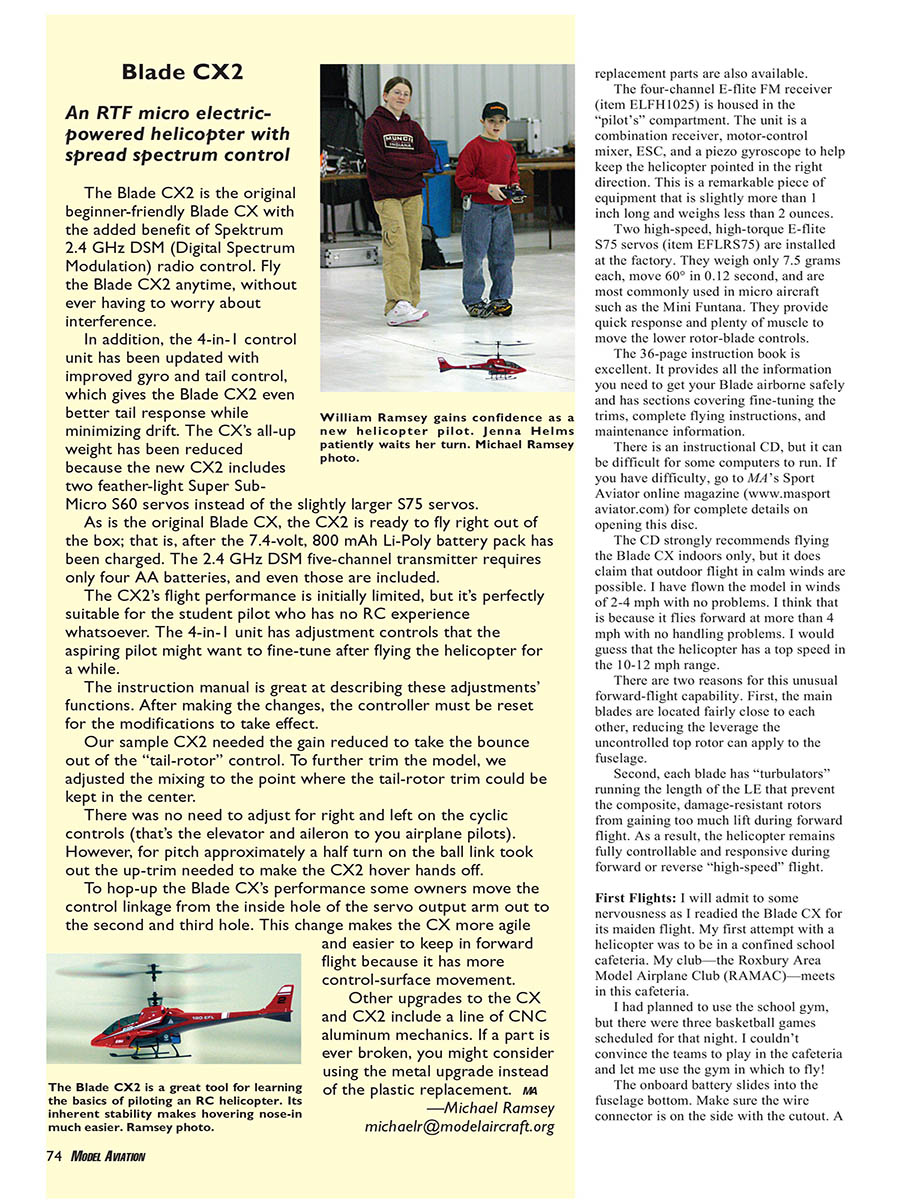
Onboard power is supplied by an E-flite 7.4-volt, 800 mAh Li-Poly battery. The transmitter uses eight AA dry cells. The onboard battery's charger needs a 12-volt power source to operate. New systems come with an AC adapter as well; you can purchase a 120-volt adapter separately for $20. Since the Blade CX is primarily an indoor aircraft, the adapter makes sense.
The charger's 500 mA output is approximately 0.625C; "C" refers to the battery's 800 mAh capacity. This is a safe current that balances the pilot's need for fast recharging with the need to charge safely and prolong battery life. From what I have been told, the lower the charge rate, the more charge cycles a Li-Poly battery will endure.
The charger is a balanced system. To avoid overcharging one cell, the charger measures each cell's voltage individually while charging and applies a small energy drain on the higher cell to keep its voltage stable until the other cell catches up. Still, always remove the battery from the helicopter to charge and do so only on a nonflammable surface.
A pair of brushed 180-series motors turns the rotors. The Blade CX will lift off using only approximately 50% throttle and is fairly fast when you get it going.
The supplied 500 mA balance charger is powered by a 12-volt resource such as an automotive battery or similar. A wall-outlet type 120-volt AC adapter is available.
Yaw control is achieved by turning the motors at different speeds while the servos adjust the lower blade's pitch and angle to control the remaining directions. Throttle controls climb.
Horizon Hobby offers a motor heat-sink option to provide extra cooling in case the pilot wants to make a flight, change the batteries, and then fly again immediately. Running cooler in electric flight usually translates into a longer operational lifetime. At $4 for the heat sink and $2 for the adhesive, the improved cooling system is a great buy. Complete installation instructions are supplied in the instruction book.
Other options include extra batteries and a trainer landing gear that helps prevent blade-damaging tipovers that occur if the helicopter is landed while moving sideways. Complete replacement parts are also available.
The four-channel E-flite FM receiver (item ELFH1025) is housed in the pilot's compartment. The unit is a combination receiver, motor-control mixer, ESC, and a piezo gyroscope to help keep the helicopter pointed in the right direction. This is a remarkable piece of equipment that is slightly more than 1 inch long and weighs less than 2 ounces.
Two high-speed, high-torque E-flite S75 servos (item EFLRS75) are installed at the factory. They weigh only 7.5 grams each, move 60° in 0.12 second, and are most commonly used in micro aircraft such as the Mini Funtana. They provide quick response and plenty of muscle to move the lower rotor-blade controls.
The 36-page instruction book is excellent. It provides all the information you need to get your Blade airborne safely and has sections covering fine-tuning the trims, complete flying instructions, and maintenance information.
There is an instructional CD, but it can be difficult for some computers to run. If you have difficulty, go to MA's Sport Aviator online magazine (www.masportaviator.com) for complete details on opening this disc.
The CD strongly recommends flying the Blade CX indoors only, but it does claim that outdoor flight in calm winds is possible. I have flown the model in winds of 2–4 mph with no problems. I think that is because it flies forward at more than 4 mph with no handling problems. I would guess that the helicopter has a top speed in the 10–12 mph range.
There are two reasons for this unusual forward-flight capability. First, the main blades are located fairly close to each other, reducing the leverage the uncontrolled top rotor can apply to the fuselage.
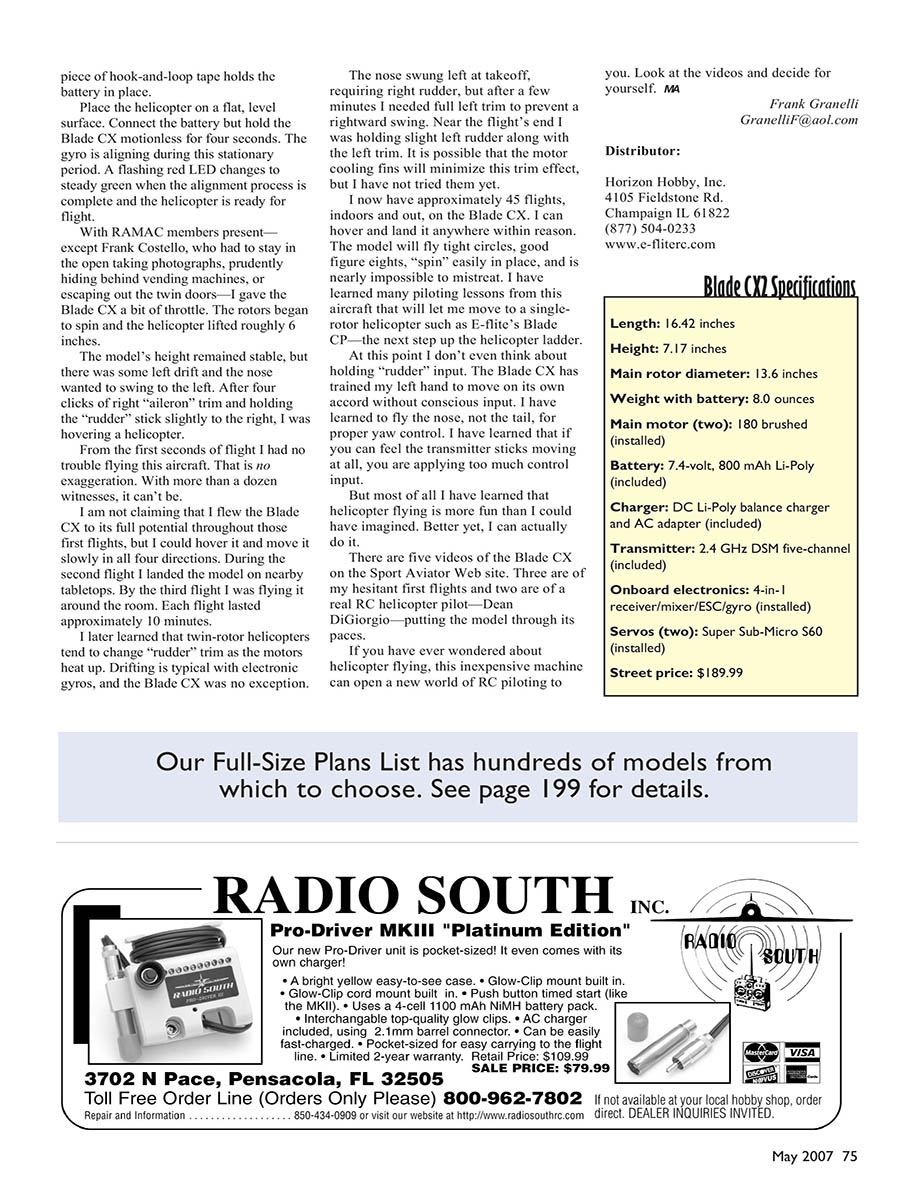
Second, each blade has turbulators running the length of the leading edge that prevent the composite, damage-resistant rotors from gaining too much lift during forward flight. As a result, the helicopter remains fully controllable and responsive during forward or reverse "high-speed" flight.
First Flights
I will admit to some nervousness as I readied the Blade CX for its maiden flight. My first attempt with a helicopter was to be in a confined school cafeteria. My club—the Roxbury Area Model Airplane Club (RAMAC)—meets in this cafeteria.
I had planned to use the school gym, but there were three basketball games scheduled for that night. I couldn't convince the teams to play in the cafeteria and let me use the gym in which to fly!
I made all of the standard checks on the heli, and when I felt comfortable I connected the battery. The battery connector is on the side with the cutout.
The onboard battery slides into the fuselage bottom. Make sure the wire connector is on the side with the cutout. A piece of hook-and-loop tape holds the battery in place.
Place the helicopter on a flat, level surface. Connect the battery but hold the Blade CX motionless for four seconds. The gyro is aligning during this stationary period. A flashing red LED changes to steady green when the alignment process is complete and the helicopter is ready for flight.
With RAMAC members present—except Frank Costello, who had to stay in the open taking photographs, prudently hiding behind vending machines, or escaping out the twin doors—I gave the Blade CX a bit of throttle. The rotors began to spin and the helicopter lifted roughly 6 inches.
The model’s height remained stable, but there was some left drift and the nose wanted to swing to the left. After four clicks of right aileron trim and holding the rudder stick slightly to the right, I was hovering a helicopter.
From the first seconds of flight I had no trouble flying this aircraft. That is no exaggeration. With more than a dozen witnesses, it can’t be.
I am not claiming that I flew the Blade CX to its full potential throughout those first flights, but I could hover it and move it slowly in all four directions. During the second flight I landed the model on nearby tabletops. By the third flight I was flying it around the room. Each flight lasted approximately 10 minutes.
I later learned that twin-rotor helicopters tend to change rudder trim as the motors heat up. Drifting is typical with electronic gyros, and the Blade CX was no exception.
The nose swung left at takeoff, requiring right rudder, but after a few minutes I needed full left trim to prevent a rightward swing. Near the flight’s end I was holding slight left rudder along with left trim. It is possible that the motor cooling fins will minimize this trim effect, but I have not tried them yet.
I now have approximately 45 flights, indoors and out, on the Blade CX. I can hover and land it anywhere within reason. The model will fly tight circles, good figure eights, spin easily in place, and is nearly impossible to mistreat. I have learned many piloting lessons from this aircraft that will let me move to a single-rotor helicopter such as E-flite’s Blade CP—the next step up the helicopter ladder.
At this point I don’t even think about holding rudder input. The Blade CX has trained my left hand to move on its own accord without conscious input. I have learned to fly the nose, not the tail, for proper yaw control. I have learned that if you can feel the transmitter sticks moving at all, you are applying too much control input.
But most of all I have learned that helicopter flying is more fun than I could have imagined. Better yet, I can actually do it.
There are five videos of the Blade CX on the Sport Aviator website. Three are of my hesitant first flights and two are of a real RC helicopter pilot—Dean DiGiorgio—putting the model through its paces.
If you have ever wondered about helicopter flying, this inexpensive machine can open a new world of RC piloting to you. Look at the videos and decide for yourself.
Frank Granelli [email protected]
Distributor
- Horizon Hobby, Inc.
- 4105 Fieldstone Rd.
- Champaign, IL 61822
- (877) 504-0233
- www.e-fliterc.com
Blade CX Specifications
- Length: 16.42 inches
- Height: 7.17 inches
- Main rotor diameter: 13.6 inches
- Weight with battery: 8.0 ounces
- Main motor (two): 180 brushed (installed)
- Battery: 7.4-volt, 800 mAh Li-Poly (included)
- Charger: DC Li-Poly balance charger and AC adapter (included)
- Transmitter: 2.4 GHz DSM five-channel (included)
- Onboard electronics: 4-in-1 receiver/mixer/ESC/gyro (installed)
- Servos (two): Super Sub-Micro S60 (installed)
- Street price: $189.99
Transcribed from original scans by AI. Minor OCR errors may remain.

