
Swashplate: Heli-Max Axe 400 Rx-R and RTF
Jacob Ramsey
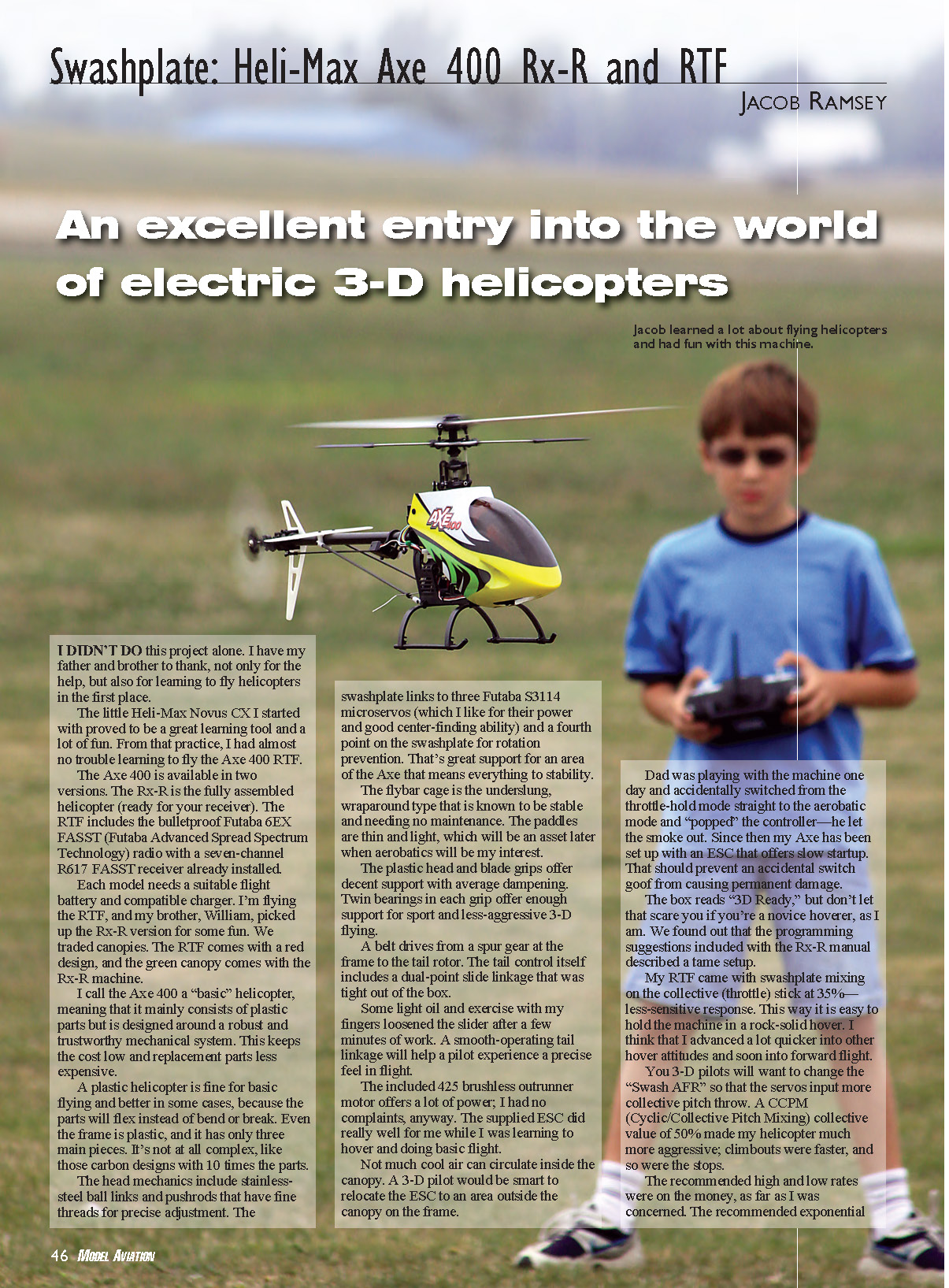
I didn't do this project alone. I have my father and brother to thank, not only for the help, but also for learning to fly helicopters in the first place.
The little Heli-Max Novus CX I started with proved to be a great learning tool and a lot of fun. From that practice, I had almost no trouble learning to fly the Axe 400 RTF.
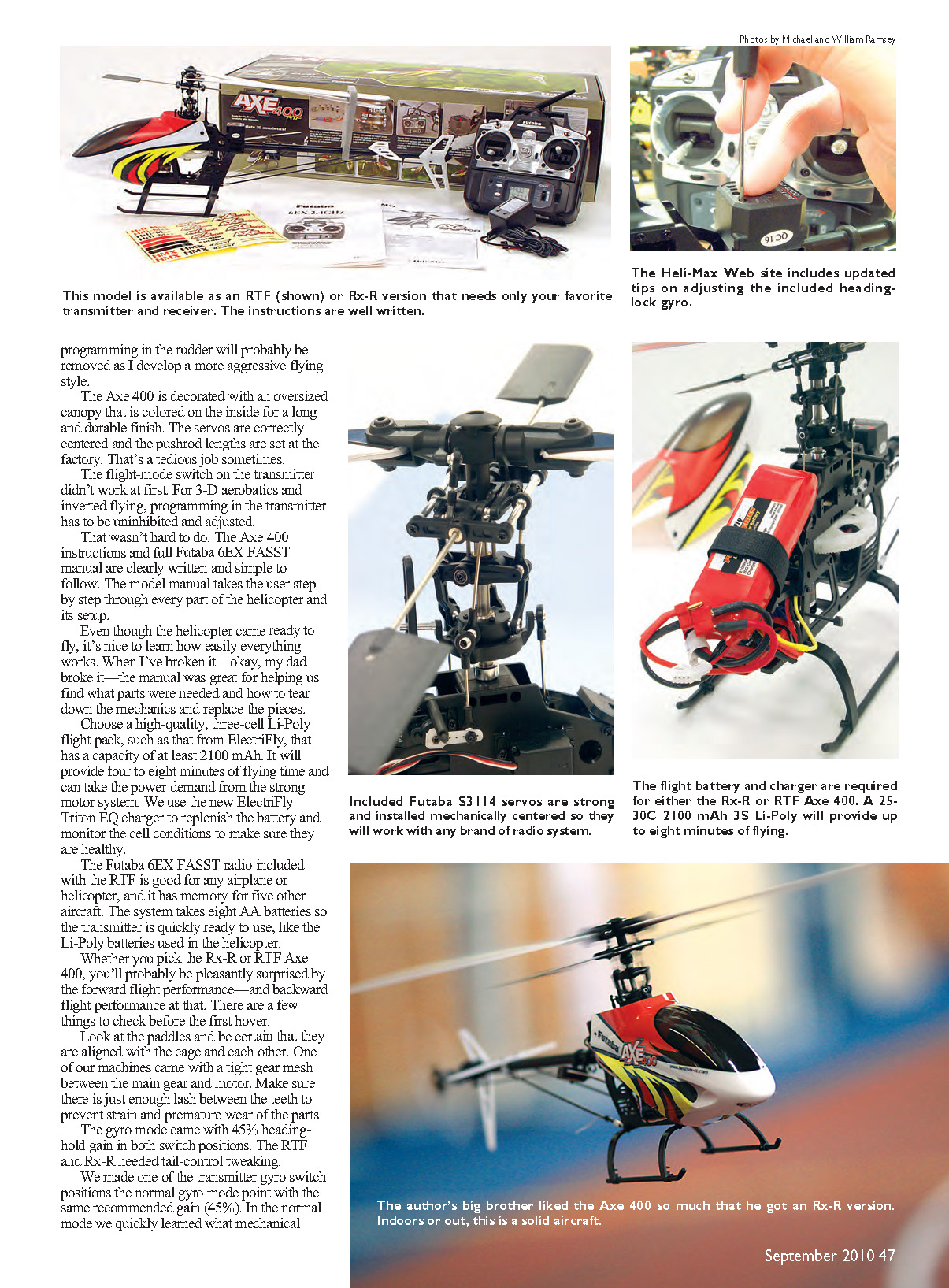
The Axe 400 is available in two versions. The Rx-R is the fully assembled helicopter (ready for your receiver). The RTF includes the bulletproof Futaba 6EX FASST (Futaba Advanced Spread Spectrum Technology) radio with a seven-channel R617 FASST receiver already installed.
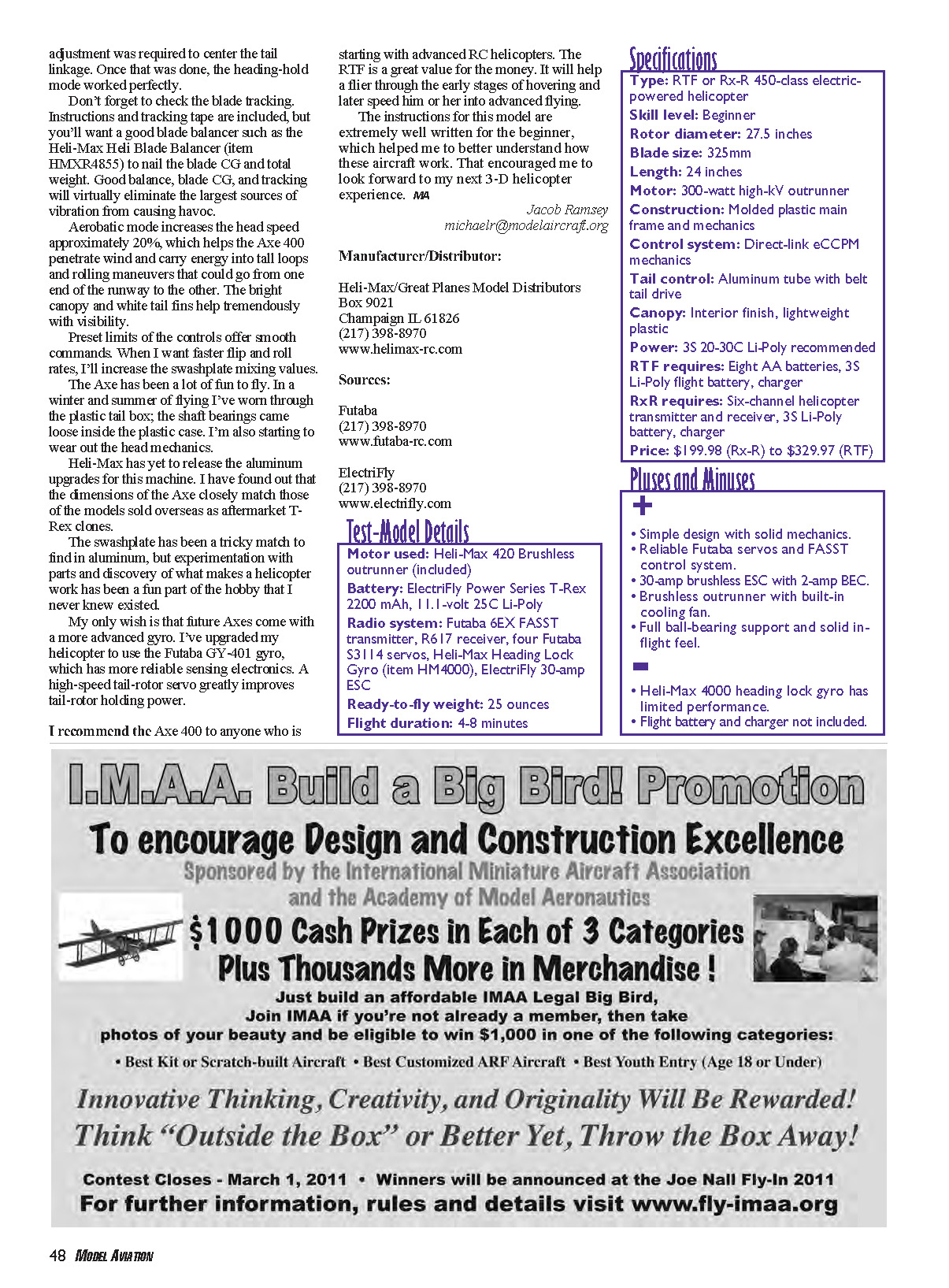
Each model needs a suitable flight battery and compatible charger. I'm flying the RTF, and my brother, William, picked up the Rx-R version for some fun. We traded canopies — the RTF comes with a red design, and the green canopy comes with the Rx-R machine.
I call the Axe 400 a "basic" helicopter, meaning it mainly consists of plastic parts but is designed around a robust and trustworthy mechanical system. This keeps the cost low and replacement parts inexpensive.
A plastic helicopter is fine for basic flying and better in some cases, because the parts will flex instead of bend or break. Even the frame is plastic, and it has only three main pieces. It's not at all complex like those carbon designs with many more parts.
The head mechanics include stainless-steel ball links and pushrods that have fine threads for precise adjustment. The swashplate links to three Futaba S3114 microservos (which I like for their power and good center-finding ability) and a fourth point on the swashplate to prevent rotation. That's great support for an area of the Axe that means everything to stability.
The flybar cage is the underslung, wraparound type that is known to be stable and needing no maintenance. The paddles are thin and light, which will be an asset later when aerobatics become my interest.
The plastic head and blade grips offer decent support with average dampening. Twin bearings in each grip offer enough support for sport and less-aggressive 3-D flying.
A belt drives from a spur gear at the frame to the tail rotor. The tail control itself includes a dual-point slide linkage that was tight out of the box. Some light oil and a little exercise with my fingers loosened the slider after a few minutes of work. A smooth-operating tail linkage helps a pilot experience a precise feel in flight.
The included Heli-Max 420 brushless outrunner motor offers a lot of power; I had no complaints. The supplied ESC did really well while I was learning to hover and doing basic flight. Not much cool air can circulate inside the canopy, so a 3-D pilot would be smart to relocate the ESC to an area outside the canopy on the frame.
Dad was playing with the machine one day and accidentally switched from throttle-hold mode straight to aerobatic mode and "popped" the controller — he let the smoke out. Since then my Axe has been set up with an ESC that offers slow startup. That should prevent an accidental switch goof from causing permanent damage.
The box reads "3D Ready," but don't let that scare you if you're a novice hoverer, as I was. We found that the programming suggestions included with the Rx-R manual described a tame setup. My RTF came with swashplate mixing on the collective (throttle) stick set at 35% — a less-sensitive response. This way it is easy to hold the machine in a rock-solid hover. I advanced quickly into other hover attitudes and soon into forward flight.
You 3-D pilots will want to change the "Swash AFR" so that the servos input more collective pitch throw. A CCPM (Cyclic/Collective Pitch Mixing) collective value of 50% made my helicopter much more aggressive; climbouts were faster, and so were the stops.
The recommended high and low rates were on the money, as far as I was concerned. The recommended exponential programming in the rudder will probably be removed as I develop a more aggressive flying style.
The Axe 400 is decorated with an oversized canopy that is colored on the inside for a long and durable finish. The servos are correctly centered and the pushrod lengths are set at the factory — a tedious job sometimes.
The flight-mode switch on the transmitter didn't work at first. For 3-D aerobatics and inverted flying, transmitter programming has to be uninhibited and adjustable. That wasn't hard to do. The Axe 400 instructions and full Futaba 6EX FASST manual are clearly written and simple to follow. The model manual takes the user step by step through every part of the helicopter and its setup.
Even though the helicopter came ready to fly, it's nice to learn how everything works. When I've broken it — okay, my dad broke it — the manual was great for helping us find what parts were needed and how to tear down the mechanics and replace the pieces.
Choose a high-quality, three-cell Li-Poly flight pack, such as one from ElectriFly, that has a capacity of at least 2100 mAh. It will provide four to eight minutes of flying time and can handle the power demand from the strong motor system. We use the ElectriFly Triton EQ charger to replenish the battery and monitor the cell conditions to make sure they are healthy.
The Futaba 6EX FASST radio included with the RTF is good for any airplane or helicopter, and it has memory for five other aircraft. The system takes eight AA batteries so the transmitter is quickly ready to use, like the Li-Poly batteries used in the helicopter.
Whether you pick the Rx-R or RTF Axe 400, you'll probably be pleasantly surprised by the forward-flight performance — and backward flight performance, too. There are a few things to check before the first hover:
- Look at the paddles and be certain they are aligned with the cage and each other.
- One of our machines came with a tight gear mesh between the main gear and motor. Make sure there is just enough lash between the teeth to prevent strain and premature wear of the parts.
- The gyro mode came with 45% heading-hold gain in both switch positions. The RTF and Rx-R needed tail-control tweaking. We made one transmitter gyro switch position the normal gyro mode with the same recommended gain (45%). In that normal mode we quickly learned what mechanical adjustment was required to center the tail linkage. Once that was done, the heading-hold mode worked perfectly.
- Don't forget to check the blade tracking. Instructions and tracking tape are included, but you'll want a good blade balancer such as the Heli-Max Heli Blade Balancer (item HMXR4855) to nail the blade CG and total weight. Good balance, blade CG, and tracking will virtually eliminate the largest sources of vibration.
Aerobatic mode increases head speed approximately 20%, which helps the Axe 400 penetrate wind and carry energy into tall loops and rolling maneuvers that could go from one end of the runway to the other. The bright canopy and white tail fins help tremendously with visibility.
Preset limits of the controls offer smooth commands. When I want faster flip and roll rates, I'll increase the swashplate mixing values.
The Axe has been a lot of fun to fly. In a winter and summer of flying I've worn through the plastic tail box; the shaft bearings came loose inside the plastic case. I'm also starting to wear out the head mechanics. Heli-Max has yet to release the aluminum upgrades for this machine. I have found that the dimensions of the Axe closely match those of models sold overseas as aftermarket T-Rex clones.
The swashplate has been a tricky match to find in aluminum, but experimentation with parts and discovery of what makes a helicopter work has been a fun part of the hobby that I never knew existed.
My only wish is that future Axes come with a more advanced gyro. I've upgraded my helicopter to use the Futaba GY-401 gyro, which has more reliable sensing electronics. A high-speed tail-rotor servo greatly improves tail-rotor holding power.
I recommend the Axe 400 to anyone who is starting with advanced RC helicopters. The RTF is a great value for the money. It will help a flier through the early stages of hovering and later speed him or her into advanced flying.
The instructions for this model are extremely well written for the beginner, which helped me better understand how these aircraft work. That encouraged me to look forward to my next 3-D helicopter experience.
Jacob Ramsey [email protected]
Manufacturer/Distributor
Heli-Max / Great Planes Model Distributors Box 9021 Champaign, IL 61826 (217) 398-8970 www.helimax-rc.com
Sources
Futaba (217) 398-8970 www.futaba-rc.com
ElectriFly (217) 398-8970 www.electrifly.com
Test-Model Details
- Motor used: Heli-Max 420 brushless outrunner (included)
- Battery: ElectriFly Power Series T-Rex 2200 mAh, 11.1-volt 25C Li-Poly
- Radio system: Futaba 6EX FASST transmitter, R617 receiver, four Futaba S3114 servos, Heli-Max Heading Lock Gyro (item HM4000), ElectriFly 30-amp ESC
- Ready-to-fly weight: 25 ounces
- Flight duration: 4–8 minutes
Specifications
- Type: RTF or Rx-R 450-class electric-powered helicopter
- Skill level: Beginner
- Rotor diameter: 27.5 inches
- Blade size: 325 mm
- Length: 24 inches
- Motor: 300-watt high-kV outrunner
- Construction: Molded plastic main frame and mechanics
- Control system: Direct-link eCCPM mechanics
- Tail control: Aluminum tube with belt tail drive
- Canopy: Interior finish, lightweight plastic
- Power: 3S 20–30C Li-Poly recommended
- RTF requires: Eight AA batteries, 3S Li-Poly flight battery, charger
- Rx-R requires: Six-channel helicopter transmitter and receiver, 3S Li-Poly battery, charger
- Price: $199.98 (Rx-R) to $329.97 (RTF)
Pluses and Minuses
Pluses
- Simple design with solid mechanics
- Reliable Futaba servos and FASST control system
- 30-amp brushless ESC with 2-amp BEC
- Brushless outrunner with built-in cooling fan
- Full ball-bearing support and solid in-flight feel
Minuses
- Heli-Max HM4000 heading-lock gyro has limited performance
- Flight battery and charger not included
Transcribed from original scans by AI. Minor OCR errors may remain.

