

Swashplate: JR Vibe 50 3D Pro Helicopter Kit
Andy Panoncillo
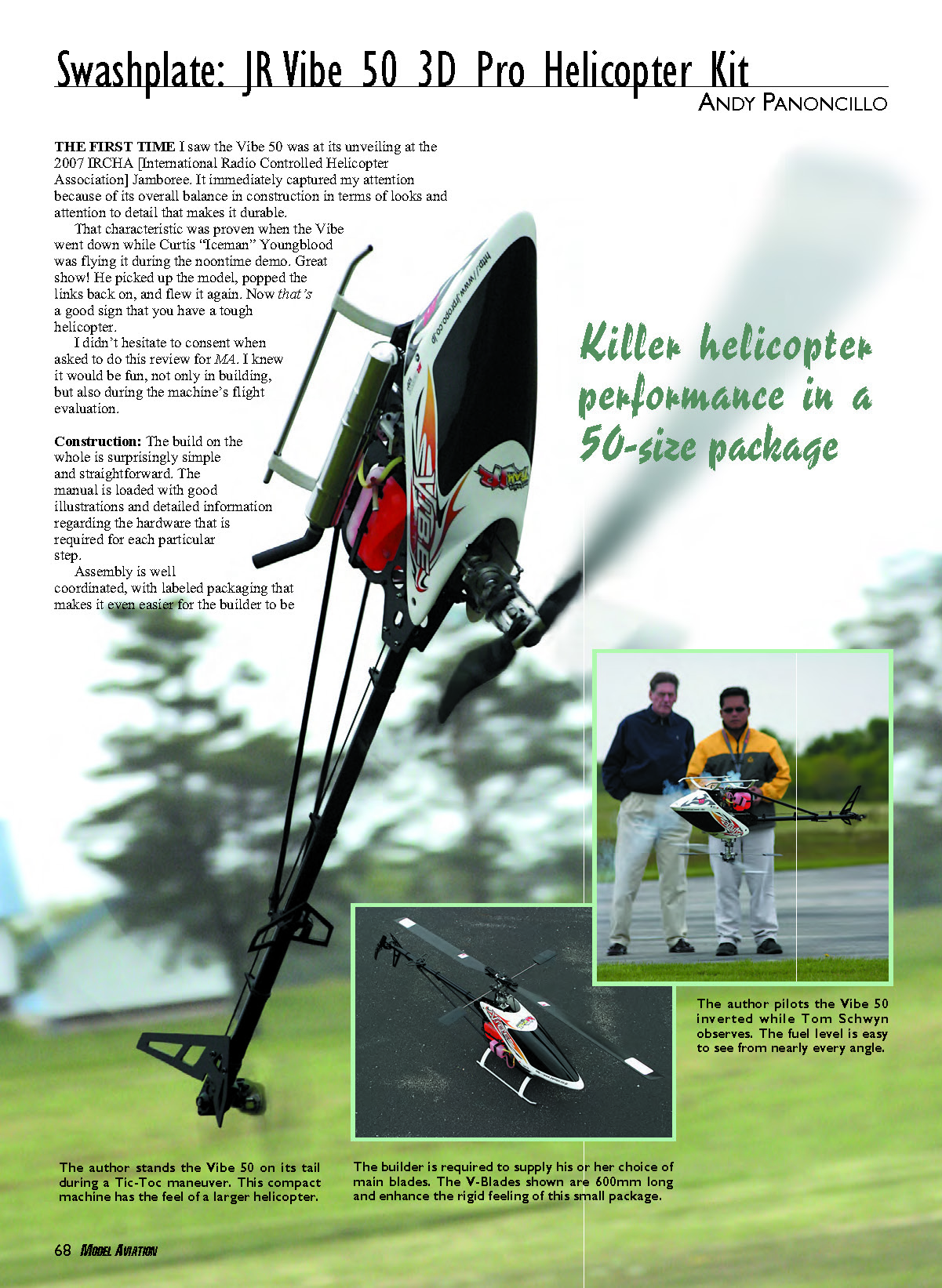
The first time I saw the Vibe 50 was at its unveiling at the 2007 IRCHA (International Radio Controlled Helicopter Association) Jamboree. It immediately captured my attention because of its overall balance in construction, looks, and attention to detail that make it durable.
That characteristic was proven when the Vibe went down while Curtis "Iceman" Youngblood was flying it during the noontime demo. He picked up the model, popped the links back on, and flew it again. Now that's a good sign that you have a tough helicopter.
I didn't hesitate to consent when asked to do this review. I knew it would be fun not only in building, but also during the machine's flight evaluation.
Construction
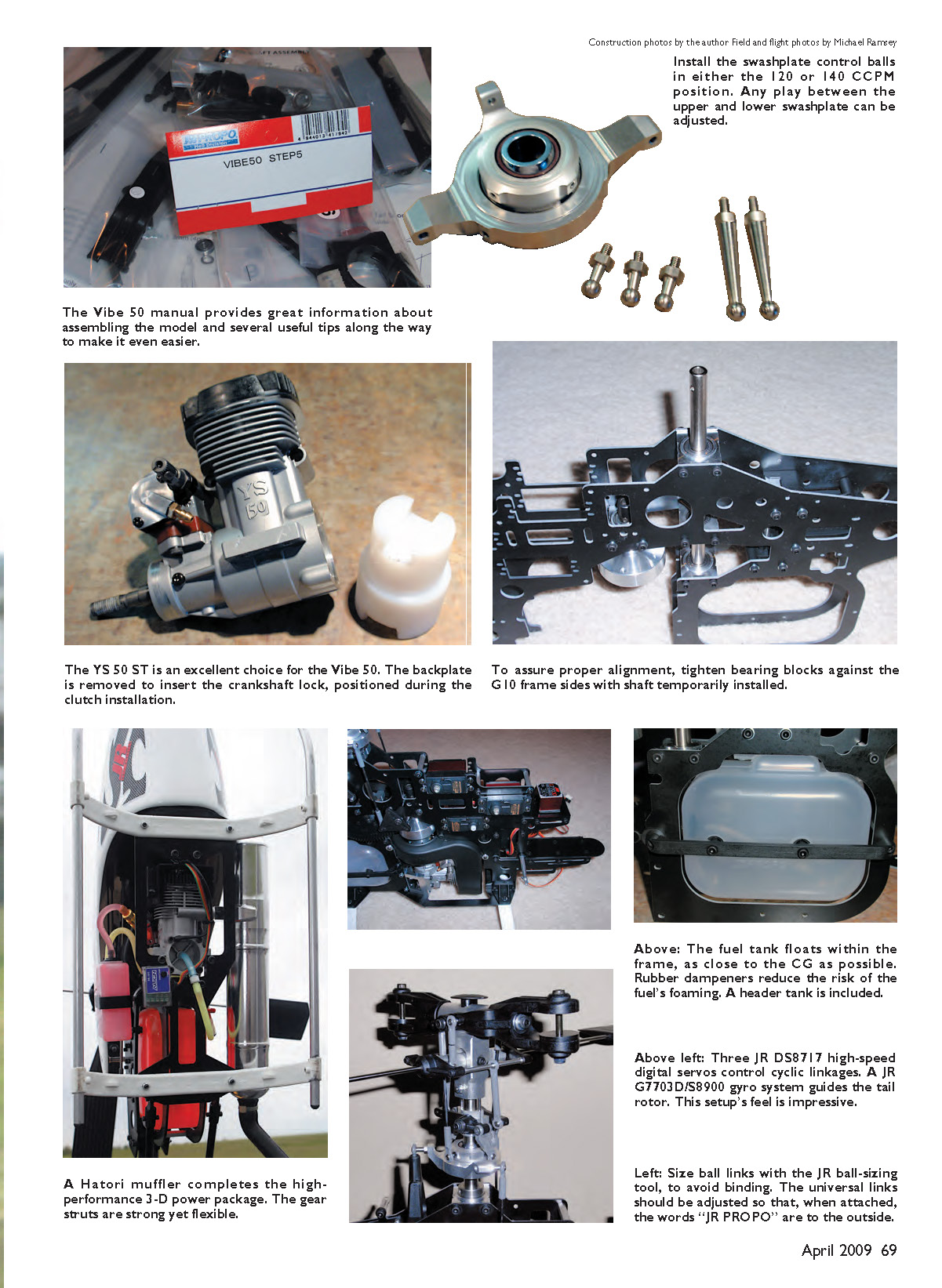
The build as a whole is surprisingly simple and straightforward. The manual is loaded with good illustrations and detailed information regarding the hardware required for each step. Assembly is well coordinated, with labeled packaging that makes it even easier for the builder to be confident during the process. The kit also comes with two grades of thread-locking compound. The builder must supply his or her choice of main blades; the V‑Blades shown are 600 mm long and enhance the rigid feeling of this small package.
Assembly highlights and notes:
- Construction begins with the clutch bell and starter-shaft assembly. The hex-shaped adapter doubles as a locking mechanism to keep the assembly secure. The clutch bell includes a mount for a governor magnet; balance is helped by a second magnet placed 180° from the other (confirmed on a pinpoint balancer).
- Two plastic housings sandwich the nylon tail pinion and pinion shaft within a bearing assembly. JR uses a crossmember to strengthen this assembly, which is often subjected to heavy loads. The bevel gear is preassembled and the tail pinion shaft is prepinned, creating a smooth gear mesh.
- The ball joints that fit into the plastic parts are a tight and secure fit.
- Decide early whether to use 120° or 140° Cyclic/Collective Pitch Mixing (CCPM), because the T-arms and elevator arms must match. Check your transmitter; not every radio supports 140° mixing.
- The dual-stage main gear is labeled right-side up, which eliminates confusion when completing the autorotation assembly. Make sure the autorotation spacer is step-side down—this is well illustrated in the manual.
- The fuel tank is located close to the CG and uses nearly foolproof hardware to ensure a leak-free seal. The tank is suspended between the frames with a rubber holder to reduce foaming. I would prefer a fuel magnet instead of a regular clunk, which would eliminate the need for a header tank.
- The side frames are not interchangeable; I assembled them backward once and had to backtrack several steps to correct it.
- Three bearing blocks with the clutch bell assembly set the frame halves in position. Hardened-steel 3 x 8 mm bolts with flat 3 mm washers secure the frames against the bearing blocks. I installed the governor mount on the left side and slid the main shaft through the bearing blocks to ensure initial alignment.
- Frame parts are not fully tightened or thread-locked until all bracing and block housings are located. There are a total of six crossmembers.
- The elevator arm is secured to the frame using its spindle, which has a notch for the setscrew. Observe through the main frame that the elevator arm is positioned at 90° to the A-arm. A longer hex driver helps with this step.
- The body catch and canopy standoff are designed to break away in a crash to protect the main frame. The engine mount is a one-piece aluminum block that makes mounting square and easier.
- Landing struts and adapters are supported with 32 mm-long crossmembers bolted with 3 x 12 mm and 3 x 50 mm socket-head bolts. The skids are bolted to the strut with 3 x 4 mm grub screws. The bottom frame plate is bolted to the engine mount with 3 x 8 mm socket-head screws that sandwich the landing gear in place.
- Set the main gear and main shaft in place, ensuring the main shaft collar eliminates vertical play. After that, go back and tighten all bolts with thread-locking compound.
- The CNC-machined aluminum swashplate is high quality: smooth operation and minimal play. Three setscrews on the swashplate can be tightened later if play develops.
- There are two sets of aileron and pitch swashplate linkages: the longer set for 140° CCPM and the shorter set for 120° CCPM. The washout base is aluminum and slides through the main shaft smoothly.
- Both mixing arms have four bearings that provide smooth operation. I like the use of a 3 mm nut to keep the 3 x 14 mm socket-head bolts against the main blade grip; if those links loosen, the problem is easy to find and correct without removing the grip.
- The plastic main blade grips are beefy. The manual gives clear illustrations for positioning the 8 x 14 x 4 mm bearing, thrust bearings, O-ring dampeners, and spacers in the correct order. Not following this sequence can lead to serious problems down the road and could be fatal to the machine.
- The one-piece, high-tilt flybar arm and one-piece universal ball link are nice features JR applied to the Vibe 50. Although the flybar is labeled 440 mm, mine was shorter; it would be easy to replace later. The paddles come with removable weights—I replaced them later for a more sensitive setup.
- The CNC-machined aluminum head assembly mounts on the 10 mm main shaft and is secured with a single 3 x 22 mm socket-head bolt and lock nut. I would prefer either a second bolt or a clamping bolt to reduce reliance on a single “Jesus bolt” for the entire load, especially since 50-size machines are often flown aggressively.
- Control rods should be matched directly according to the manual's illustrations. A ball-sizing tool helps ensure all links move freely.
- The tail-drive shaft assembly requires only a few steps. The aluminum shaft floats inside the aluminum tailboom within bearings isolated by rubber grommets. A little oil or grease on the bearing holders makes sliding the drive shaft easier. JR’s driveshaft joint design gives a solid feel.
- The tail-gear assembly is larger and stronger than most other 50-class machines, contributing to the Vibe’s overall integrity. The tail fins (horizontal and vertical) are G10 material; they could be lighter if made thinner.
- The manual provides detailed instructions for the dual-yoke tail-rotor actuator and hub assembly. The tail-pitch slider is extraordinarily smooth against the tail output shaft, moving freely even without lubrication.
- Plastic tail-blade holders are joined with four 2 x 10 mm socket-head bolts, making disassembly and regreasing straightforward.
- Tailboom supports are simple to assemble and guaranteed equal in length due to predrilled holes. The manual recommends J.B. Weld; I used the five-minute formula.
- Once assembled, the tail bellcrank provides enough throw and exhibits no slop or binding. The tail control rod is supported with three guides, using a flexible rod with multiple guides to keep it operating smoothly.
- I used the YS 50 ST engine with a Hatori SAB-50 pipe. The engine slides up from the bottom without removing the needle, which simplifies maintenance. The high-efficiency fan housing is self-aligning with enough clearance to avoid fan rubbing.
- The kit includes servo mounting plates and self-tapping screws; I prefer socket-head screws with lock nuts to reduce stripping during maintenance.
- Servo locations are well laid out and the kit includes servo wheels handy for push-pull linkages. Choose servo arms that follow the 90° rule as closely as possible to avoid large transmitter trim adjustments.
- The manual provides exact control rod measurements from the servos to the T-arms; this proved helpful and required almost no adjustment.
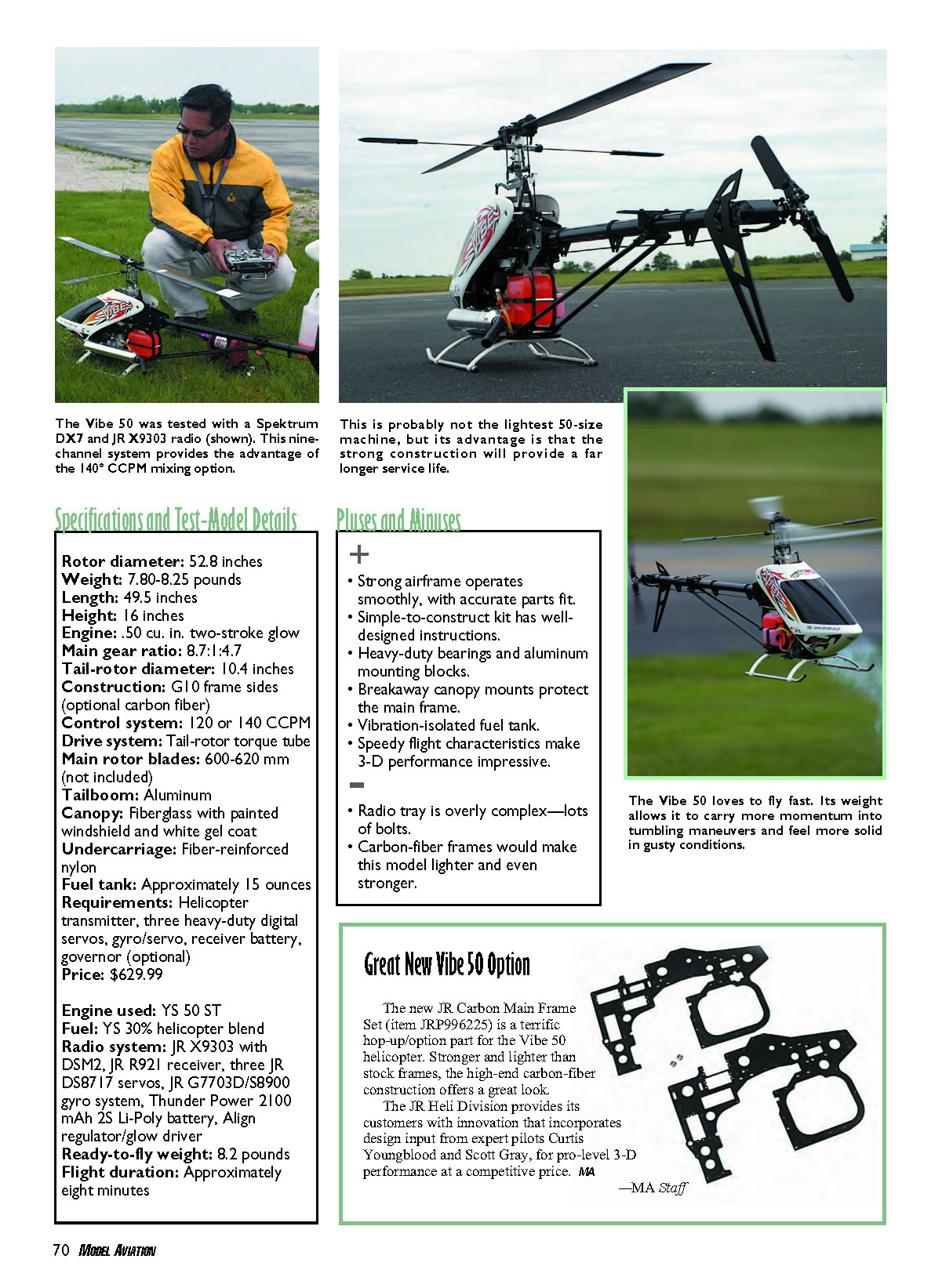
Pluses
- Strong airframe that operates smoothly with accurate parts fit.
- Simple-to-construct kit with well-designed instructions.
- Heavy-duty bearings and aluminum mounting blocks.
- Breakaway canopy mounts protect the main frame.
- Vibration-isolated fuel tank.
- Speedy flight characteristics make 3-D performance impressive.
Minuses
- Radio tray is overly complex—lots of bolts.
- Carbon-fiber frames would make the model lighter and even stronger.
Great New Vibe 50 Option
The new JR Carbon Main Frame Set (item JRP996225) is a terrific hop-up/option part for the Vibe 50. Stronger and lighter than stock frames, the high-end carbon-fiber construction also offers a great look. JR's Heli Division incorporates design input from expert pilots Curtis Youngblood and Scott Gray for pro-level 3-D performance at a competitive price.
Specifications and Test-Model Details
- Rotor diameter: 52.8 inches
- Weight: 7.80–8.25 pounds
- Length: 49.5 inches
- Height: 16 inches
- Engine: .50 cu. in. two-stroke glow
- Main gear ratio: 8.7:1 / 4.7:1
- Tail-rotor diameter: 10.4 inches
- Construction: G10 frame sides (optional carbon fiber)
- Control system: 120° or 140° CCPM
- Drive system: Tail-rotor torque tube
- Main rotor blades: 600–620 mm (not included)
- Tailboom: Aluminum
- Canopy: Fiberglass with painted windshield and white gel coat
- Undercarriage: Fiber-reinforced nylon
- Fuel tank: Approximately 15 ounces
- Requirements: Helicopter transmitter, three heavy-duty digital servos, gyro/servo, receiver battery, governor (optional)
- Price: $629.99
Test-model specifics:
- Engine used: YS 50 ST
- Fuel: YS 30% helicopter blend
- Radio system: JR X9303 with DSM2, JR R921 receiver, three JR DS8717 servos, JR G7703D/S8900 gyro system, Thunder Power 2100 mAh 2S Li-Poly battery, Align regulator/glow driver
- Ready-to-fly weight: 8.2 pounds
- Flight duration: Approximately eight minutes
Flight Characteristics
Flight tests began with a hover, and the Vibe 50 proved stable and predictable. I set the governor at 2,050 rpm for idle-up Number 1, which is good for basic forward flight and fundamental aerobatics. The helicopter carried speed well and tracked straight. During backward right-side-up and backward inverted maneuvers, it performed with surprising stability. The JR G770 3D gyro held the tail steady.
If you love 3-D, don't let this helicopter's weight deceive you. At first I thought the weight would make the Vibe 50 a collective-management challenge, but the model maintained authority and speed. The extra weight actually helps in high-speed 3-D maneuvers such as the Hurricane, Funnel, Tic-Toc, and others.
My cyclic setup was noticeably quick, and the helicopter proved predictable and easy to lock into position during Pirouetting Flips or the Chaos. Tailslide maneuvers were more dramatic because the model carries speed well in the descent. Performance improved over multiple flights as I became more accustomed to its capabilities.
Durability is another strong point. On one occasion I touched the grass with it inverted in a hover; the only damage was to the main shaft. Amazing.
I'd like to see carbon frames become available for this helicopter, as they would make it even more fun to fly. In the meantime, the JR Vibe 50 is a solid model that provides strong construction and less maintenance worry.
Andy Panoncillo [email protected]
Manufacturer / Distributor
JR / Horizon Hobby Inc. 4105 Fieldstone Rd. Champaign, IL 61822 (800) 338-4639 www.jrradios.com
Items Used in Review
- YS 50 ST engine
- YS Parts and Service
- (775) 267-9252
- www.yspartsandservice.com
- Hatori muffler systems
- Ron's Heliproz South
- (800) 321-9909
- www.ronlund.com
- Thunder Power batteries
- Thunder Power RC
- (702) 228-8889
- www.thunderpowerrc.com
Other Published Reviews
- Model Helicopter World: September 2008
Transcribed from original scans by AI. Minor OCR errors may remain.

