
Swashplate: JR Vibe 90SG Helicopter Kit
Andy Panoncillo
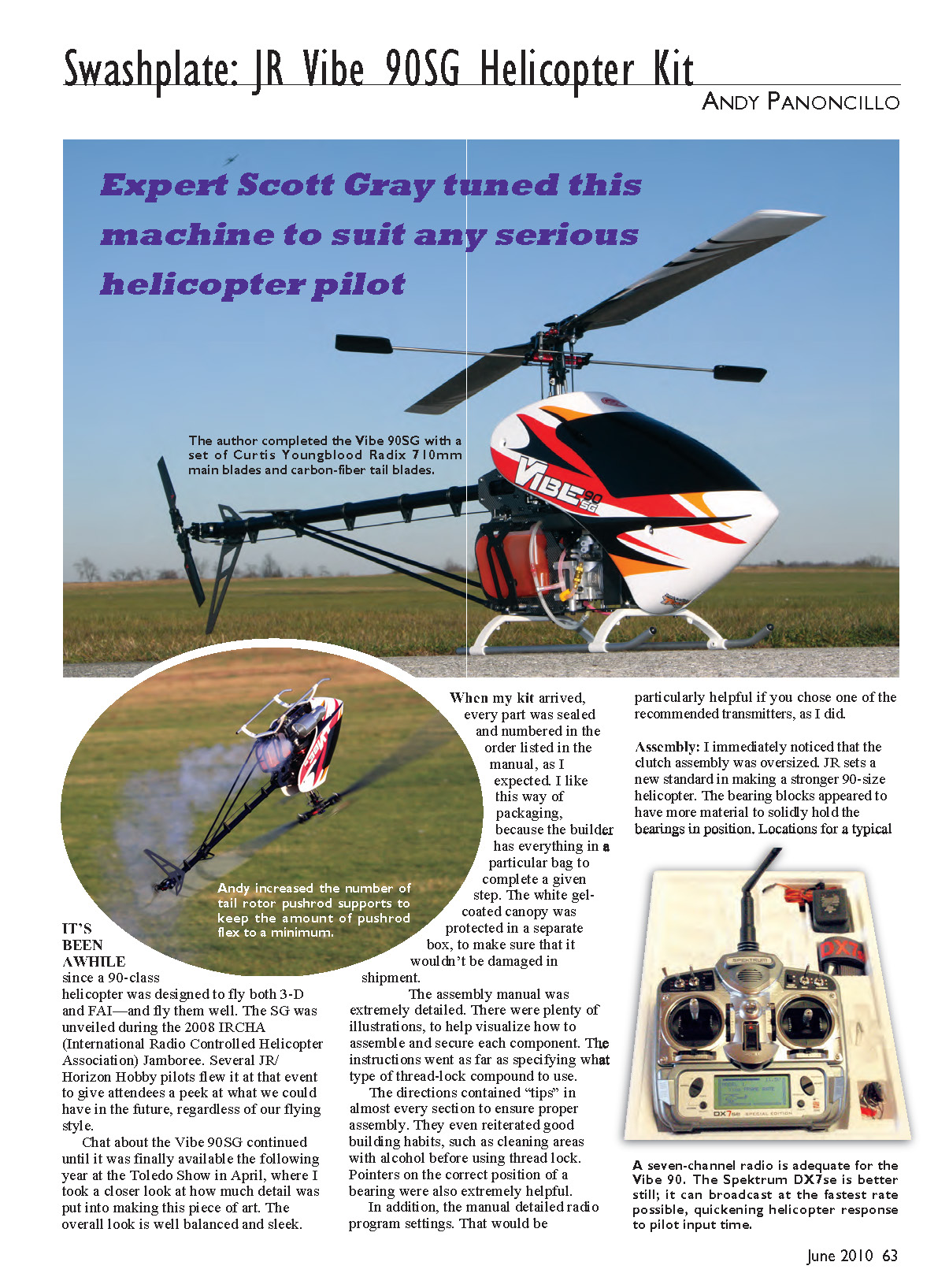
It's been a while since a 90-class helicopter was designed to fly both 3-D and FAI—and fly them well. The Vibe 90SG was unveiled during the 2008 IRCHA (International Radio Controlled Helicopter Association) Jamboree. Several JR/Horizon Hobby pilots flew it at that event to give attendees a peek at what we could have in the future, regardless of flying style.
Chat about the Vibe 90SG continued until it became available the following year at the Toledo Show in April, where I took a closer look at how much detail was put into making this piece of art. The overall look is well balanced and sleek.
When my kit arrived, every part was sealed and numbered in the order listed in the manual. I like this packaging because the builder has everything in a particular bag to complete each step. The white gelcoat canopy was protected in a separate box to prevent damage in shipment.
The assembly manual was extremely detailed, with plenty of illustrations to visualize each component. The instructions even specified what type of thread-lock compound to use and included tips in almost every section to ensure proper assembly. They reiterated good building habits, such as cleaning areas with alcohol before using thread lock, and provided pointers on the correct position of bearings. The manual also detailed radio program settings, which is particularly helpful if you choose one of the recommended transmitters, as I did.
Assembly and Construction
I immediately noticed the oversized clutch assembly. JR sets a new standard in making a stronger 90-size helicopter. The bearing blocks have extra material to solidly hold bearings in position.
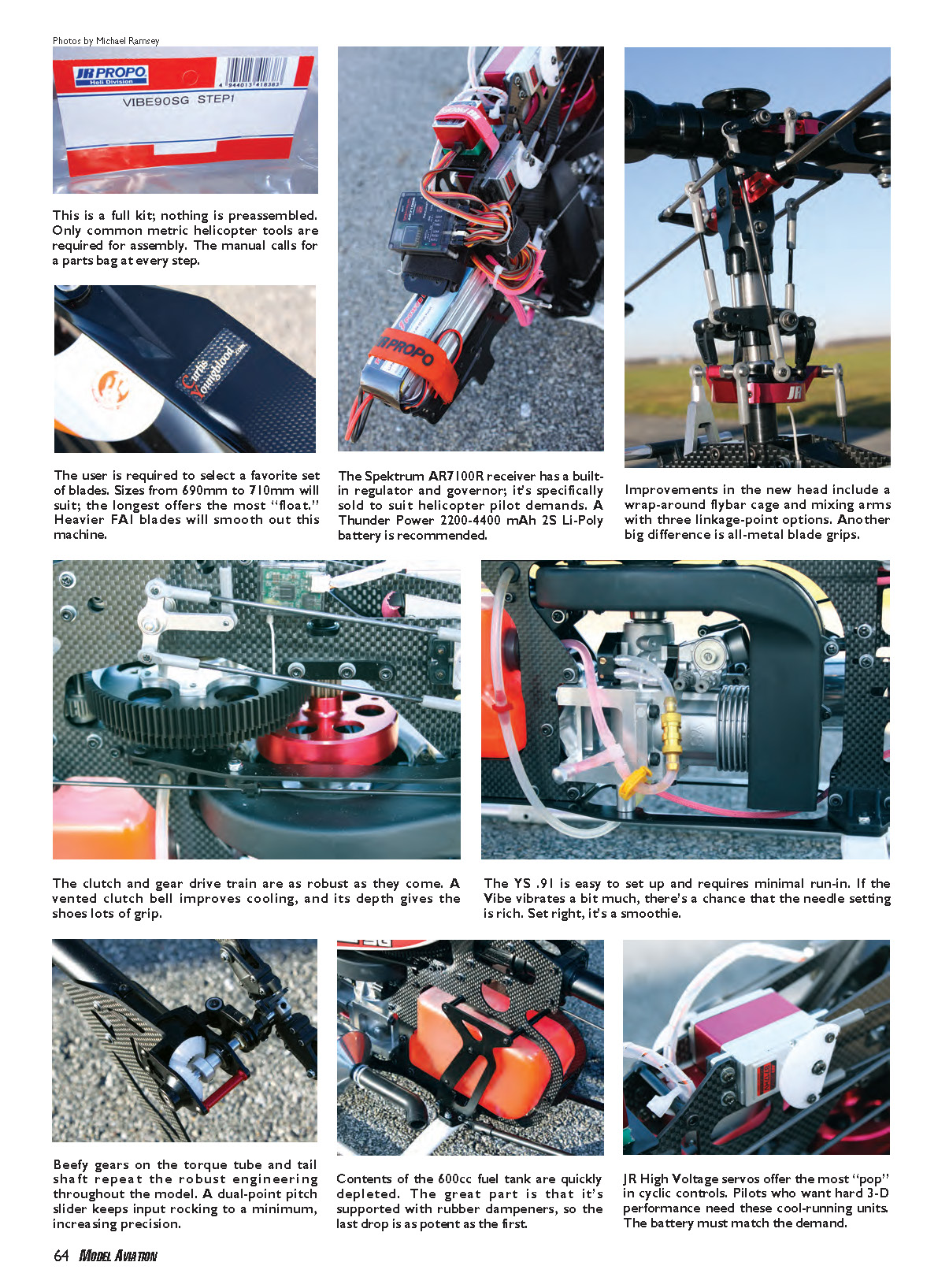
The YS .91 is easy to set up and requires minimal run-in. If the Vibe vibrates a bit, there’s a chance the needle setting is rich. Set correctly, it’s very smooth.
The clutch and gear drivetrain are as robust as they come. A vented clutch bell improves cooling, and its depth gives the shoes lots of grip. This is a full kit; nothing is preassembled. Only common metric helicopter tools are required for assembly. The manual calls for a parts bag at every step. The builder is required to select a favorite set of blades; sizes from 690 mm to 710 mm will suit. The longest blades offer the most float. Heavier FAI blades will smooth out the machine.
The Spektrum AR7100R receiver has a built-in regulator and governor and is specifically sold to suit helicopter pilot demands. A Thunder Power 2200–4400 mAh 2S Li-Po battery is recommended.
Improvements in the new head include a wrap-around flybar cage and mixing arms with three linkage-point options. Another big difference is all-metal blade grips. JR High Voltage servos offer the most “pop” in cyclic controls—pilots who want hard 3-D performance will appreciate these cool-running units. Beefy gears on the torque tube and tail shaft repeat the robust engineering throughout the model. A dual-point pitch slider keeps input rocking to a minimum, increasing precision. The 600 cc fuel tank is big and is supported with rubber dampeners, so the last drop is as potent as the first.
A 4 mm-diameter governor magnet is provided in the clutch assembly.
The main gear assembly, tail drive gear, and autorotation hub are easy to assemble. Sliding the autorotation shaft into the hub is such a smooth action that it’s easy to tell JR paid attention to machining quality. I recommend putting an ample amount of oil in the sprag bearing to ensure smooth operation.
The 10-year-old single-stack frame design continues to be popular because of its ease of assembly and maintenance, reduced parts count, and lighter overall weight. Unlike other helicopters that use the power plant to support frame integrity, the engine mount block and lower bearing block in the Vibe 90SG are bridged with an extra frame support.
A frame brace plate on each side holds the lower bearing block to the front side of the frame. Another internal frame support in the front mounts parallel to the frame support and bridges the engine and lower bearing block. There is a tremendous amount of torsional strength not only in the entire frame but also, more importantly, along the main gear and main shaft section, to keep it from flexing during high-demand maneuvers.
All lever arms, including the elevator A-arm, are made from aluminum. The bearings fit beautifully.
There are two forward equipment trays on which to mount electronics. The bottom tray includes the canopy posts. The one-piece gyro tray is located on the front top of the frame. The canopy protects all sensitive electronics.
The tank is mounted in the rear portion of the frame and held in place with separate lateral frame sets. It is suspended with four rubber posts and does not touch the mainframe, completely isolating it from vibration.
Two brass collets center the fan hub on the motor. The cooling fan is wide with 12 blades, making it efficient in cooling the engine regardless of flight conditions. The fan shroud has a large opening to accommodate most engines without trimming. The engine mount is a separate piece from the engine block mount; spacers are included so any brand of power plant will fit.
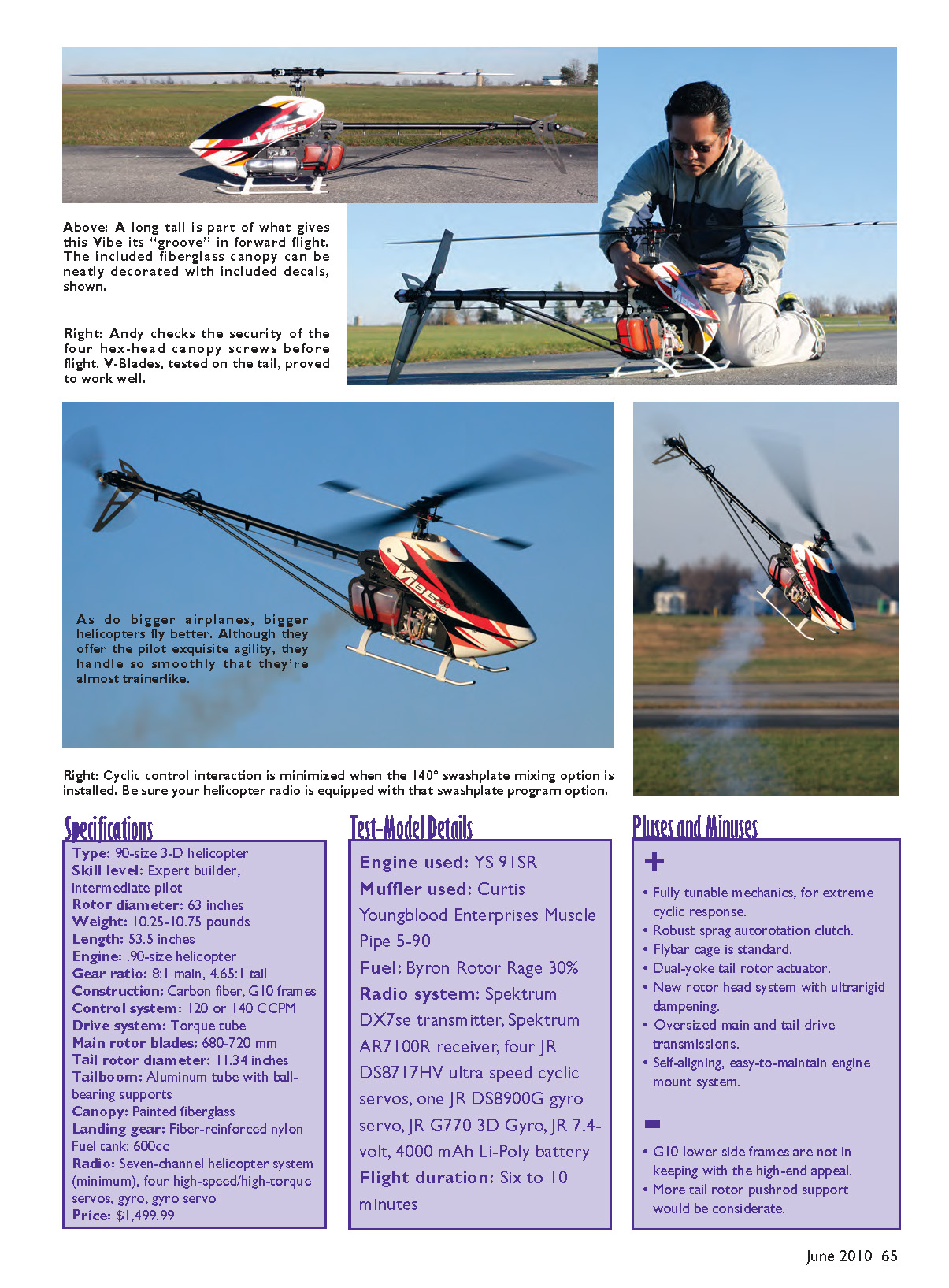
The bottom frame plate and landing gear bolt to the aluminum frame lower bracket. The landing struts are sturdy and sit slightly lower to the ground than on previous models, enhancing the sleek appearance.
I’m impressed by how clean and smooth the swashplate feels, yet there is no significant play. Again, full credit goes to the attention to machining every part of the Vibe 90SG to exact tolerances.
This kit gives you a choice between 120 and 140 CCPM (Cyclic Collective Pitch Mixing). The full metal head with JR’s trademark red and black anodizing is appealing. The pitch arms and mixing arms have multiple ball-link pivot positions for 3-D or FAI settings.
Two kinds of head dampeners are provided: extra hard and medium hard. A silicon insulator around the blade spindle shaft allows some dampening of the spindle inside the head block. The flybar cage is also anodized red and black.
Two ball-bearing shaft drive guides support the torque tube. Its connection points are designed with the same robust philosophy as the gear system. Two washers are provided for setting the correct tail-gear mesh. Dual-pin support of the tail-pitch slider provides linear movement, making it smoother and more precise.
Thrust bearings, other bearings, and washers are installed in the tail hub before assembling the tail grips. I like this grip design because it’s easy to maintain and service. Three pushrod guide clamps support the tail pushrod design, though I added two more guides because the rod can flex between the recommended supports and can resonate during lower RPM modes.
Some parts are not self-aligning, so take care during assembly. When you align the clutch assembly to the main gear to set the gear mesh, the brass tapered collet doesn’t self-seat with the fan hub; check for runout.
The fine machining and quality of metal used throughout speak to high quality control, but it puzzles me that G10 material is used for the lateral side frames that hold the tank. Using carbon plates, as is done on the rest of the machine, might add cost but would add support to the bottom plate and improve appearance.
Flight
Hovering has always been hard for me. Keeping a helicopter in one place, as if hanging by a string, while performing a simple pirouette can be difficult. But when I hover the Vibe 90SG, I’m amazed by how much easier it is to keep locked in one spot. Its stability and balance create a feeling of being in full control—this model doesn’t tend to wander.
The Vibe 90SG tracks well in forward flight; I don’t have to work hard to keep the same altitude during forward or backward maneuvers. It rolls linearly and smoothly. Even with a 3-D setup, FAI pilots will probably love this machine.
Regarding 3-D flying, wow! I installed the hard dampening, and it is adequate for 3-D performance. The Vibe gives a feeling of control: it doesn’t wander and tracks well, making backward, inverted, or right-side-up maneuvers comfortable.
During stressful maneuvers, you can tell the rigidity of the frame structure is working. The strong, fast JR DS8717HV servos complement the model’s great feel during flight.
If you want a great-quality helicopter you can use for 3-D and FAI, I strongly recommend the Vibe 90SG. It looks great and flies well regardless of flying style or category. The kit costs more than a traditional 3-D machine, but consider its quality and durability—especially if you’re into precision flying and can’t afford play in the head. The Vibe 90SG is much less likely to surprise you.
There are minor issues, such as the use of G10 side frames, but that is mostly a cosmetic preference and does not affect flight characteristics. After the first few flights, I forgot about it.
I currently have the Vibe 90SG installed in an F3C fuselage but have not yet set it up to fly FAI maneuvers. I plan to use this machine in the Nats this year. Mark Fadely, MA’s RC helicopter columnist, is interested in how that part of the project works out, so keep an eye on his column for my report.
Andy Panoncillo [email protected]
Specifications
- Type: 90-size 3-D helicopter
- Skill level: Expert builder, intermediate pilot
- Rotor diameter: 63 inches
- Weight: 10.25–10.75 pounds
- Length: 53.5 inches
- Engine: .90-size engine
- Gear ratio: 8:1 main, 4.65:1 tail
- Construction: Carbon fiber, G10 frames
- Control system: 120 or 140 CCPM
- Drive system: Torque tube
- Main rotor blades: 680–720 mm
- Tail rotor diameter: 11.34 inches
- Tailboom: Aluminum tube with ball-bearing supports
- Canopy: Painted fiberglass
- Landing gear: Fiber-reinforced nylon
- Fuel tank: 600 cc
- Radio: Seven-channel helicopter system (minimum), four high-speed/high-torque servos, gyro, gyro servo
- Price: $1,499.99
Test-Model Details
- Engine used: YS 91SR
- Muffler used: Curtis Youngblood Enterprises Muscle Pipe 5-90
- Fuel: Byron Rotor Rage 30%
- Radio system: Spektrum DX7se transmitter, Spektrum AR7100R receiver; four JR DS8717HV ultra-speed cyclic servos; one JR DS8900G gyro servo; JR G770 3D Gyro; JR 7.4-volt, 4000 mAh Li-Po battery
- Flight duration: Six to 10 minutes
Pluses and Minuses
- Fully tunable mechanics for extreme cyclic response.
- Robust sprag autorotation clutch.
- Flybar cage is standard.
- Dual-yoke tail rotor actuator.
- New rotor head system with ultrarigid dampening.
- Oversized main and tail drive transmissions.
- Self-aligning, easy-to-maintain engine mount system.
- G10 lower side frames are not in keeping with the high-end appeal.
- More tail rotor pushrod support would be considerate.
Manufacturer / Distributor
JR / Horizon Hobby, Inc. 4105 Fieldstone Rd. Champaign, IL 61822 (800) 338-4639 www.horizonhobby.com
Sources
- YS Parts and Service — (775) 267-9252 — www.yspartsandservice.com
- Curtis Youngblood Enterprises — (979) 779-2172 — www.curtisyoungblood.com
- Byron Fuels — (712) 364-3165 — www.byronfuels.com
- Spektrum — (800) 338-4639 — www.spektrumrc.com
- JR — (800) 338-4639 — www.jrradios.com
Transcribed from original scans by AI. Minor OCR errors may remain.

