
Tactic TTX650 Radio
Chris Mulcahy
The only thing cheap about this radio is the price
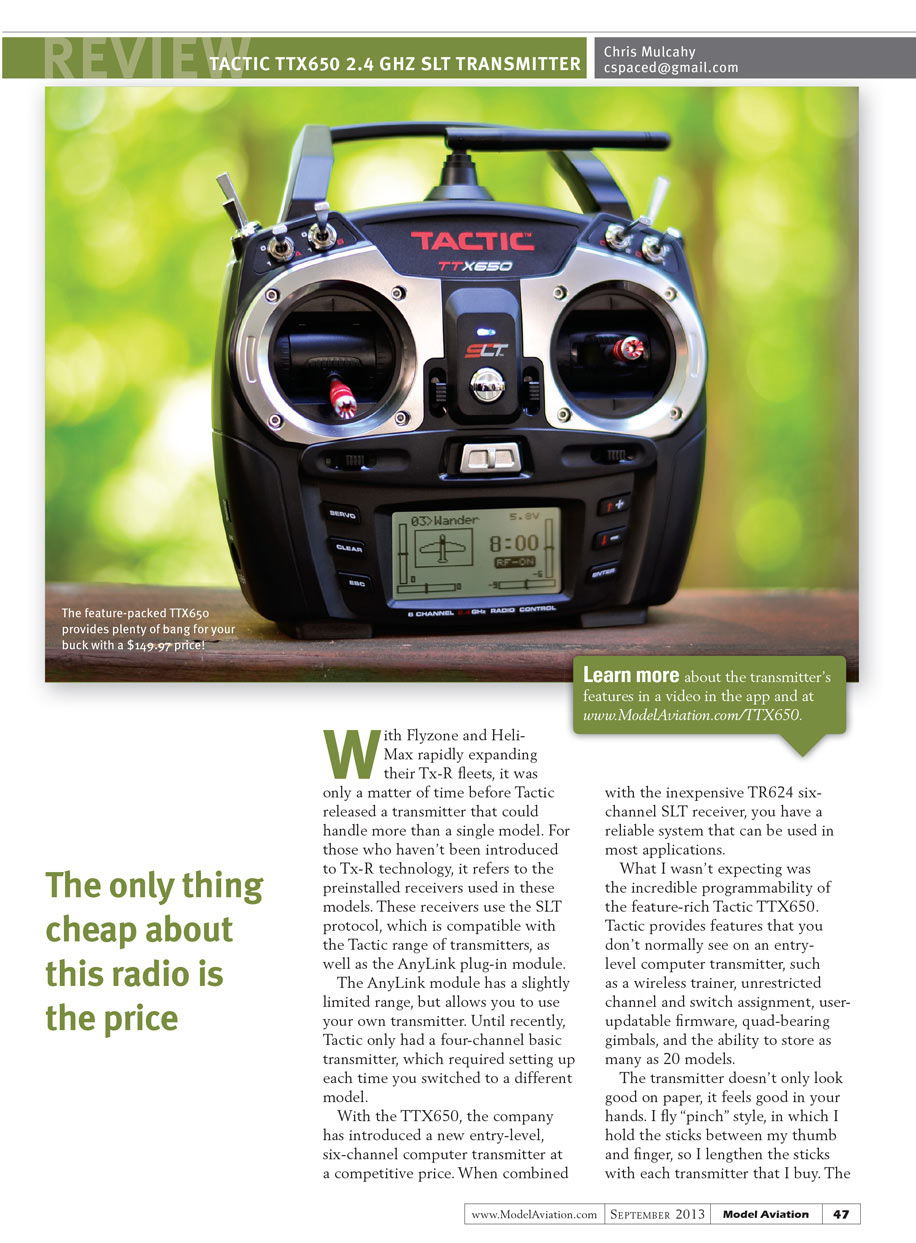
With Flyzone and Heli-Max rapidly expanding their Tx-R fleets, it was only a matter of time before Tactic released a transmitter that could handle more than a single model. For those who haven't been introduced to Tx-R technology, it refers to the preinstalled receivers used in these models. These receivers use the SLT protocol, which is compatible with the Tactic range of transmitters, as well as the AnyLink plug-in module. The AnyLink module has a slightly limited range, but allows you to use your own transmitter. Until recently, Tactic only had a four-channel basic transmitter, which required setting up each time you switched to a different model.
With the TTX650, the company has introduced a new entry-level, six-channel computer transmitter at a competitive price. When combined with the inexpensive TR624 six-channel SLT receiver, you have a reliable system that can be used in most applications.
What I wasn't expecting was the incredible programmability of the feature-rich Tactic TTX650. Tactic provides features that you don't normally see on an entry-level computer transmitter, such as a wireless trainer, unrestricted channel and switch assignment, user-updatable firmware, quad-bearing gimbals, and the ability to store as many as 20 models.
The transmitter doesn't only look good on paper, it feels good in your hands. I fly "pinch" style in which I hold the sticks between my thumb and finger, so I lengthen the sticks with each transmitter that I buy. The sticks on the TTX650 are removable and are the longer size — ideal for pinch-grip flyers. The red, aluminum sticks are comfortable and the quad bearings give the gimbals a silky-smooth feel.
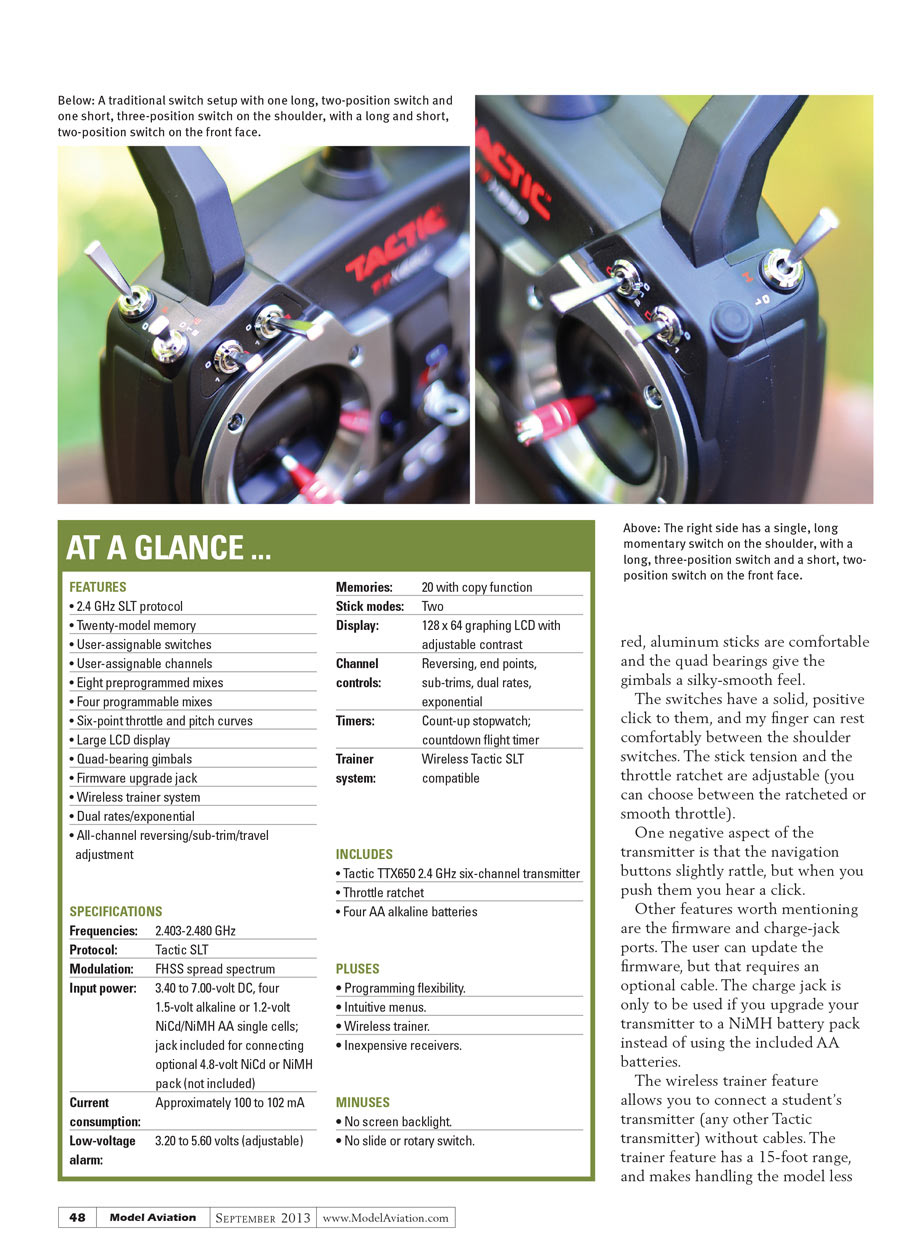
The switches have a solid, positive click to them, and my finger can rest comfortably between the shoulder switches. The stick tension and the throttle ratchet are adjustable (you can choose between the ratcheted or smooth throttle).
One negative aspect of the transmitter is that the navigation buttons slightly rattle, but when you push them you hear a click.
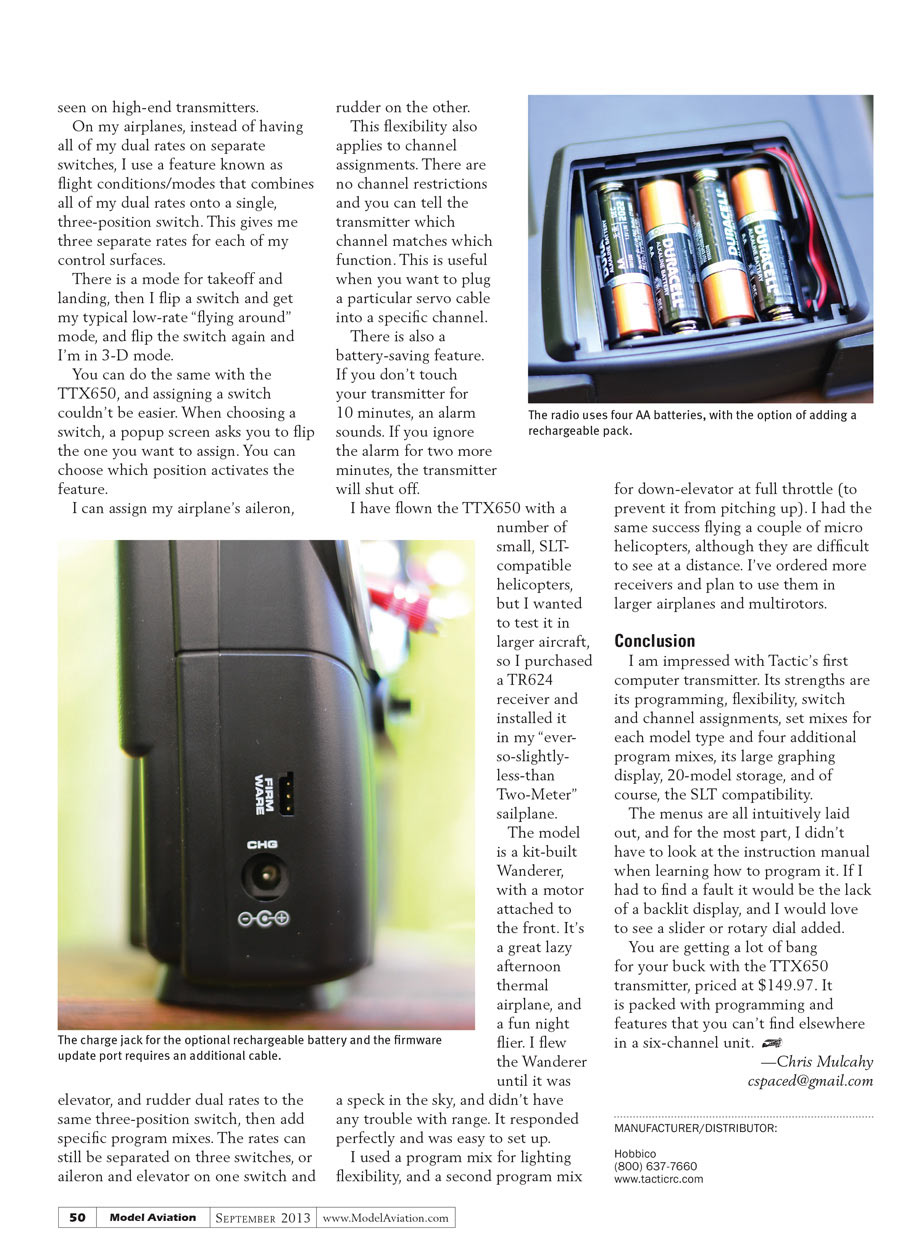
Other features worth mentioning are the firmware and charge-jack ports. The user can update the firmware, but that requires an optional cable. The charge jack is only to be used if you upgrade your transmitter to a NiMH battery pack instead of using the included AA batteries.
The wireless trainer feature allows you to connect a student’s transmitter (any other Tactic transmitter) without cables. The trainer feature has a 15-foot range, and makes handling the model less stressful for the student while allowing the instructor to take control instantly.
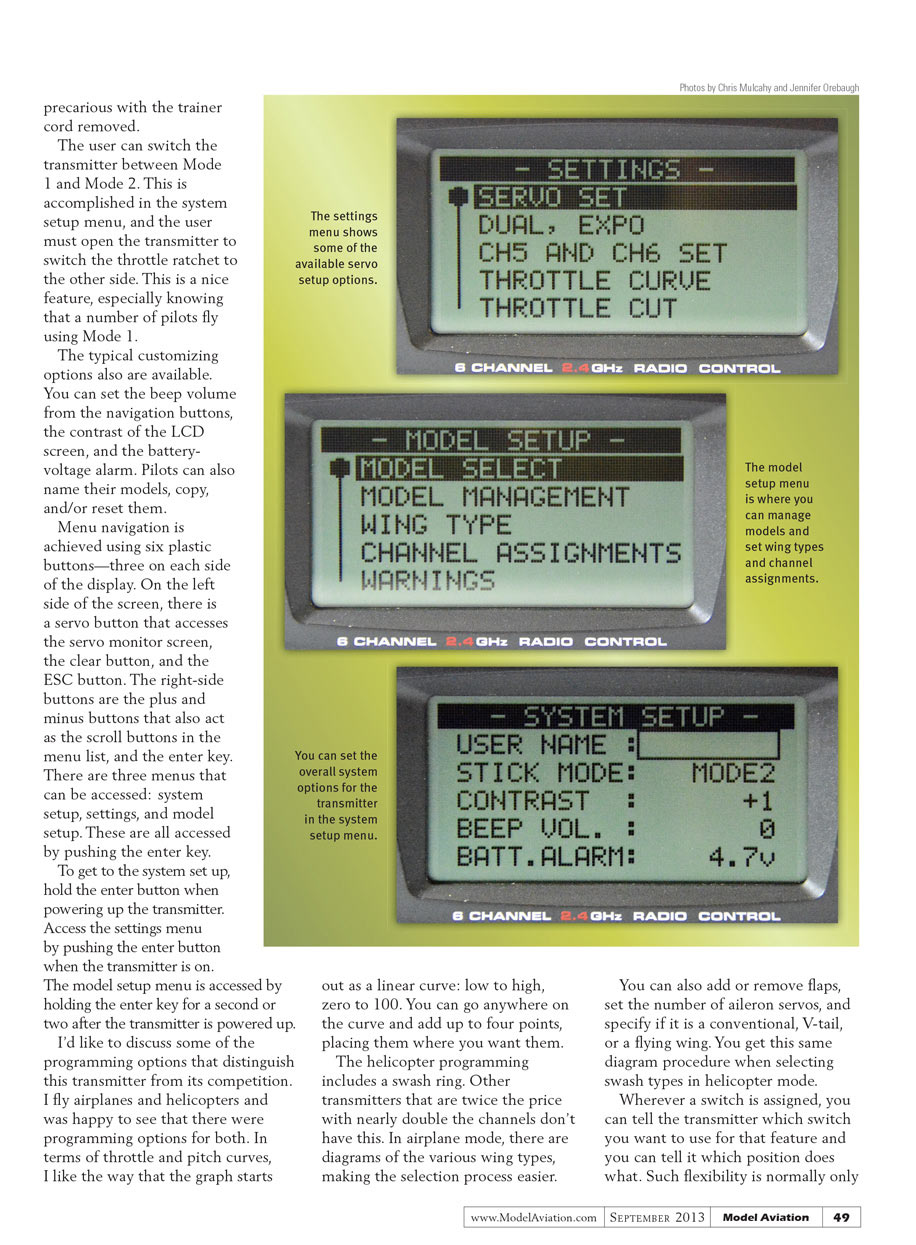
The typical customizing options also are available. You can set the beep volume from the navigation buttons, the contrast of the LCD screen, and the battery-voltage alarm. Pilots can also name their models, copy, and/or reset them.
Menu navigation is achieved using six plastic buttons—three on each side of the display. On the left side of the screen, there is a servo button that accesses the servo monitor screen, the clear button, and the ESC button. The right-side buttons are the plus and minus buttons that also act as the scroll buttons in the menu list, and the enter key. There are three menus that can be accessed: system setup, settings, and model setup. These are all accessed by pushing the enter key.
To get to the system set up, hold the enter button when powering up the transmitter. Access the settings menu by pushing the enter button when the transmitter is on.
The model setup menu is accessed by holding the enter key for a second or two after the transmitter is powered up.
I’d like to discuss some of the programming options that distinguish this transmitter from its competition. I fly airplanes and helicopters and was happy to see that there were programming options for both. In terms of throttle and pitch curves, I like the way that the graph starts out as a linear curve: low to high, zero to 100. You can go anywhere on the curve and add up to four points, placing them where you want them.
The helicopter programming includes a swash ring. Other transmitters that are twice the price with nearly double the channels don’t have this. In airplane mode, there are diagrams of the various wing types, making the selection process easier.
You can also add or remove flaps, set the number of aileron servos, and specify if it is a conventional, V-tail, or a flying wing. You get this same diagram procedure when selecting swash types in helicopter mode.
Wherever a switch is assigned, you can tell the transmitter which switch you want to use for that feature and you can tell it which position does what. Such flexibility is normally only seen on high-end transmitters.
Tactic TTX650 Radio
Chris Mulcahy
On my airplanes, instead of having all of my dual rates on separate switches, I use a feature known as flight conditions/modes that combines all of my dual rates onto a single, three-position switch. This gives me three separate rates for each of my control surfaces.
There is a mode for takeoff and landing, then I flip a switch and get my typical low-rate "flying around" mode, and flip the switch again and I'm in 3-D mode.
You can do the same with the TTX650, and assigning a switch couldn't be easier. When choosing a switch, a popup screen asks you to flip the one you want to assign. You can choose which position activates the feature.
I can assign my airplane's aileron, elevator, and rudder dual rates to the same three-position switch, then add specific program mixes. The rates can still be separated on three switches, or aileron and elevator on one switch and rudder on the other.
This flexibility also applies to channel assignments. There are no channel restrictions and you can tell the transmitter which channel matches which function. This is useful when you want to plug a particular servo cable into a specific channel.
There is also a battery-saving feature. If you don't touch your transmitter for 10 minutes, an alarm sounds. If you ignore the alarm for two more minutes, the transmitter will shut off.
I have flown the TTX650 with a number of small, SLT-compatible helicopters, but I wanted to test it in larger aircraft, so I purchased a TR624 receiver and installed it in my "ever-so-slightly-less-than-Two-Meter" sailplane.
The model is a kit-built Wanderer, with a motor attached to the front. It's a great lazy afternoon thermal airplane, and a fun night flier. I flew the Wanderer until it was a speck in the sky, and didn't have any trouble with range. It responded perfectly and was easy to set up.
I used a program mix for lighting flexibility, and a second program mix for down-elevator at full throttle (to prevent it from pitching up). I had the same success flying a couple of micro helicopters, although they are difficult to see at a distance. I've ordered more receivers and plan to use them in larger airplanes and multirotors.
Conclusion
I am impressed with Tactic's first computer transmitter. Its strengths are its programming, flexibility, switch and channel assignments, set mixes for each model type and four additional program mixes, its large graphing display, 20-model storage, and, of course, the SLT compatibility.
The menus are all intuitively laid out, and for the most part, I didn't have to look at the instruction manual when learning how to program it. If I had to find a fault it would be the lack of a backlit display, and I would love to see a slider or rotary dial added.
You are getting a lot of bang for your buck with the TTX650 transmitter, priced at $149.97. It is packed with programming and features that you can't find elsewhere in a six-channel unit.
—Chris Mulcahy [email protected]
Transcribed from original scans by AI. Minor OCR errors may remain.

