
Technical Review
Bob Aberle
E-mail: [email protected]
I'll begin by referring you to MA's "From the Ground Up" beginners' series and the January 2004 installment "Advanced RC Systems," in which I explained why an RC beginner or a basic sport flier might benefit from using a more advanced RC system. If you haven't read that article, I strongly urge you to do so before you read this article.
Modern computer-driven RC transmitters have come way down in price, and at the same time their operation has been greatly simplified. That being the case, advanced RC systems can meet the needs of the beginner/sport flier from a price and ease-of-operation standpoint.
In the pages of MA I've discussed advanced RC systems that are available from Airtronics, Futaba, and Hitec RCD. All of these cost approximately $200 and are easy to operate. This time I will cover the newly released JR XP6102 RC system, which is distributed by Horizon Hobby Inc.
XP6102 System Highlights
This offering features 10 model memory positions. Most systems in this category only offer four to six positions. You have the option of purchasing this system with a Pulse Code Modulation (PCM) receiver that also allows the use of a fail-safe mode or a standard FM (Pulse Position Modulation, or PPM) receiver, which will cost less.
The XP6102 comes programmed for fixed-wing aircraft and helicopter flying. You choose which type from the provided menu system. There are also special switch functions specifically for the helicopter enthusiast.
Each model memory position can be identified by number and a model name that you assign with a maximum of eight characters. That number and name is displayed on the LCD screen every time you turn on the power. Digital trim is employed with the position of each control surface clearly shown on the LCD screen at all times.
This system includes all of the special controls you would expect on an advanced RC system. There are provisions for a trainer cable and for a DSC (Direct Servo Connect) cable (both optional, at extra cost) that allow you to operate your aircraft controls without placing a radio signal on the air. You can operate the system at your flying field and not interfere with any other modelers.
The best news is that the JR XP6102 RC system's street price ranges from $250 to $290, depending on the options you choose. The key feature is the 10 model memory positions in a radio that sells for as little as $250.
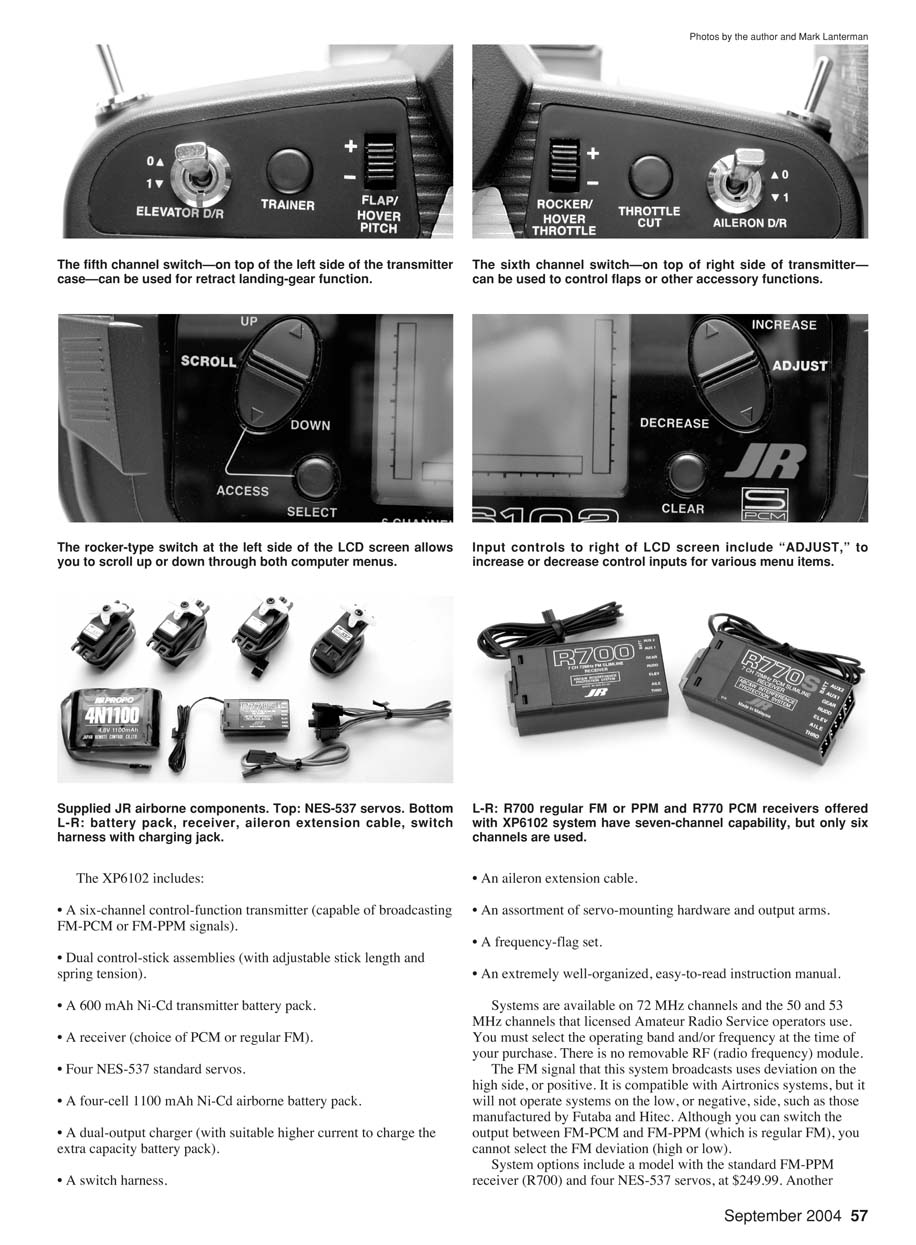
JR XP6102 radio
Technical Highlights:
- Ten model memory positions can be numbered and/or named for identification purposes.
- Six-channel control functions.
- Broadcasts FM-PCM or FM-PPM (regular FM), depending on receiver you purchase.
- FM signal is on high-side deviation and is not selectable.
- Comes programmed for helicopter and fixed-wing flying.
- Full Ni-Cd batteries and charger supplied. Receiver pack has 1100 mAh capacity.
- Provisions for trainer and DSC cables.
- Full instruction manual available in PDF format on Horizon Hobby's web site.
- Street prices range from $250 to $290.
The XP6102 includes:
- A six-channel control-function transmitter (capable of broadcasting FM-PCM or FM-PPM signals).
- Dual control-stick assemblies (with adjustable stick length and spring tension).
- A 600 mAh Ni-Cd transmitter battery pack.
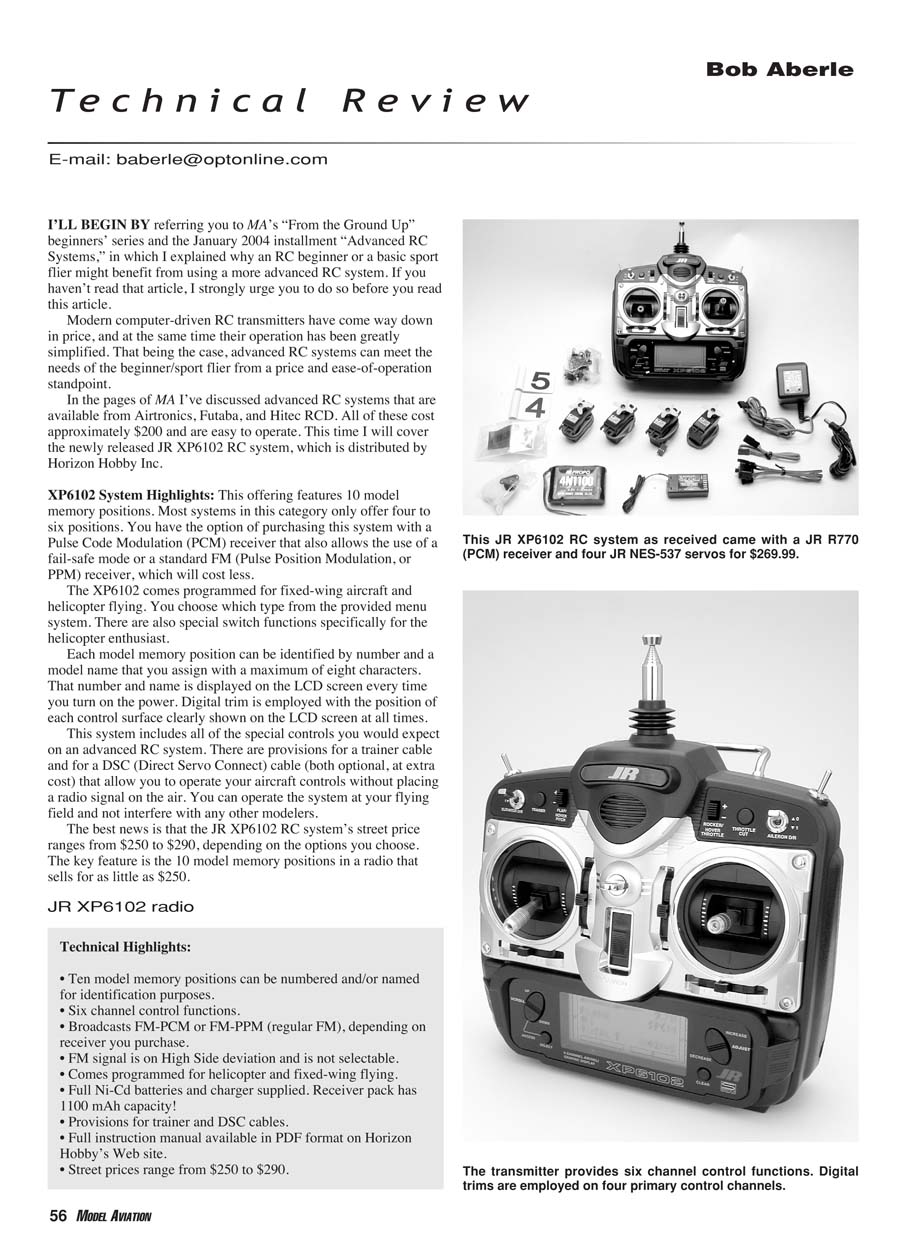
- A receiver (choice of PCM or regular FM).
- Four NES-537 standard servos.
- A four-cell 1100 mAh Ni-Cd airborne battery pack.
- A dual-output charger (with suitable higher current to charge the extra capacity battery pack).
- A switch harness.
- An aileron extension cable.
- An assortment of servo-mounting hardware and output arms.
- A frequency-flag set.
- An extremely well-organized, easy-to-read instruction manual.
Systems are available on 72 MHz channels and the 50 and 53 MHz channels that licensed Amateur Radio Service operators use. You must select the operating band and/or frequency at the time of your purchase. There is no removable RF (radio frequency) module. The FM signal that this system broadcasts uses deviation on the high side, or positive. It is compatible with Airtronics systems, but it will not operate systems on the low, or negative, side, such as those manufactured by Futaba and Hitec. Although you can switch the output between FM-PCM and FM-PPM (which is regular FM), you cannot select the FM deviation (high or low).
System options include:
- A model with the standard FM-PPM receiver (R700) and four NES-537 servos, at $249.99.
- A version with a PCM receiver (R770PCM) and four NES-537 servos, or the R700PPM receiver with five NES-537 servos, for $269.99.
- A helicopter version with the R770PCM receiver and five NES-537 servos, for $289.99.
XP6102 Transmitter
The four basic flight controls (aileron, elevator, rudder, and throttle) are operated by the two dual-axis control-stick assemblies. A fifth channel (nonproportional) control, intended for retractable landing gear, is operated by a switch located at the top left corner of the transmitter case.
A sixth channel function (also nonproportional) is operated by a switch located at the top right corner of the case. You could use this switch to deploy flaps, drop bombs, turn lights on or off, etc. Although the fifth and sixth channel functions do not have trim controls, you do have travel adjustment available for them, which is a great convenience.
At the left front corner of the transmitter case is the elevator dual-rate switch. To the right of that is the "TRAINER" operation push button, which is used with the optional trainer cable and another JR transmitter with the same capability. To the right of that is a helicopter-peculiar control switch identified as "FLAP/HOVER PITCH."
At the right front corner of the case is the aileron dual-rate switch. To the left of that is the "THROTTLE CUT" switch that will allow you to cut off your fueled engine without the need to operate the throttle trim lever. To the left of that switch is another helicopter-peculiar switch identified as "ROCKER/HOVER THROTTLE."
This system actually provides for dual-rate and exponential (expo) rate control on the aileron, elevator and rudder control functions. Individual switches can turn aileron and elevator dual-rate and/or expo rate on or off. You may also assign the fifth or sixth channel switches on the top corners of the case to turn all three control functions on or off. You cannot turn the rudder dual-rate or expo control on or off separately.
When the transmitter battery voltage drops to less than 9.0 volts, an audible alarm will sound and the words "BATT LOW" will flash on the LCD screen. The timer readout on the normal display screen appears to be the transmitter’s elapsed operating time. It does not allow you to time individual flights.
As do most JR transmitters, the XP6102 employs a memory-backup lithium battery. It is claimed to last approximately five years. When it needs replacement, a "BACK ERROR" message will appear on the LCD screen. At that time you must return the transmitter to the JR Horizon Service Center for battery replacement.
LCD Screen and Special Controls
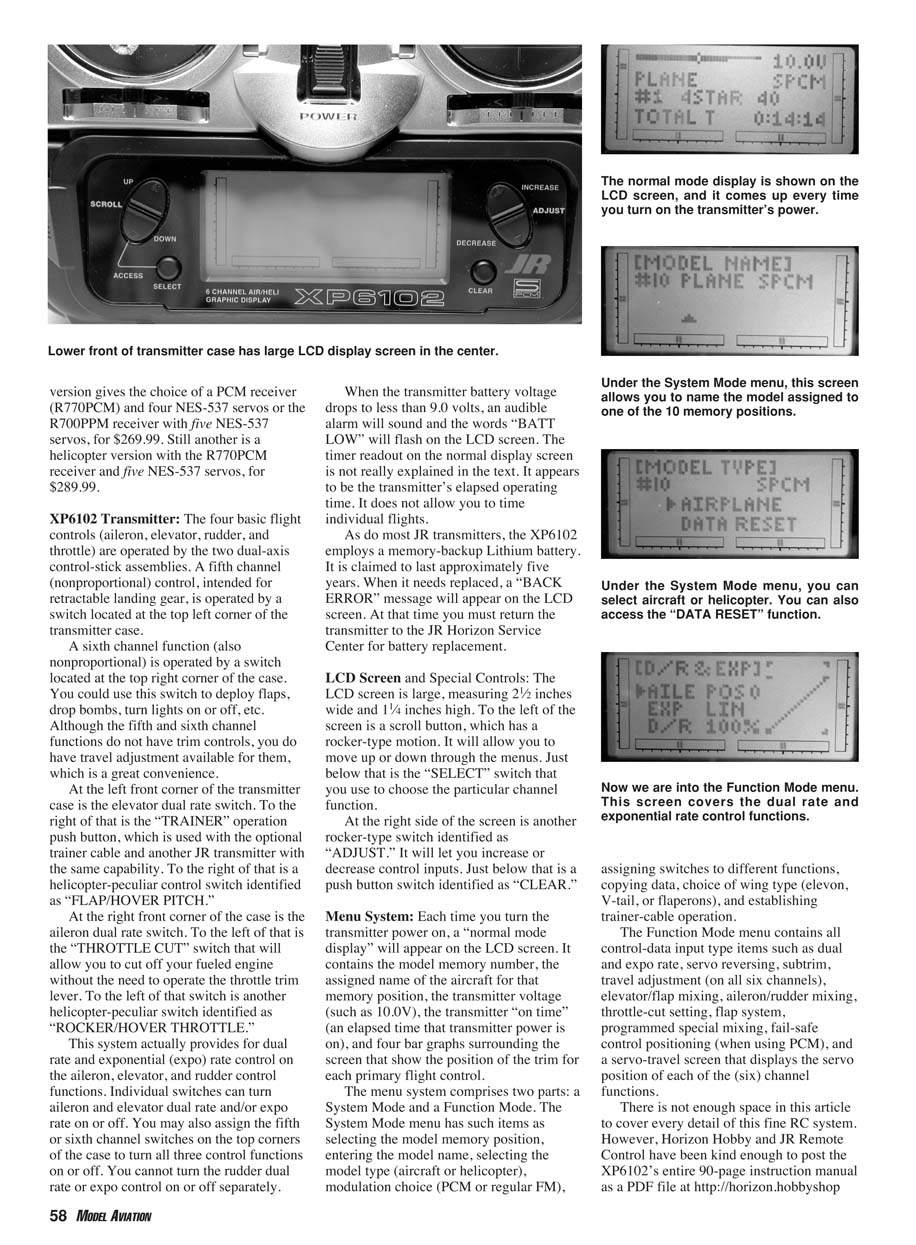
The LCD screen is large, measuring 2.5 inches wide and 1.25 inches high. To the left of the screen is a scroll button, which has a rocker-type motion. It allows you to move up or down through the menus. Just below that is the "SELECT" switch that you use to choose the particular channel function.
At the right side of the screen is another rocker-type switch identified as "ADJUST." It lets you increase or decrease control inputs. Just below that is a push-button switch identified as "CLEAR."
Menu System
Each time you turn the transmitter power on, a "normal mode display" will appear on the LCD screen. It contains the model memory number, the assigned name of the aircraft for that memory position, the transmitter voltage (such as 10.0 V), the transmitter "on time" (an elapsed time that transmitter power is on), and four bar graphs surrounding a screen that show the position of the trim for each primary flight control.
The menu system comprises two parts: a System Mode and a Function Mode.
System Mode menu items include:
- Selecting the model memory position.
- Naming the model (aircraft or helicopter).
- Mode selection (PCM or regular FM).
- Assigning switches to different functions.
- Copying data.
- Choice of wing type (elevon, V-tail, or flaperons).
- Establishing trainer-cable operation.
Function Mode menu items include:
- Dual-rate and expo rate settings.
- Servo reversing.
- Subtrim.
- Travel adjustment (on all six channels).
- Elevator/flap mixing.
- Aileron/rudder mixing.
- Throttle-cut setting.
- Flap system.
- Programmed special mixing.
- Fail-safe settings.
- Throttle-curve.
- Trims (when using PCM).
- A servo-travel screen that displays the servo position of each of the six channel functions.
There is not enough space in this article to cover every detail of this fine RC system. However, Horizon Hobby and JR Remote Control have posted the XP6102’s entire 90-page instruction manual as a PDF file at: http://horizon.hobbyshopnow.com/ProdInfo/Files/jrp6644-manual.pdf
Airborne Components
The JR F770S (PCM) receiver was supplied with my review system. This receiver enables you to use the fail-safe feature with preset controls. Should your RC signal be lost or interfered with, the controls will automatically move to your preset positions.
The JR literature notes that this receiver weighs 1.5 ounces; in fact, it weighs only 0.67 ounce and is small in size, at 1 7/8 inches long, 1 1/16 inch wide, and 9/16 inch thick. (The FM version is the same size and weight.)
Each NES-537 servo weighs 1.36 ounces and has a rated output of 43 ounce-inches of torque. JR provides a four-cell 1100 mAh Ni-Cd airborne battery pack. With this higher capacity, you can easily power five servos for helicopter and certain aircraft applications.
The supplied JR NEC-222 battery charger has a receiver output of 120 mA current, which is extremely close to the C/10 overnight charge level for their 1100 mAh pack. That is the correct charging approach.
The 10 model memory positions and the ability to name each model, a choice of PCM or FM, and an easy-to-use menu system make the JR XP6102 RC system very special. It is well suited to the RC sport flier and even the RC beginner, and the system prices make it affordable.
Distributor
Horizon Hobby Inc. 4104 Fieldstone Rd. Champaign, IL 61822 (877) 504-0233 www.horizonhobby.com
Transcribed from original scans by AI. Minor OCR errors may remain.

