
Technical Review - 2005/02
Bob Aberle E-mail: [email protected]
JR XP9303 RC System
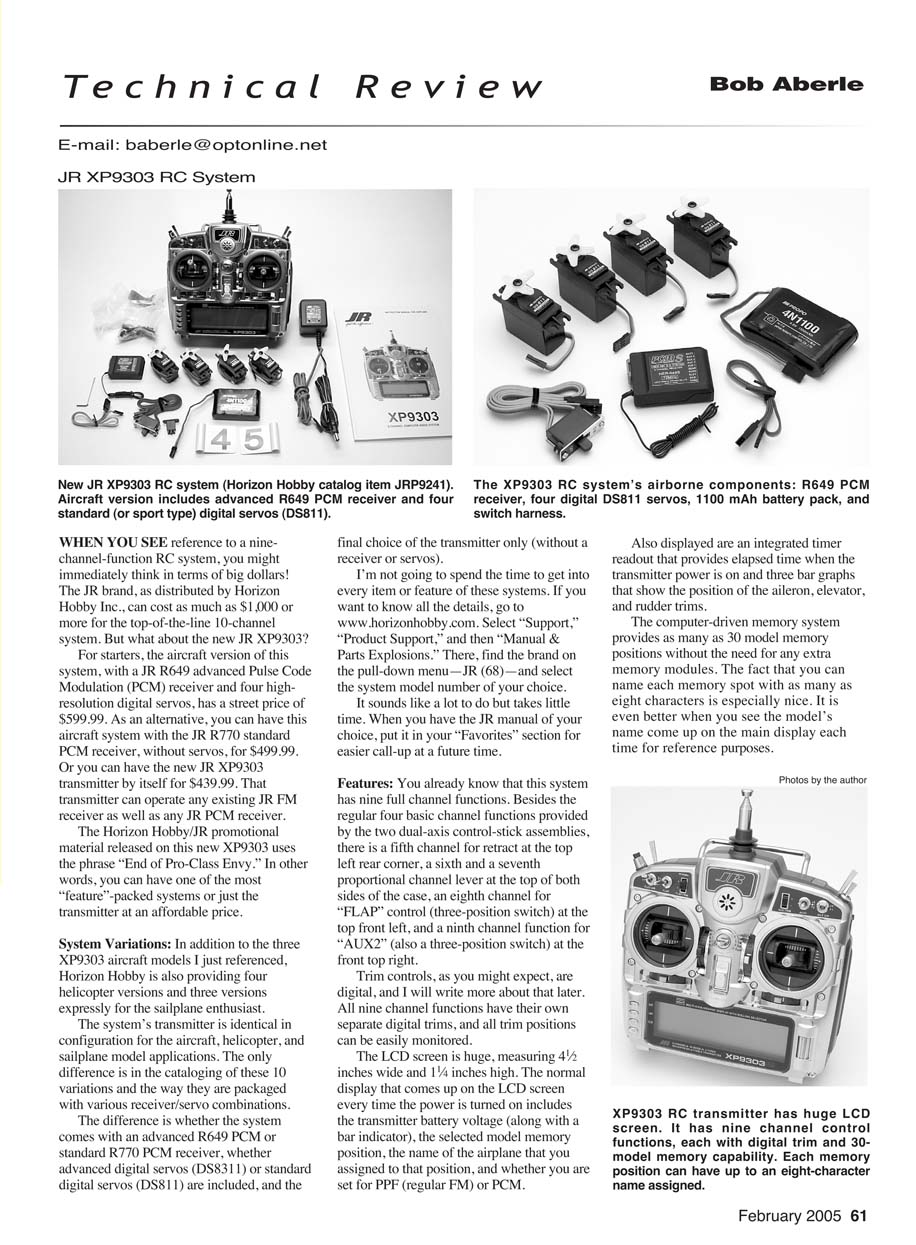
When you see a reference to a nine-channel-function RC system, you might immediately think in terms of big dollars. The JR brand, as distributed by Horizon Hobby Inc., can cost as much as $1,000 or more for the top-of-the-line 10-channel system. But consider the new JR XP9303.
The aircraft version of this system, with a JR R649 advanced Pulse Code Modulation (PCM) receiver and four high-resolution digital servos, has a street price of $599.99. Alternatively, you can have the aircraft system with the JR R770 standard PCM receiver (without servos) for $499.99. Or you can buy the new JR XP9303 transmitter by itself for $439.99. That transmitter can operate any existing JR FM receiver as well as any JR PCM receiver.
The Horizon Hobby/JR promotional material released on this new XP9303 uses the phrase "End of Pro-Class Envy." In other words, you can have one of the most feature-packed systems—or just the transmitter—at an affordable price.
System Variations
In addition to the three XP9303 aircraft models above, Horizon Hobby is providing:
- four helicopter versions, and
- three versions specifically for sailplane enthusiasts.
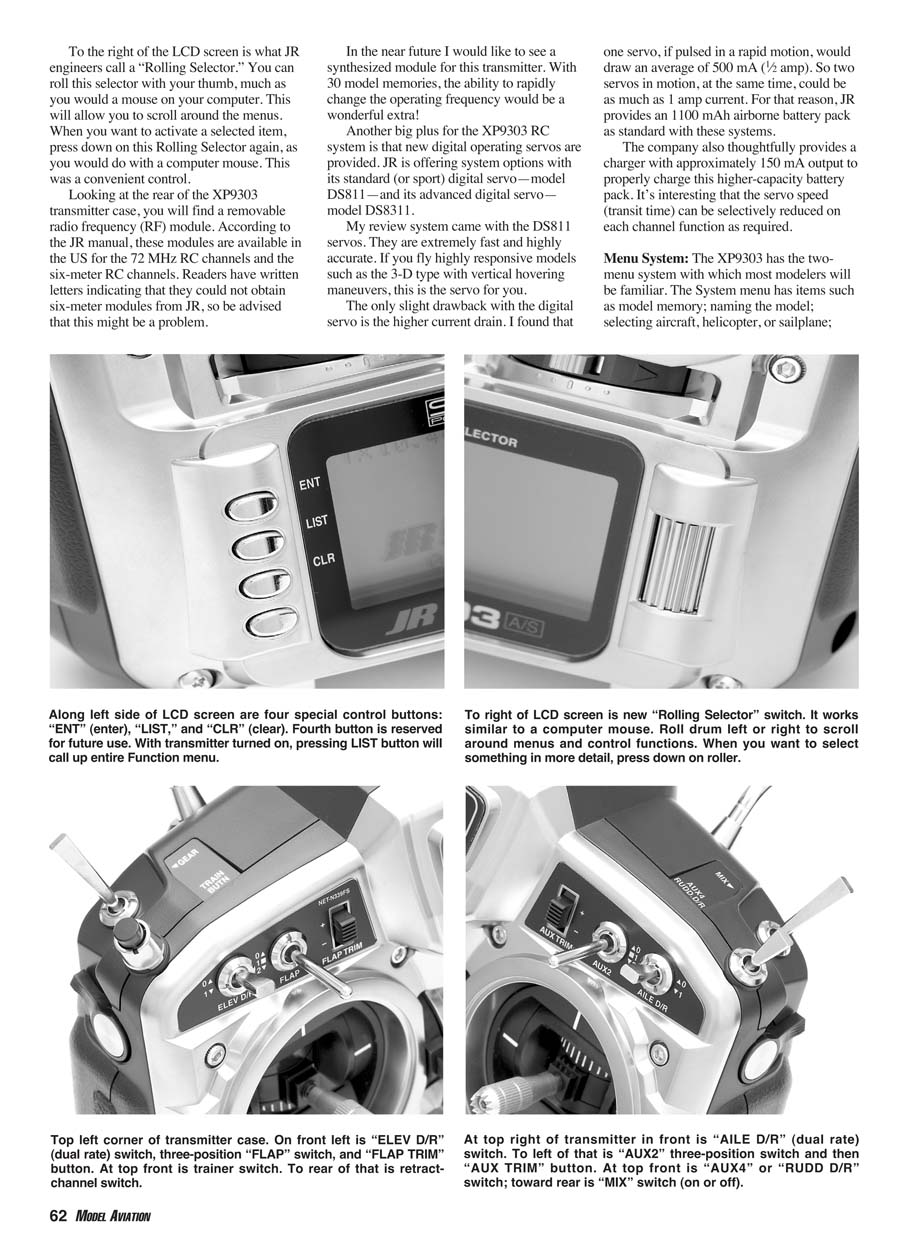
The transmitter is identical for the aircraft, helicopter, and sailplane applications. Differences are in cataloging and packaging: whether the system comes with an advanced R649 PCM or standard R770 PCM receiver, whether advanced digital servos (DS8311) or standard digital servos (DS811) are included, or whether it is the transmitter only (no receiver or servos).
If you want every detail, go to www.horizonhobby.com → Support → Product Support → Manual & Parts Explosions. Select JR (68) from the brand pull-down and choose the system model number. Save the manual in your browser favorites for future reference.
Features
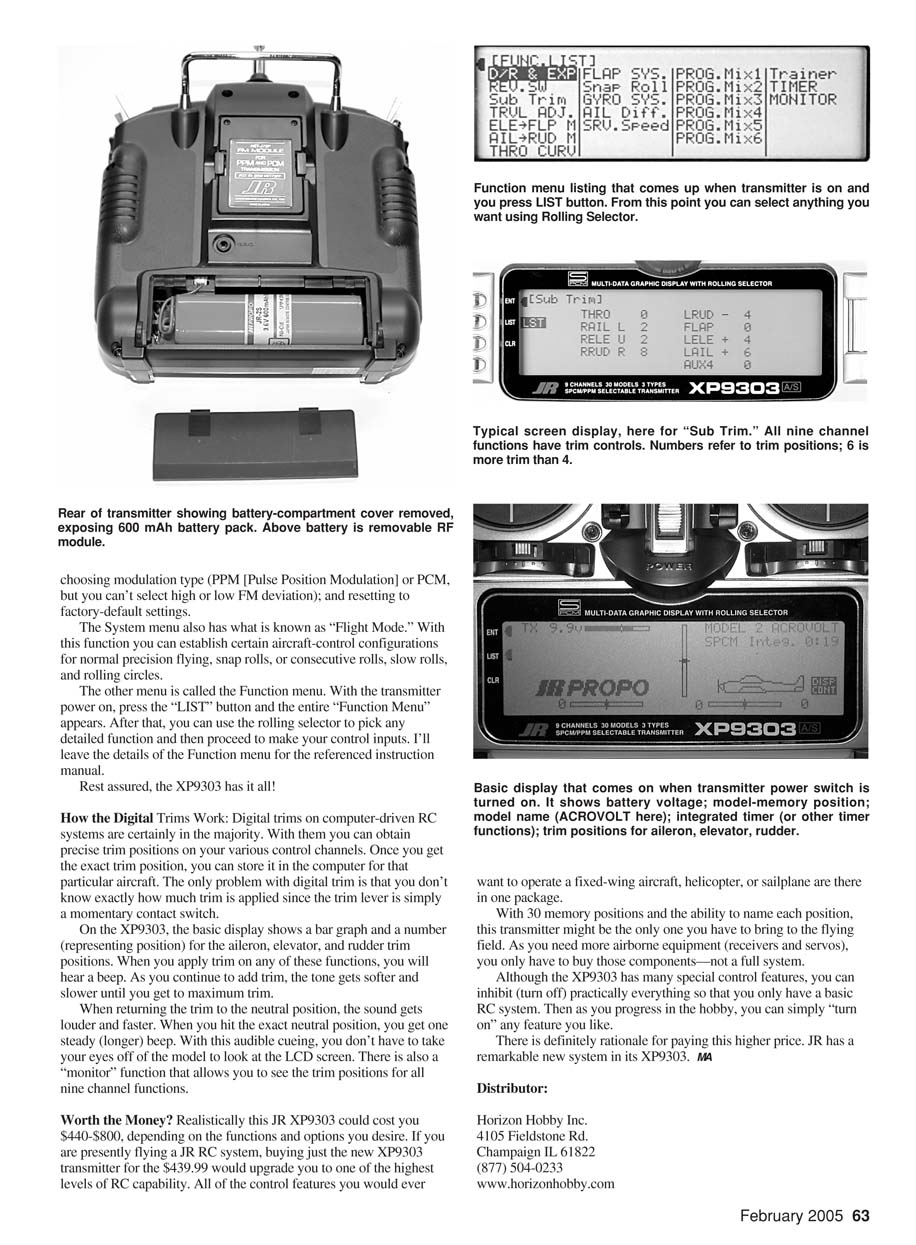
The system provides nine full-channel functions. Beyond the four basic channel functions from the two dual-axis control sticks, the remaining channels are:
- fifth channel: retract (top left rear corner),
- sixth and seventh channels: proportional levers (top of both sides of the case),
- eighth channel: FLAP control (three-position switch; top front left),
- ninth channel: AUX2 (three-position switch; top front right).
All nine channels have separate digital trims, and all trim positions can be monitored.
The LCD screen measures 4 1/2 inches wide by 1 1/4 inches high. The normal display shown at power-up includes:
- transmitter battery voltage (with bar indicator),
- selected model memory position,
- the assigned airplane name for that memory position,
- whether the unit is set for PPM (regular FM) or PCM,
- an integrated timer readout (elapsed time while transmitter power is on),
- three bar graphs showing the position of aileron, elevator, and rudder trims.
The computer-driven memory system provides up to 30 model memory positions without extra memory modules. You can name each memory slot with up to eight characters; the model name appears on the main display for easy reference.
To the right of the LCD screen is JR’s "Rolling Selector." You roll the selector with your thumb (like a computer mouse wheel) to scroll menus, and press down to activate a selected item. This is a convenient control.
On the rear of the XP9303 transmitter case is a removable radio-frequency (RF) module. According to the manual, modules are available in the U.S. for the 72 MHz RC channels and the six-meter RC channels. Some readers have reported difficulty obtaining six-meter modules from JR, so availability may be an issue.
A synthesized module would be a useful future option: with 30 memory positions, the ability to rapidly change operating frequency would be desirable.
Another big plus is the inclusion of digital operating servos. JR offers standard (sport) digital servos, model DS811, and advanced digital servos, model DS8311.
My review system came with DS811 servos. They are extremely fast and highly accurate—suitable for highly responsive models such as 3-D aircraft with vertical hovering maneuvers.
The slight drawback of digital servos is higher current drain. I found one servo pulsed rapidly could draw about 500 mA (0.5 A). Two servos moving simultaneously could draw about 1 A. For that reason, JR provides an 1100 mAh airborne battery pack as standard with these systems and includes a charger with approximately 150 mA output to properly charge this higher-capacity pack. Servo speed (transit time) can be selectively reduced on each channel as required.
Menu System
The XP9303 uses a two-menu system common to many modelers:
- System menu — contains items such as model memory, naming the model, selecting aircraft/helicopter/sailplane, choosing modulation type (PPM [Pulse Position Modulation] or PCM; you cannot select high or low FM deviation), and resetting to factory-default settings. The System menu also includes "Flight Mode," which allows you to establish aircraft-control configurations for normal precision flying, snap rolls, consecutive rolls, slow rolls, rolling circles, etc.
- Program (Function) menu — contains model-specific adjustments such as servo reversing, subtrim, dual rates and exponential, travel limits, mixing functions, and other model-specific settings.
With the transmitter power on, press the "LIST" button to display the Function menu. Use the Rolling Selector to pick a detailed function and then make your control inputs. For full details, consult the instruction manual.
Rest assured, the XP9303 has it all.
How the Digital Trims Work
Digital trims are the norm on computer-driven RC systems and allow precise trim positions that can be stored per model. The drawback is you cannot see how much trim is being applied from the trim lever, since it is a momentary-contact switch.
On the XP9303, the basic display shows a bar graph and a number representing position for the aileron, elevator, and rudder trims. When you apply trim you will hear a beep: as you add trim, the tone becomes softer and slower until maximum trim is reached. When returning trim toward neutral, the sound becomes louder and faster; at the exact neutral position you get one steady (longer) beep. This audible cue lets you adjust trims without taking your eyes off the aircraft. There is also a "monitor" function that allows you to view trim positions for all nine channels.
Worth the Money?
The JR XP9303 could cost $440–$800 depending on the chosen options. If you already fly a JR RC system, buying the XP9303 transmitter alone ($439.99) would upgrade you to one of the highest levels of RC capability. The transmitter supports fixed-wing aircraft, helicopters, and sailplanes in one package.
With 30 memory positions and the ability to name each position, this transmitter might be the only one you need to bring to the flying field. As you need more airborne equipment (receivers and servos), you buy those components—not a whole new transmitter.
Although the XP9303 has many special control features, you can disable most functions to use it as a basic RC system, then enable additional features as you progress in the hobby.
There is solid rationale for paying the higher price. JR has produced a remarkable new system in the XP9303.
Distributor
Horizon Hobby Inc. 4105 Fieldstone Rd. Champaign, IL 61822 (877) 504-0233 www.horizonhobby.com
Transcribed from original scans by AI. Minor OCR errors may remain.

