
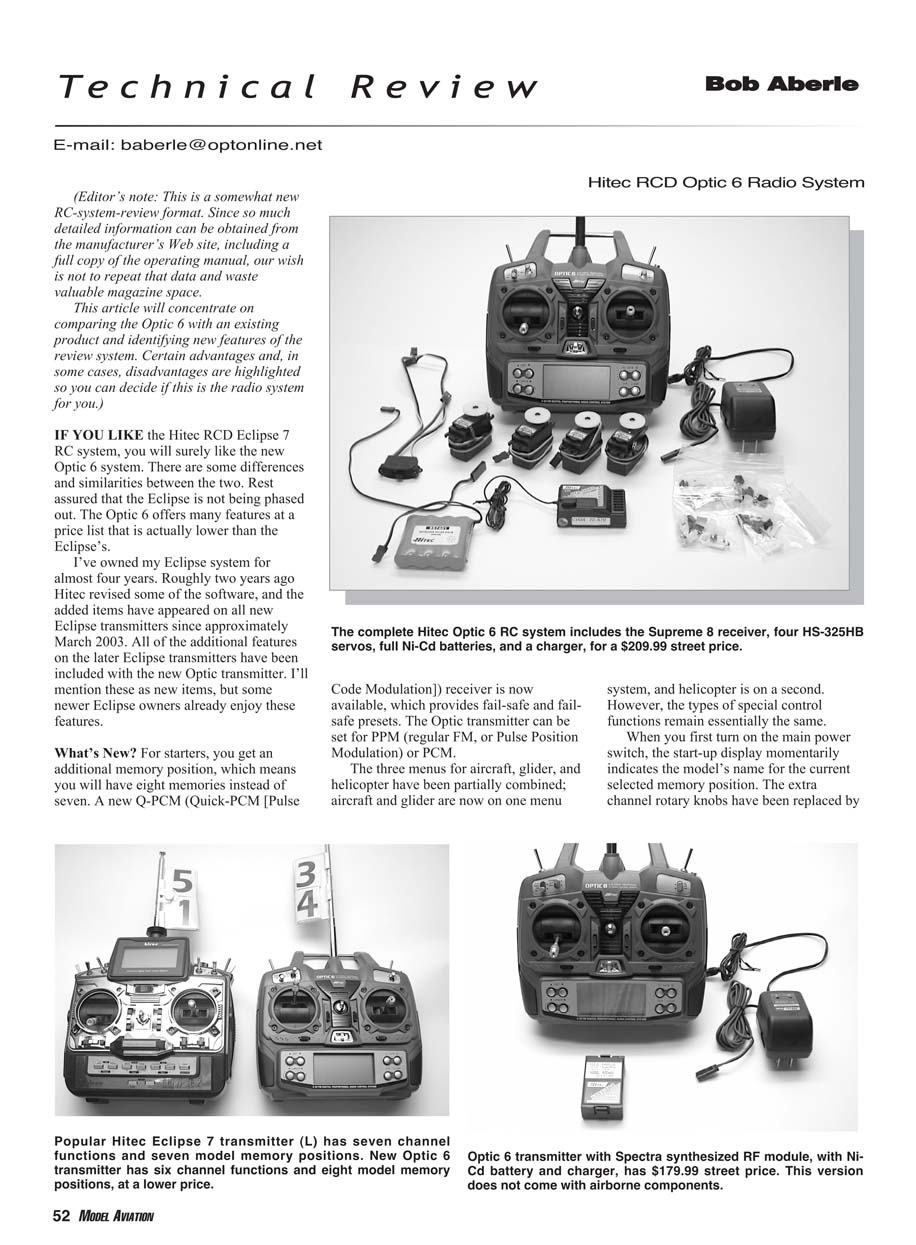
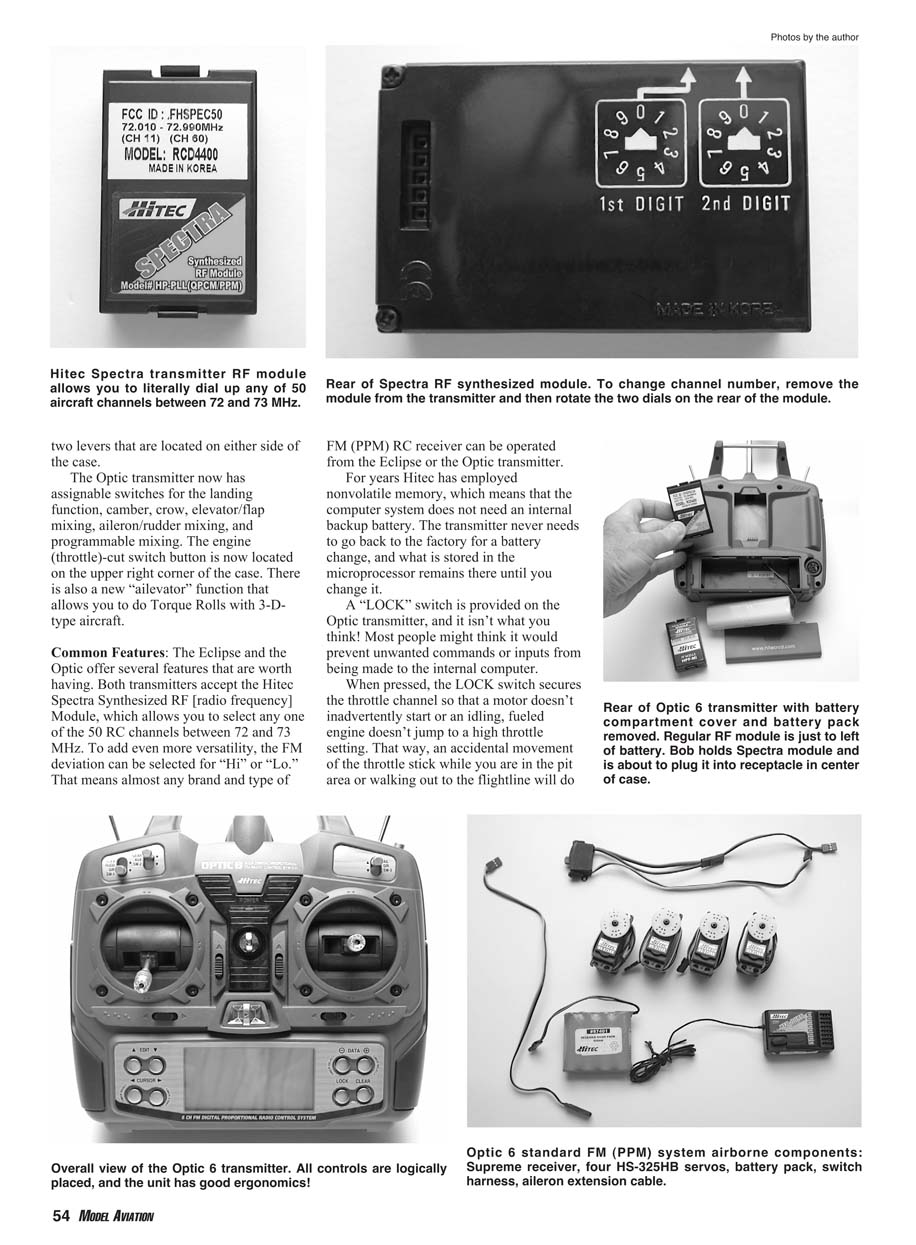
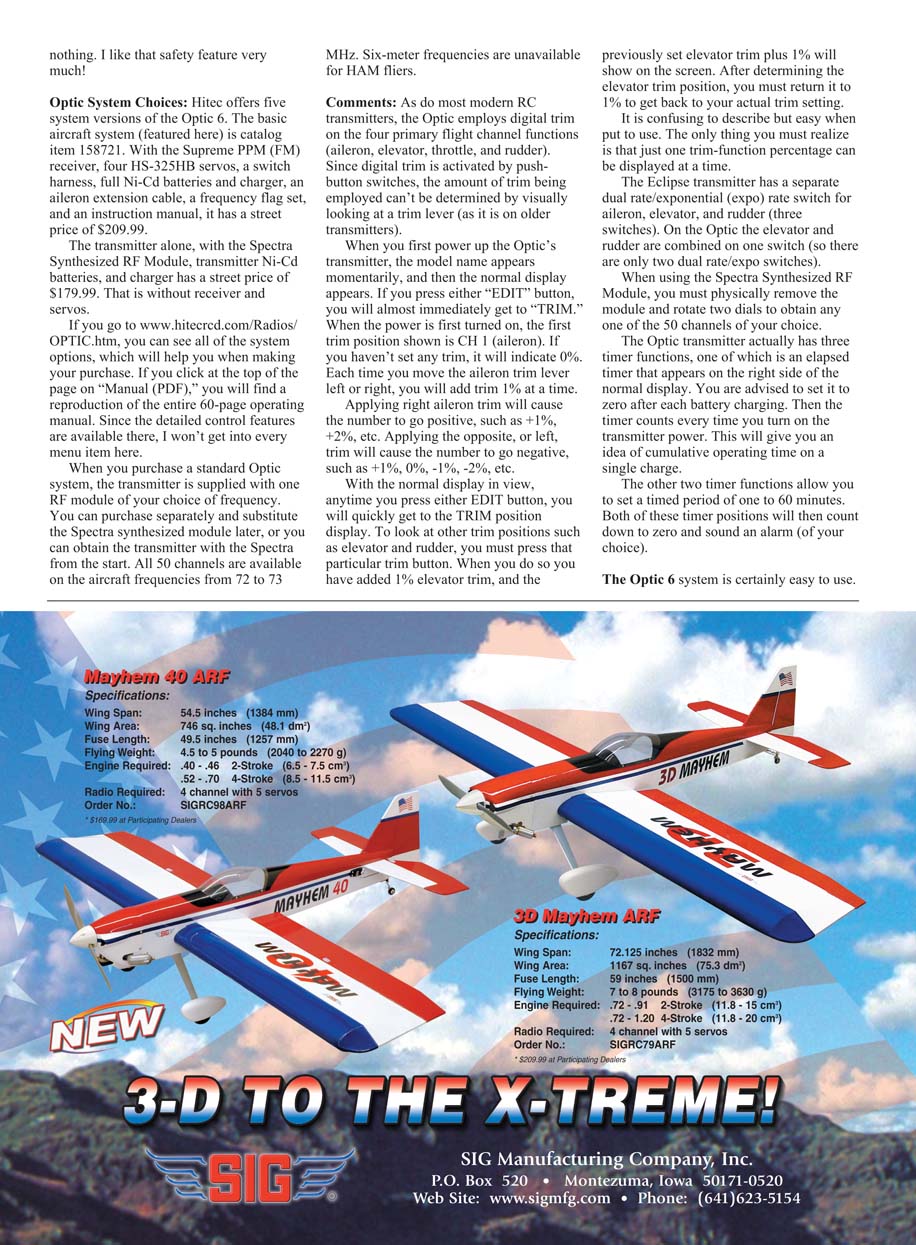

Technical Review - 2005/06
Bob Aberle
E-mail: [email protected]
(Editor's note: This is a somewhat new RC-system-review format. Since so much detailed information can be obtained from the manufacturer's web site, including a full copy of the operating manual, our wish is not to repeat that data and waste valuable magazine space.
This article will concentrate on comparing the Optic 6 with an existing product and identifying new features of the review system. Certain advantages and, in some cases, disadvantages are highlighted so you can decide if this is the radio system for you.)
If you like the Hitec RCD Eclipse 7 RC system, you will surely like the new Optic 6 system. There are some differences and similarities between the two. Rest assured that the Eclipse is not being phased out. The Optic 6 offers many features at a price list that is actually lower than the Eclipse's.
I've owned my Eclipse system for almost four years. Roughly two years ago Hitec revised some of the software, and the added items have appeared on all new Eclipse transmitters since approximately March 2003. All of the additional features on the later Eclipse transmitters have been included with the new Optic transmitter. I'll mention these as new items, but some newer Eclipse owners already enjoy these features.
What's New?
- You get an additional memory position: eight memories instead of seven.
- A new Q-PCM (Quick-PCM / Pulse Code Modulation) receiver is available, providing fail-safe and fail-safe presets.
- The Optic transmitter can be set for PPM (regular FM / Pulse Position Modulation) or PCM.
- The three menus for aircraft, glider, and helicopter have been partially combined: aircraft and glider now share one menu and helicopter is on a second. Special control functions remain essentially the same.
- At power-up the start-up display momentarily indicates the model name for the currently selected memory position.
- The extra channel rotary knobs have been replaced by two levers located on either side of the case.
- The Optic transmitter now has assignable switches for landing function, camber, crow, elevator/flap mixing, aileron/rudder mixing, and programmable mixing.
- The engine (throttle)-cut switch button is now located on the upper right corner of the case.
- A new "ailevator" function allows advanced maneuvers such as Torque Rolls with 3-D-type aircraft.
Common Features
The Eclipse and the Optic offer several useful features:
- Both accept the Hitec Spectra Synthesized RF module, which allows selection of any one of the 50 RC channels between 72 and 73 MHz.
- FM deviation can be selected for "Hi" or "Lo," which makes the transmitters compatible with most FM (PPM) RC receivers.
- Hitec uses nonvolatile memory, so the computer system does not need an internal backup battery. Stored settings remain until you change them; the transmitter never needs to go back to the factory for a memory battery change.
- The Optic includes a LOCK switch that secures the throttle channel to prevent an engine from inadvertently starting or jumping to high throttle while you are in the pit area or walking to the flight line.
Optic System Choices
Hitec offers several versions of the Optic 6. Examples:
- Basic aircraft system (catalog item 158721): includes the Supreme PPM (FM) receiver, four HS-325HB servos, a switch harness, full Ni-Cd batteries and charger, an aileron extension cable, a frequency flag set, and an instruction manual. Street price: $209.99.
- Transmitter-only package: transmitter with the Spectra Synthesized RF module, transmitter Ni-Cd batteries, and charger (no receiver or servos). Street price: $179.99.
Additional notes:
- The Hitec web page (www.hitecrcd.com/Radios/OPTIC.htm) shows all system options and includes a link to the full 60-page operating manual (PDF).
- When you purchase a standard Optic system, the transmitter is supplied with one RF module at your chosen frequency. You can purchase the Spectra synthesized module separately or obtain it with the transmitter from the start.
- All 50 channels are available on the aircraft frequencies from 72 to 73 MHz. Six-meter (ham) frequencies are unavailable for ham fliers.
Comments on Operation and Features
- The Optic uses digital trim for the four primary flight channels (aileron, elevator, throttle, rudder). Because digital trim is activated by pushbuttons, the amount of trim cannot be determined by looking at a trim lever as on older transmitters.
- At power-up the model name appears momentarily, then the normal display. Pressing either EDIT button will quickly bring you to the TRIM display. When power is first turned on, the first trim position shown is CH1 (aileron). If no trim is set, it displays 0%.
- Each time you move the aileron trim button, trim changes by 1% increments. Right aileron trim increases the number (+1%, +2%, etc.). Left aileron trim decreases the number (-1%, -2%, etc.).
- To view other trim positions (elevator, rudder), you must press the corresponding trim button. Note: pressing the trim button advances the displayed value by 1%, so the previously set trim will appear offset by that increment; you must return it to the correct value after checking.
- The Eclipse has separate dual rate/exponential (expo) rate switches for aileron, elevator, and rudder (three switches). On the Optic, elevator and rudder are combined on one switch (two dual rate/expo switches total).
- When using the Spectra Synthesized RF module, you must remove the module and rotate two dials to select any one of the 50 channels.
- The Optic transmitter includes three timer functions:
- An elapsed timer on the right side of the normal display: reset to zero after each battery charge to track cumulative operating time on a single charge.
- Two countdown timer functions that can be set from 1 to 60 minutes; both count down and sound an alarm when they reach zero.
The Optic 6 system is easy to use. The menu system is straightforward; beginners can activate only the special controls they need. Endpoint adjustment lets control throws be tailored to a new pilot's skill level, avoiding tedious mechanical adjustments. Expo rate control desensitizes control feel around neutral, smoothing out flight for inexperienced pilots. The Spectra module makes changing frequencies simple (you must also change the receiver crystal to match).
The prices of the Hitec Optic 6 systems are attractive. Refer to the Hitec web site and the operating manual for additional details.
Manufacturer
Hitec RCD USA Inc. 12115 Paine St. Poway, CA 92064 (858) 748-6948 Fax: (858) 748-1767 www.hitecrcd.com
Transcribed from original scans by AI. Minor OCR errors may remain.

