
Technical Review: Feigao IPS Motor Park Flyer Upgrade
Bob Aberle
WITH THE CURRENT popularity of RC park flyer models, it is easy to find many aircraft, motors, and RC systems for your hobby enjoyment. One of the most popular series of electric motors for this application is the GWS IPS line, which uses a 12mm-class brushed motor and an assortment of gear-reduction ratios. These motors can handle aircraft ranging in weight from approximately 6 to 12 ounces.
Besides all the choices, the best part is these motors' reasonable prices. Most can be purchased, with the gearbox, for approximately $18. The downside is that since these motors have brushes, they are particularly sensitive to operating current. The maximum for this size of motor should be roughly 2.0 amps.
If you decide to push these little motors by going to higher-pitch propellers or more battery cells (higher voltage), you are going to exceed the recommended maximum current and quickly burn them out. However, at their price it's no big deal!
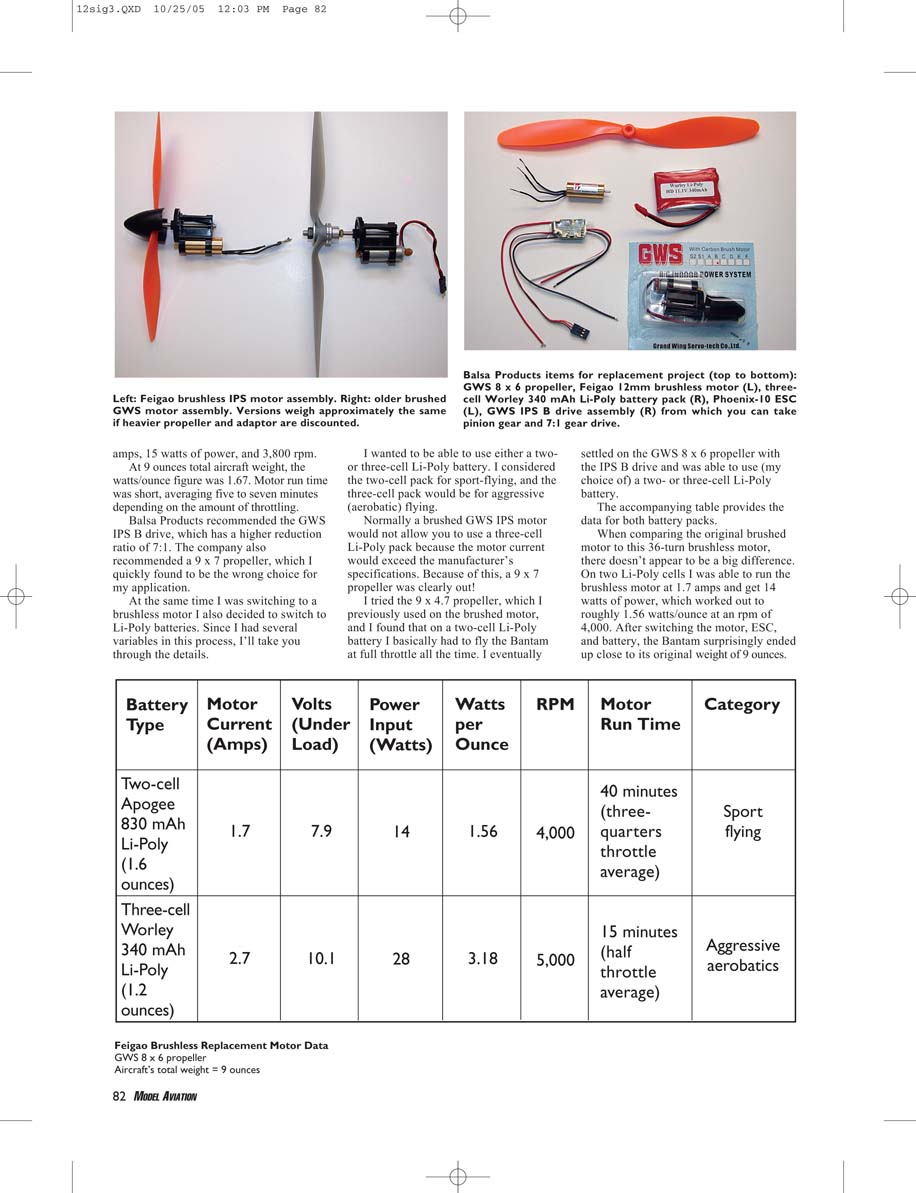
Soon after these motors' introduction, park flyer owners began looking for a brushless 12mm (diameter) x 30mm (length) motor that literally "drops in" to the more than adequate GWS gear drive. As luck would have it, Dave and Bob Perui of Balsa Products have been able to import such a motor from the Feigao company of China.
The catalog-item 1208436L motor, which weighs 17 grams, is selling for $32.99. Balsa Products also offers a number of suitable brushless ESCs and will make a "combo" deal, with the motor and ESC, for as little as approximately $50.
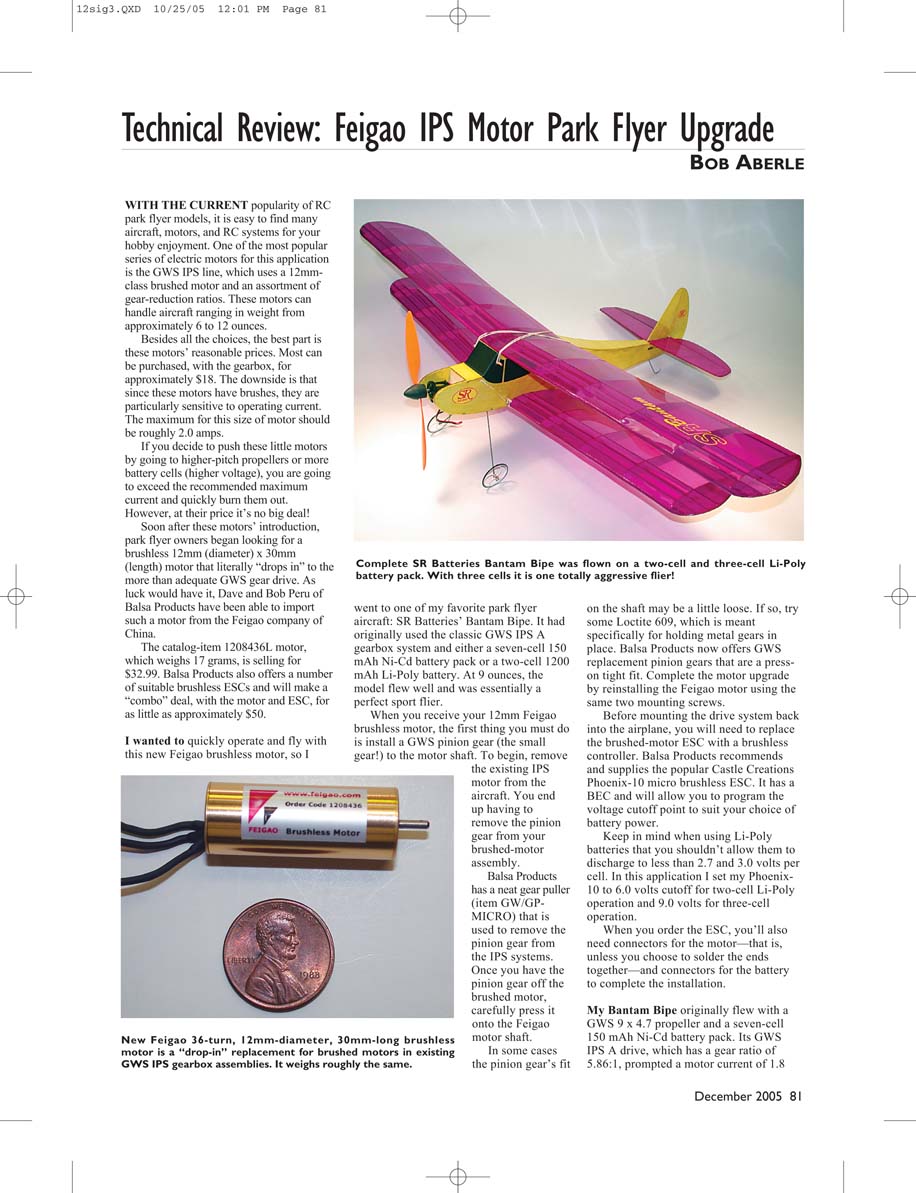
I wanted to quickly operate and fly with this new Feigao brushless motor, so I went to one of my favorite park flyer aircraft: SR Batteries' Bantam Bipe. I originally used the classic GWS IPS A gearbox system and either a seven-cell 150 mAh Ni-Cd battery pack or a two-cell 1200 mAh Li-Poly battery. At 9 ounces, the model flew well and was essentially a perfect sport flier.
When you receive your 12mm Feigao brushless motor, the first thing you must do is install a GWS pinion gear (the small gear!) to the motor shaft. To begin, remove the existing IPS motor from the aircraft. You end up having to remove the pinion gear from your brushed-motor assembly!
Balsa Products has a neat gear puller (item GW/GP-MICRO) that is used to remove the pinion gear from the IPS systems. Once you have the pinion gear off the brushed motor, carefully press it onto the Feigao motor shaft.
In some cases the pinion gear's fit on the shaft may be a little loose. If so, try some Loctite 609, which is meant specifically for holding metal gears in place. Balsa Products now offers GWS replacement pinion gears that are a press-on tight fit. Complete the motor upgrade by reinstalling the Feigao motor using the same two mounting screws.
Before mounting the drive system back into the airplane, you will need to replace the brushed-motor ESC with a brushless controller. Balsa Products recommends and supplies the popular Castle Creations Phoenix-10 micro brushless ESC. It has a BEC and will allow you to program the voltage cutoff point to suit your choice of battery pack.
Keep in mind when using Li-Poly batteries that you shouldn't allow them to discharge to less than 2.7 and 3.0 volts per cell. In this application I set my Phoenix-10 to 6.0 volts cutoff for two-cell Li-Poly operation and 9.0 volts for three-cell operation.
When you order the ESC, you'll also need connectors for the motor—that is, unless you choose to solder the ends together—and connectors for the battery to complete the installation.
My Bantam Bipe originally flew with a GWS 9 x 4.7 propeller and a seven-cell 150 mAh Ni-Cd battery pack. Its GWS IPS A drive, which has a gear ratio of 5.86:1, prompted a motor current of 1.8 amps, 15 watts of power, and 3,800 rpm.
At 9 ounces total aircraft weight, the watts/ounce figure was 1.67. Motor run time was short, averaging five to seven minutes depending on the amount of throttling.
Balsa Products recommended the GWS IPS B drive, which has a higher reduction ratio of 7:1. The company also recommended a 9 x 7 propeller, which I quickly found to be the wrong choice for my application.
At the same time I was switching to a brushless motor I also decided to switch to Li-Poly batteries. Since I had several variables in this process, I'll take you through the details.
I wanted to be able to use either a two- or three-cell Li-Poly battery. I considered the two-cell pack for sport-flying, and the three-cell pack would be for aggressive (aerobatic) flying.
Normally a brushed GWS IPS motor would not allow you to use a three-cell Li-Poly pack because the motor current would exceed the manufacturer's specifications. Because of this, a 9 x 7 propeller was clearly out!
I tried the 9 x 4.7 propeller, which I previously used on the brushed motor, and I found that on a two-cell Li-Poly battery I basically had to fly the Bantam at full throttle all the time. I eventually settled on the GWS 8 x 6 propeller with the IPS B drive and was able to use (my choice of) a two- or three-cell Li-Poly battery.
The accompanying table provides the data for both battery packs.
When comparing the original brushed motor to this 36-turn brushless motor, there doesn't appear to be a big difference. On two Li-Poly cells I was able to run the brushless motor at 1.7 amps and get 14 watts of power, which worked out to roughly 1.56 watts/ounce at an rpm of 4,000. After switching the motor, ESC, and battery, the Bantam surprisingly ended up close to its original weight of 9 ounces.
Battery Type Motor Current (Amps) Volts (Under Load) Power Input (Watts) Watts per Ounce RPM Motor Run Time Category
Two-cell Apogee 830 mAh Li-Poly (1.6 ounces) 1.7 7.9 14 1.56 4,000 40 minutes (three-quarters throttle average) Sport flying
Three-cell Worley 340 mAh Li-Poly (1.2 ounces) 2.7 10.1 28 3.18 5,000 15 minutes (half throttle average) Aggressive aerobatics
Feigao Brushless Replacement Motor Data GWS 8 x 6 propeller Aircraft's total weight = 9 ounces
Bob Aberle
My two-cell pack—in this case an Apogee 830 mAh capacity—provided up to 40 minutes of flight time, most of which was done on approximately three-quarters throttle settings. Everything being equal, the brushed motor would have also run for 40 minutes on the new two-cell Li-Poly battery.
So why would you want the brushless-motor replacement? First of all, the brushless motor is going to last much longer than the brushed motor.
Second, the brushless motor is more efficient and, as a result, was able to produce slightly more rpm while at slightly less current. Remember I wrote “slightly”? But the even better news is that this brushless replacement motor can easily operate on a three-cell Li-Poly battery pack at up to 3.0 amps, outputting close to 30 watts of power.
The advantage is that with the same IPS B drive, with a GWS 8 x 6 propeller, on three Li-Poly cells, you can fly the Bantam Bipe at 3.18 watts/ounce and 5,000 rpm. Doing this, you will obtain the “aggressive performance” you wished you could have gotten from your brushed motor but couldn’t!
So if you are the person who wanted to go to a higher-pitch propeller and/or more battery cells (more voltage), this Feigao brushless motor will let you do it comfortably.
The Feigao 4122 KV IPS motor (item 1208436L) can handle 3.0 amps and 30 watts, and it can do that for a long, long time, making it a smart investment. Park fliers are going to love this new freedom!
If you have a GWS ducted-fan system that uses the GWS IPS motor, check out the Feigao 1208425L and 1208428L motors that Balsa Products sells. They have an even higher current and rpm/volt rating, so they really offer the opportunity to wake up those little fan units. Using the same IPS B drive, and the installation information I’ve outlined, minus the pinion removal, you can add performance and duration to your jet that you never thought possible.
Bob Aberle [email protected]
Manufacturers/Distributors:
Apogee Li-Poly batteries www.pfmdistribution.com
Feigao motors, Castle Creations ESC, GWS motors, pinion-gear puller, Worley Li-Poly batteries: Balsa Products Inc. www.balsapr.com
Phoenix-10 micro brushless ESC: Castle Creations www.castlecreations.com
Bantam Bipe park flyer kit: SR Batteries Inc. www.srbatteries.com
Transcribed from original scans by AI. Minor OCR errors may remain.

