
Technical Review: Horizon Hobby Spektrum DX6/AR6000 System
Steve Kaluf [email protected]
The DX6 from Spektrum RC (distributed by Horizon Hobby) is one of the newest entries into radio systems made specifically for park-flyer and mini/micro helicopter use. More importantly, the DX6 is the first mass-market radio-control system for aircraft to utilize the 2.4 GHz band and spread-spectrum technology. This review covers the spread-spectrum technology the DX6 employs and the system’s conventional features, ergonomics, and performance.
What's in the box?
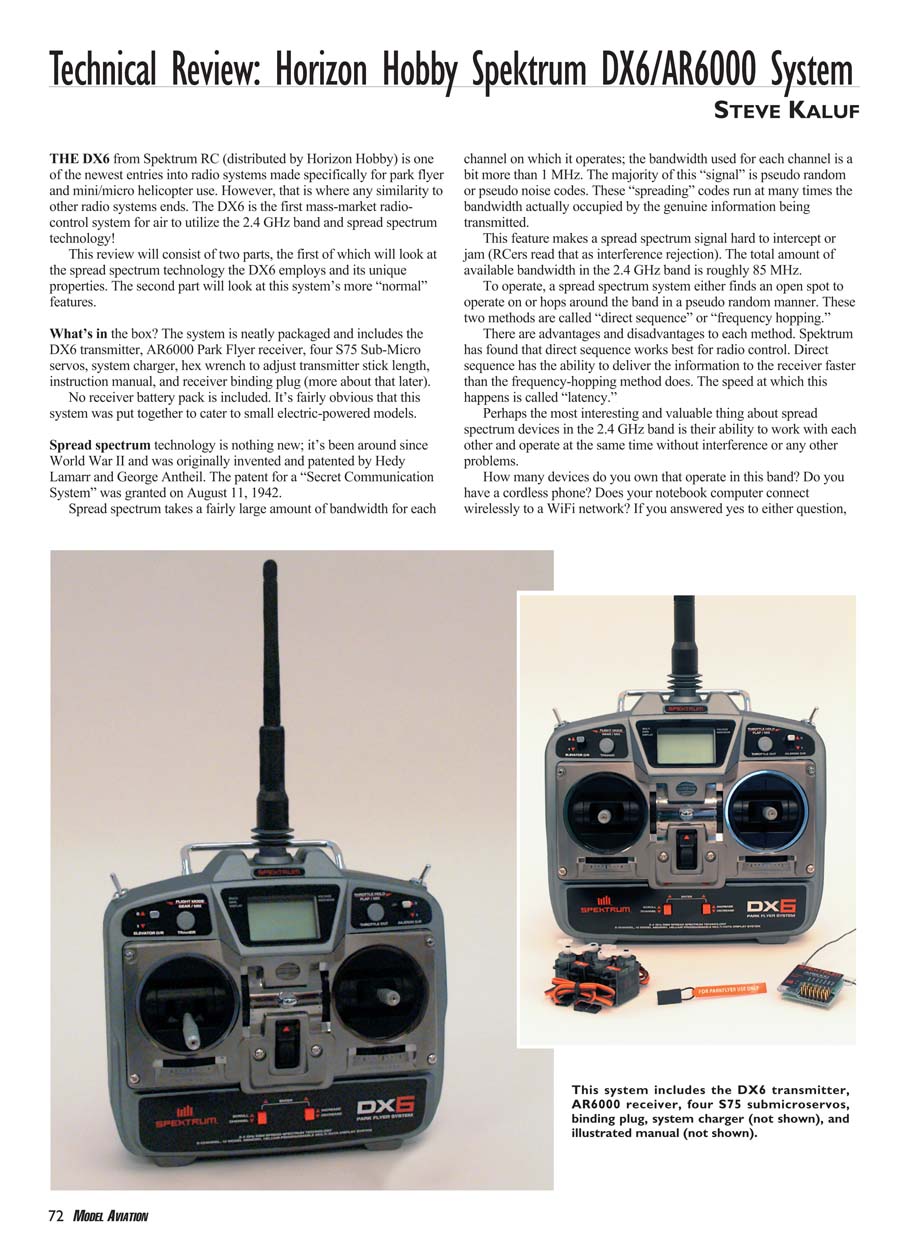
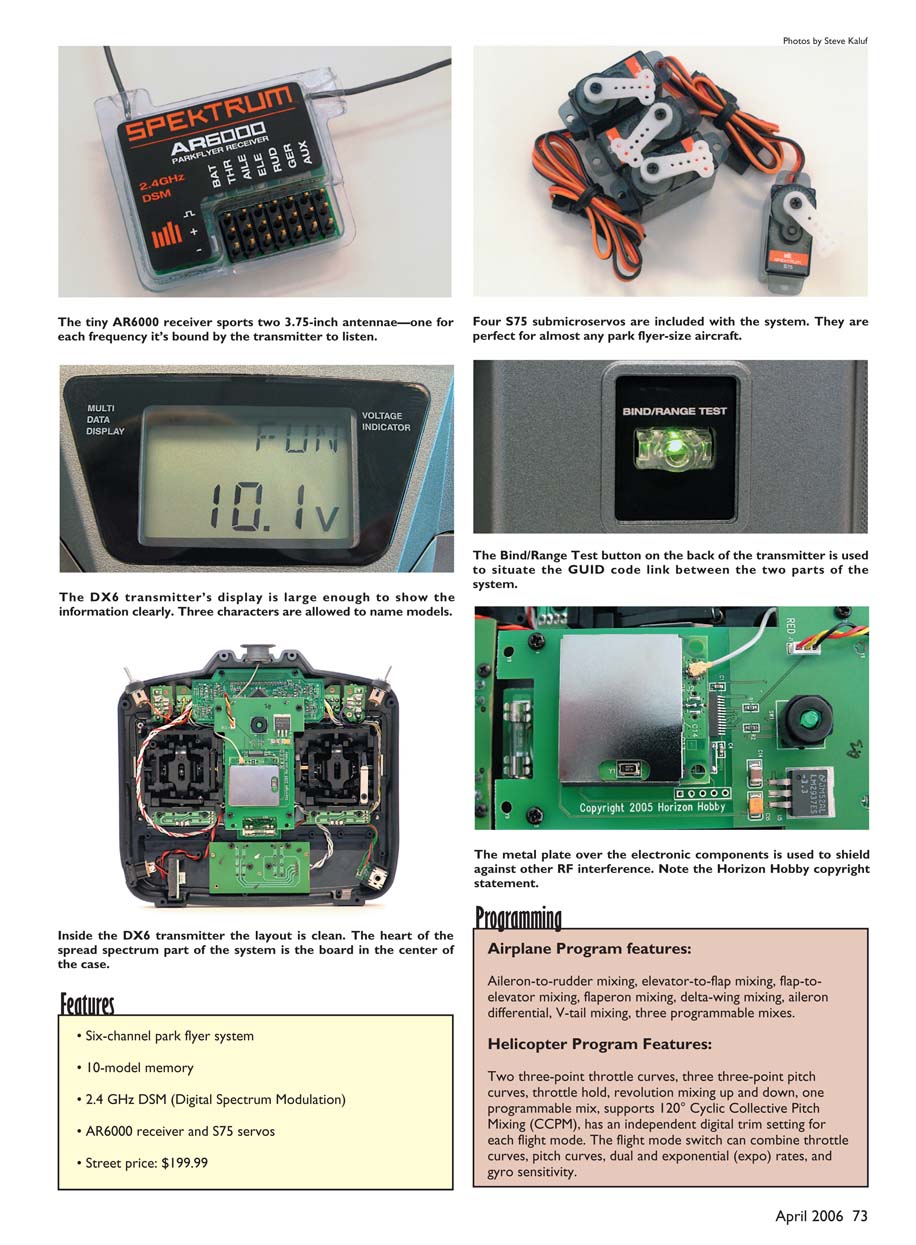
- DX6 transmitter
- AR6000 Park Flyer receiver
- Four E-flite S75 sub-micro servos
- System charger
- Hex wrench (for adjusting transmitter stick length)
- Instruction manual
- Receiver binding plug
Note: No receiver battery pack is included. The kit is clearly targeted at small electric-powered models.
Spread spectrum technology
Spread-spectrum techniques date back to World War II (patent by Hedy Lamarr and George Antheil, 1942). Key points relevant to the DX6:
- Each channel uses roughly 1 MHz of bandwidth; most of the transmitted signal is pseudo-random “spreading” code, which makes the signal hard to intercept or jam (strong interference rejection).
- The 2.4 GHz band available for these devices spans roughly 85 MHz.
- Two main spread-spectrum methods: direct-sequence (DS) and frequency-hopping (FH). Spektrum uses direct-sequence because it delivers information faster (lower latency) than FH, which is important for RC control.
- Devices operating in this band use Globally Unique Identifier Codes (GUIDs). There are millions of GUIDs, which makes accidental cross-interference between devices effectively impossible. This is standardized internationally.
- Regulatory limits restrict output power (typically ≤ 1 W); the DX6 transmits at roughly 100 mW—adequate for its intended use.
Antenna considerations and DualLink
- 2.4 GHz antennas are short (DX6 transmitter antenna ~5 inches; receiver antennas ~3.75 inches) but require reasonably clear line-of-sight and can be sensitive to orientation.
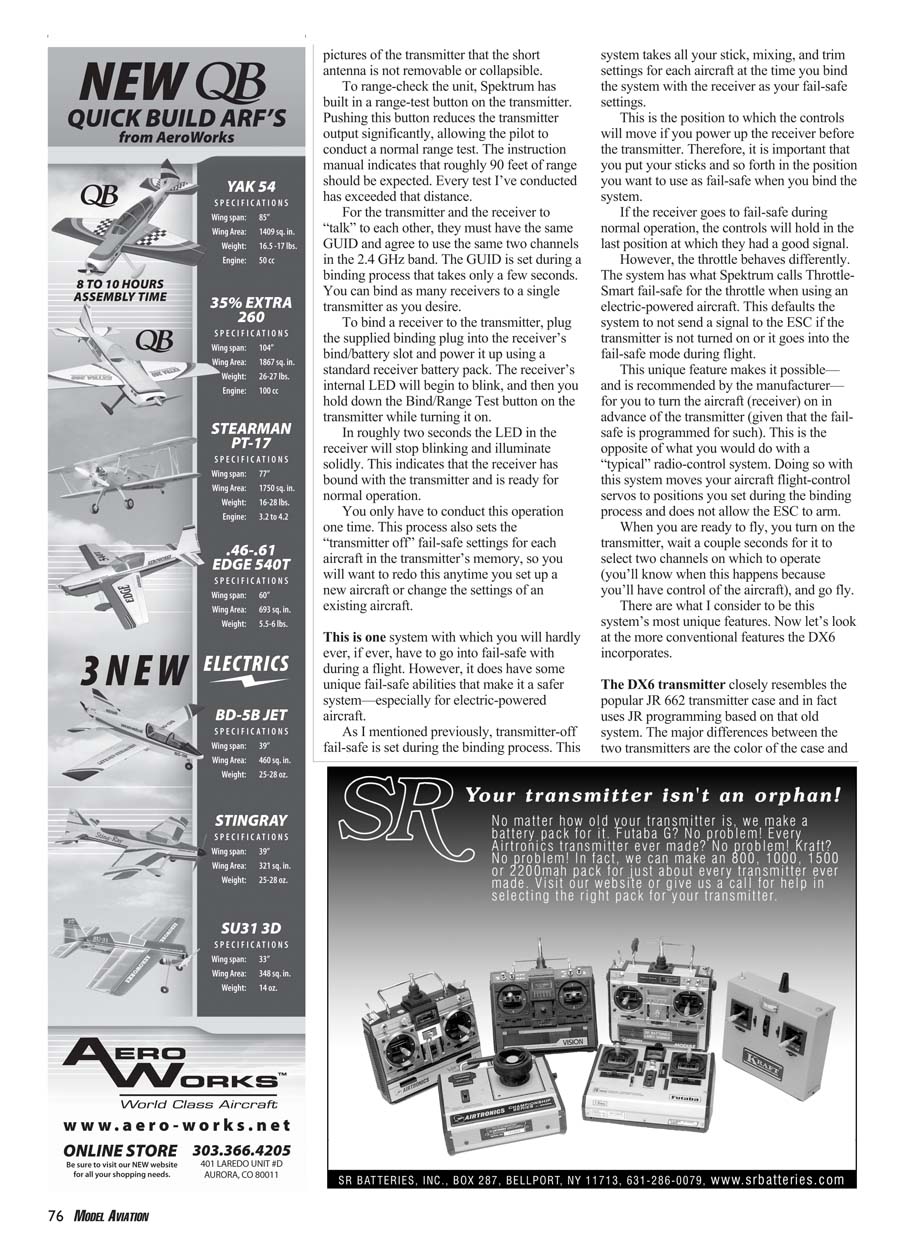
- Spektrum’s proprietary DualLink broadcasts on two separate channels simultaneously; the AR6000 is effectively two receivers in one. The transmitter switches between the two channels about 50 times per second while the receiver listens to both channels. If one channel degrades, the other should maintain control.
- A spectrum analyzer of the transmitter shows two separate waveforms within the 85 MHz band (approx. 2.400–2.485 GHz).
- Spektrum/Horizon have applied for many patents on DualLink and DSM technology.
Field experience
- In testing (outdoor and at a large indoor RC event with many other 2.4 GHz and 72 MHz systems), control remained solid with no interference issues and no manual frequency control required.
- The system removes the need for traditional frequency control: simply power up the transmitter and fly.
Range checking, binding, and fail-safe
- The DX6 antenna is short and fixed. For range-checking, the transmitter has a Range/Test button that reduces output power (manual indicates roughly 90 ft expected; tests exceeded that).
- Binding: the transmitter and receiver must share the same GUID and agree on the two channels. Binding is done by inserting the supplied binding plug into the receiver’s bind/battery slot, powering the receiver with a standard Rx battery pack, then holding the DX6 Bind/Range Test button while powering on the transmitter. The receiver LED flashes and becomes solid when binding completes (about two seconds).
- Binding also sets the transmitter-off fail-safe positions for that model. Put sticks, trims, and mixes in the desired fail-safe positions before binding.
- If the receiver loses signal during flight, controls will hold at the last position with valid signal (stick/servo hold). Throttle uses ThrottleSmart fail-safe: for electric aircraft, the system defaults to not sending a signal to the ESC if the transmitter is off or if it goes into fail-safe. This prevents arming the motor when the transmitter powers up after the receiver.
- You can bind multiple receivers to a single transmitter; re-bind after significant model setup changes.
Features
- Six-channel park-flyer system
- 10-model memory
- 2.4 GHz DSM (Digital Spectrum Modulation)
- AR6000 receiver and S75 servos included
- Street price (at review): $199.99
- Channel resolution: 1024
- Exponential and dual rates on aileron and elevator (can be combined on one switch)
- Trainer system compatible with Spektrum and JR radio systems
- Adjustable stick length
- Throttle trim affects only idle position
- Two-speed scrolling for programming menus
- ThrottleSmart fail-safe system
- Digital trims
Programming
General
- 10-model memories (each model can be airplane or helicopter).
- Two main programming levels:
- System Mode (top level): set aircraft type (airplane/helicopter), wing type, model data reset, dual-rate switch selection, select model, and name models (up to three characters).
- Function Mode: aircraft-type-specific configuration (accessed after selecting airplane or helicopter).
- To enter System Mode: hold both programming buttons up while powering on the transmitter. To enter Function Mode: press both buttons up after the transmitter is powered up.
Airplane features
- Dual-rate (DR) and exponential (EXPO) for aileron and elevator (rudder EXPO not available).
- DR and EXPO set per switch position (switch labeled with "1" and "0"); elevator and aileron DR can be combined on one switch.
- Three programmable mixes plus:
- Aileron-to-rudder mixing
- Elevator-to-flap mixing
- Flap-to-elevator offset trim mix
- Flaperon mixing
- Delta-wing mixing
- V-tail mixing
- Aileron differential
Helicopter features
- Two three-point throttle curves and three three-point pitch curves
- Throttle hold and throttle cut
- Revolution mixing (up and down)
- One programmable mix
- Supports 120° CCPM (Cyclic Collective Pitch Mixing)
- Independent digital trim setting for each flight mode
- Flight mode switch can combine throttle curves, pitch curves, dual and exponential rates, and gyro sensitivity
Programming notes
- Pitch and throttle curves are three-point; more points would be better for fine dialing but three is workable.
- Spektrum supplies a programming “cheat sheet” sticker for the bottom of the transmitter and a model-location sticker.
Ergonomics and Controls
Case and display
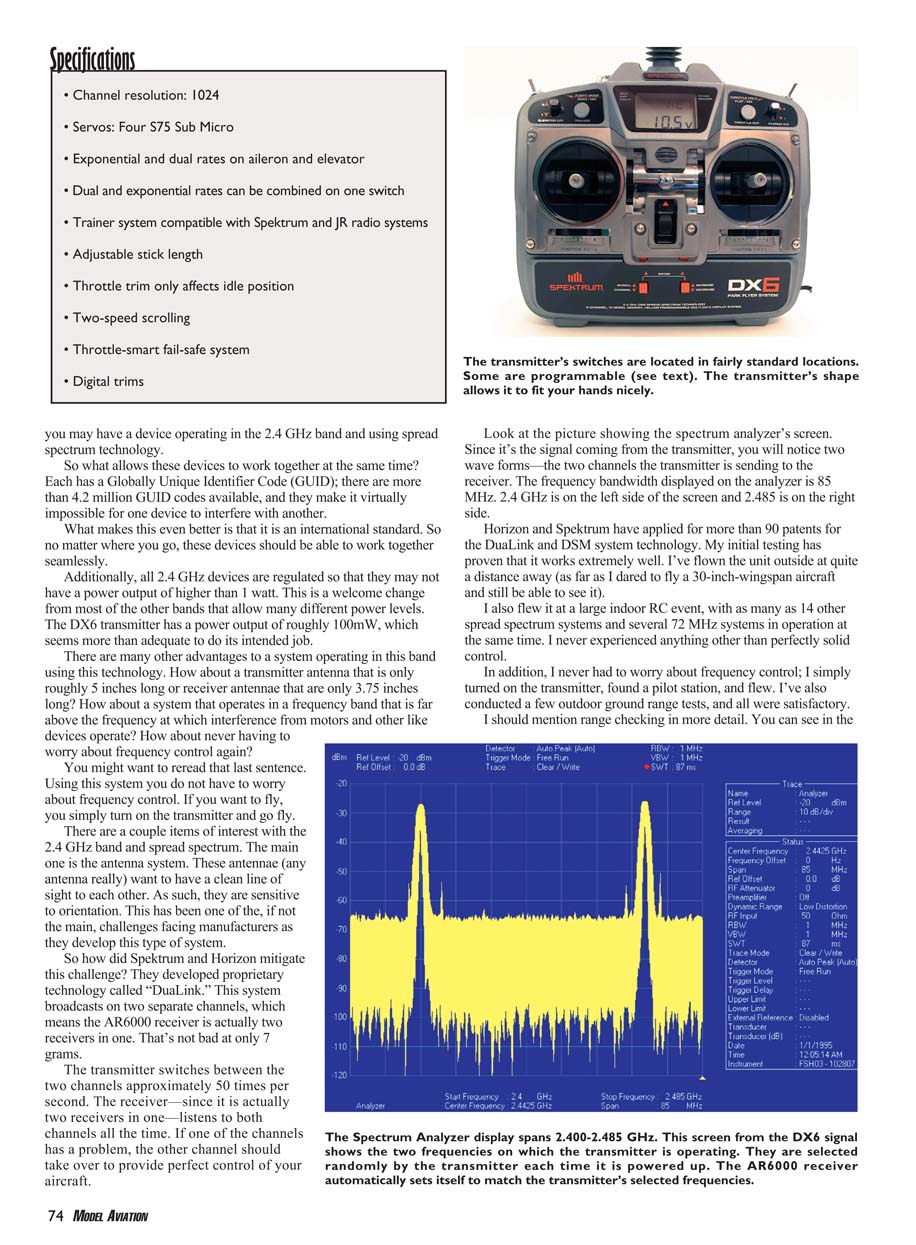
- The DX6 case resembles the JR 662 and uses similar JR-style programming. It is ergonomically shaped with comfortable handholds.
- LCD is about 1" x 1", easy to read, shows transmitter voltage and selected model, and guides programming.
- Model names limited to three characters.
Switches and buttons
- Switch placement is standard and reachable; overall quality is good.
- Two front-top push buttons (near dual-rate/expo switches) are for Trainer and Throttle Cut; their placement makes them a bit awkward to hold for some users.
- Two switches near the antenna top are used to toggle mixes, change flight mode, and enable helicopter throttle hold.
Trims and gimbals
- Digital trims (single push = small increment; hold = continuous movement). Trims are saved per model.
- Stick lengths are adjustable with supplied hex wrench.
- Gimbals have a good feel for the price range; diagonal tracking test results were satisfactory.
- Throttle gimbal has a ratchet. It can be softened by slightly loosening the retaining screw or removing the ratchet spring (requires opening the transmitter).
Criticisms
- No rudder EXPO option.
- Trainer and throttle-cut button placement and tactile feel could be improved.
- Three-point curves may be limiting for advanced tuning.
Specifications (selected)
- Receiver (AR6000): 1.50 x 1.20 x 0.35 in, 7 grams
- Receiver voltage range: 3.2–9.6 V (verify servo compatibility)
- Receiver current draw: ~75 mA
- Servos: Four E-flite S75 sub-micro servos (.90 x .45 x .94 in, 7.5 g)
- Servo speed: 0.12 s/60° at 4.8 V
- Servo torque: 17.2 oz-in at 4.8 V
- Antennae: two, each < 4 inches, oriented 90° apart
Receiver and Servos
AR6000 receiver
- Tiny, light (7 g), dual-antenna design (optimum orientation is 90° apart).
- Operates on 3.2–9.6 V (make sure your servos support the chosen voltage).
- Orientation sensitivity is reduced by DualLink, and in practice the receiver is easy to place in many models.
E-flite S75 servos
- Well-suited for park-flyer applications: fast, lightweight, universal connector, supplied with various servo arms (including a long arm suitable for some 3-D uses).
- Operating voltage 4.8–5.3 V.
Performance and Field Experience
- Extensive indoor and outdoor testing produced consistently solid control even with many other 2.4 GHz systems present.
- Range checks exceeded the manual’s indicated ~90 feet under tested conditions.
- Binding is fast and reliable; model fail-safe positions are stored at bind time.
- ThrottleSmart fail-safe provides extra safety for electric-powered models by preventing ESC arming during receiver-only power-up or transmitter-off failsafe.
Conclusion and Recommendation
The Spektrum DX6/AR6000 system is easy to use, well thought out, and an excellent value, especially for beginners or anyone flying park-flyer class aircraft. Its 2.4 GHz DSM and DualLink design remove the need for frequency control and provide robust interference rejection. Experienced R/C pilots flying small models should also give this system a close look.
Note: This system is intended for park-flyer/small R/C models. Pilots of larger aircraft have different requirements; Spektrum indicates more products for other classes will follow.
Distributor: Horizon Hobby 4105 Fieldstone Rd. Champaign, IL 61822 (800) 338-4639 www.spektrumrc.com
Transcribed from original scans by AI. Minor OCR errors may remain.

