
Top Five Building Tips - 2014/10
ADVICE FROM SOME TOP KIT MANUFACTURERS
by Jay Smith
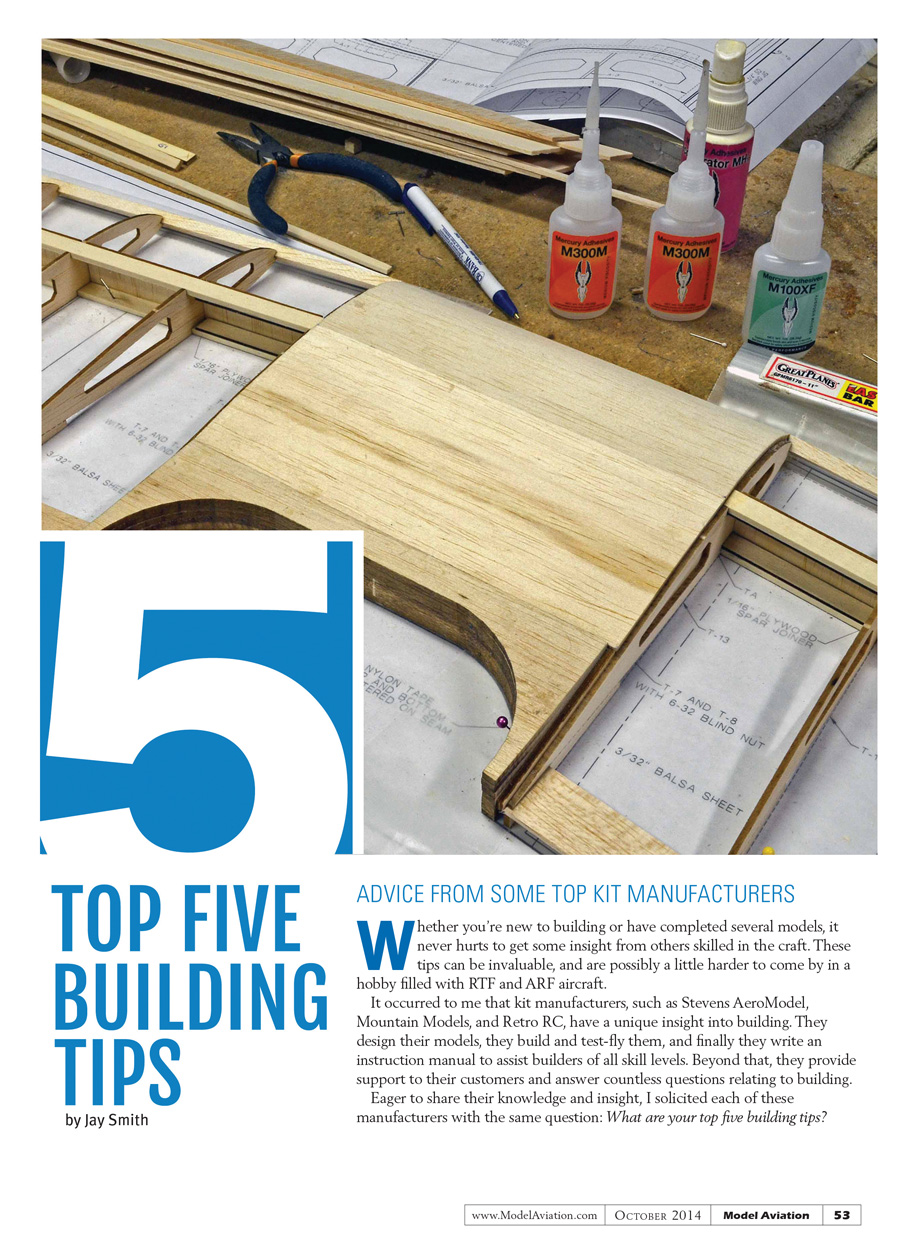
Whether you're new to building or have completed several models, it never hurts to get insight from others skilled in the craft. These tips can be invaluable, especially in a hobby increasingly filled with RTF and ARF aircraft.
Kit manufacturers such as Stevens AeroModel, Mountain Models, and Retro RC have a unique perspective: they design models, build and test-fly them, write instruction manuals, and provide customer support. Eager to share their knowledge, I asked each manufacturer the same question: What are your top five building tips?
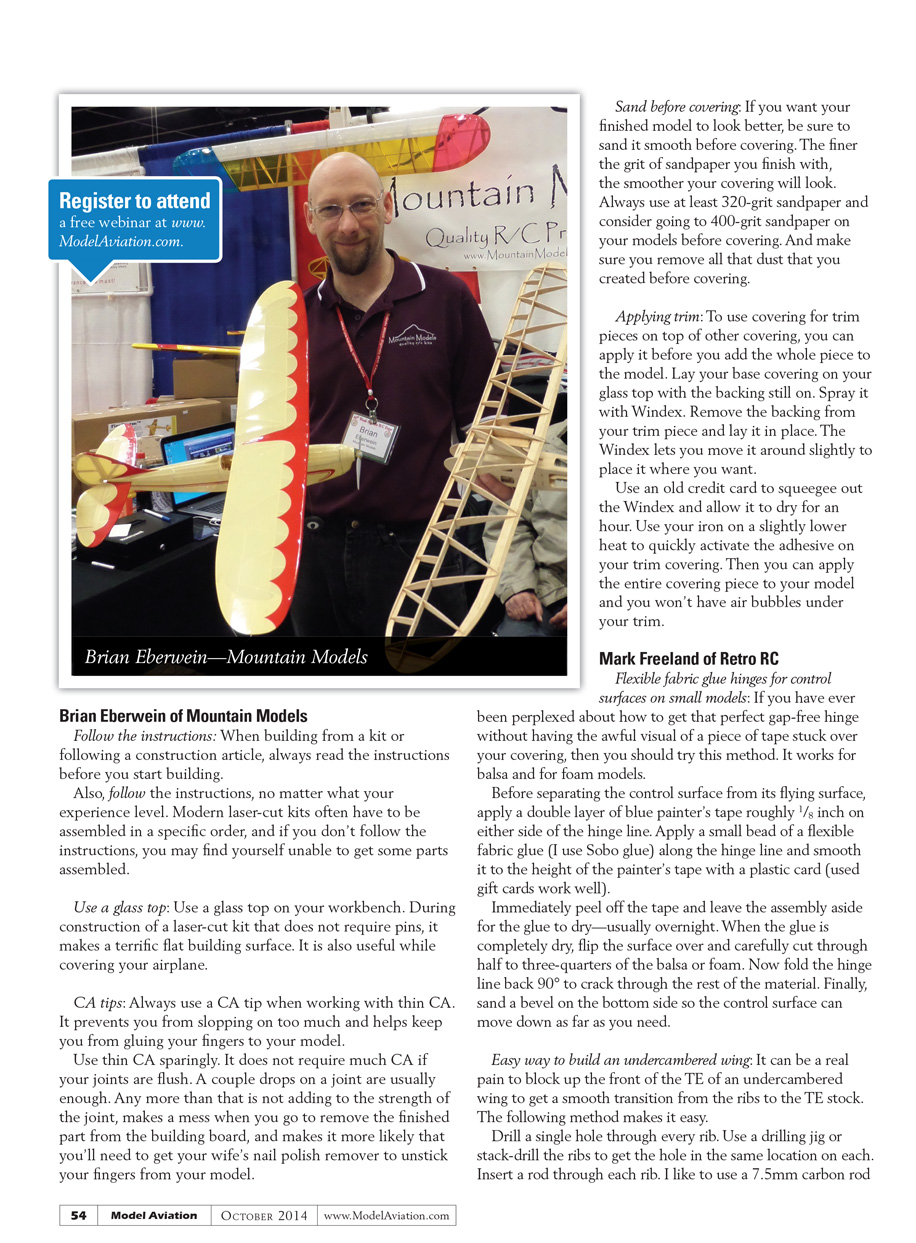
Brian Eberwein of Mountain Models
- Follow the instructions
- Always read the instructions before you start building.
- Follow them regardless of your experience level. Modern laser-cut kits often require assembly in a specific order; if you don't follow the instructions you may find parts that can't be assembled later.
- Use a glass top
- A glass top on your workbench provides a flat building surface for laser-cut kits that don't require pins and is also very useful while covering your airplane.
- CA tips
- Use a CA tip when working with thin CA to prevent excess glue and avoid gluing your fingers to the model.
- Use thin CA sparingly. If your joints are flush, a couple drops are usually enough. Excess CA doesn't add strength, makes a mess when removing parts from the building board, and increases the chance of sticking your fingers to the model.
- Sand before covering
- Sand smooth before covering to improve the finished appearance. Finish with at least 320-grit sandpaper; consider 400-grit for an even smoother look.
- Make sure to remove all dust created by sanding before covering.
- Applying trim
- For trim pieces applied on top of other covering: lay the base covering on your glass top with the backing still on and spray it with Windex.
- Remove the backing from the trim piece and place it; the Windex allows slight movement for positioning.
- Use an old credit card to squeegee out the Windex and allow it to dry for an hour. Use your iron on slightly lower heat to activate the trim adhesive, then apply the entire covering piece to the model to avoid air bubbles under the trim.
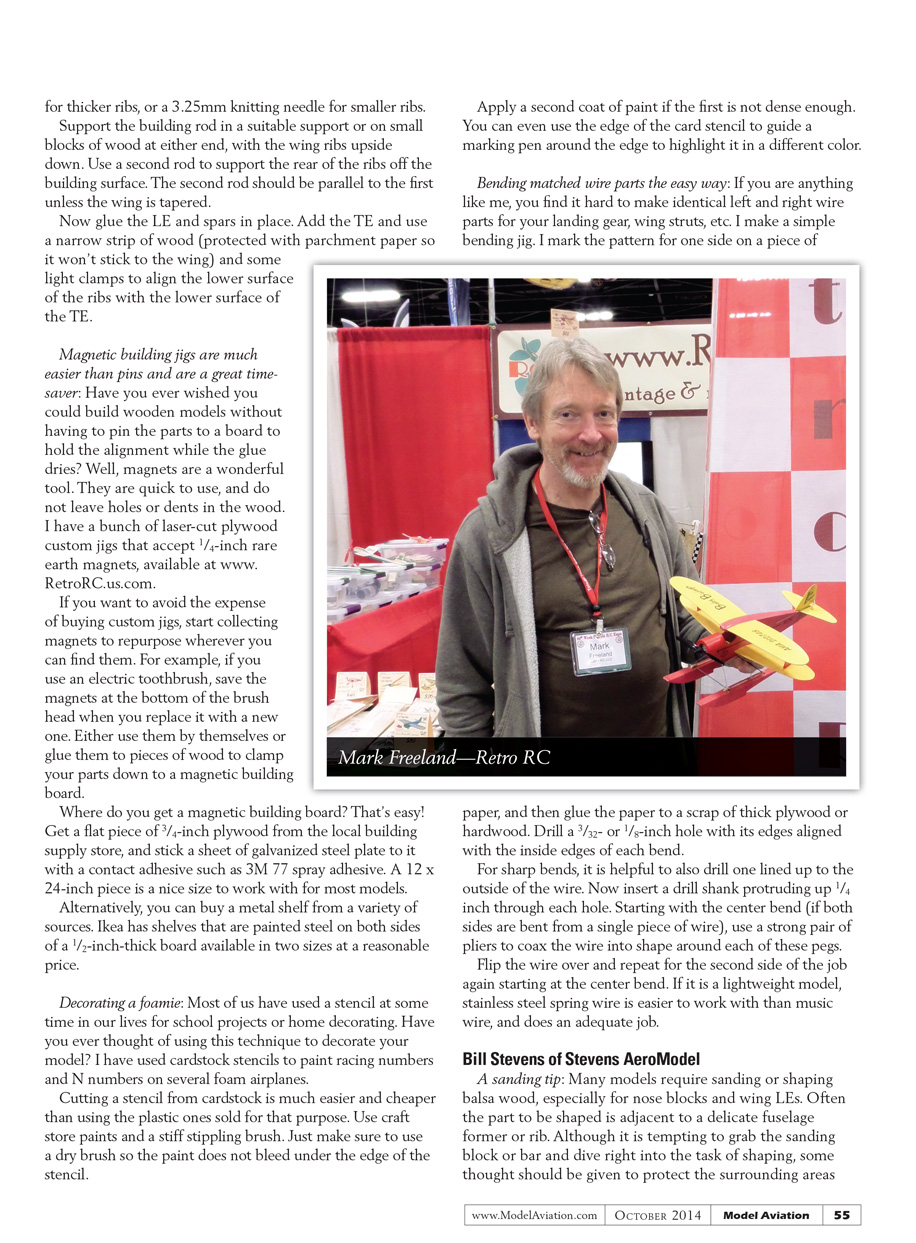
Mark Freeland of Retro RC
- Flexible fabric glue hinges for small control surfaces
- Works for balsa and foam models. Before separating the control surface from the flying surface, apply a double layer of blue painter's tape about 1/8 inch on either side of the hinge line.
- Apply a small bead of flexible fabric glue (Sobo works well) along the hinge line and smooth it to the height of the tape with a plastic card.
- Immediately peel off the tape and let the assembly dry—usually overnight. When dry, flip the surface and carefully cut through half to three-quarters of the balsa or foam, then fold back 90° to crack through the rest. Sand a bevel on the bottom side so the control surface can move as needed.
- Easy way to build an undercambered wing
- Drill a single hole through every rib (use a drilling jig or stack-drill to keep location consistent).
- Insert a rod through each rib: a 7.5 mm carbon rod for thicker ribs or a 3.25 mm knitting needle for smaller ribs.
- Support the building rod on blocks or suitable supports with the wing ribs upside down. Use a second rod to support the rear of the ribs off the building surface (parallel to the first unless the wing is tapered).
- Glue the leading edge (LE) and spars in place. Add the trailing edge (TE) and use a narrow strip of wood (protected with parchment paper) and light clamps to align the lower surface of the ribs with the lower surface of the TE.
- Magnetic building jigs are much easier than pins
- Magnets are quick to use and don't leave holes or dents in the wood. Retro RC uses custom laser-cut plywood jigs that accept 1/4-inch rare-earth magnets.
- You can repurpose magnets from items like electric toothbrush heads or glue magnets to pieces of wood to clamp parts to a magnetic building board.
- To make a magnetic building board, stick a sheet of galvanized steel plate to a flat piece of 3/4-inch plywood with contact adhesive (3M 77 is good). A 12 x 24-inch piece is a handy size. Alternatively, painted steel shelves (Ikea) are an affordable option.
- Decorating a foamie
- Use cardstock stencils to paint racing numbers and registration numbers on foam airplanes. Cardstock is cheaper and easier to cut than plastic stencils.
- Use craft-store paints and a stiff stippling brush. Keep the brush dry to prevent paint bleeding under the stencil.
- Apply a second coat if needed; you can also use the stencil edge to guide a marker for highlighting in a different color.
- Bending matched wire parts the easy way
- Make a simple bending jig: mark the pattern for one side on paper, glue it to scrap hardwood, and drill 3/32- or 1/8-inch holes aligned with the inside edges of each bend.
- For sharp bends, drill a hole aligned with the outside of the wire as well. Insert drill shanks protruding about 1/4 inch through each hole and bend the wire around these pegs with strong pliers.
- Flip the wire and repeat for the other side, starting at the center bend. For lightweight models, stainless steel spring wire is easier to work with than music wire and is adequate.
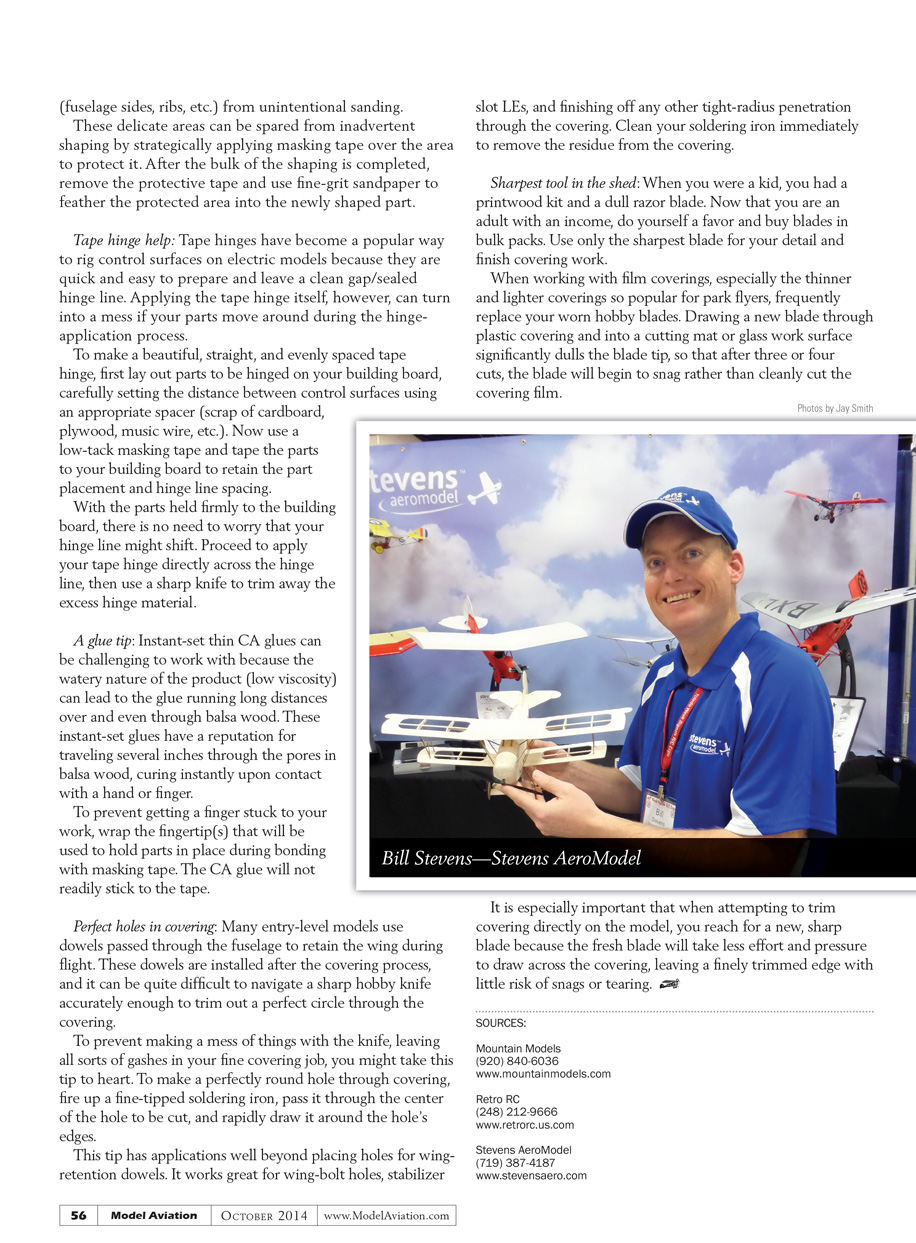
Bill Stevens of Stevens AeroModel
- A sanding tip
- When shaping balsa (nose blocks, wing LEs, etc.), protect adjacent delicate areas (fuselage formers, ribs) with masking tape before aggressive sanding.
- After bulk shaping, remove the tape and feather the protected area into the newly shaped part with fine-grit sandpaper.
- Tape hinge help
- Tape hinges are quick and leave a clean gap or sealed hinge line, but hinge application can get messy if parts move.
- Lay out parts to be hinged on your building board and set the gap using an appropriate spacer (cardboard, scrap plywood, music wire, etc.).
- Use low-tack masking tape to hold parts in place to retain spacing and hinge alignment. Apply the tape hinge across the hinge line, then trim excess with a sharp knife.
- A glue tip
- Thin instant-set CA can run through balsa pores and cure on skin. To avoid getting fingers stuck, wrap the fingertips you use to hold parts with masking tape; CA won't readily stick to the tape.
- Perfect holes in covering
- To make perfectly round holes in covering (for wing dowels, wing-bolt holes, stabilizer slot LEs, etc.), use a fine-tipped soldering iron.
- Pass the heated tip through the center of the hole and quickly draw it around the hole's edge. Clean the soldering iron immediately to remove covering residue.
- Sharpest tool in the shed
- Use sharp blades for detail and finishing work. Buy blades in bulk and replace them frequently when cutting film coverings.
- A fresh blade requires less pressure and effort, leaving a clean trimmed edge with less risk of snags or tearing—especially important when trimming covering directly on the model.
SOURCES
- Mountain Models
- (920) 840-6036
- www.mountainmodels.com
- Retro RC
- (248) 212-9666
- www.retrorc.us.com
- Stevens AeroModel
- (719) 387-4187
- www.stevensaero.com
Transcribed from original scans by AI. Minor OCR errors may remain.

