
Top Gun 2004
by Stan Alexander
Top Gun Invitational Tournament started in 1989 in Florida, moved to Mesa, Arizona the next year, then to the polo club at West Palm Beach, Florida, where it stayed until 2001. Now in its third year at Lakeland Linder Regional Airport (home of the Experimental Aircraft Association’s Sun ’n Fun), Top Gun continues to improve for modelers, spectators, and the city of Lakeland. The 2004 edition was held April 27–May 2.
Top Gun combines an international scale contest, an air show, a trade show, and parties and dinners each evening during the week for all who attend. Current scale classes include Expert, Master, Team Scale, and ProAm. There are also “Best of” awards, recognition for the high static score in each class, the National Association of Scale Aeromodelers Flight Achievement Award (NASA Flight Achievement), the Grey Eagle Award, and flight awards.
Test flights were conducted on Tuesday and Wednesday, April 27 and 28. An additional field was available for testing during the rest of the week. Flight competition was lengthened this year with the addition of the ProAm class; it started Thursday and was completed Sunday afternoon. A few days were windy, but Saturday and Sunday were great for outdoor activities in central Florida.
ProAm Scale was held for the first time in 2004. This class is not for ARFs; it allows modelers who have entered Top Gun in the past to compete with older competition models, aircraft they have built or bought to fly until they can finish next year’s competition airplanes, or models that have surpassed the three-year competition limit in Top Gun and are still doing well. More than 36 pilots entered this event, and it looks to be a popular class that will remain on the contest schedule.
Expert Class
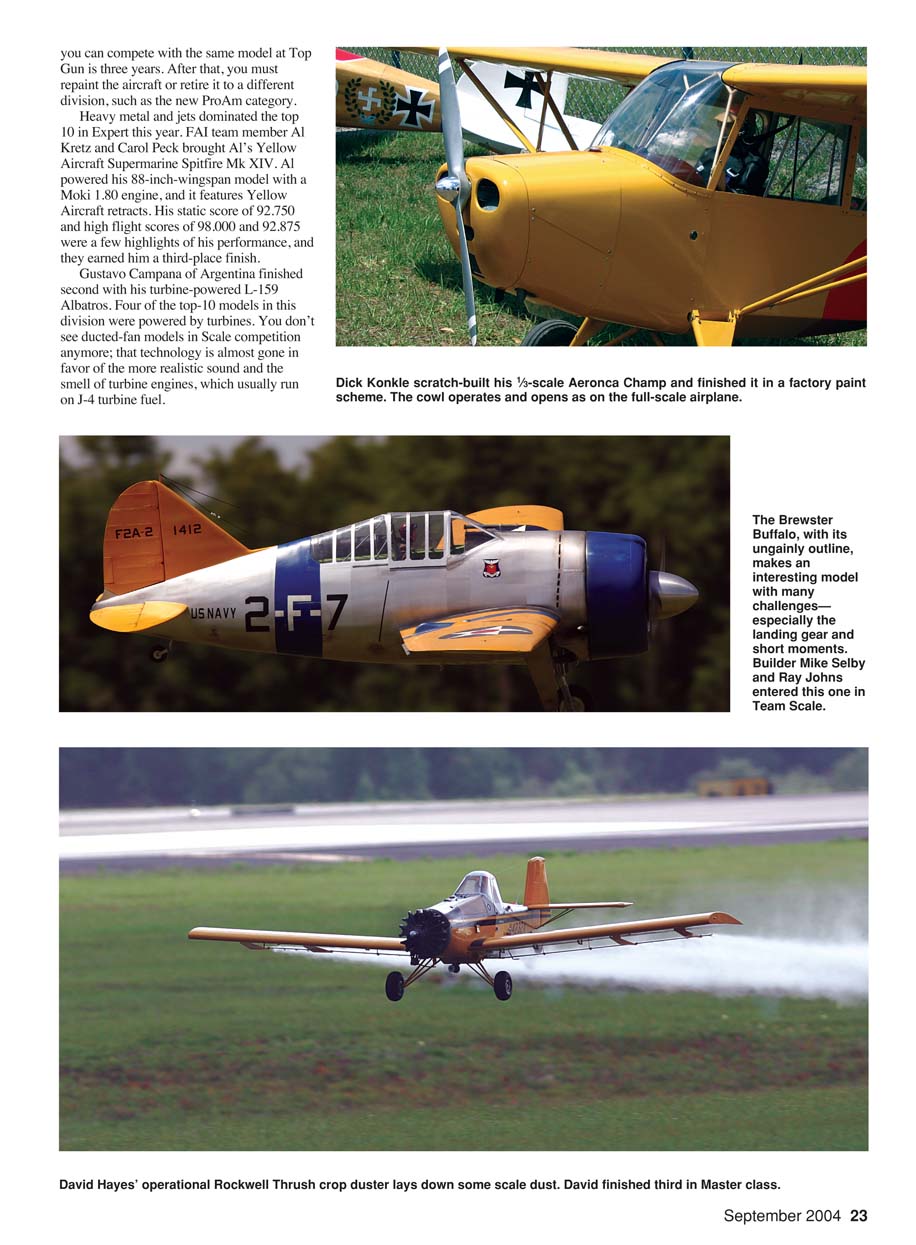
Top Gun often features unusual full-scale types that aren’t modeled frequently. The Brewster Buffalo built by Mike Selby and piloted by Ray Johns stood out this year. The model began as plans from Jerry Bates, was heavily modified, and the revised version is now available from Jerry Bates. The full-scale aircraft’s color scheme was from the carrier USS Lexington in early 1941, with pre-World War II high-visibility colors. The model was painted in lacquer like the full-scale aircraft, powered by a 3W-150 twin-spark engine, and used center-pull retracts — a one-off unit built by Sierra Giant Scale.
Expert class featured both new faces and familiar past winners. The maximum time you can compete with the same model at Top Gun is three years; after that you must repaint the aircraft or move it to a different division such as ProAm.
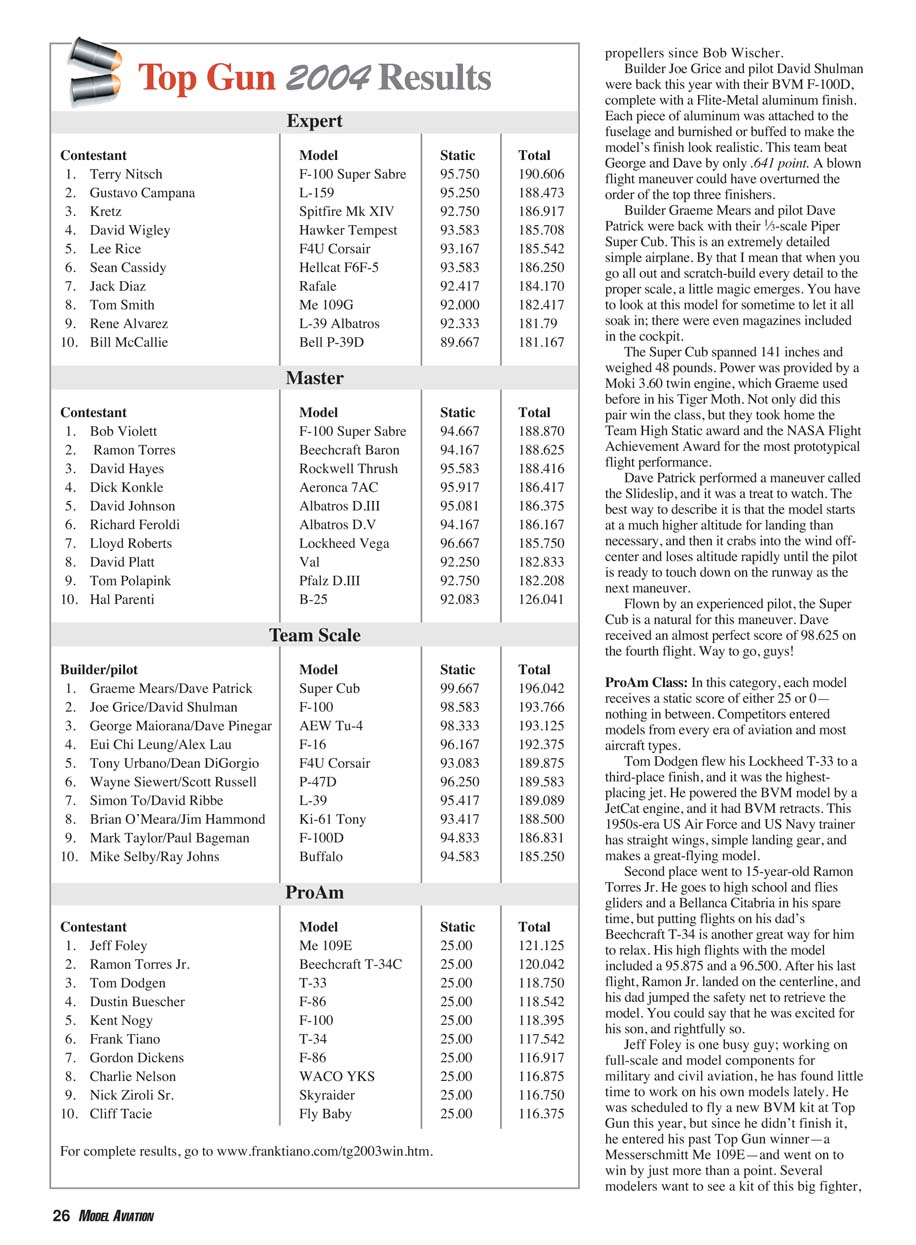
Heavy metal and jets dominated the top ten in Expert. FAI team member Al Kretz (with Carol Peck) flew Al’s Yellow Aircraft Supermarine Spitfire Mk XIV, an 88-inch-wingspan model powered by a Moki 1.80 and using Yellow Aircraft retracts. His static score of 92.750 and flight scores of 98.000 and 92.875 helped earn him a third-place finish.
Gustavo Campana of Argentina finished second with his turbine-powered L-159 Albatros. Four of the top-10 models in this division were turbine-powered — turbine models have largely supplanted ducted-fan models in scale competition because of the more realistic sound and smell of turbine engines.
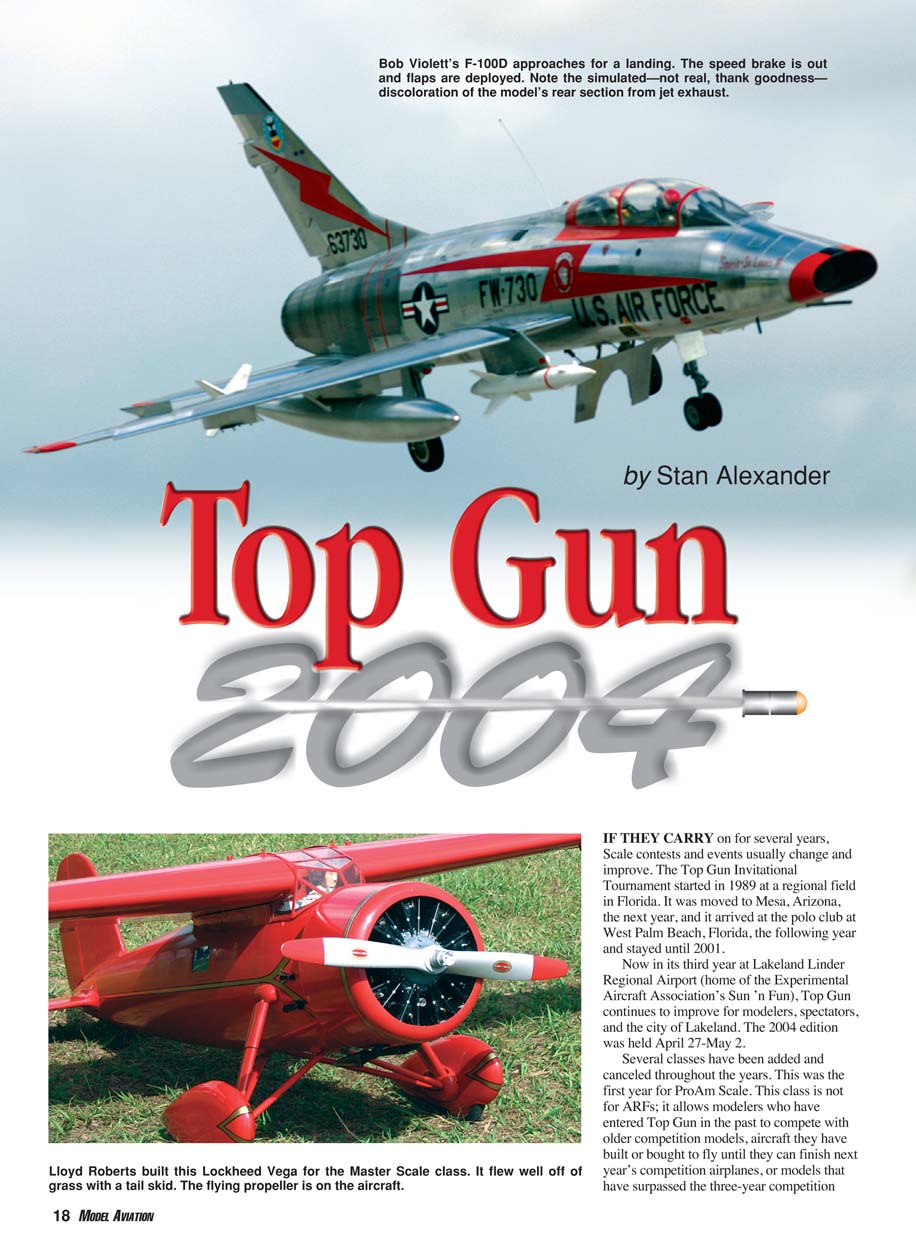
Terry Nitsch returned with a Bob Violett Models (BVM) North American F-100 Super Sabre (“Hun”), fresh from a win at the Toledo RC expo in the jet class. Terry built the F-100 from the BVM kit over two years and powered it with an AMT 450 turbine. The model included an opening canopy, speed brake, retractable landing lights, a tail skid, and more than 50,000 simulated rivets and screws. Terry achieved the finish using Flite-Metal, BVM Metal-Kote, Distler DCB base coat, and Concept 20-21 clear-coat paint. With a static score of 95.750 and three flight scores exceeding 92.978, he beat Gustavo by only 2.133 points on the last flight to take the Expert win.
Master Class
Master class is for modelers who scratch-build their own plans and models rather than building from someone else’s plans or a kit.
This year the division featured three different aircraft types and a very close score spread — only 0.454 points separated first and third place.
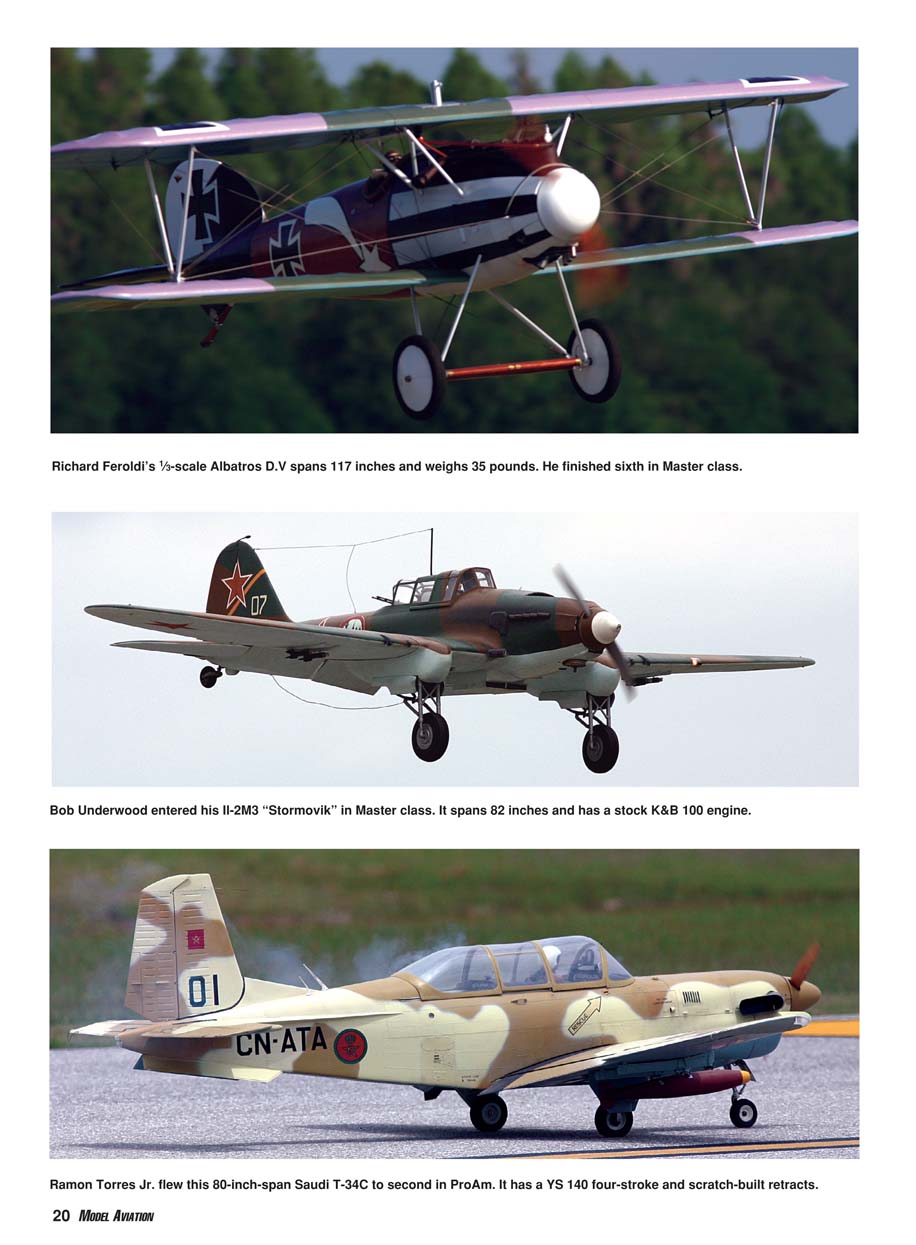
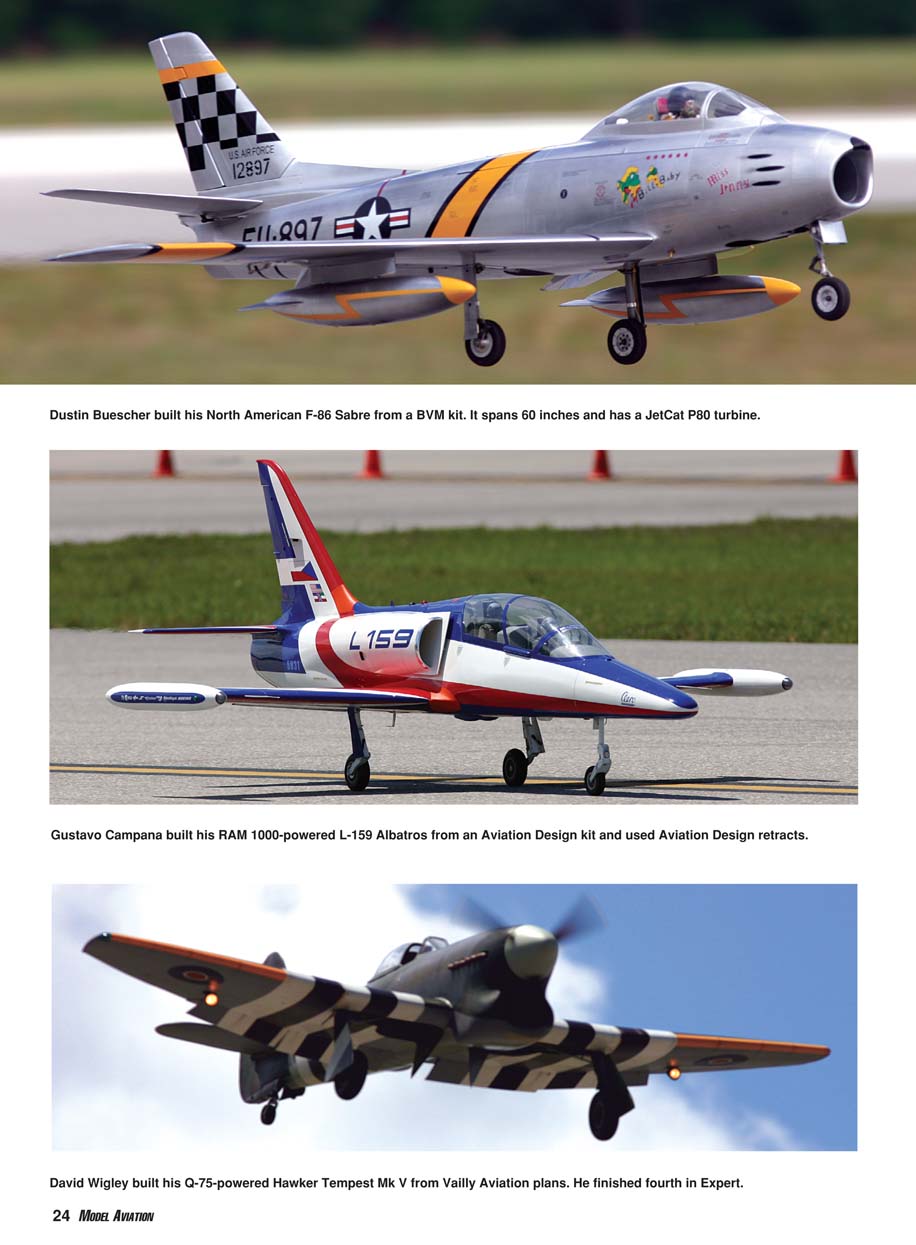
- Third place: David Hayes, flying a Rockwell Thrush crop duster. The 107-inch-span model used a Saito 1.80 single-cylinder engine and weighed about 21 pounds. David has refined spraying systems on this type of model over several years.
- Second place: Ramon Torres, flying his own-design Beechcraft Baron twin (a military version built from fiberglass and carbon). Ramon makes all the molds for his models; kits of his Baron and the T-34 that his son flew in Team Scale are for sale. He used YS 63 engines, RTA (R. Torres Aerospace) retracts, and a Futaba radio.
- First place: Bob Violett, with a North American F-100F Super Sabre. The big jet was powered by an AMT 450 turbine, featured BVM retracts, and was finished with BVM Metal-Kote.
There were more BVM kits than any other brand at this year’s Top Gun, and the F-100 (single- and two-seat versions) outnumbered all other models.
Team Scale
Team Scale pairs a builder (who usually doesn’t fly) with a pilot (who usually excels at flying), producing some of the most detailed scale models. Team Scale is also an AMA class (event 52 in the AMA Competition Regulations); Top Gun rules vary somewhat.
- Third place: Builder George Maiorana and pilot Dave Pinegar, bringing back their AEW Tupolev Tu-4 (a Russian B-29 variant). George converted the Tu-4’s battery system to Li-Poly, saving roughly 3 pounds and adding endurance for the 115-inch-span, radar-equipped airplane. He used MaxCim 13X motors with four-blade handmade propellers (which he fabricated), and he constructed the retracts and rotating radar dome.
- Fourth place: Builder Hui Chi Leung and pilot Alex Lau (Chinese team), close behind George and Dave.
- Runner-up: Builder Joe Grice and pilot David Shulman, with a BVM F-100D finished in Flite-Metal aluminum. Each piece of aluminum was burnished and buffed to create a realistic finish. Joe and David beat George and Dave by only 0.641 point.
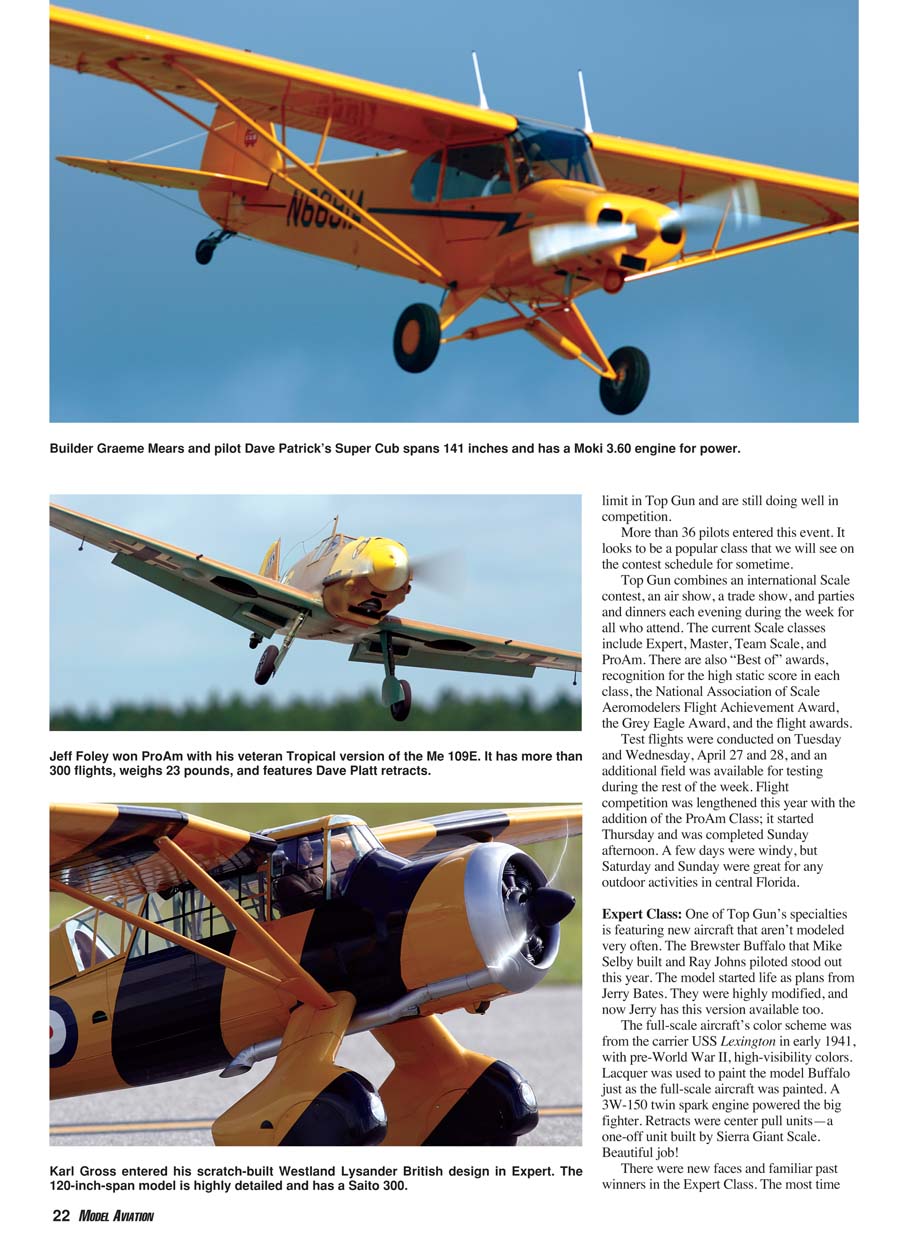
- First place: Builder Graeme Mears and pilot Dave Patrick, with a 1/3-scale Piper Super Cub. The extremely detailed Super Cub rewarded close inspection — even magazines were included in the cockpit. The model spanned 141 inches, weighed 48 pounds, and was powered by a Moki 3.60 twin. Graeme and Dave won the class, the Team High Static award, and the NASA Flight Achievement Award for the most prototypical flight performance.
Dave Patrick performed a maneuver called the “Slideshow,” in which the model starts high for landing, crabs into the wind off-center, loses altitude rapidly, and touches down as the final maneuver. The Super Cub is ideal for this, and Dave received an almost perfect flight score of 98.625 on the fourth flight.
ProAm Class
In ProAm, each model receives a static score of either 25 or 0 — nothing in between. Competitors entered models from every era and many aircraft types.
- Third place (highest-placing jet): Tom Dodgen, flying a BVM Lockheed T-33 powered by a JetCat engine with BVM retracts.
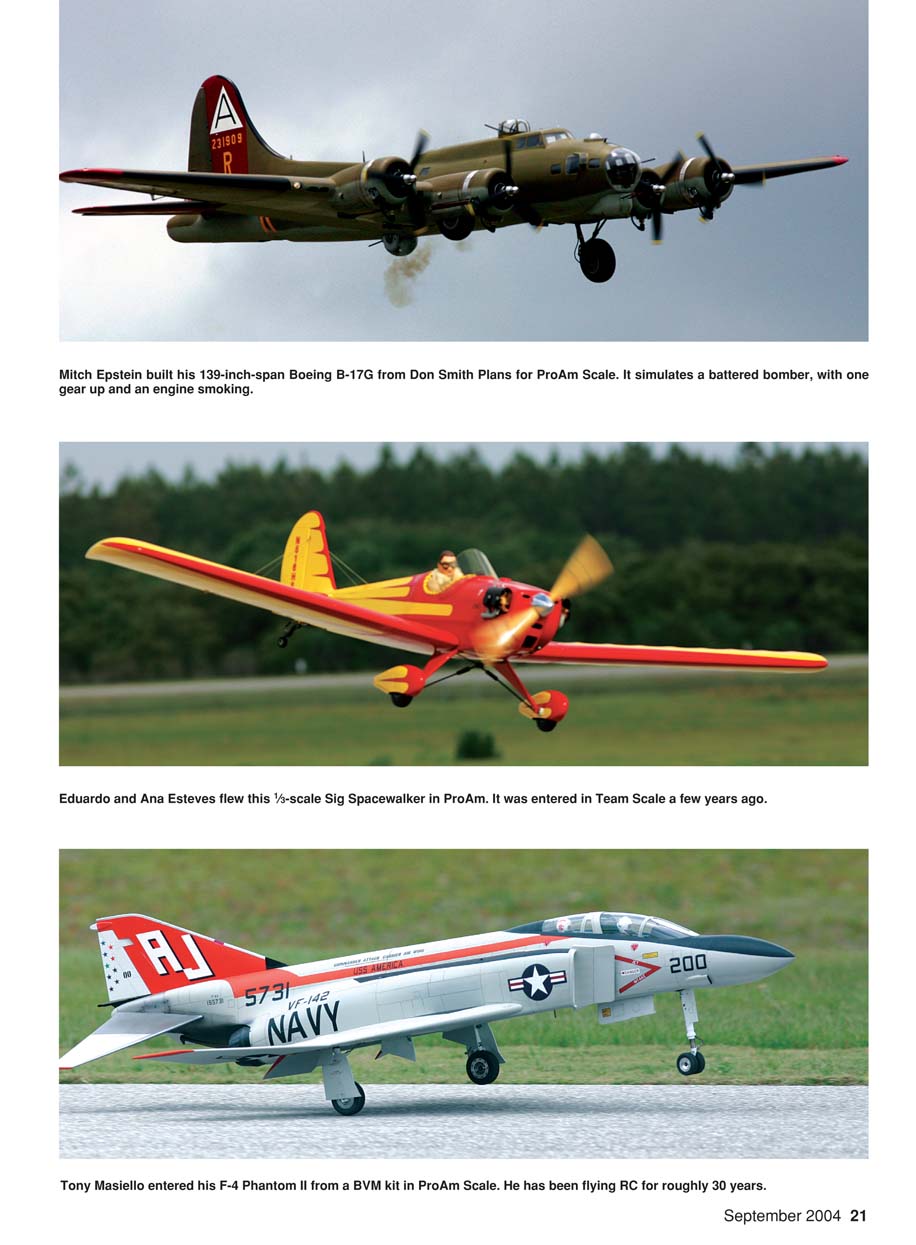
- Second place: 15-year-old Ramon Torres Jr., who flies gliders and a Bellanca Citabria in real life and put high flights on his dad’s Beechcraft T-34 (95.875 and 96.500). After his last flight, Ramon Jr. landed on the centerline.
- First place: Jeff Foley, who flew a past Top Gun winner — a Messerschmitt Me 109E — and won by just over a point. Jeff, who works on full-scale and model components for military and civil aviation, had planned to fly a new BVM kit but entered his previous winner instead.
There will likely be changes in the ProAm division next year as Top Gun continues to evolve.
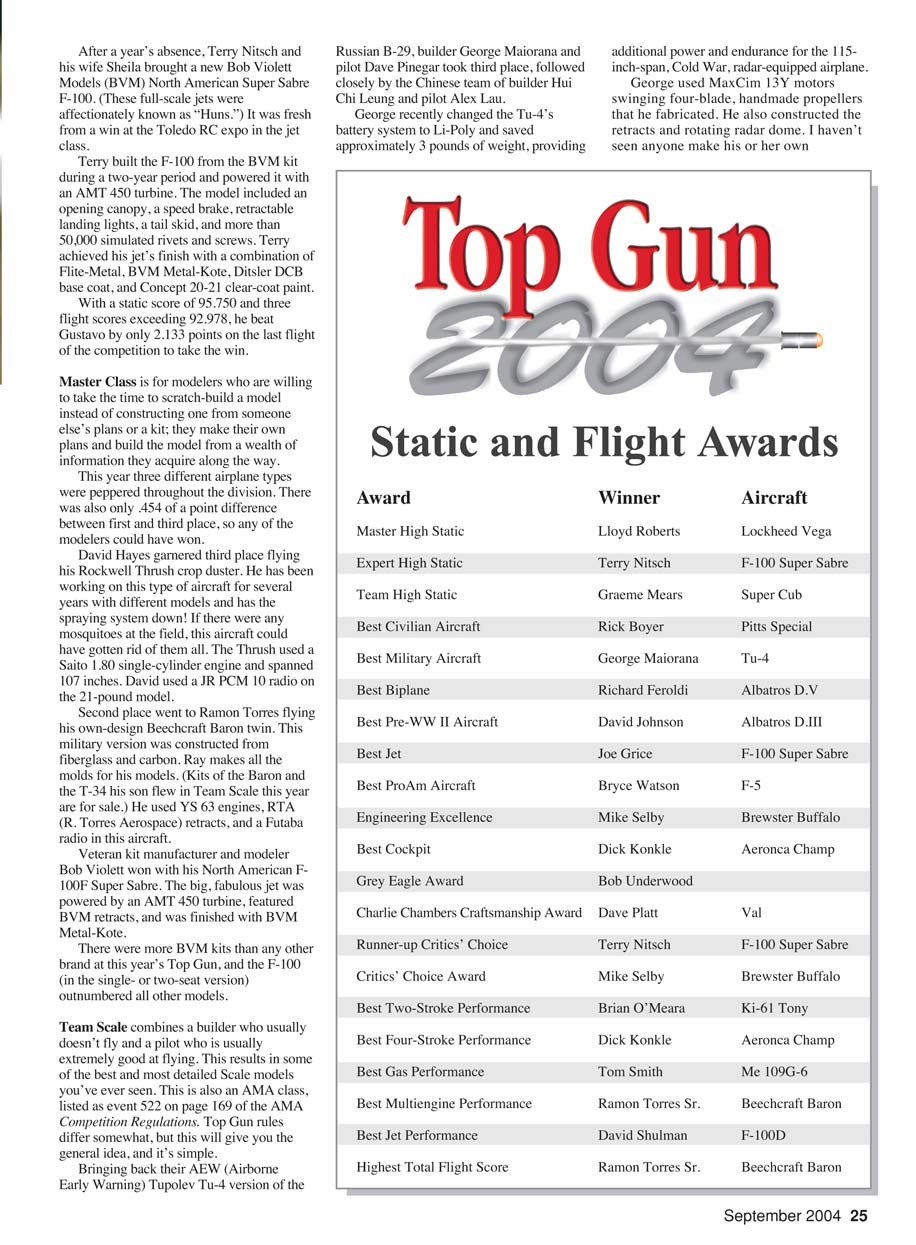
Static and Flight Awards
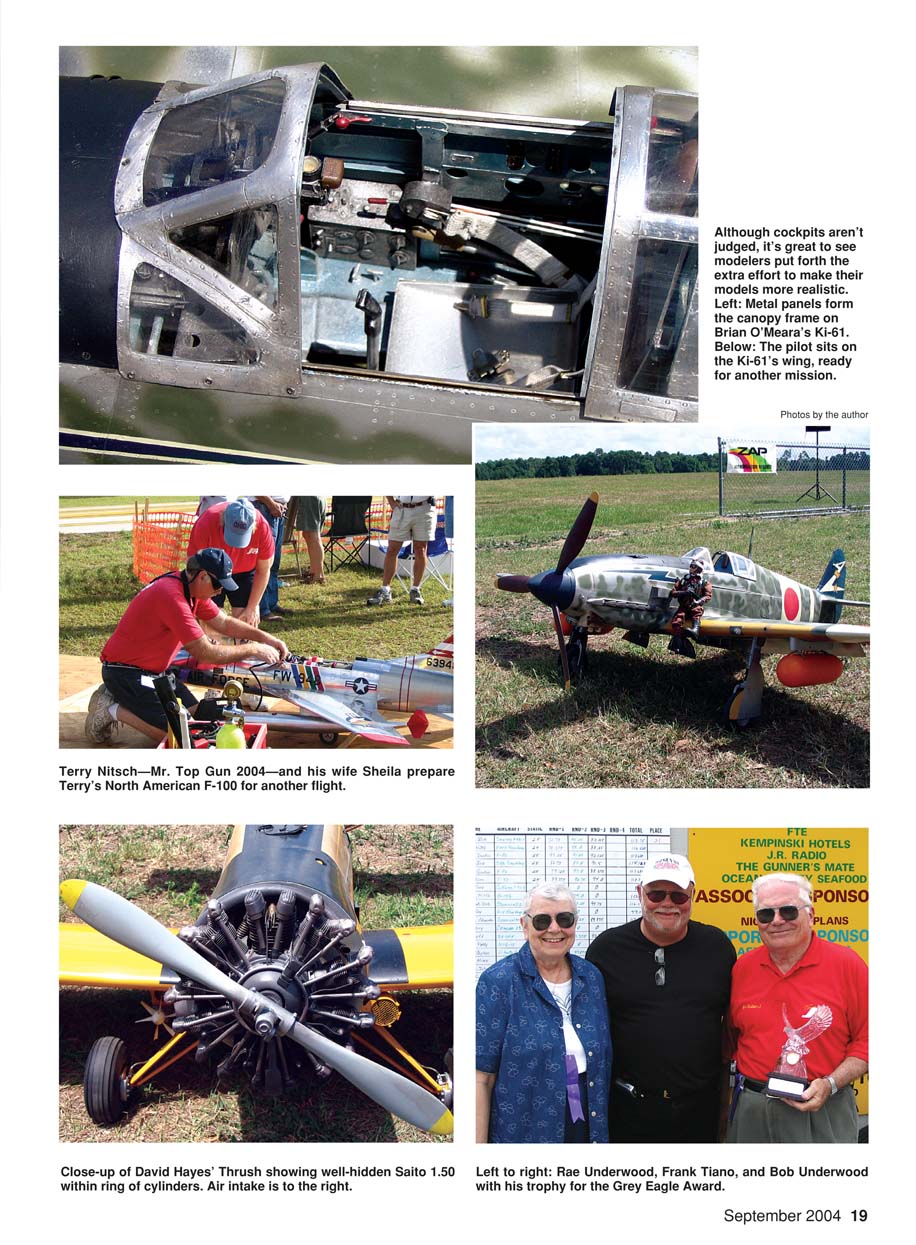
- Master High Static — Lloyd Roberts, Lockheed Vega
- Expert High Static — Terry Nitsch, F-100 Super Sabre
- Team High Static — Graeme Mears, Super Cub
- Best Civilian Aircraft — Rick Boyer, Pitts Special
- Best Military Aircraft — George Maiorana, Tu-4
- Best Biplane — Richard Feroldi, Albatros D.V
- Best Pre-WWII Aircraft — David Johnson, Albatros D.III
- Best Jet — Joe Grice, F-100 Super Sabre
- Best ProAm Aircraft — Bryce Watson, F-5
- Engineering Excellence — Mike Selby, Brewster Buffalo
- Best Cockpit — Dick Konkle, Aeronca Champ
- Grey Eagle Award — Bob Underwood
- Charlie Chambers Craftsmanship Award — Dave Platt, Val
- Runner-up Critics' Choice — Terry Nitsch, F-100 Super Sabre
- Critics' Choice Award — Mike Selby, Brewster Buffalo
- Best Two-Stroke Performance — Brian O'Meara, Ki-61 Tony
- Best Four-Stroke Performance — Dick Konkle, Aeronca Champ
- Best Gas Performance — Tom Smith, Me 109G-6
- Best Multiengine Performance — Ramon Torres Sr., Beechcraft Baron
- Best Jet Performance — David Shulman, F-100D
- Highest Total Flight Score — Ramon Torres Sr., Beechcraft Baron
Sponsors and Thanks
Special thanks to Frank Tiano, Jim Parker, Rosie Curry, Sharon and Bill Holland, the city of Lakeland, and the members of the Imperial RC Club.
Primary sponsors: Fly RC magazine and ZAP glue. Major sponsors: Airtronics, Futaba/O.S., Robart Manufacturing, Frank Tiano Enterprises, Kempinski Hotels, JR Radio, The Gunner's Mate, Ocean Beauty Seafood. Associate sponsors: Bob Violett Models, Nick Ziroli Plans. Supporting sponsors: Aerotech Models, Cooper Fuels, Gerard Enterprises, Jersey Modelers, O'Meara Ford, Puerto Rico RC Modelers, R/C Report magazine, Saito Engines, RC Scale International magazine, Tamiya USA, and the Top Gun Hussies.
Stan Alexander 3709 Valley Ridge Dr. Nashville, TN 37211 [email protected]
Contestant Numbers
- Expert: 22
- Masters: 12
- Team Scale: 14
- ProAm: 36
Radios Used
- Airtronics: 9
- Futaba: 31
- JR: 48
- Graupner: 3
- Hitec: 0
- Other: 1
Engines Used
- AMT turbine: 6
- Brison: 7
- D&B: 1
- Enya: 1
- Fuji: 1
- GT: 1
- JetCat: 13
- Kavan: 1
- K&B: 1
- Laser: 2
- MaxCim: 1
- Moki: 7
- O.S.: 9
- Quadra: 4
- RAM: 3
- Sachs: 1
- SimJet: 3
- Saito: 4
- 3W: 6
- YS: 2
- Zenoah: 11
Transcribed from original scans by AI. Minor OCR errors may remain.

