
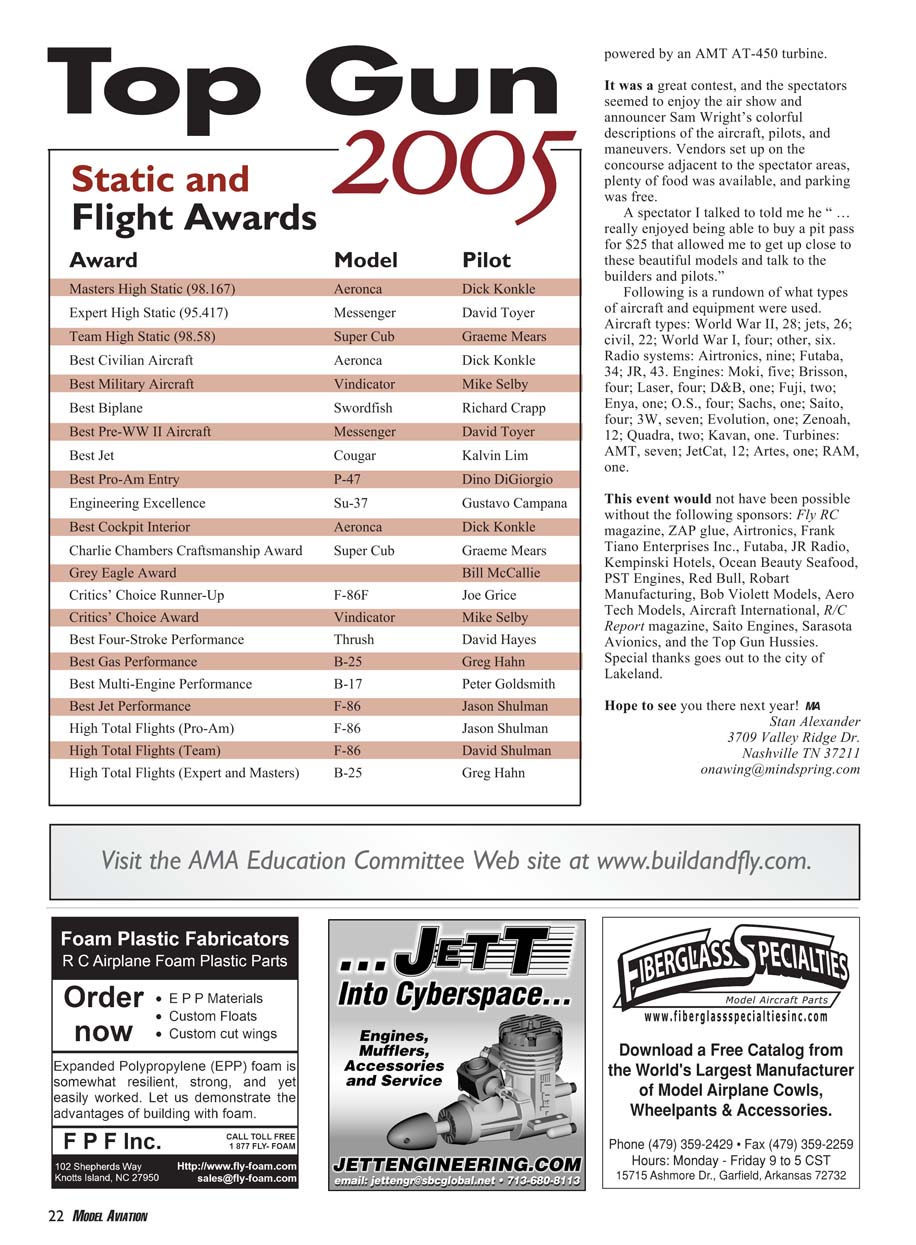
Top Gun 2005
By Stan Alexander
WEATHER CAN EITHER make or break a Scale contest anywhere it's held. Florida had all of the hurricanes later last year, but Top Gun usually has just a small thunderstorm that comes through in the night; it wouldn't dare rain during the contest. However, this year's weather was probably the best we've seen in many years either at the event's former Palm Beach Polo Club location or at the current Lakeland Linder Regional Airport venue.
With contestants traveling from almost every continent, Mexico, and Canada, Top Gun ranks as one of the most diverse and prestigious Scale events anywhere on the globe. This contest is continually changing. Although some Scale buffs scoff at the United States' way of having four flightlines with four models flying at once, there is hardly ever an incident—especially if the lines are close together.
The first two days of Top Gun are taken up with static judging and practice flying. There is a noon air show for the spectators, who had beautiful weather the weekend of April 30–May 1. In static judging, a pilot receives 50% of his or her total score (for almost any Scale class). The contestant's top three flight scores are averaged for the total flight score, which is added to the static score.
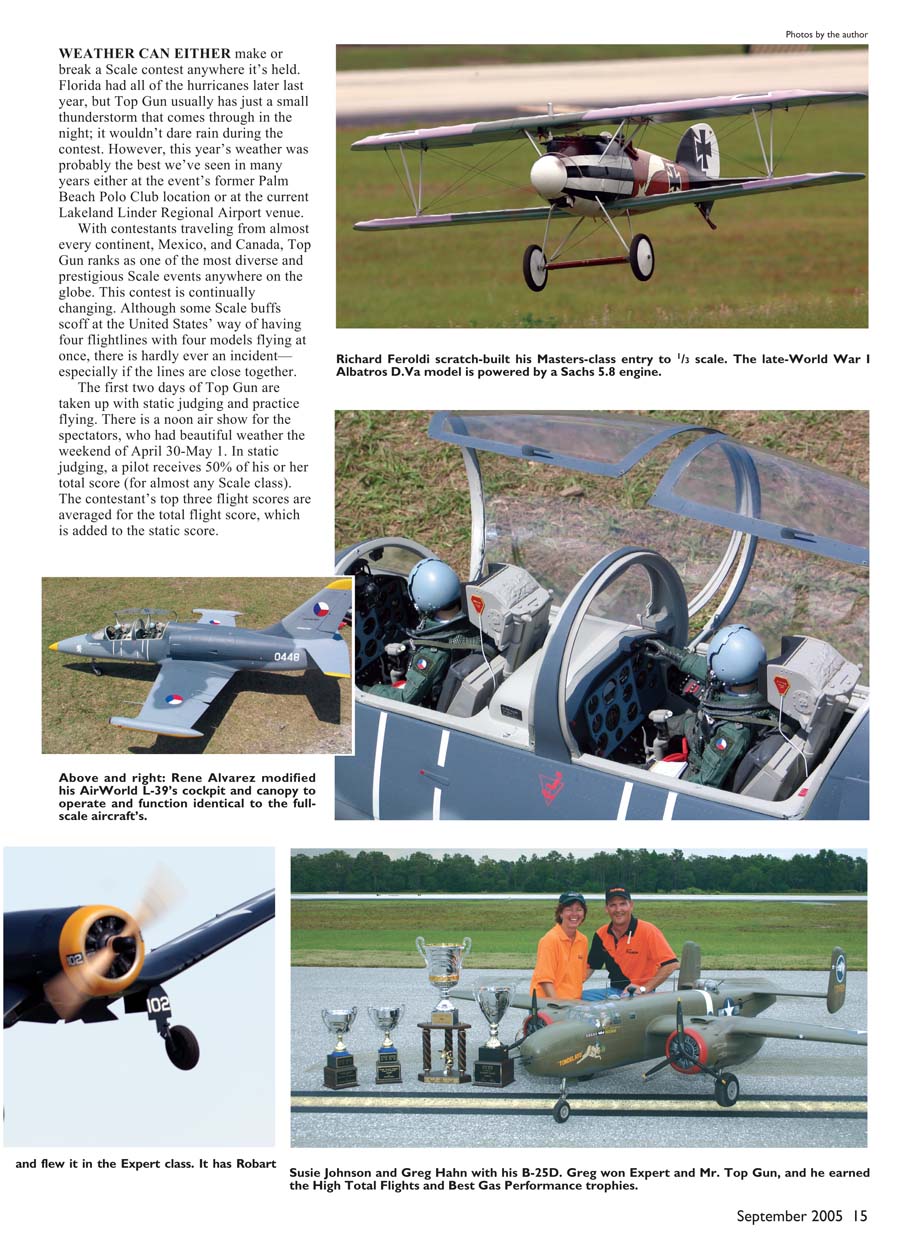
and flew it in the Expert class. It has Robart
Expert:
The most consistent modelers usually finish on top, and this year they were there again in the Expert and Masters classes. In Expert there were nine jets, and all other types of aircraft made up the rest of the field. Six of the jets finished in the top 10, earning the second through fourth spots.
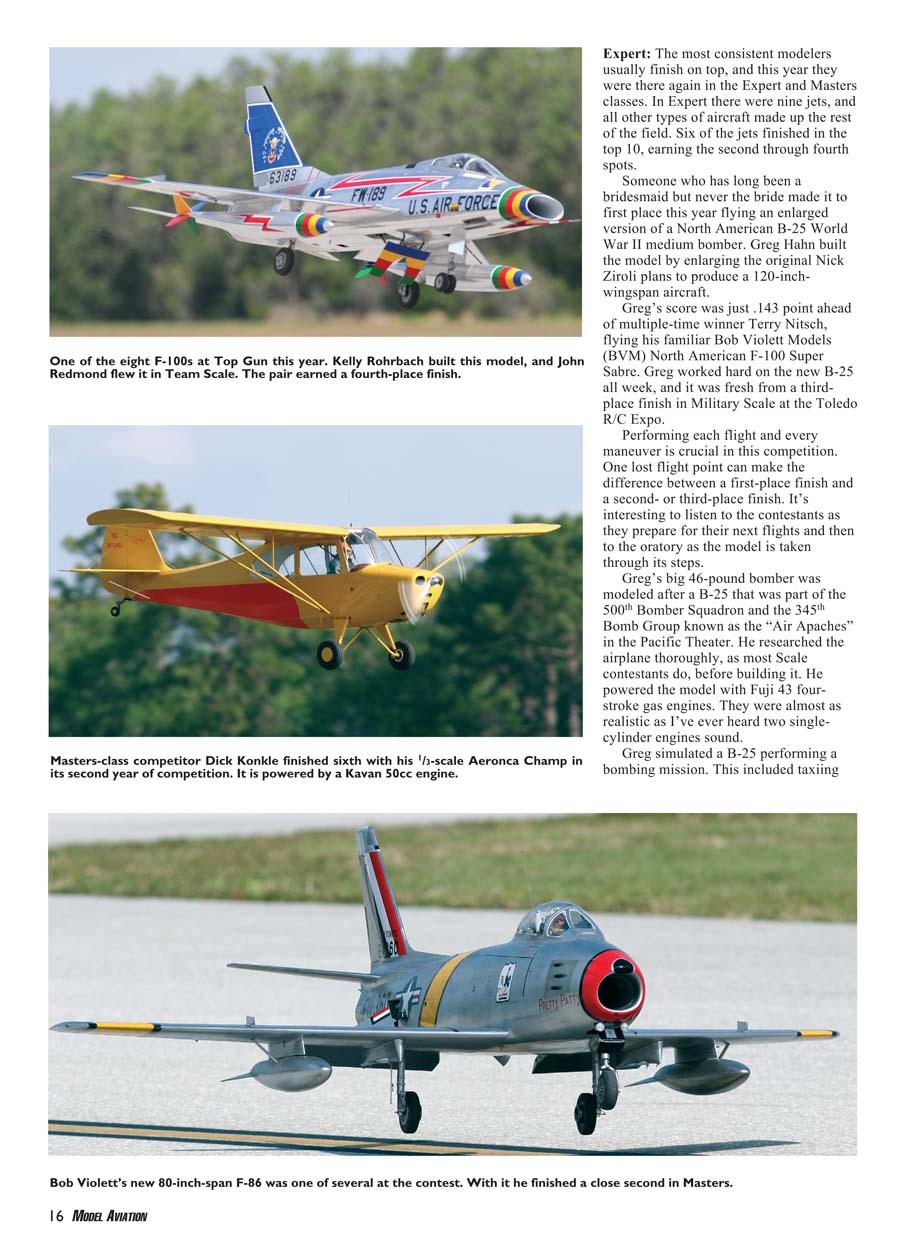
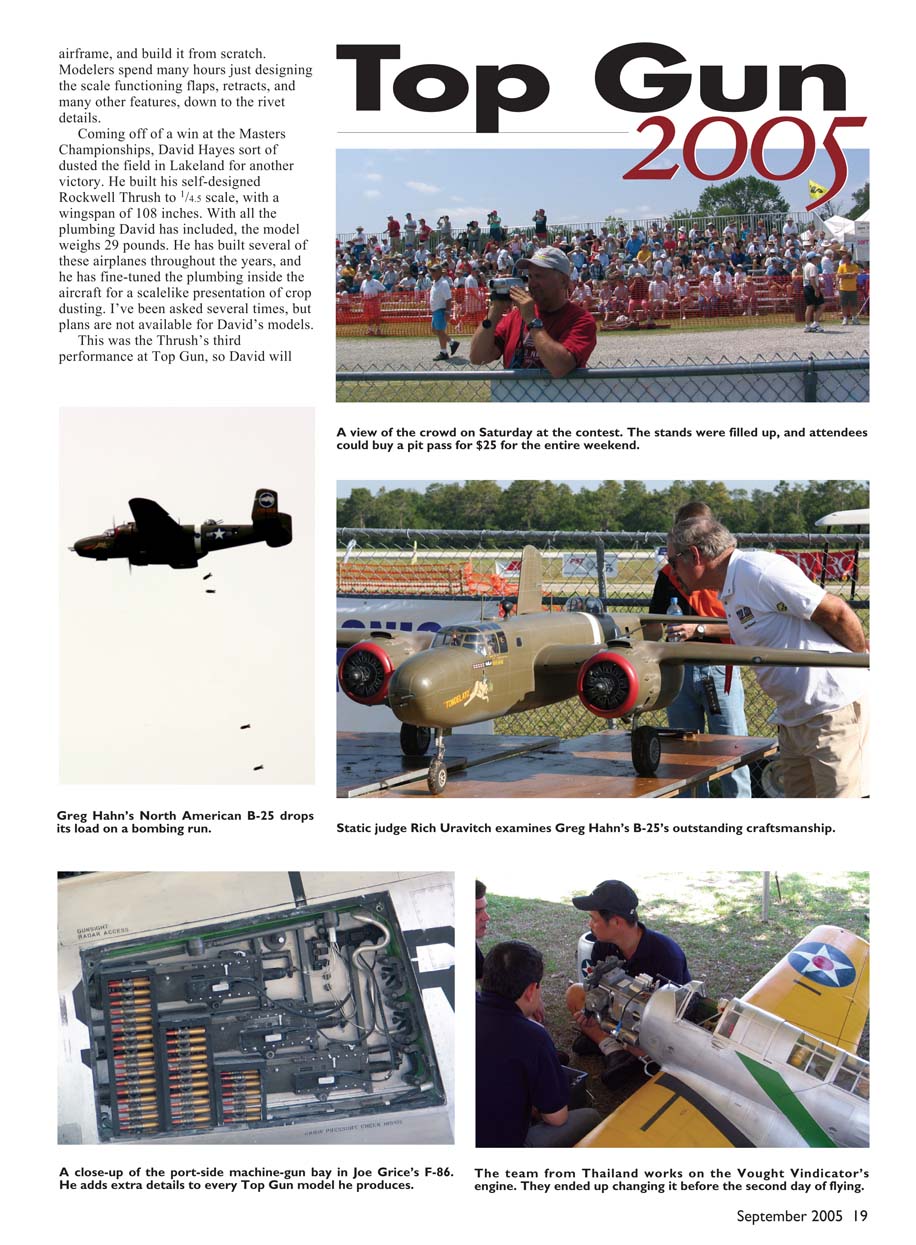
Someone who has long been a bridesmaid but never the bride made it to first place this year flying an enlarged version of a North American B-25 World War II medium bomber. Greg Hahn built the model by enlarging the original Nick Ziroli plans to produce a 120-inch-wingspan aircraft.
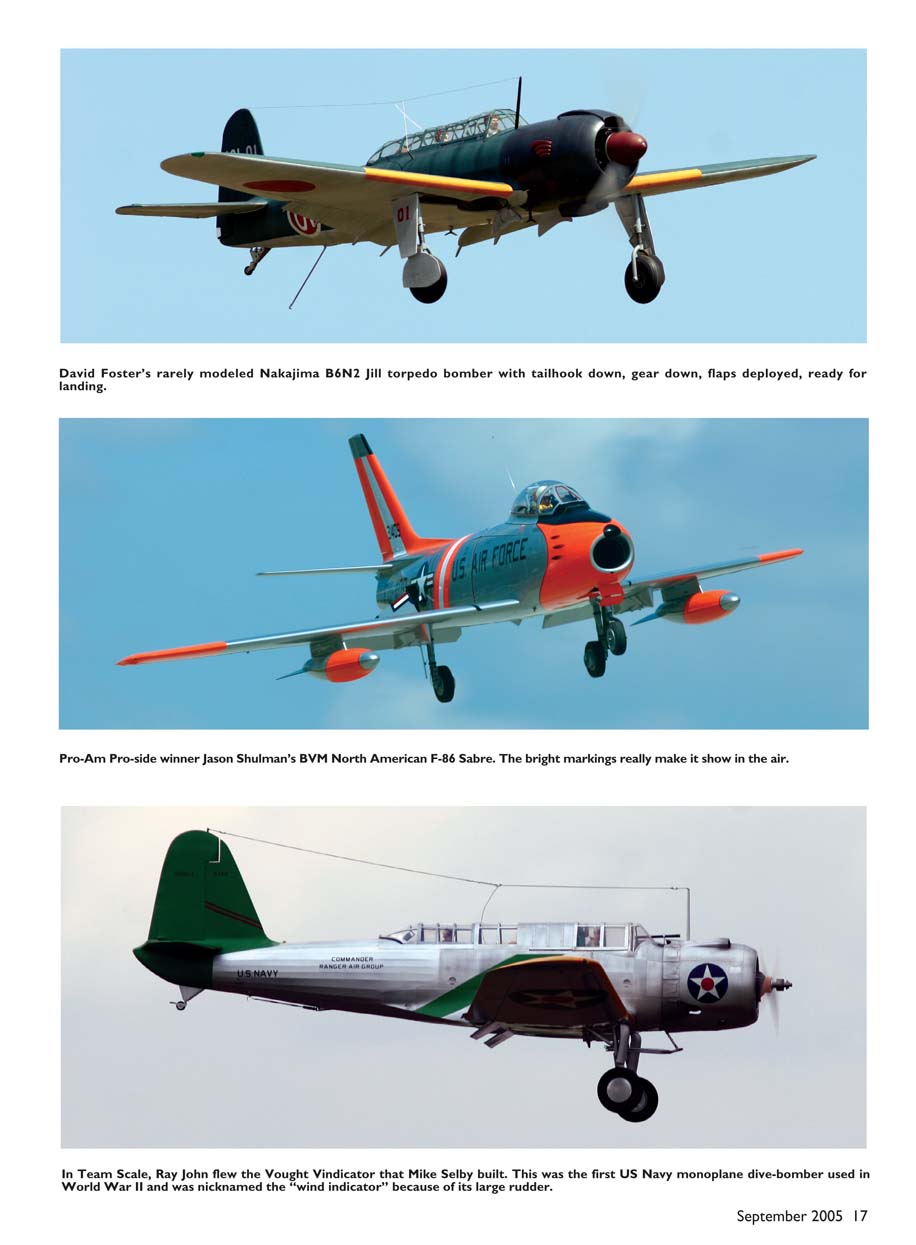
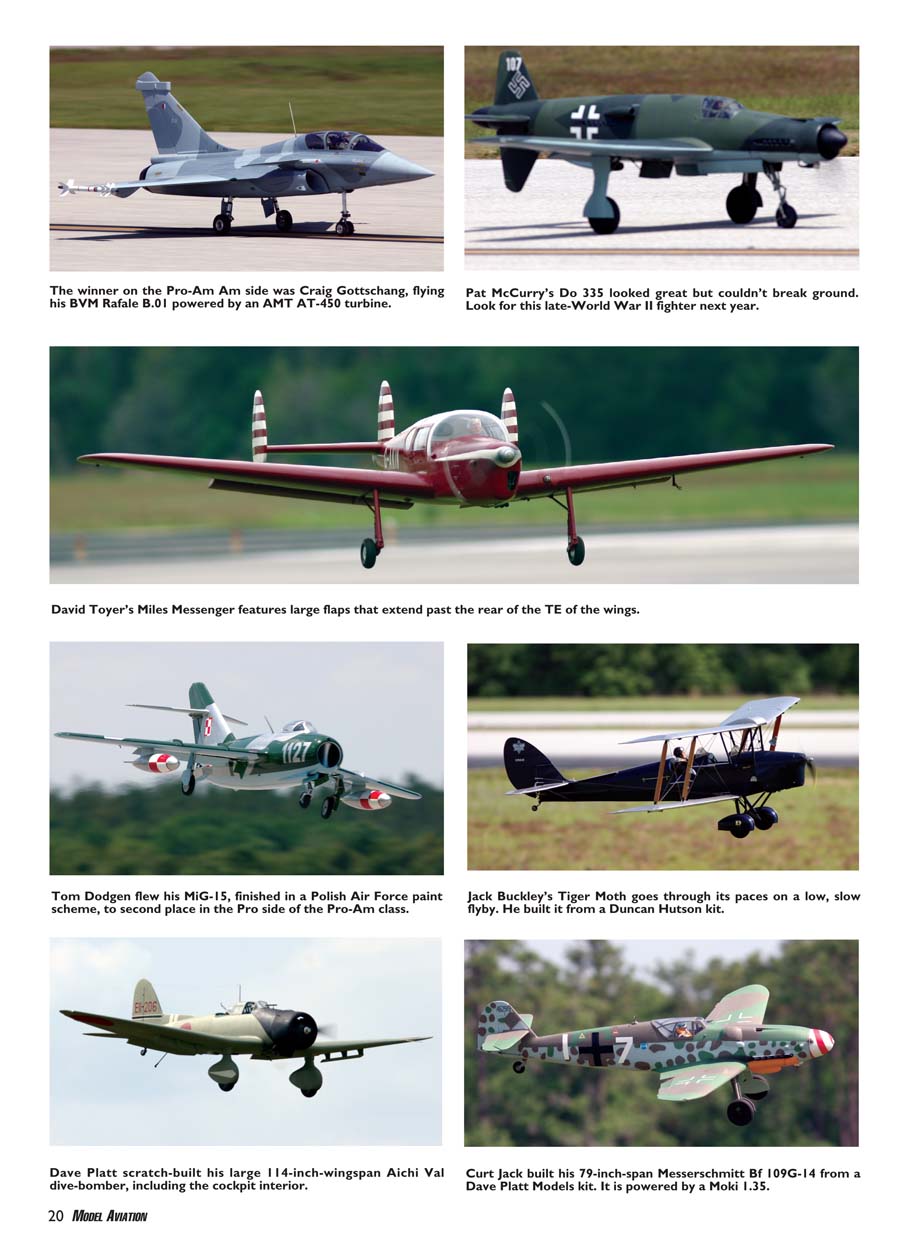
Greg's score was just .143 point ahead of multiple-time winner Terry Nitsch, flying his familiar Bob Violett Models (BVM) North American F-100 Super Sabre. Greg worked hard on the new B-25 all week, and it was fresh from a third-place finish in Military Scale at the Toledo R/C Expo.
Performing each flight and every maneuver is crucial in this competition. One lost flight point can make the difference between a first-place finish and a second- or third-place finish. It's interesting to listen to the contestants as they prepare for their next flights and then to the oratory as the model is taken through its steps.
Greg's big 46-pound bomber was modeled after a B-25 that was part of the 500th Bomber Squadron and the 345th Bomb Group known as the "Air Apaches" in the Pacific Theater. He researched the airplane thoroughly, as most Scale contestants do, before building it. He powered the model with Fuji 43 four-stroke gas engines. They were almost as realistic as I've ever heard two single-cylinder engines sound.
Greg simulated a B-25 performing a bombing mission. This included taxiing out to the main runway, applying brakes, checking the engines and control surfaces, and executing a straight and level takeoff.
After that, the gear and the flaps came up.
The next maneuver was the bomb drop. Greg used a tactic that the full-scale aircraft would have employed on low-level bombing missions. The bombs had parachutes attached to them to slow their progress to the target so the aircraft could get out of the way of the explosions. The B-25’s bombs didn’t explode, but the effect was realistic.
On the way back to the “hangar” Greg used a similar routine as before: taxi off the main runway, apply brakes, and then a lean engine shutoff, in which the engines were idled up and the kill switch was turned on. Then the flight was complete.
Greg took home awards for High Total Flight, Best Gas Performance, and—the most prestigious honor—“Mr. Top Gun.”
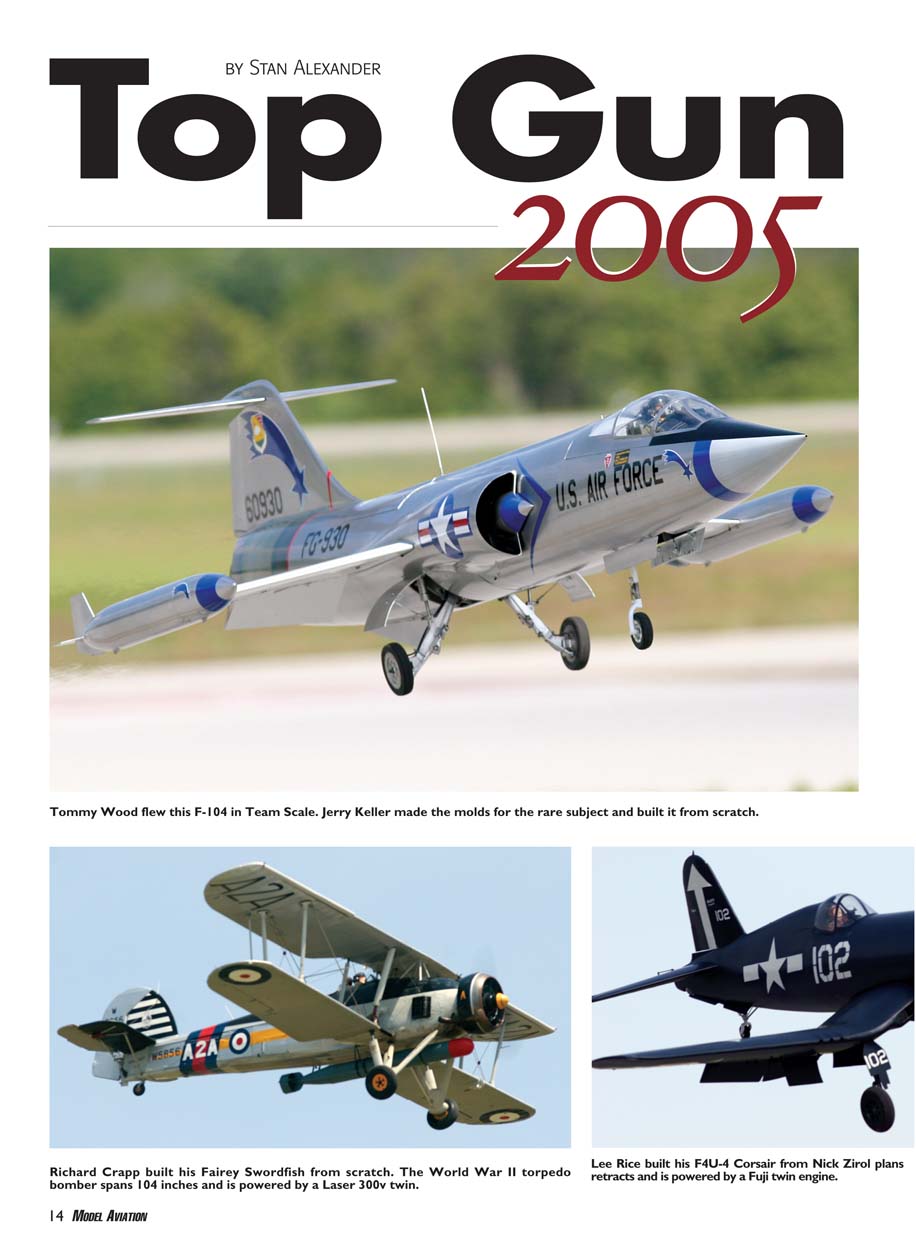
Runner-up Terry Nitsch’s BVM F-100, or “Hun” as those jets were called, weighed 40 pounds and was powered by an AMT AT-450 turbine. The interesting part about the second-place finish was that because of so many jets’ prefabrication (such as where the fuselage and wings are molded fiberglass or composite parts), there is a 2% deduction to the flight score for such a violation. The F-100 and many other jets in competition today qualify for this deduction.
Third place went to Kalvin Lim with his swept-wing AirWorld Grumman F9F Cougar. The model of the 1950s jet had a wingspan of 85 inches, and power was provided by a JetCat P-160 turbine. The retracts were also by AirWorld—a German company which has several kits out.
Masters: This is one of the fellow competitors’ favorite divisions. In this class, as in AMA’s Designer Scale, the modeler has to draw the plans, design the airframe, and build it from scratch. Modelers spend many hours just designing the scale functioning flaps, retracts, and many other features, down to the rivet details.
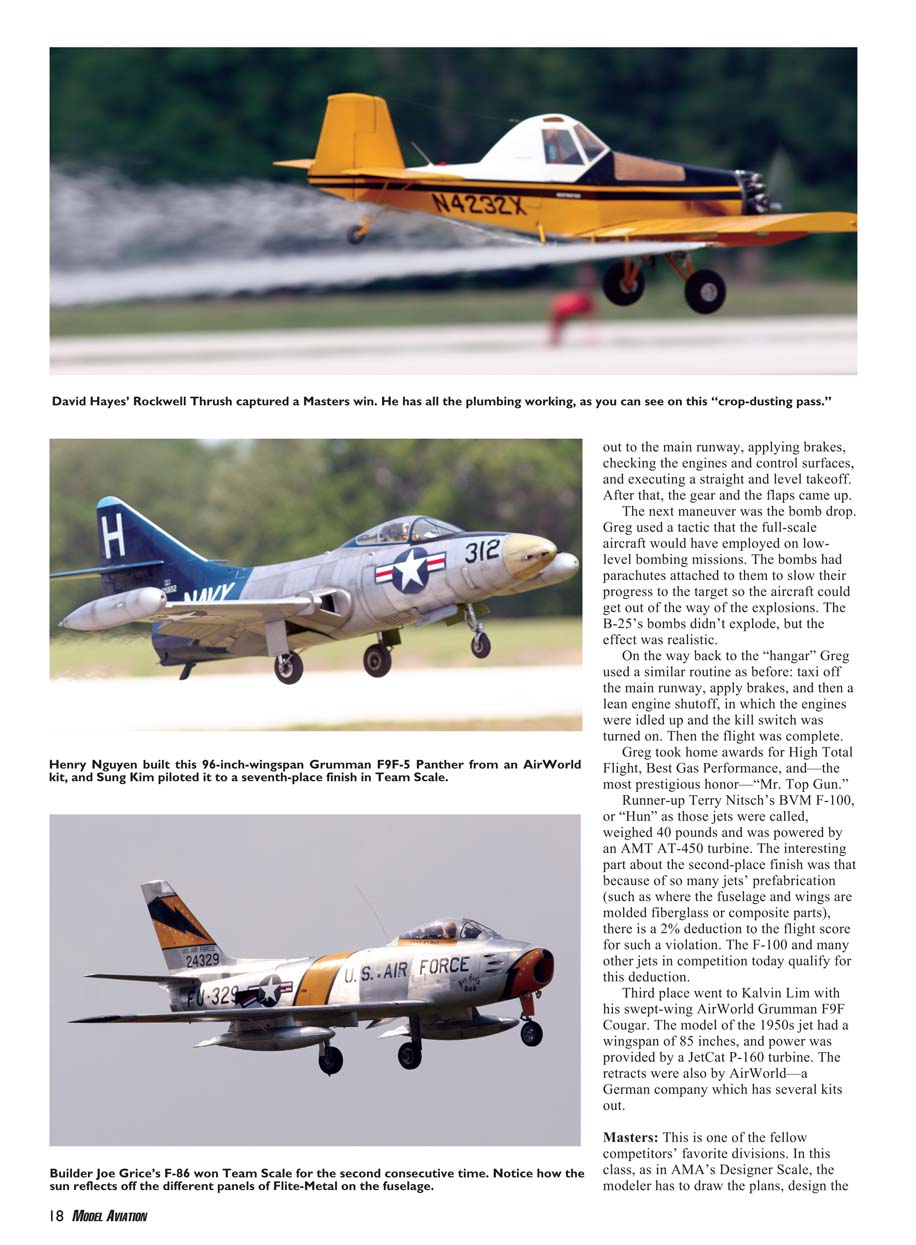
Coming off of a win at the Masters Championships, David Hayes sort of dusted the field in Lakeland for another victory. He built his self-designed Rockwell Thrush to 1/4.5 scale, with a wingspan of 108 inches. With all the plumbing David has included, the model weighs 29 pounds. He has built several of these airplanes throughout the years, and he has fine-tuned the plumbing inside the aircraft for a scalelike presentation of crop dusting. I’ve been asked several times, but plans are not available for David’s models.
This was the Thrush’s third performance at Top Gun, so David will
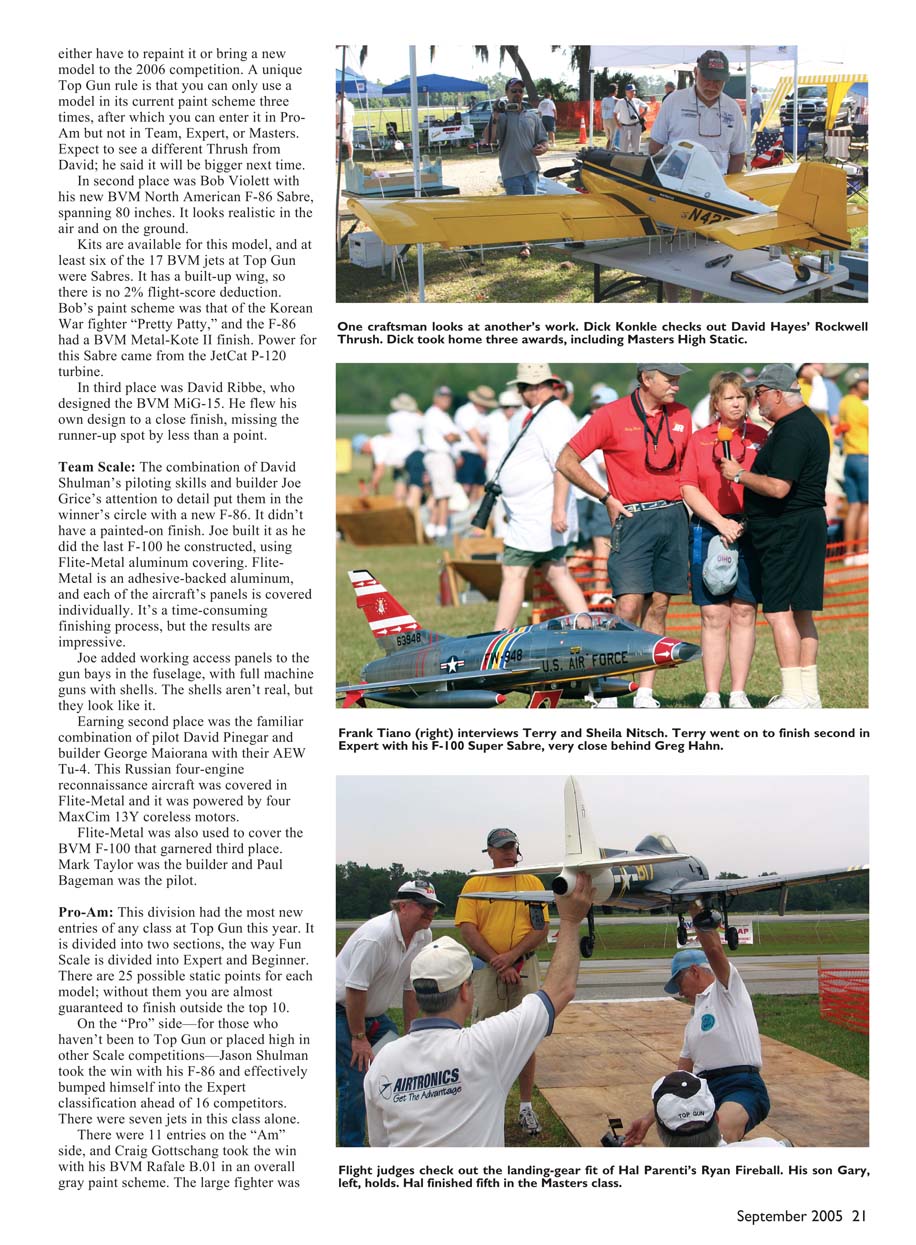
powered by an AMT AT-450 turbine.
It was a great contest, and the spectators seemed to enjoy the air show and announcer Sam Wright’s colorful descriptions of the aircraft, pilots, and maneuvers. Vendors set up on the concourse adjacent to the spectator areas, plenty of food was available, and parking was free.
A spectator I talked to told me he “... really enjoyed being able to buy a pit pass for $25 that allowed me to get up close to these beautiful models and talk to the builders and pilots.”
Following is a rundown of what types of aircraft and equipment were used. Aircraft types: World War II, 28; jets, 26; civil, 22; World War I, four; other, six. Radio systems: Airtronics, nine; Futaba, 34; JR, 43. Engines: Moki, five; Brisson, four; Laser, four; D&B, one; Fuji, two; Enya, one; O.S., four; Sachs, one; Saito, four; 3W, seven; Evolution, one; Zenoah, 12; Quadra, two; Kavan, one. Turbines: AMT, seven; JetCat, 12; Artes, one; RAM, one.
This event would not have been possible without the following sponsors: Fly RC magazine, ZAP glue, Airtronics, Frank Tiano Enterprises Inc., Futaba, JR Radio, Kempinski Hotels, Ocean Beauty Seafood, PST Engines, Red Bull, Robart Manufacturing, Bob Violett Models, Aero Tech Models, Aircraft International, R/C Report magazine, Saito Engines, Sarasota Avionics, and the Top Gun Hussies. Special thanks goes out to the city of Lakeland.
Hope to see you there next year! MA
Stan Alexander 3709 Valley Ridge Dr. Nashville TN 37211 [email protected]
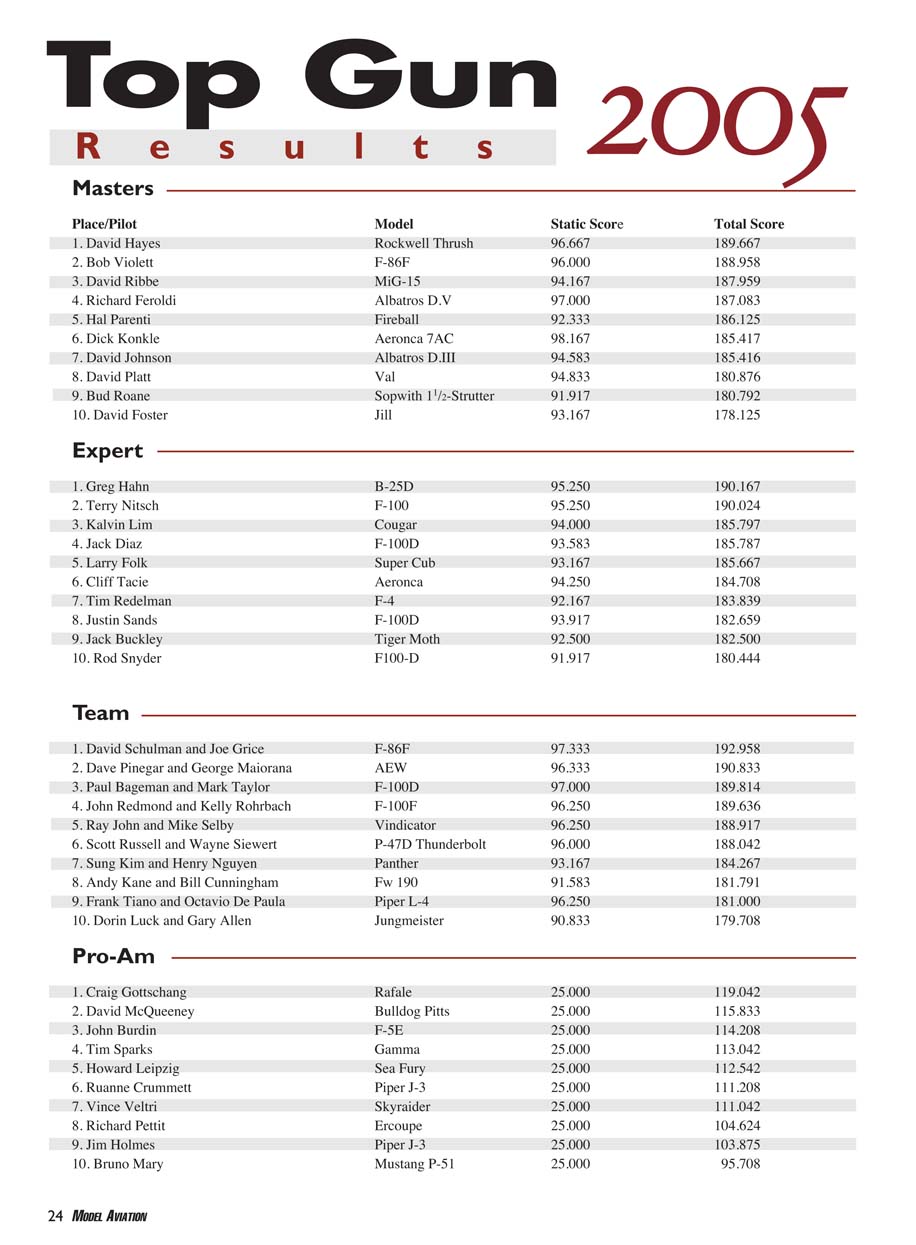
Top Gun 2005
Results
#### Masters
- David Hayes — Rockwell Thrush — 96.667 — 189.667
- Bob Violett — F-86F — 96.000 — 188.958
- David Ribbe — MiG-15 — 94.167 — 187.959
- Richard Feroldi — Albatros D.V — 97.000 — 187.083
- Hal Parenti — Fireball — 92.333 — 186.125
- Dick Konkle — Aeronca 7AC — 98.167 — 185.417
- David Johnson — Albatros D.III — 94.583 — 185.416
- David Platt — Val — 94.833 — 180.876
- Bud Roane — Sopwith 1½-Strutter — 91.917 — 180.792
- David Foster — Jill — 93.167 — 178.125
#### Expert
- Greg Hahn — B-25D — 95.250 — 190.167
- Terry Nitsch — F-100 — 95.250 — 190.024
- Kalvin Lim — Cougar — 94.000 — 185.797
- Jack Diaz — F-100D — 93.583 — 185.787
- Larry Folk — Super Cub — 93.167 — 185.667
- Cliff Tacie — Aeronca — 94.250 — 184.708
- Tim Redelman — F-4 — 92.167 — 183.839
- Justin Sands — F-100D — 93.917 — 182.659
- Jack Buckley — Tiger Moth — 92.500 — 182.500
- Rod Snyder — F100-D — 91.917 — 180.444
#### Team
- David Schulman and Joe Grice — F-86F — 97.333 — 192.958
- Dave Pinegar and George Maiorana — AEW — 96.333 — 190.833
- Paul Bageman and Mark Taylor — F-100D — 97.000 — 189.814
- John Redmond and Kelly Rohrbach — F-100F — 96.250 — 189.636
- Ray John and Mike Selby — Vindicator — 96.250 — 188.917
- Scott Russell and Wayne Siewert — P-47D Thunderbolt — 96.000 — 188.042
- Sung Kim and Henry Nguyen — Panther — 93.167 — 184.267
- Andy Kane and Bill Cunningham — Fw 190 — 91.583 — 181.791
- Frank Tiano and Octavio De Paula — Piper L-4 — 96.250 — 181.000
- Dorin Luck and Gary Allen — Jungmeister — 90.833 — 179.708
#### Pro-Am
- Craig Gottschang — Rafale — 25.000 — 119.042
- David McQueeney — Bulldog Pitts — 25.000 — 115.833
- John Burdin — F-5E — 25.000 — 114.208
- Tim Sparks — Gamma — 25.000 — 113.042
- Howard Leipzig — Sea Fury — 25.000 — 112.542
- Ruanne Crummett — Piper J-3 — 25.000 — 111.208
- Vince Veltri — Skyraider — 25.000 — 111.042
- Richard Pettit — Ercoupe — 25.000 — 104.624
- Jim Holmes — Piper J-3 — 25.000 — 103.875
- Bruno Mary — Mustang P-51 — 25.000 — 95.708
Transcribed from original scans by AI. Minor OCR errors may remain.

