
Top Gun
THIS YEAR was the 13th time modelers from various parts of the world have traveled to the Top Gun Invitational.
The first Top Gun was held in Florida; the next year it landed in Mesa, Arizona; and for the last 11 years, the contest has been held at the Palm Beach Polo and Country Club in West Palm Beach, Florida.
Pilots from across the U.S., Canada, Brazil, Germany, Ireland, Argentina, and several other countries came to the 2001 event, held April 25-29.
The contest was marred by several crashes. The Polo Club management didn't seem to take care of the field this year as it had in the past. The weather did its best to create horrible conditions, with full cloudy days and 20-25 mph winds at 90° to the runway.
Although the crosswind runways did help, landing gears as well as airframes were under tremendous stress levels.
Behind the scenes, the West Palm Beach Skyhawks kept everything running smoothly, including parking, flightlines, transmitter impound, crash cart, and crowd control.
The club's volunteers took care of the AMA Delta Dart half-time contest Saturday and Sunday. Many kids got their initiation into aeromodeling with this popular mass-launch event. Try it sometime at a local contest; it's fun!
As is the case with any Top Gun, several new and interesting aircraft were present.
While looking at the airplane specifications, I learned that the average wingspan of the models was 92 inches and the average weight of the models was 29.62 pounds.
The heaviest model was an F-18 that came in at 152 pounds. The largest wingspan belonged to Anthony Greco's Sikorsky S-39B, which measured 156 inches.
The number of turbine-jet models increased from last year, and the total number of model entries was up to 66.
A new event was kicked off at this Top Gun: Scale Helicopters. Only static competition was held for these models, and eight were in competition. A variety of helicopter types competed.
Unlike the AMA rule book event, these machines were not limited to a very low weight limit; several models were in the 20- to 25-pound range.
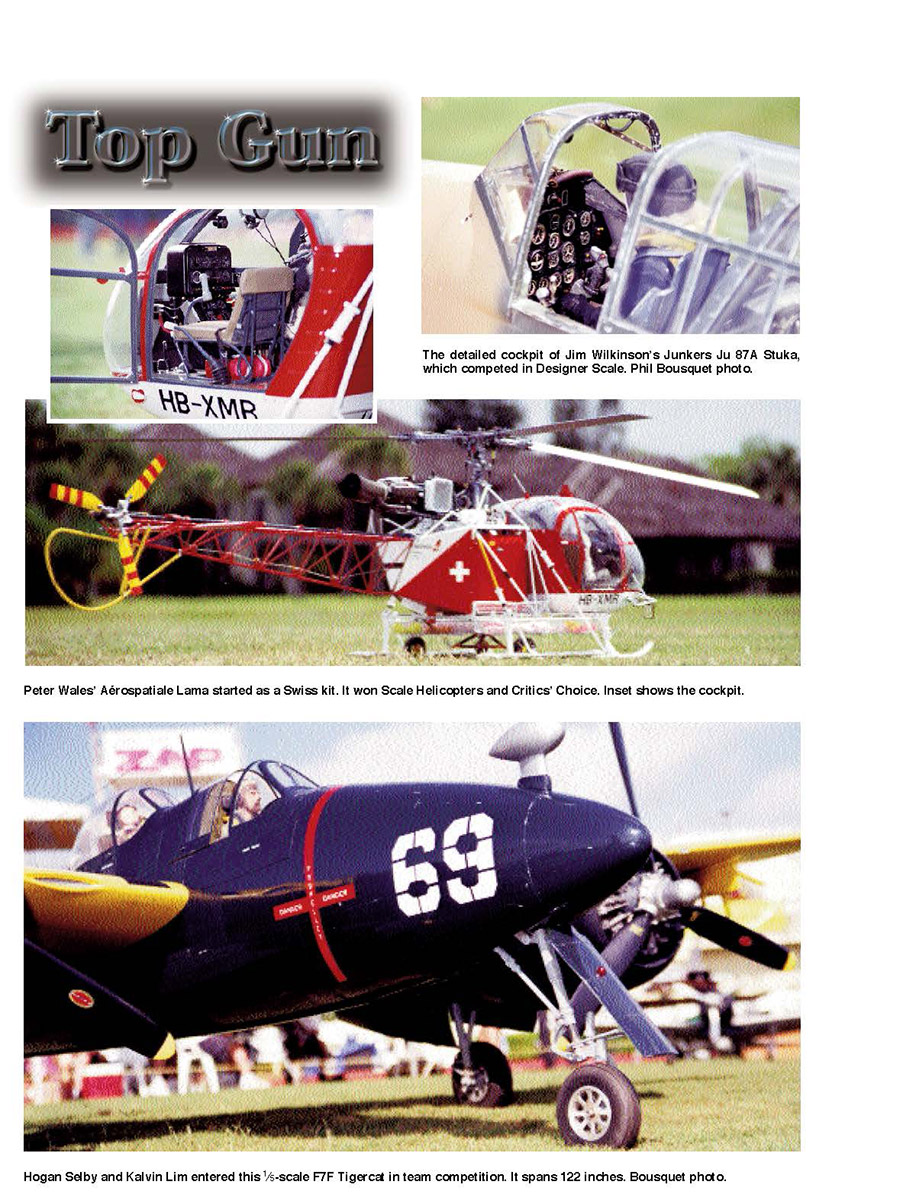
First place and the Critics' Choice award went to Peter Wales with his Aerospatiale Lama. This aircraft started as a kit from Switzerland, and it came to life with many modifications and machined parts constructed by the builder.
Second place and Best Cockpit went to Len Mount with his Eurocopter EC 155 Dauphin. Jerry Hicks took third place with a simple Bell Model 412.
The top five were rounded out by Russell Mattini, with his Bell LongRanger, and Mike Robins. Mike's model of the Boeing AH-64D Longbow Apache took Best Military.
Planning for next year's Top Gun includes the Helicopter event that will lead off Monday with static and flight competition.
The lure for spectators at Top Gun each year includes a great show. But with Scale models—whether they're helicopters, airplanes, or jets—the variety of aircraft types and the different personalities of the aircraft are the attraction.
From pre-World War I to modern-day jet airliners, models from every era could be seen in the pit area this year.
Some of the aircraft have been there before—for as many as three years, which is the limit on a color scheme for Top Gun. After that, you either have to repaint or construct another model. This helps keep the field fresh for the spectators and the press.
Several aircraft were on their second or last year, including several of the top-placing models.
Three classes are held each year: Expert, Designer, and Team Scale.
- Expert class includes modelers who have built Scale models from kits or plans.
- Designer Scale is for the modeler who takes three-view or multiview scale drawings (such as Paul Matt drawings), draws his or her own plans, constructs the model from those plans, then takes the new aircraft to the field and flies and competes with it.
- Team Scale is for two people: the builder and the pilot.
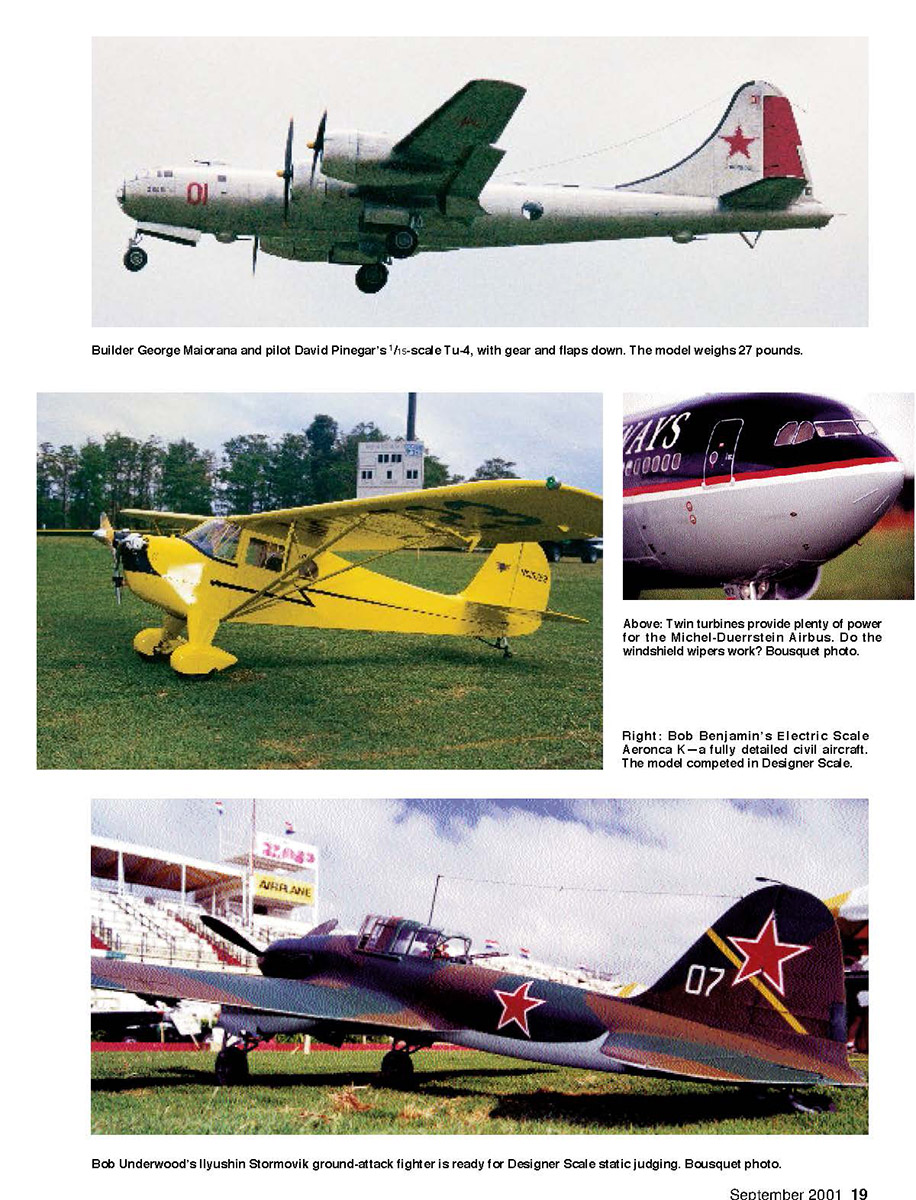
Electric Scale models seem to be on the rise, and several were in competition this year. The Tupolev Tu-4 (a Russian copy of the B-29) entered in Team Scale was designed and built by George Maiorana, and flown by pilot David Pinegar.
The model was designed using drawings, and by actually going to measure a B-29 in the U.S. Air Force Museum in Dayton, Ohio. George did his homework well, and he was rewarded with a beautiful model after a lot of hard work.
According to David, the nonaerobatic model flies like a trainer. Using electric power for a four-engine bomber makes good sense for power-plant reliability.
The 115-inch-span model uses four MaxCim NEO 13Y coreless motors, geared to 2.73:1, turning 13 x 10 Master Airscrew propellers. The model has 48 Panasonic 3000 mA cells for power.
The Tu-4 is finished with aluminum tape. George used the following process for applying and working the material: he applied the tape to the model in workable panels, then wet-sanded it with 400-grit sandpaper. He scoured the surface with Bright Bar to dull the low spots, then smoothed the surface with #00 steel wool. Then he applied the rivet detail and polished some of the panels to make it more realistic.
David flew the past contest-winning model to a third-place finish.
An electric aircraft flown in Designer Scale was Bob Benjamin's Aeronca K. The 1/4-scale model spans 108 inches and is powered by an Astro motor swinging an 18 x 12 propeller.
The yellow civil two-seater's "dummy" motor looks so real, many asked if it was an O.S. 1.2 Twin or a custom-designed motor.
Bob took his Aeronca to a seventh-place finish.
Not one, but three French Rafale twin-turbine jets were entered this year, with two in Expert class and the other in Team Scale. All were from the Bob Violett Models (BVM) kit, and had similar color schemes of overall gray.
The big twin-turbine-powered models are built from fiberglass and carbon fiber. Robart supplied landing gear, and the modelers added details to the stock parts.
Other jets included the ill-fated Airbus A330 entered in Team Scale by builder Peter Michel and pilot Stephan Duerrstein. The 150-inch-span, 157-inch-long model appeared to lose the port turbine, and slowly rolled into the ground behind the pit area.
The Airbus was powered by two JetCat P80 turbines and controlled by an MC-24 radio. The big model was finished using original Airbus factory paint.
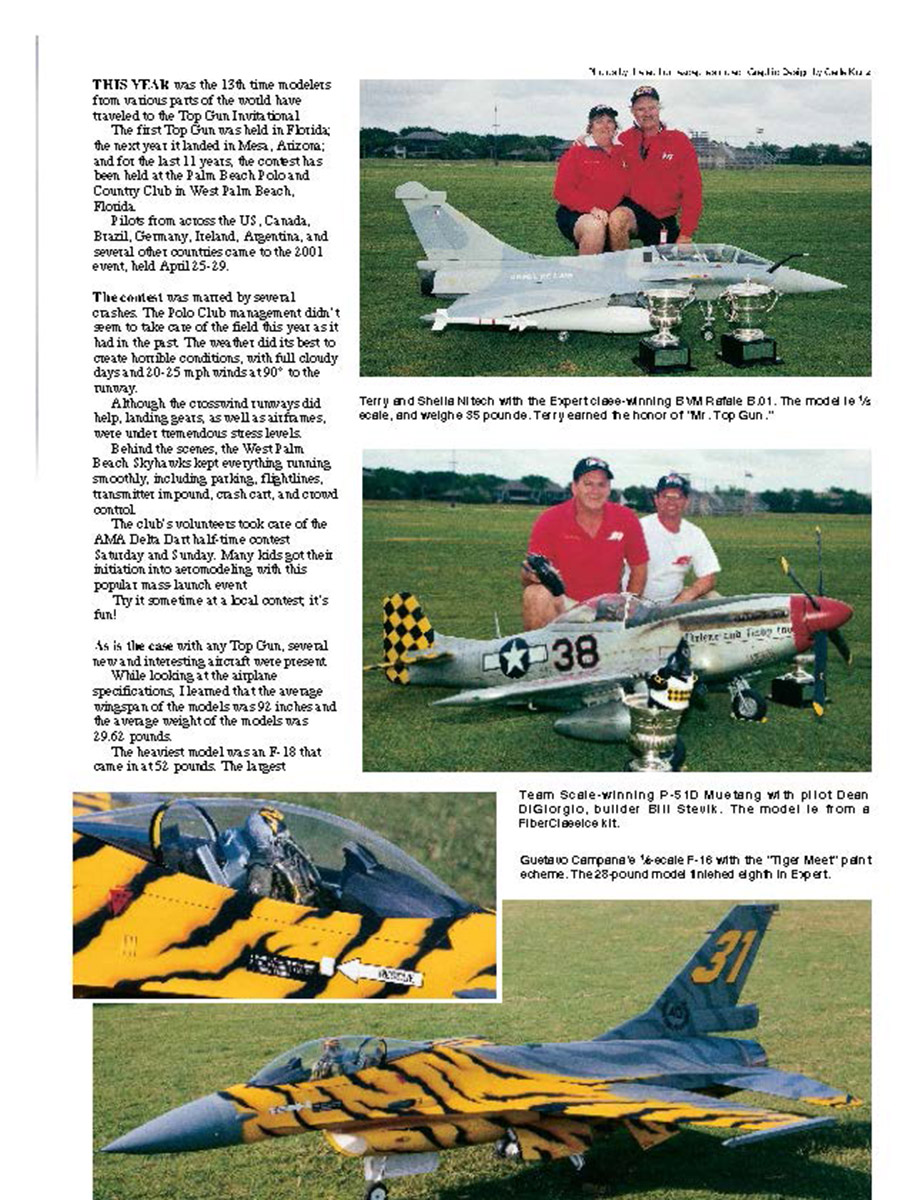
Twenty-year modeling veteran Gustavo Campana entered an F-16 that had one of the snazziest paint schemes of any Scale model at the contest.
Gustavo said the Aviation Design kit is from France, and the paint scheme originated at the Belgian Tiger Meet. The landing gear is from Air Magic.
When asked why he picked this color scheme in which to finish the F-16, Gustavo replied, "This color scheme has a very nice silhouette in the air and the Tiger Meet jets are all painted in special color schemes just for this aerial competition."
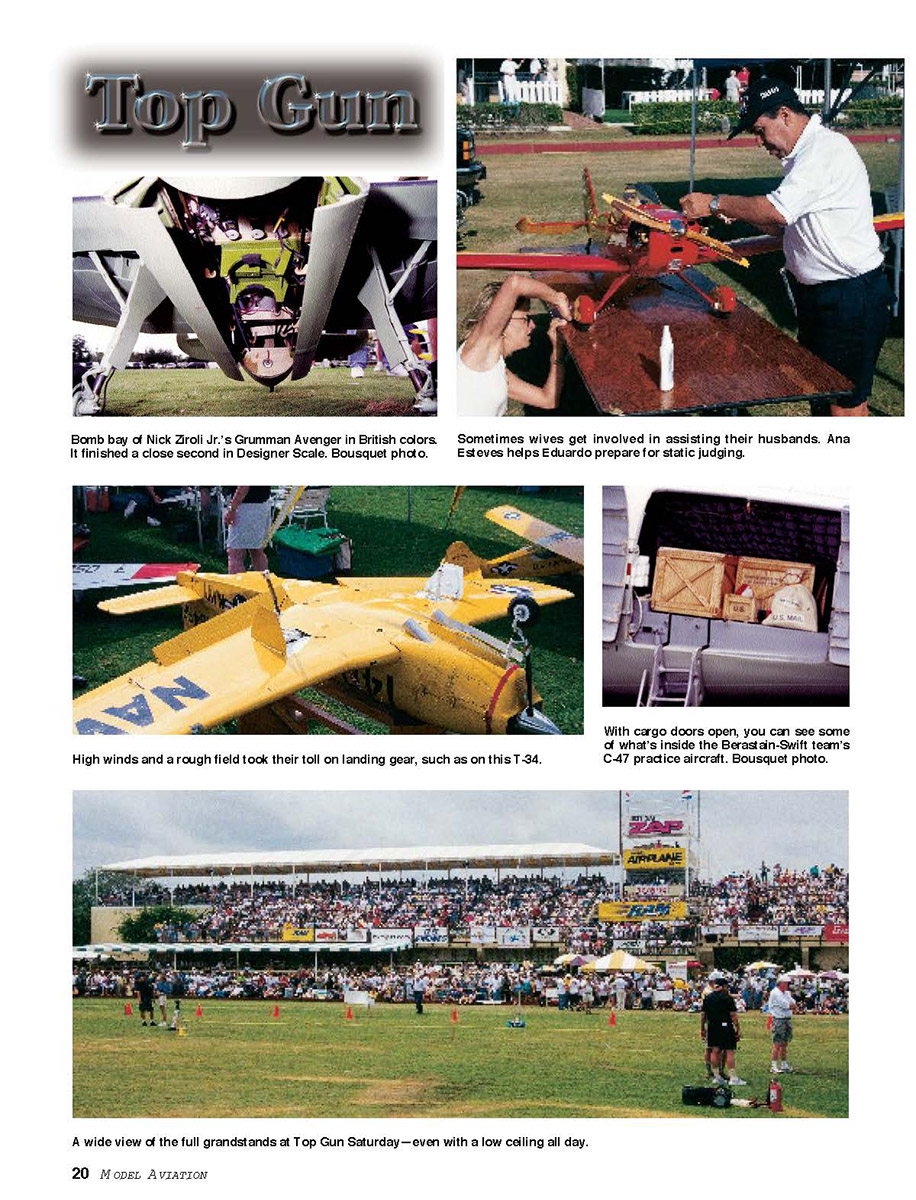
Team Scale: Eduardo Esteves of Belo Horizonte, Brazil brought an excellent-flying 1/3-scale Spacewalker, powered by an Eagle 3.2 engine. Albert Araujo, the builder, finished the model with the PPG paint system and many scale details inside and out.
The Brazilian team went on to finish seventh. There were 11 supporters from Brazil with the pair this year.
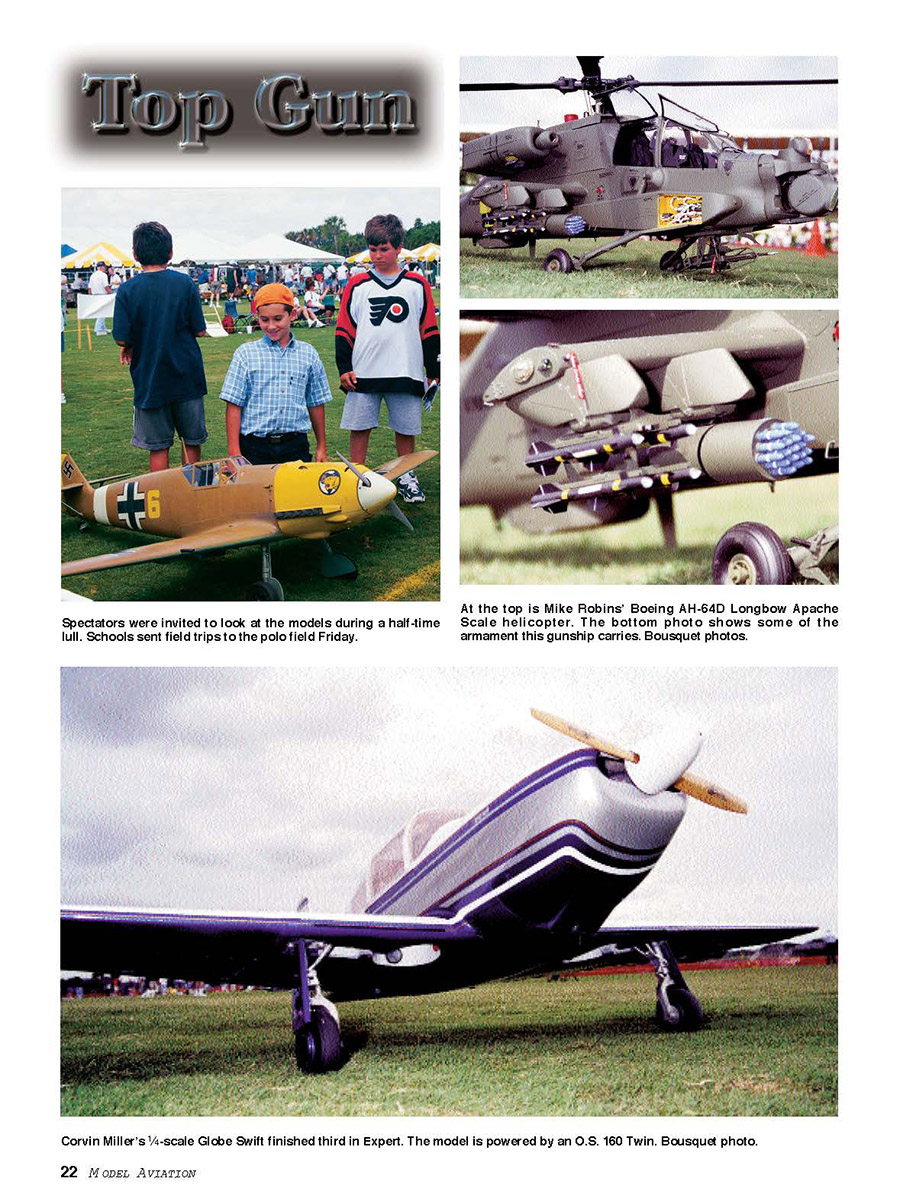
The youngest pilot at Top Gun was 18-year-old Dave Malchione Jr., flying an F-4 Phantom from a BVM kit built by Sam Leonard. The teenager handled himself like a seasoned veteran on the sticks, for a convincing third-place finish.
The electric-powered Tu-4 flown by David Pinegar and built by George Maiorana went unscathed during the weekend. It finished second by less than a point behind Dean DiGiorgio flying Bill Stevik's P-51D Mustang.
The big fighter had an onboard strobe with flashing guns during the strafing runs. Built from a FiberClassics kit, the 102-inch-span model was powered by a 3W-80R2 twin-cylinder engine.
The P-51 was finished with nitrate dope and was very realistic-looking.
Expert Class: Several modelers in the Expert class took a simpler route than the complicated fighters, jets, and bombers. Cliff Tacie brought his Aeronca L-16 Champ and finished fifth.
Another very competitive simple Scale model was Kim Foster's de Havilland Moth Minor, which finished fourth.
Corvin Miller, a past Top Gun winner, came to compete with his trusty Globe Swift that did have retracts and flaps. Always a fierce competitor, Corvin finished a close third.
In a battle of static scores and piloting skill, perennial competitors Greg Hahn and Terry Nitsch fought for each point to the last maneuver of the last flight.
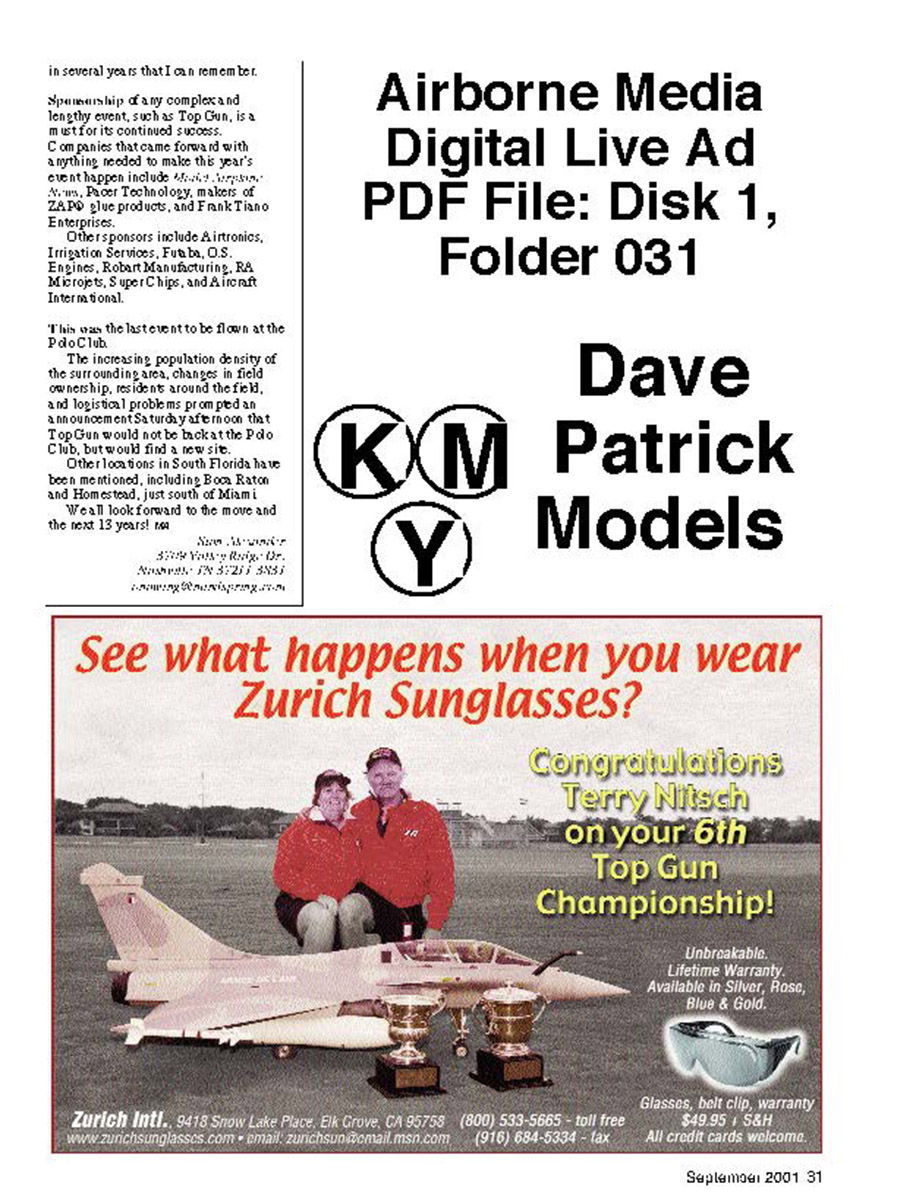
In the end, Terry won the class and "Mr. Top Gun" by only .542 of a point. His big Rafale B.01 from a BVM kit is powered by twin turbine engines, and is finished with the PPG paint system.
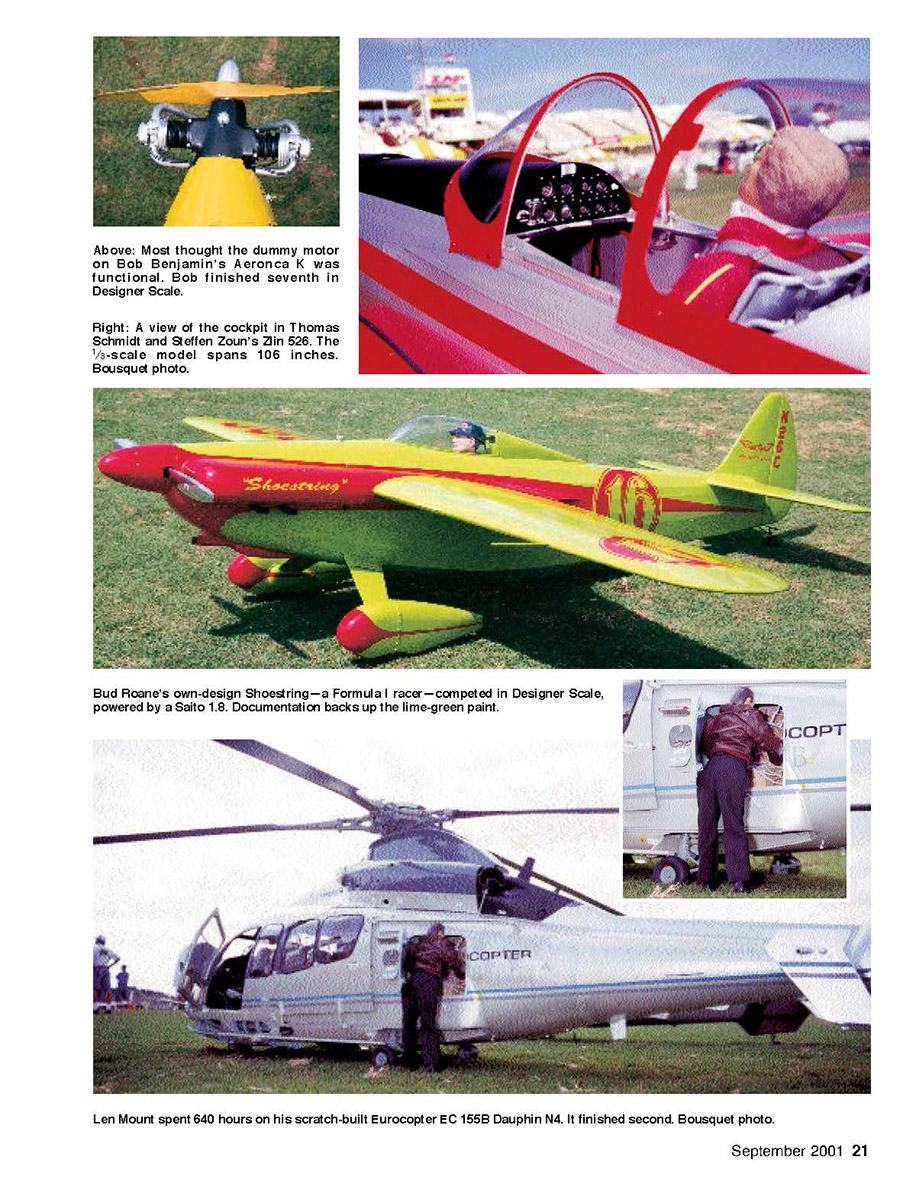
Greg Hahn flew a new model of the P-61 Black Widow with a D-Day paint scheme on very convincing missions.
Sponsorship of any complex and lengthy event, such as Top Gun, is a must for its continued success. Companies that came forward with anything needed to make this year's event happen include Aeroworks, Ams, Pacer Technology, makers of ZAPO glue products, and Frank Tiano Enterprises.
Other sponsors include Airtronics, Irrigation Services, Futaba, O.S. Engines, Robert Manufacturing, R.A. Microjets, SuperChips, and Aircraft International.
This was the last event to be flown at the Polo Club.
The increasing population density of the surrounding areas, changes in field ownership, residents around the field, and logistical problems prompted an announcement Saturday afternoon that Top Gun would not be back at the Polo Club, but would find a new site.
Other locations in South Florida have been mentioned, including Boca Raton and Homestead, just south of Miami.
We all look forward to the move and the next 13 years! rae
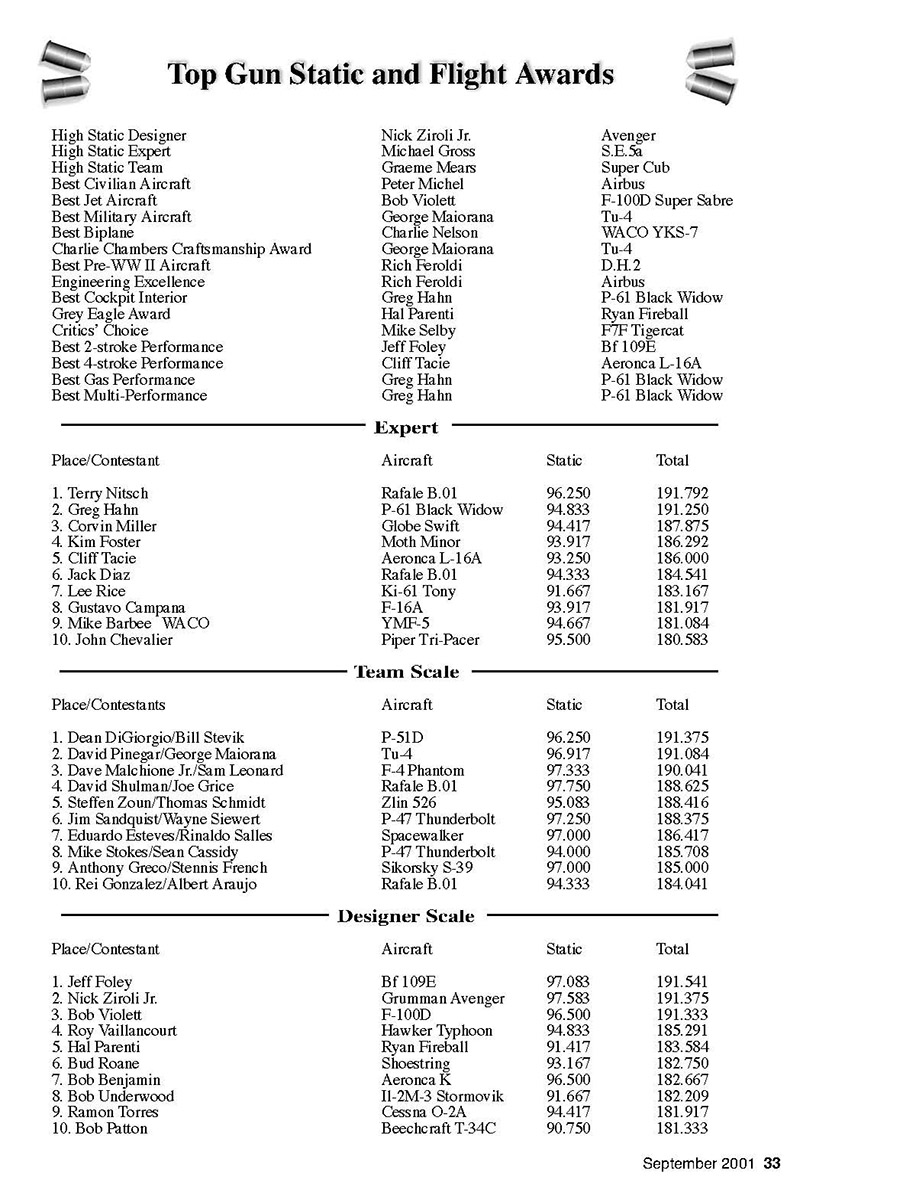
Top Gun Static and Flight Awards
- High Static Designer - Nick Ziroli Jr. - Avenger
- High Static Expert - Michael Gross - S.E.5a
- High Static Team - Graeme Mears - Super Cub
- Best Civilian Aircraft - Peter Michel - Airbus
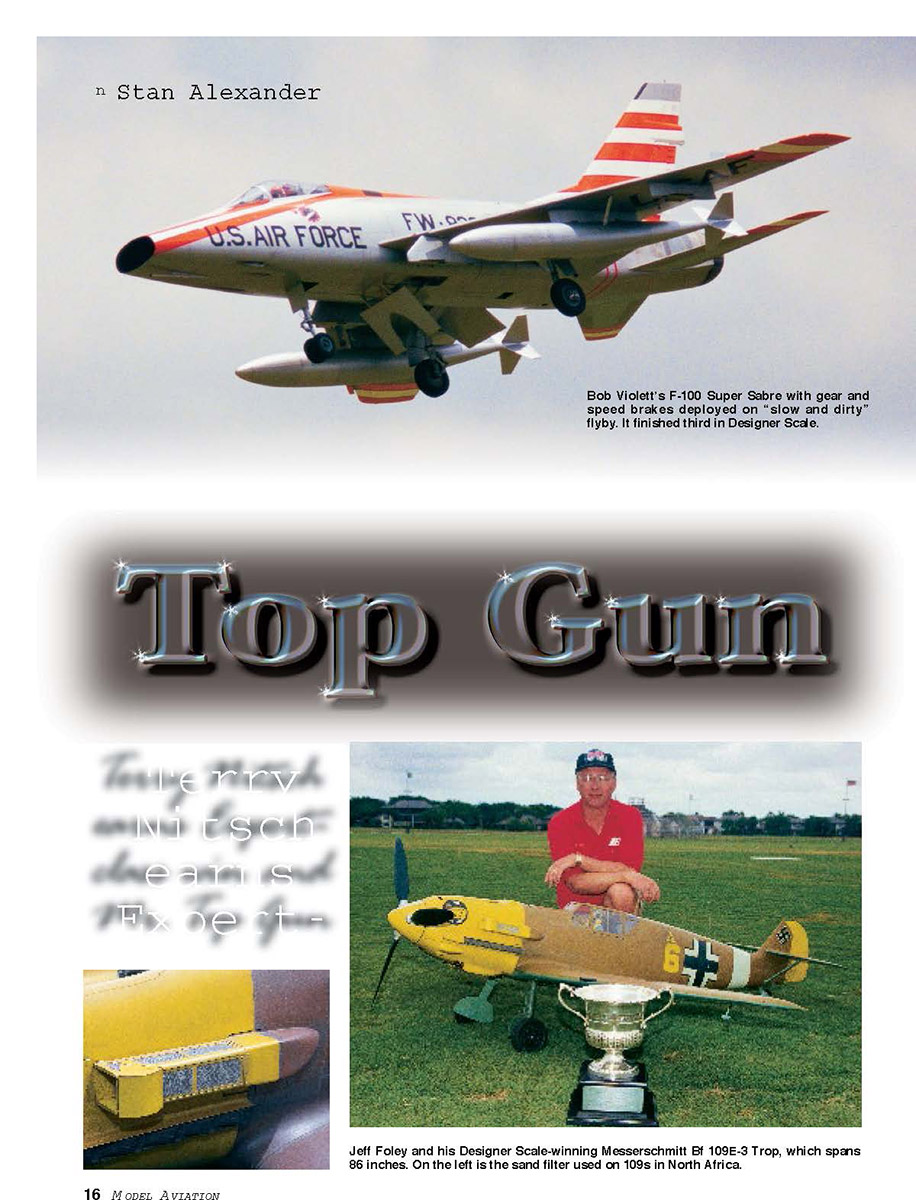
- Best Jet Aircraft - Bob Violett - F-100D Super Sabre
- Best Military Aircraft - George Maiorana - Tu-4
- Best Biplane - Charlie Nelson - WACO YKS-7
- Charlie Chambers Craftsmanship Award - George Maiorana - Tu-4
- Best Pre-WW II Aircraft - Rich Feroldi - D.H.2
- Engineering Excellence - Rich Feroldi - Airbus
- Best Cockpit Interior - Greg Hahn - P-61 Black Widow
- Grey Eagle Award - Hal Parenti - Ryan Fireball
- Critics' Choice - Mike Selby - F7F Tigercat
- Best 2-stroke Performance - Jeff Foley - Bf 109E
- Best 4-stroke Performance - Cliff Tacie - Aeronca L-16A
- Best Gas Performance - Greg Hahn - P-61 Black Widow
- Best Multi-Performance - Greg Hahn - P-61 Black Widow
Expert
- Terry Nitsch — Rafale B.01 — 96.250 — 191.792
- Greg Hahn — P-61 Black Widow — 94.833 — 191.250
- Corvin Miller — Globe Swift — 94.417 — 187.875
- Kim Foster — Moth Minor — 93.917 — 186.292
- Cliff Tacie — Aeronca L-16A — 93.250 — 186.000
- Jack Diaz — Rafale B.01 — 94.333 — 184.541
- Lee Rice — Ki-61 Tony — 91.667 — 183.167
- Gustavo Campana — F-16A — 93.917 — 181.917
- Mike Barbee/WACO — YMF-5 — 94.667 — 181.084
- John Chevalier — Piper Tri-Pacer — 95.500 — 180.583
Team Scale
- Dean DiGiorgio/Bill Stevik — P-51D — 96.250 — 191.375
- David Pinegar/George Maiorana — Tu-4 — 96.917 — 191.084
- Dave Malchione Jr./Sam Leonard — F-4 Phantom — 97.333 — 190.041
- David Shulman/Joe Grice — Rafale B.01 — 97.750 — 188.625
- Steffen Zoun/Thomas Schmidt — Zlin 526 — 95.083 — 188.416
- Jim Sandquist/Wayne Siewert — P-47 Thunderbolt — 97.250 — 188.375
- Eduardo Esteves/Rinaldo Salles — Spacewalker — 97.000 — 186.417
- Mike Stokes/Sean Cassidy — P-47 Thunderbolt — 94.000 — 185.708
- Anthony Greco/Stennis French — Sikorsky S-39 — 97.000 — 185.000
- Rei Gonzalez/Albert Araujo — Rafale B.01 — 94.333 — 184.041
Designer Scale
- Jeff Foley — Bf 109E — 97.083 — 191.541
- Nick Ziroli Jr. — Grumman Avenger — 97.583 — 191.375
- Bob Violett — F-100D — 96.500 — 191.333
- Roy Vaillancourt — Hawker Typhoon — 94.833 — 185.291
- Hal Parenti — Ryan Fireball — 91.417 — 183.584
- Bud Roane — Shoestring — 93.167 — 182.750
- Bob Benjamin — Aeronca K — 96.500 — 182.667
- Bob Underwood — Il-2M-3 Stormovik — 91.667 — 182.209
- Ramon Torres — Cessna O-2A — 94.417 — 181.917
- Bob Patton — Beechcraft T-34C — 90.750 — 181.333
Transcribed from original scans by AI. Minor OCR errors may remain.

