
Trike Tricks
Keep your model on the straight-and-narrow with these tips
■ Steve Springer
Tricycle landing gear is by far the most popular type, especially on trainer aircraft. If you would like to improve the performance of your trike-gear airplane, try some of the following suggestions.
Nose gear: common problems and solutions
Consider replacing the nose gear that came with your airplane. Many of the nose gear included with kits and Almost Ready to Fly models (ARFs) have two inherent problems:
- The small-diameter or low-quality wire allows excessive flexing. In a hard landing or on a rough field this often results in a damaged prop.
- The relationship of the nose wheel to the attachment point of the gear imparts a twisting motion when it strikes the ground or encounters a rock, which may result in servo damage. During a less-than-perfect landing, this twisting force can jerk the nose wheel sharply, collapsing the nose gear and snapping the prop.
The solution? A Fults Dual Strut nose gear. The design includes two springs, with the wheel centered between them, solving the off-center geometry problem. Although the gear has a fair degree of flexibility to absorb landing loads, it rarely flexes enough to break a prop. Its rugged construction has withstood years of punishing landings, outlasting several airplanes.
You don't want to spend $15–20 for better gear? In two flying sessions, I saved enough in broken props to cover the cost.
Improper nose-gear caster is another problem.
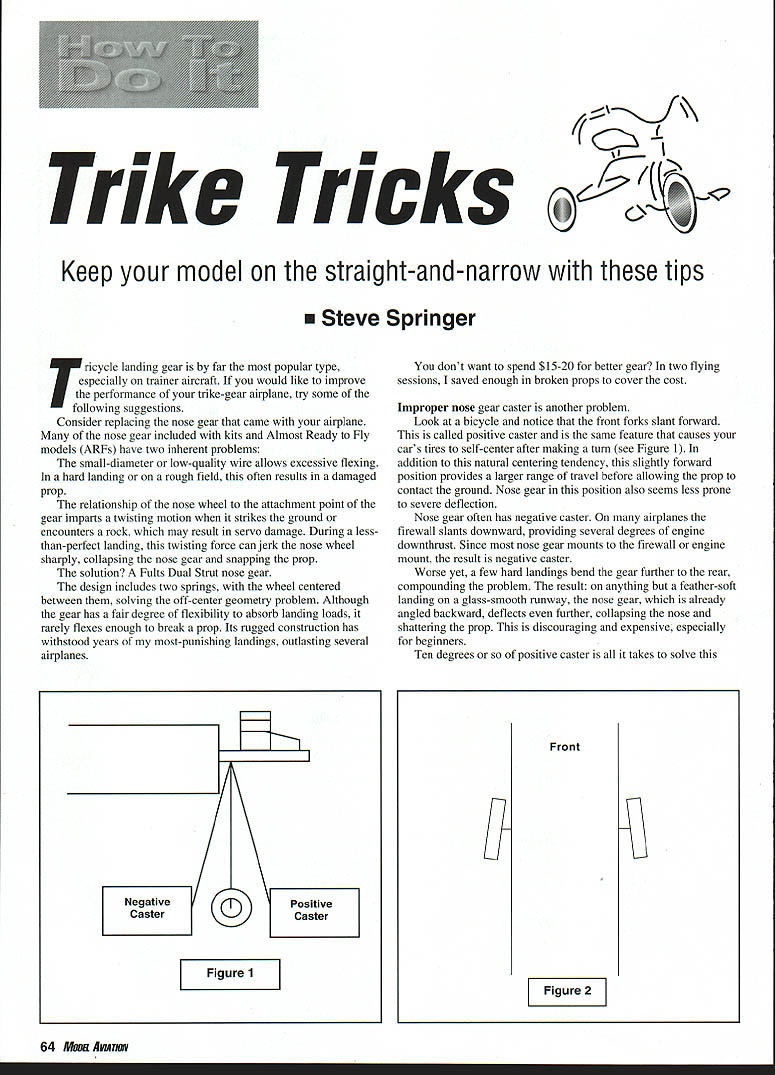
Look at a bicycle and notice that the front forks slant forward. This is called positive caster and is the same feature that causes your car's tires to self-center after making a turn. In addition to this natural centering tendency, this slightly forward position provides a larger range of travel before allowing the prop to contact the ground. Nose gear in this position also seems less prone to severe deflection.
Nose gear often has negative caster. On many airplanes the firewall slants downward, providing several degrees of engine downthrust. Since most nose gear mounts to the firewall or engine mount, the result is negative caster.
Worse yet, a few hard landings can bend the gear further to the rear, compounding the problem. The result: on anything but a feather-soft landing on a glass-smooth runway, the nose gear, which is already angled backward, deflects even further, collapsing the nose and shattering the prop. This is discouraging and expensive, especially for beginners.
About ten degrees of positive caster is all it takes to solve this problem. The Fults gear bends easily to the required angle while installed on your airplane. Other gear may need to be removed and secured in a vise while bending.
For rough fields, Du-Bro and Great Planes make a device called Servo Saver that will help protect your cowl servo after it has been pounding. This gadget contains small springs that absorb some of the jolts and shocks that would otherwise be transmitted to the servo. It's inexpensive and easy to install.
Preventing creep and reducing steering sensitivity
Does your airplane creep forward at idle? Try moving the wheel collar closer to the front of the wheel, creating just enough friction to prevent airplane movement at idle. A small section of fuel tubing inserted between the wheel collar and wheel produces a similar result. If you use the minimum drag possible, takeoff will be almost unaffected, but landing roll will be considerably less. Ground control will be significantly better.
- Don’t try this on the main gear; it is nearly impossible to create equal drag on both wheels. Fellow pilots will not appreciate your airplane veering toward the pit area on takeoff or landing.
For a straighter takeoff, reduce the amount of nose-wheel movement. Many airplanes are set up with excess control throw, causing overcontrol when accelerating on takeoff.
- Connect the control rod to the outermost hole on the control horn that attaches to the nose gear.
- At the servo, use the innermost hole.
It will seem that the nose wheel barely turns, but on most fields you don't need a small turning radius. If you need more steering control, adjusting the servo attachment point is generally easier.
Main gear: wing angle and incidence
With the main gear, incorrect wing angle relative to the ground is one of the most common problems. On most aircraft, the wing and horizontal stabilizer should be parallel to the ground.
How do you check for parallel? A Robart or Great Planes incidence meter is the best tool, but a small level will also do the trick. Check the building plans for the proper wing incidence (usually 0°), set your airplane on a level surface, then place the level on the horizontal tail. If the bubble is in the center, you're done.
- If the bubble is toward the nose (the most common condition), gently bend the main gear toward the fuselage until you achieve level.
- If the bubble is toward the tail, gently pull the gear out.
You could also raise or lower the nose gear, but lowering the nose gear may not be possible, and prop clearance is reduced.
Hard landings are the main cause of a nose-high condition. Beginners are especially hard on the main gear, but all of us have occasional firm landings. This creates a positive incidence effect of the wings relative to the ground and causes two problems:
- On takeoff, the aircraft will often lift off before you are ready, and before the airplane has sufficient flying speed.
- On landing, the airplane is prone to bounce.
Two or three degrees of nose-down attitude will solve these problems. However, too much may cause your airplane to leap off the ground on takeoff as the main wing rotates from a negative to a positive angle of attack.
Toe-in and other tips for better tracking
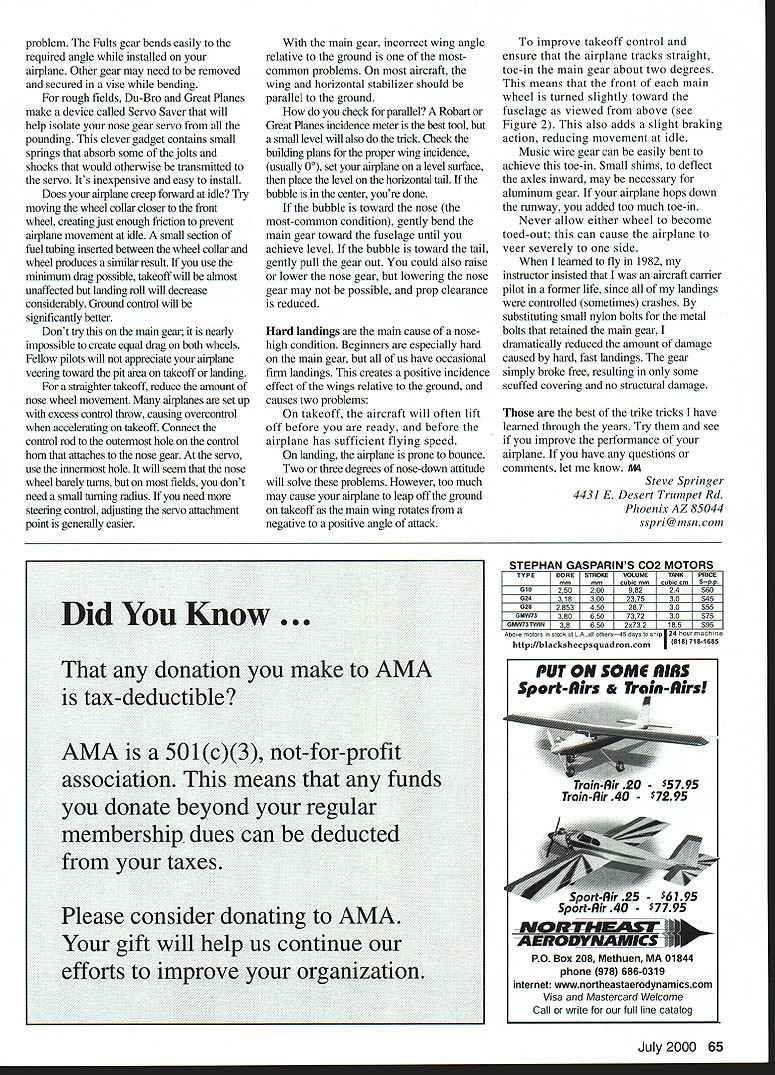
To improve takeoff control and ensure that the airplane tracks straight, toe-in the main gear about two degrees. This means that the front of each main wheel is turned slightly toward the fuselage as viewed from above. This also adds a slight braking action, reducing movement at idle.
- Music wire gear can be easily bent to achieve this toe-in.
- Small shims, to deflect the axles inward, may be necessary for aluminum gear.
- If your airplane hops down the runway, add double that much toe-in.
Never allow either wheel to become toe-out; this can cause the airplane to veer severely to one side.
When I learned to fly in 1982, my instructor insisted that I was an aircraft carrier pilot in a former life, since all of my landings were controlled (sometimes) crashes. By substituting small nylon bolts for the metal bolts that retained the main gear, I dramatically reduced the amount of damage caused by hard, fast landings. The gear simply broke free, resulting in only some scuffed covering and no structural damage.
Those are the best of the trike tricks I have learned through the years. Try them and see if you improve the performance of your airplane. If you have any questions or comments, let me know.
Steve Springer 4431 E. Desert Trumpet Rd. Phoenix, AZ 85044 [email protected]
Transcribed from original scans by AI. Minor OCR errors may remain.

