
Twin Tuning - 2007/08
By Eric Henderson
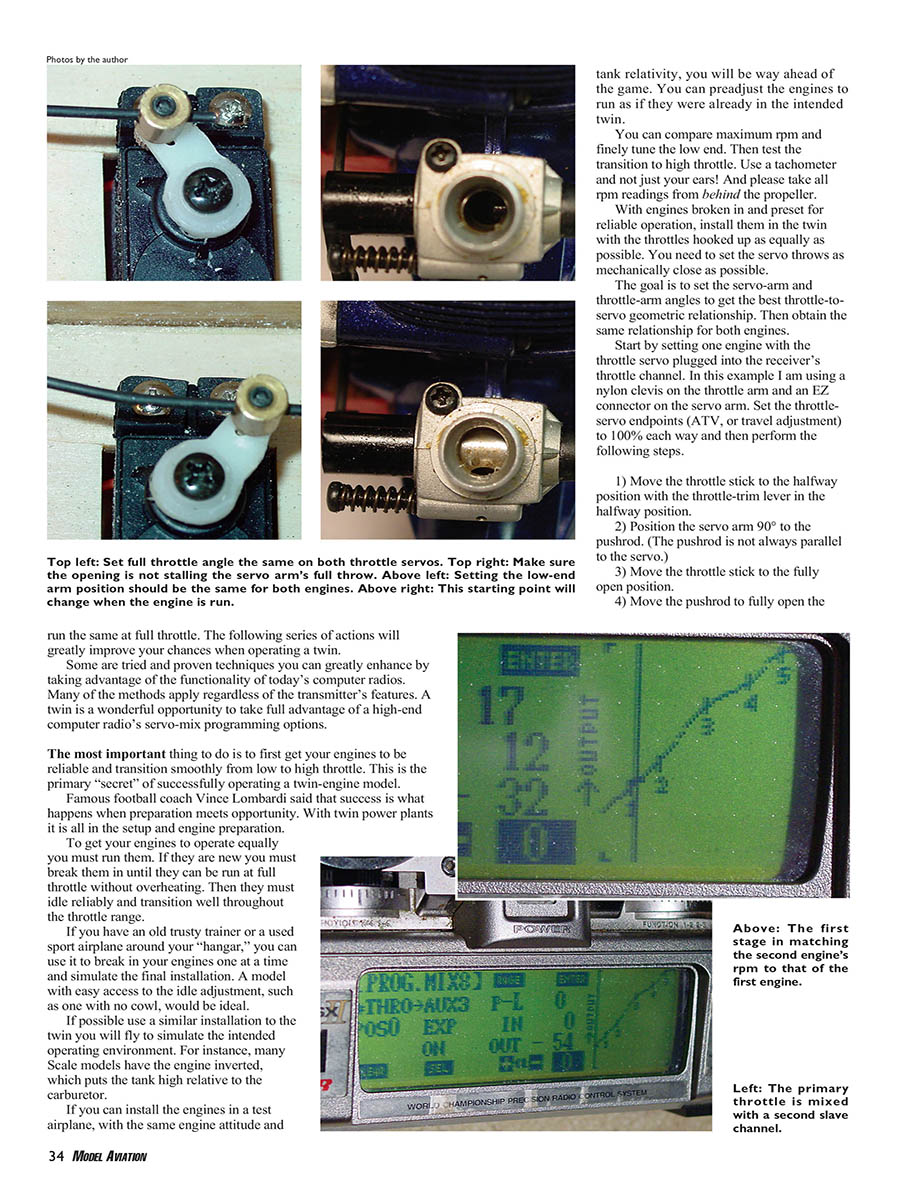
There is nothing like the sound of two engines beating out a synchronous thrum as you hold your model’s line in a scintillating low pass down the center of the runway. On the other hand, it does not sound right or handle very well if one of a twin aircraft’s engines is not set up to run as well as the other.
A twin-engine airplane is an attractive “next step” once you have become proficient at flying an RC airplane. Twins are much more readily available now than in the past because of an increasing selection of twin-engine ARFs. There are several basic versions you could call twin trainers and a range of more scalelike models that could tempt you to “go twin.”
When everything is working right, a twin is not that much different to fly from a single-engine model except for the sumptuous sound the former produces. Time spent working on a good initial setup greatly improves your chances of success.
Twins can be difficult to handle on the ground because of the outboard position of the engines, which are well away from the airplane’s centerline. During takeoff a centered fin and rudder does not have much steering effect until the airplane gains speed. Up to that moment you are basically relying on your engines to pull the model in a straight line. One engine pulling more than the other makes a twin hard to steer on the ground or guide in the air. It can also cause the model to tuck under a wing in a banked turn if your aircraft is going a bit slow.
Getting both engines to come up equally from idle is more important than having them run the same at full throttle. The following series of actions will greatly improve your chances when operating a twin. Some are tried-and-proven techniques you can greatly enhance by taking advantage of the functionality of today’s computer radios. Many of the methods apply regardless of the transmitter’s features.
A twin is a wonderful opportunity to take full advantage of a high-end computer radio’s servo-mix programming options. The most important thing to do is to first get your engines to be reliable and to transition smoothly from low to high throttle. This is the primary “secret” of successfully operating a twin-engine model.
Famous football coach Vince Lombardi said that success is what happens when preparation meets opportunity. With twin power plants it is all in the setup and engine preparation.
Preparation and engine break-in
To get your engines to operate equally you must run them. If they are new, break them in until they can be run at full throttle without overheating. Then ensure they idle reliably and transition well throughout the throttle range.
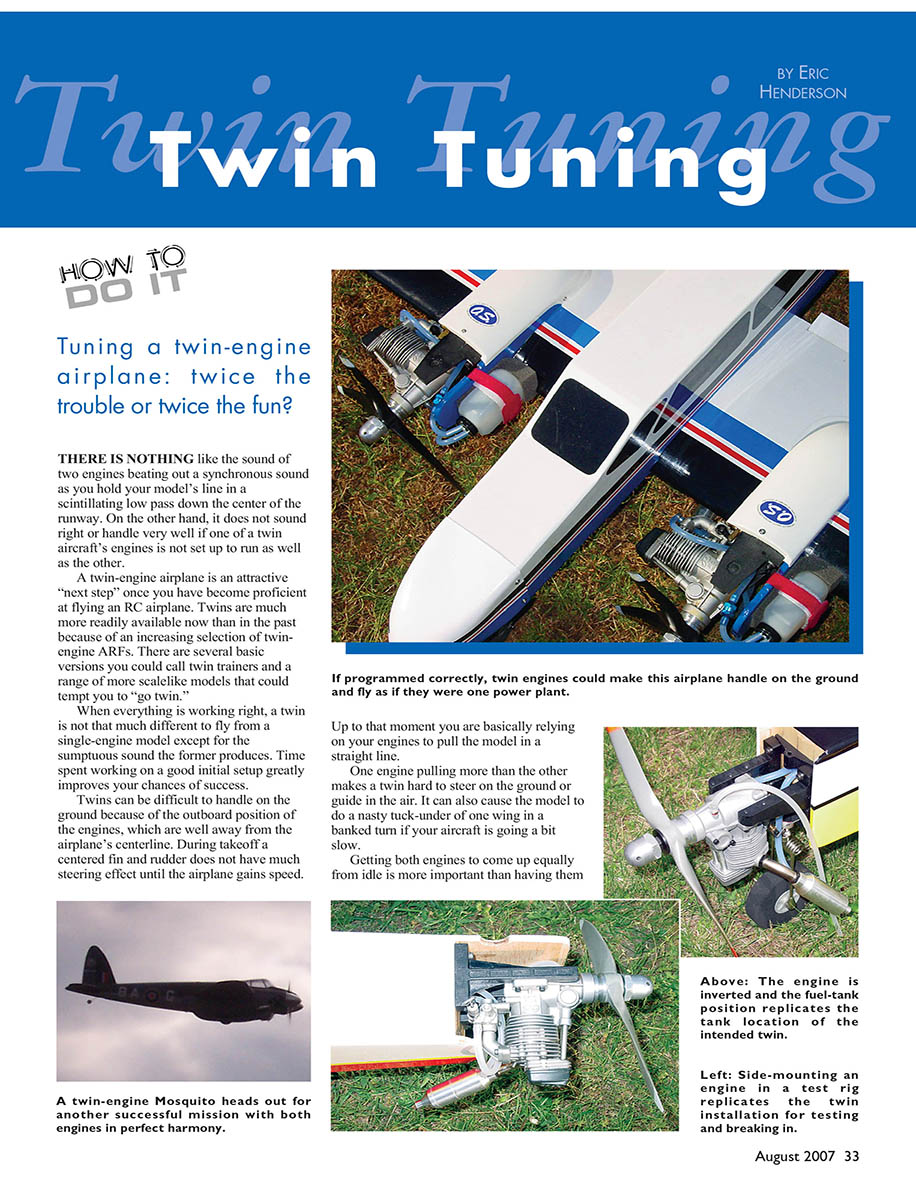
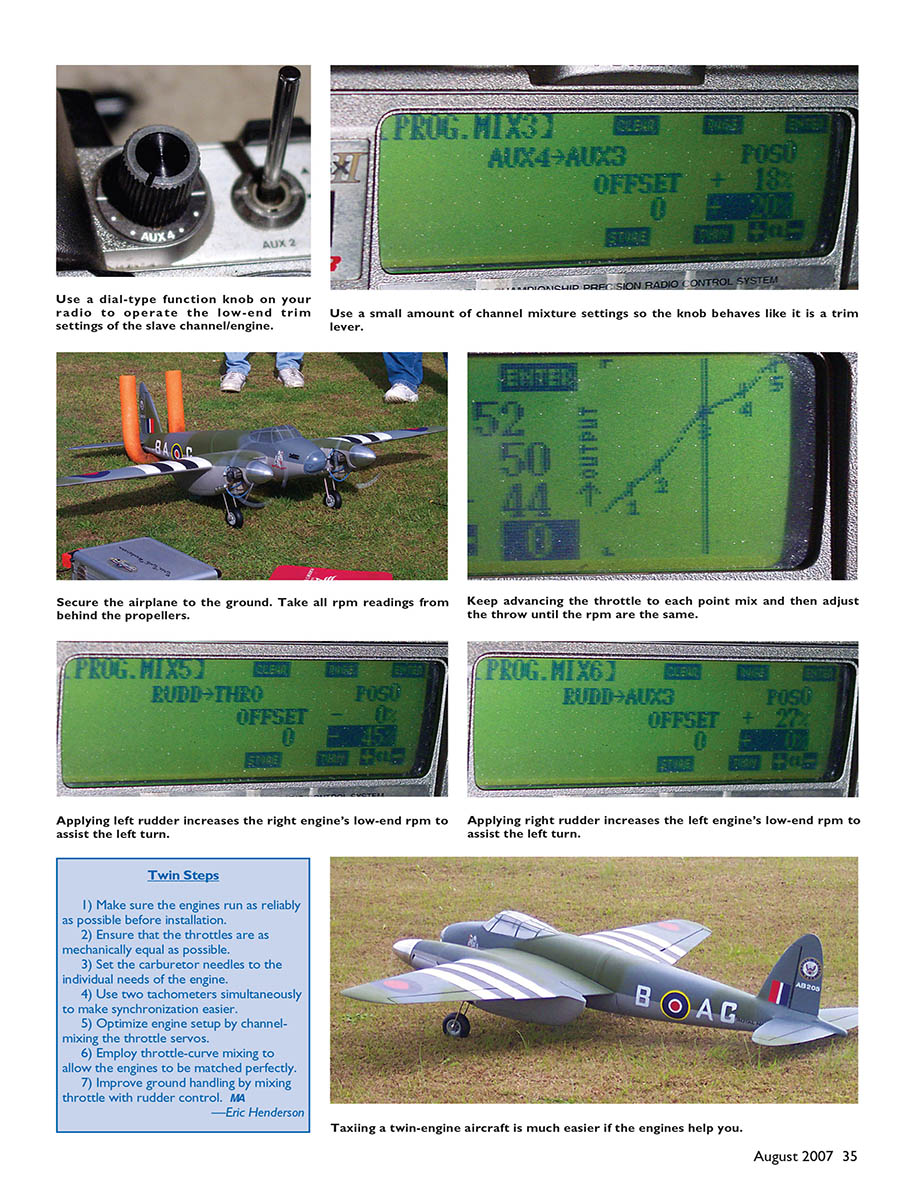
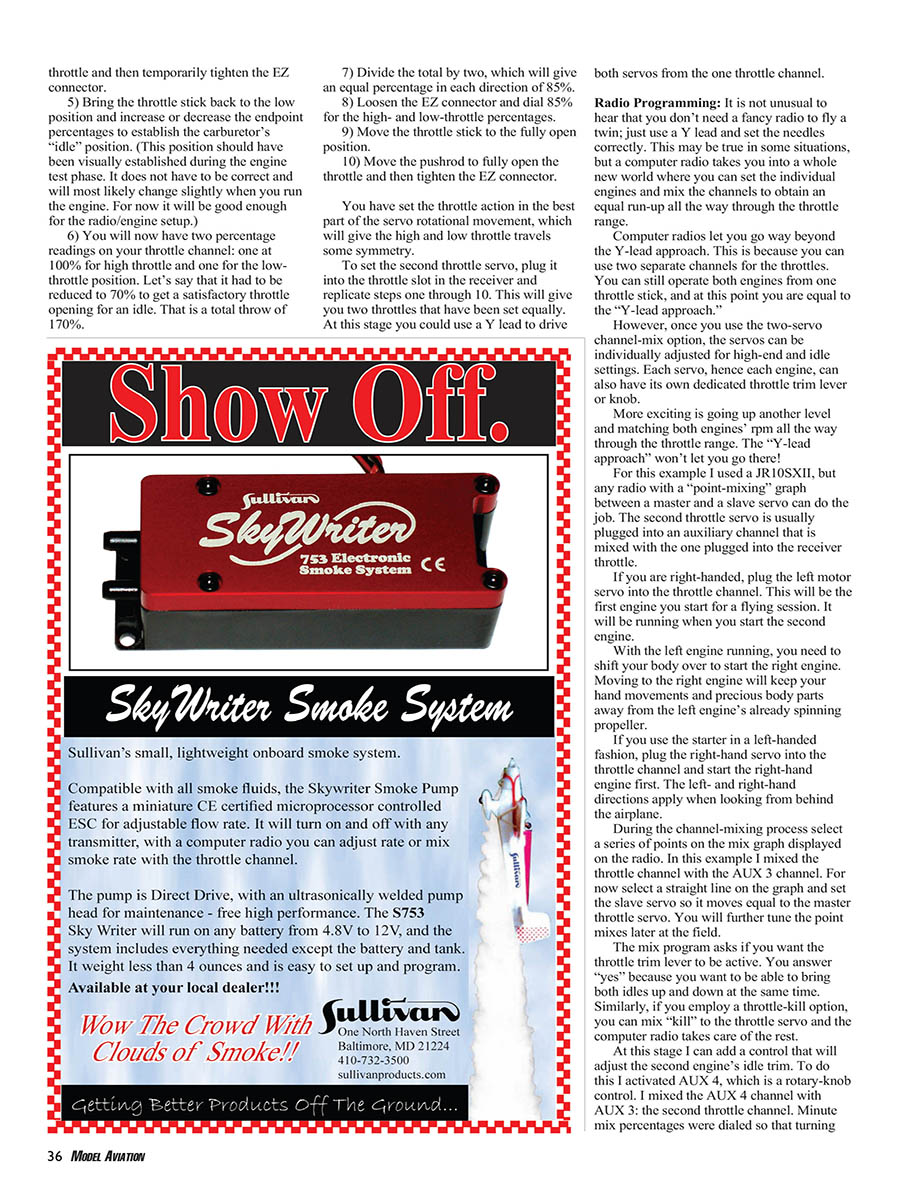
If you have an old trainer or a used sport airplane around your “hangar,” use it to break in your engines one at a time and simulate the final installation. A model with easy access to the idle adjustment, such as one with no cowl, is ideal. If possible, use a similar installation to the twin you will fly to simulate the intended operating environment. For instance, many scalelike models have the engine inverted, which puts the tank high relative to the carburetor. If you can install the engines in a test airplane with the same engine attitude and tank relationship, you will be way ahead of the game. You can preadjust the engines to run as if they were already in the intended twin.
You can compare maximum rpm and finely tune the low end. Then test the transition to high throttle. Use a tachometer and not just your ears! And please take all rpm readings from behind the propeller.
With engines broken in and preset for reliable operation, install them in the twin with the throttles hooked up as equally as possible. You need to set the servo throws as mechanically close as possible.
Mechanical throttle setup
The goal is to set the servo-arm and throttle-arm angles to get the best throttle-to-servo geometric relationship, and to obtain the same relationship for both engines. Set one engine first, then copy the results to the second.
Start by setting one engine with the throttle servo plugged into the receiver's throttle channel. In this example I use a nylon clevis on the throttle arm and an EZ connector on the servo arm. Set the throttle-servo endpoints (ATV, or travel adjustment) to 100% each way and then perform the following steps:
- Move the throttle stick to the halfway position with the throttle-trim lever in the halfway position.
- Position the servo arm at 90° to the pushrod. (The pushrod is not always parallel to the servo arm.)
- Move the throttle stick to the fully open position.
- Move the pushrod to fully open the carburetor and then temporarily tighten the EZ connector.
- Bring the throttle stick back to the low position and increase or decrease the endpoint percentages to establish the carburetor’s idle position. (This position should have been visually established during the engine test phase. It does not have to be final and will most likely change slightly when you run the engine. For now it will be good enough for the radio/engine setup.)
- You will now have two percentage readings on your throttle channel: one at 100% for high throttle and one for the low-throttle position. Let’s say the low position had to be reduced to 70% to get a satisfactory idle. That is a total travel of 170%.
- Divide the total by two, which gives an equal percentage in each direction of 85%.
- Loosen the EZ connector and dial 85% for the high- and low-throttle percentages.
- Move the pushrod to fully open the throttle and then tighten the EZ connector.
You have now set the throttle action in the most efficient part of the servo’s rotational movement, giving the high- and low-throttle travels some symmetry.
To set the second throttle servo, plug it into the throttle slot in the receiver and replicate steps 1 through 10. This will give you two throttles that have been set equally. At this stage you could use a Y lead to drive both servos from the single throttle channel if you choose.
Twin steps (overview)
- Optimize engine setup by channel-mixing the throttle servos.
- Employ throttle-curve mixing to allow the engines to be matched perfectly through the throttle range.
- Improve ground handling by mixing throttle with rudder control.
Radio programming
It is not unusual to hear that you don’t need a fancy radio to fly a twin—just use a Y lead and set the needles correctly. This may be true in some situations, but a computer radio takes you into a whole new world where you can set the individual engines and mix the channels to obtain an equal run-up all the way through the throttle range.
Computer radios let you go way beyond the Y-lead approach because you can use two separate channels for the throttles while still operating both engines from one throttle stick. Once you use the two-servo channel-mix option, the servos can be individually adjusted for high-end and idle settings. Each servo, hence each engine, can also have its own dedicated throttle trim lever or knob.
More exciting is matching both engines’ rpm all the way through the throttle range. The “Y-lead approach” won’t let you do that.
For this example I used a JR10SXII, but any radio with a “point-mixing” graph between a master and a slave servo can do the job. The second throttle servo is usually plugged into an auxiliary channel that is mixed with the one plugged into the receiver throttle.
If you are right-handed, plug the left motor servo into the throttle channel. This will be the first engine you start for a flying session and will be running when you start the second engine. With the left engine running, shift your body to the right to start the right engine; moving to the right keeps your hand movements and precious body parts away from the left engine’s already spinning propeller.
(If you use the starter left-handed, plug the right-hand servo into the throttle channel and start the right-hand engine first. Left and right are given as seen from behind the airplane.)
During the channel-mixing process, select a series of points on the mix graph displayed on the radio. In this example I mixed the throttle channel with AUX 3. For now select a straight line on the graph and set the slave servo so it moves equal to the master throttle servo. You will further tune the point mixes later in the air.
The mix program asks if you want the throttle trim lever to be active. Answer “yes” because you want to be able to bring both idles up and down at the same time. Similarly, if you employ a throttle-kill option, you can mix “kill” to the throttle servos and the computer radio will take care of both engines.
At this stage you can add a control that adjusts the second engine’s idle trim. I activated AUX 4 (a rotary-knob control) and mixed AUX 4 with AUX 3 (the second throttle channel). Minute mix percentages were dialed so that turning the knob moves the second engine’s idle setting in small steps. I also mixed a small amount of rudder into both throttles so I could add a little counter-bias to help overcome any asymmetry on takeoff.
This works well for smaller twins with less torque, but bigger engines may require more rudder authority. Turning the knob had a small effect on servo movement, similar to a throttle trim lever.
You do not want the auxiliary throttle trim to be active all the way through the throttle-stick movement. You can prevent and control this by using the throttle-stick position option as a switch. Once the throttle stick is advanced beyond approximately 15% open, the trim mix can be turned off.
Running the engines
Secure the airplane with a reliable restraint. Start the left engine and adjust for optimum running performance. Turn that engine off and start the second engine. It should be close in regards to throttle range. You can adjust the low-end rpm with the AUX 4 trim knob.
If this is not enough, adjust the low-throttle endpoint via the mix settings between the left and right engines rather than using the global endpoint option. The point-mix relationship is where you want to make all fine tuning adjustments.
Next, find two similar tachometers. A good safety practice is to tape each one to a small stake and position one behind each engine’s propeller blades. Start the engines, warm them up, and then set the idle rpm to be equal with the radio trims. Anything between 2,000 and 2,500 rpm is good for this exercise.
Then go to the throttle-servo’s mix-adjustment graph on your computer-radio screen. Advance the throttle to the first point on the graph. Increase or decrease the mix percentage for the right engine until it holds the same rpm as the left engine.
For example, if the left engine reads 3,250 rpm and the right engine reads 3,100 rpm, bump up the mix until the right engine also reads 3,250 rpm. Move the throttle to the next point on the graph and match the rpm again. Do this for all points on the graph, including maximum rpm. Many systems (such as the JR 10SXII and 10X) let you create seven points on the mix graph and turn that into an exponential curve between each point.
Now you have two synchronized engines that will pull your twin airplane in a straight line at all throttle positions. However, synchronizing rpm through the throttle range does not by itself help you taxi your model on the runway.
You may have heard that “You don’t need a fancy radio to taxi a twin.” This may be true in certain situations, but there is nothing like being able to swing a twin’s tail around with throttle-assisted rudder.
The inboard wheel can be made to almost stay put as the airplane spins around. It is as if there were a pilot onboard doing the job. It makes turning on grass much easier for a tail-dragger, and is especially advantageous for a warbird twin, such as a Mosquito, that loves to tip forward at any opportunity.
If you have come this far with your computer-radio mixing, you might as well have throttle-assisted turning—if for no other reason than you can!
You should have no trouble getting one engine to increase rpm by applying rudder. The way to set this up is to have left rudder request a small rpm increase on the right engine and right rudder request a small rpm increase on the left engine.
How much throttle mix to apply is a matter of experimentation. An increase to about 3,500 rpm has proven manageable during taxi runs. Also, using the throttle position as a switch lets you disengage this option during flight and takeoff. Remember that nothing happens unless you apply the rudder in the first place.
If you have done all the preceding, you now have a tuned-up twin-engine model. You have improved your airplane’s flying capabilities, engine operation, and general handling characteristics.
You can run each engine individually. You can move both engines’ idle at the same time. You can adjust and balance the right engine with an auxiliary trim knob. You can taxi your model like a full-scale twin and maneuver it in tight spaces. Most of all, you have improved your aircraft’s chances of success on takeoff and landing.
Now all you have to do is accept a low-level mission over Holland to release freedom fighters from the clutches of their evil captors. Your tuned-up Mosquito is warming its Merlins for the dawn raid and awaiting its pilot!
Eric Henderson [email protected]
Transcribed from original scans by AI. Minor OCR errors may remain.

