
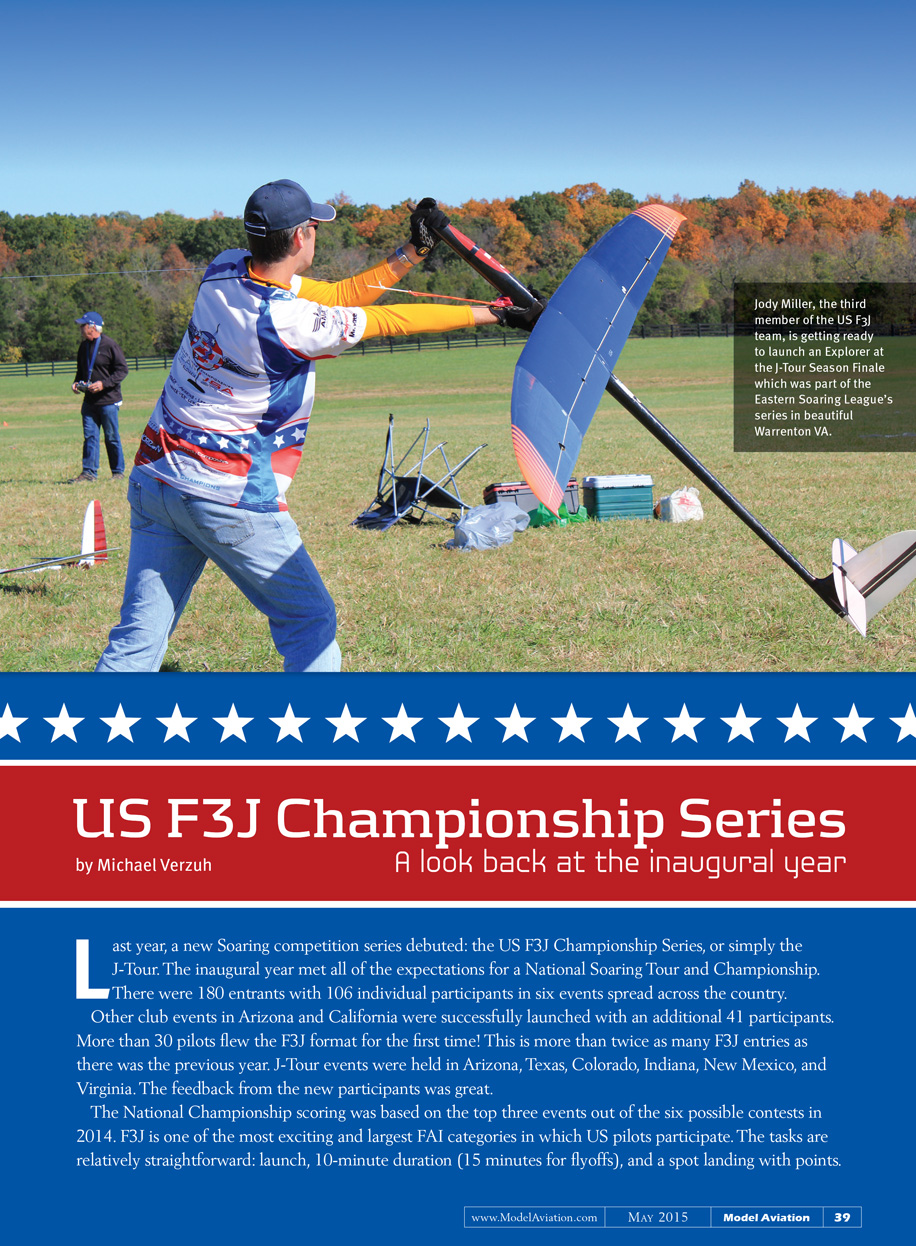
US F3J Championship Series
by Michael Verzuh
A look back at the inaugural year
Last year a new soaring competition series debuted: the US F3J Championship Series, or simply the J-Tour. The inaugural year met expectations for a national soaring tour and championship. There were 180 entrants with 106 individual participants in six events spread across the country. Other club events in Arizona and California were successfully launched with an additional 41 participants. More than 30 pilots flew the F3J format for the first time — more than twice as many F3J entries as the previous year. The feedback from the new participants was great.
J-Tour events were held in:
- Arizona
- Texas
- Colorado
- Indiana
- New Mexico
- Virginia
National Championship scoring was based on the top three events out of the six possible contests in 2014. F3J is one of the most exciting and largest FAI categories in which US pilots participate. The tasks are relatively straightforward:
- Launch
- 10-minute duration (15 minutes for flyoffs)
- Spot landing with points
Typical sailplane characteristics:
- Wingspan: 3.6 to 4.0 meters
- Weight: no more than 4 to 5 pounds
These airplanes are amazingly efficient and can stay aloft for 6 to 8 minutes with a good launch. However, the task time is 10 to 15 minutes and, to achieve this, the pilot must find rising air. This is where the fun and challenge comes in.
A good analogy is that it is like a giant chess game spread across two square miles. Pilots who choose the correct portion of the field are rewarded with thermal activity; those who don't must either reach the rising air or risk losing the round by landing early or, worse, off the field.
Mastering piloting skills is only the first step. Pilots must also master an understanding of thermal activity and "air reading." Thus the J-Tour motto is "Own the Air."
The J-Tour follows the FAI F3J rule set, except that launching is accomplished with winches rather than a two-man tow. This has allowed much broader participation because many Thermal Duration pilots are used to winch launching. Winches are spaced 17 to 18 meters apart, which provides sufficient separation. Pilots launch at the start of the 10-minute window on the horn and then must touch down before the closing horn. If they are late, they lose the possible 100 points for the landing and suffer an additional 30-point penalty. Despite the simultaneous launches and landings, pilots do a great job of keeping blue sky between the airplanes, staying in their launch corridor, and landing into the wind in sync with their neighbors.
A telling commentary from an F3J newcomer on the 2014 tour: "I went into this event with two preconceived notions about F3J — that it would be an intense pressure-cooker-type situation, and that there would be mass carnage involving planes. Neither of those things turned out to be true. Once the first round was underway, a rhythm developed with the team that actually made it kind of relaxing."
"Because you are on a team there is always something to do — launching, timing, entering scores, shagging lines, calling air, or talking smack about other teams. It actually makes it very fun and never boring. And yes, there is always the possibility of breaking an airplane, but no more than at any other competition I have been to — at least that's how I felt."
Transcribed from original scans by AI. Minor OCR errors may remain.

