
US Free Flight Championships
John Oldenkamp
FOR FREE FLIGHT contest zealots, the United States Free Flight Championships is always a Big Deal: It is one of only two Category I meets remaining in the US (the other being the San Diego Orbiters Annual).
The USFFC offers a multitude of entry options during a three-day schedule (there were 58 events in 1999, including 15 AMA; six FAI; four Nostalgia; 19 Old-Timers; five Scale; and nine "Special" events). It is flown on the huge and relatively level Lost Hills, California venue that easily supports high scores and extended flyoffs, but with safe and efficient retrieves on its treeless field of play. Quite a package, that USFFC.
The 1999 USFFC wore a new face, a slightly more-svelte shape, and improved pocketbook strategy. The recent hostile ambient conditions during the El Niño period led to consensus for a timetable shift to early November (6-8) dates, researched from 50 years of local weather history that showed that choice benign to the max, and certainly cooler than the 1994-1998 Labor Day dates.
The events list had been cleaned up a bit, reducing it from prox 70 down to 58; Corporate, company, and individual sponsors/contributors were solicited so that trophy and award merchandise would be virtually no drag on the CUFFMAC (California United Free Flight Model Airplane Clubs) collective purse. Some satisfaction was also generated by the fact that the dates selected ran concurrent with the Veterans' Day "partial" holiday that applied to many participants.
By any measure, the 1999 United States Free Flight Championships was the best-organized, best-managed, best-ever of the previous 28 productions. Entry and exit from the officials' tables was easy—almost instant. Scorekeeping was flawless. The heaps of prizes and trophies laid out for each event were dazzling. Many hands manned (and womanned) this important but sometimes-lacking contest facility. And just 12 feet away, pleasant aromas from Jay Sloane's dining fly beckoned. Several more paces led to Al Heinrich's full-service on-field Aerodyne Model Products shop. Major, major arrangements here!
But for the relative hordes that attended, the weather was not all that attractive. Unaccountably high winds plagued the entire weekend, causing many present not to fly at all and made chases difficult for those without wheelgoals. More than a few airplanes found new, distant homes despite the generous Lost Hills dimensions. One could not have predicted on Friday, one of the most spectacular test-flying days ever on the venue, that the Saturday opener would be so, well, unpleasant.
It was.
The usually frenetic flightline was deserted early on. Wisps of fine dust moved through open windows, toolboxes, open foods. A bitter and chill wind pulled flags and tarps level. The wisest among us packed up and stayed in their cars, or read, or made repairs. Others fought on. Many of the champs showed superb technique and nerve and managed to post wins in conditions that would have humbled lesser technicians. sat in our rigs with engine running, heater on, and coffee at hand, well past midmorning—a mark where the top fliers usually have big max strings and are kicking back to see what the others are up to (or are having lunch, given the 0700 start time). The fabled California Great Central Valley seemingly was about to let us down again as it had three of the past four years. Drat!
Sometime after 1030, Business Manager Lynn Pulley sent off what appeared to be an AMA C Gas model, testing what could only be described as slightly improved flight parameters. The end of the power run showed smooth air above, but with very strong drift; the airplane descending after about a minute at least 3/4 mile distant.
After a brief huddle, Pulley and Contest Directors Steve Moffatt and Ralph Pryee declared the meet Category III. Unprecedented, but there was one! Accordingly, the FAI slate, perhaps more equipment-critical, was scrubbed until the following day, as were Dawn P-30 and Twin Pusher. Even so, fliers were traversing a lot of real estate going after their fleeing machinery, some of which "left the building," so to speak.
Resiliency being the commodity in Free Flight that it is, however, watchful fliers went "one leg then the other" as minor calmings developed at about 1,100, scurrying into the air through a window of useful lift, that lasting 90 minutes or so. Carl Redlin had the day's high time with his OT C Rubber Stick (1,030 seconds). The winners in B Gas Old Time Fuselage (Sal Taibi), AMA D Gas (Dave Anderson), and AMA 1/2 A Gas (Terry Thorkildsen) each had maxouts plus, with times of 777, 692, and 677 respectively. Other winning/placing times were on the low side of terrific, but all events were completed.
In late afternoon there was another uptick in wind velocity, so untested airplanes abbed for the Sunday schedule remained untested.
A monochromatic sunset footnoted a trying day.
Saturday night entertainment consisted of watching tents and awnings go horizontal, silt and sand infiltrating any unsealed crevices, and the passage of great trains of ragged cumulus, the leading edge of an encroaching low-pressure system from the north.
Caterer Jay "Chez" Sloane's entire 20 x 20-foot kit went down at 0300 amidst the clatter of heavy pans, stands, tables, tarps, poles, glassware, and the hiss of propane tanks separated from their appliances. Those of us safely off the Motel 6 porch in "town" were unaffected, dinner at the "new" Denny's notwithstanding. It was actually above-average!
Potluck weather continued for Sunday, with cool-to-medium temps, breezy/windy back to windy to partial calm with increasingly occluded conditions developing—not really bad, but not overly pleasant, either.
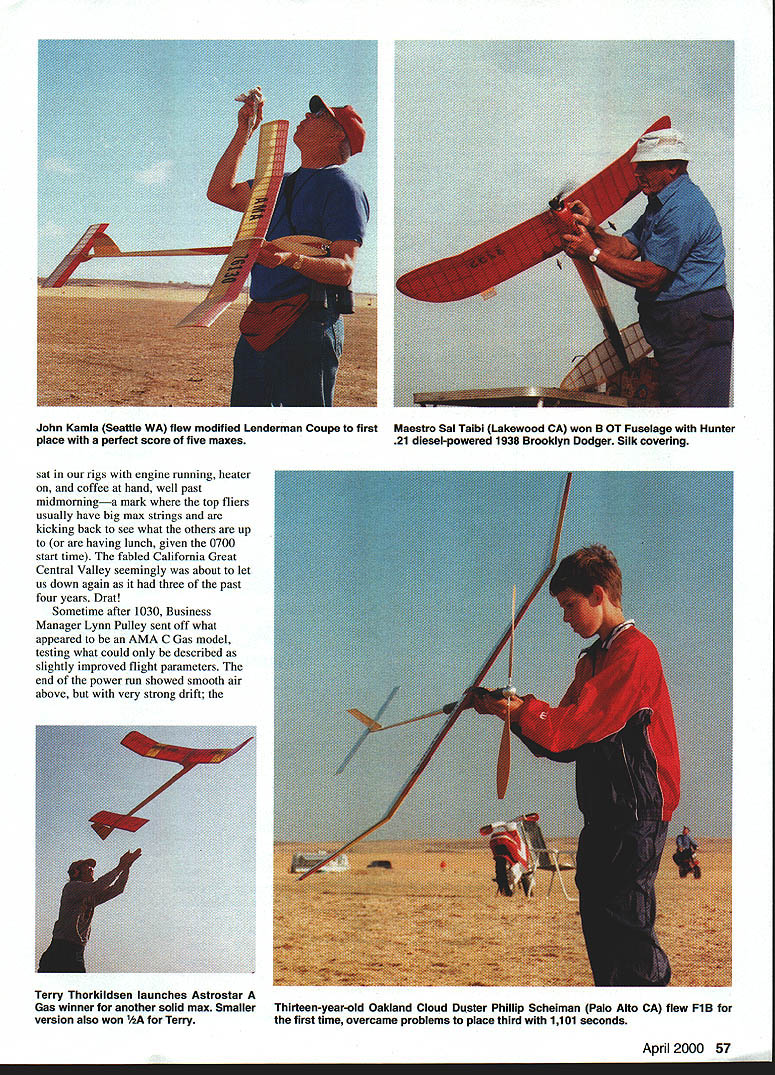
The FAI contingent got its seven rounds in, the mixed ambient allowing perfect scores in F1C Power (Daryl Perkins) and F1A Nordic Glider (Ernesto Busnelli), but no flyoff rounds. Larry Norvall topped F1B Wakefield at 1,203, with second-place finisher John Pratt nipping at 1,156. Junior competitor Phillip Schieman in third place posted a respectable 1,101, despite having to fly at least one round with a prop blade absent pending repair/replacement! Kate Joyce qualified for the Women's High Time Trophy with a 567 in F1A Towline under difficult conditions.
Some of the Special events on Sunday deserve mention.
Ten stalwarts lined up for the Dawn Handlaunch Glider one-flighter under what continued to be tough conditions, and on Steve Geraghty's countdown, let go their mighty heavies; the winner, Paul Herbst, clocked just 40 seconds in an anticlimax of anticlimaxes. Did anyone hear the tree fall in the forest?
Carl Redlin did 620 in Dawn Mulvihill to Bud Romak's 571, although the Romak machine spanked-out and was lost.
The 0745 P-30 Mass Launch was again the province of Stan Buddenbohm and his tweaked AirShark design, which did a hefty 220 in the breezy chill. (USFFC rules now allow Dawn event timers to follow the airplanes after launch, either on foot or by motorcycle, sometimes riding double with the pilot.)
Later in the day, Bob Goldie put up 220 to win the new-for-1999 Bob Cushenberry Memorial Gollywock Mass Launch. And Hank Cole put away the Twin Pusher OT Rubber title with 319s to John Camp's 249—stellar times, all things considered.
The on-again, off-again drift sets sent more than a few packing for home, but those who came from afar, notably the Oregon and Washington contingents, wasted little time putting up good numbers. John Kamla did 1,260 in A Gas, Elmer Nelsen made 1,060 in P-30, and National Free Flight Society president Bob Stalick (Albany OR) posted a workmanlike 540 to win .020 Replica. Londoner Paul Masterman bagged the Mulvihill rubber honors with a fine 1032. Norm Peterson flew his Ramrod 750 (Veco .35 engine) to the USFFC '99 High Time of 1,737—really special!
A pelting rain overnight Sunday cleared out quickly, leaving the handful of competitors who stayed on for Monday blessed with arguably the best weather of the weekend: "soft" air, warmish temps, gentle drift, and early (but small) thermals.
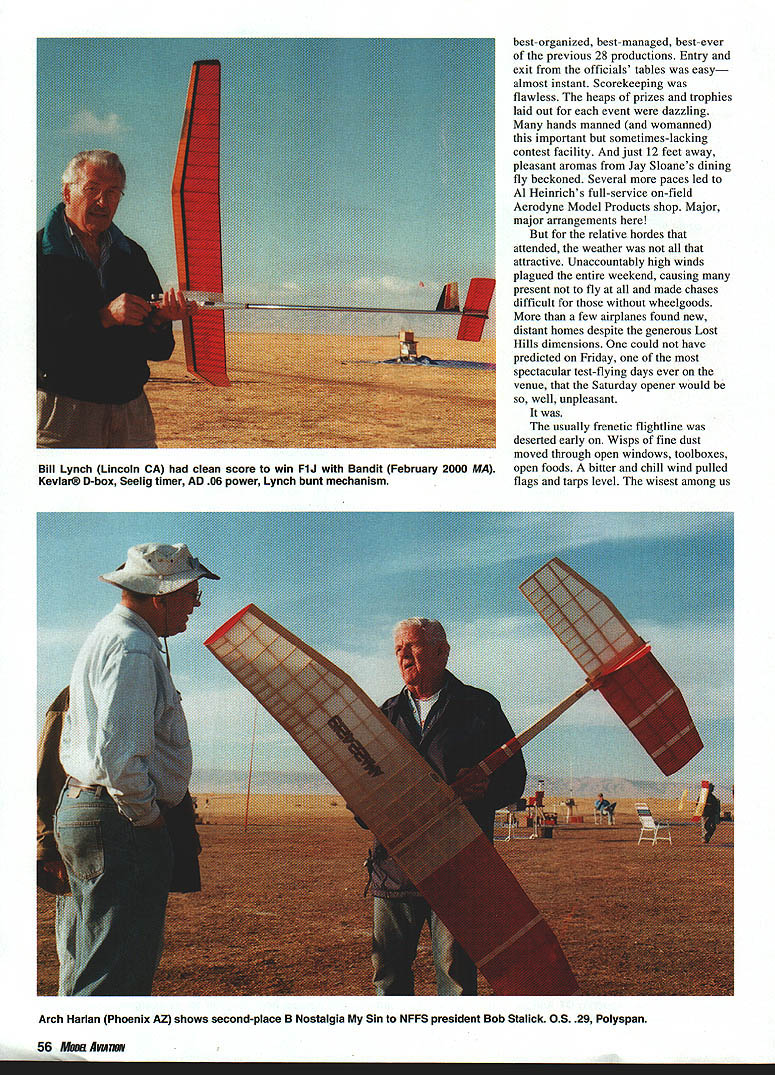
John Kamla and Bill Lynch were perfect in the FIG (Coupe d'Hiver) and F1J (Power) mini-FAI events. Tom Carman topped nine fliers in SloGas (aka SLOP—Slow Open Power) with five-maxes-plus. MartyConley won F1H Towline Glider with 719 to Ernesto Busnelli's 653. Cowley also won Catapult Glider on Saturday, topping a field of 13 at 308.
Any large Free Flight contest will produce admirable numbers, most likely from dedicated enthusiasts who show up to fly hard and have fun, weather and other stuff notwithstanding.
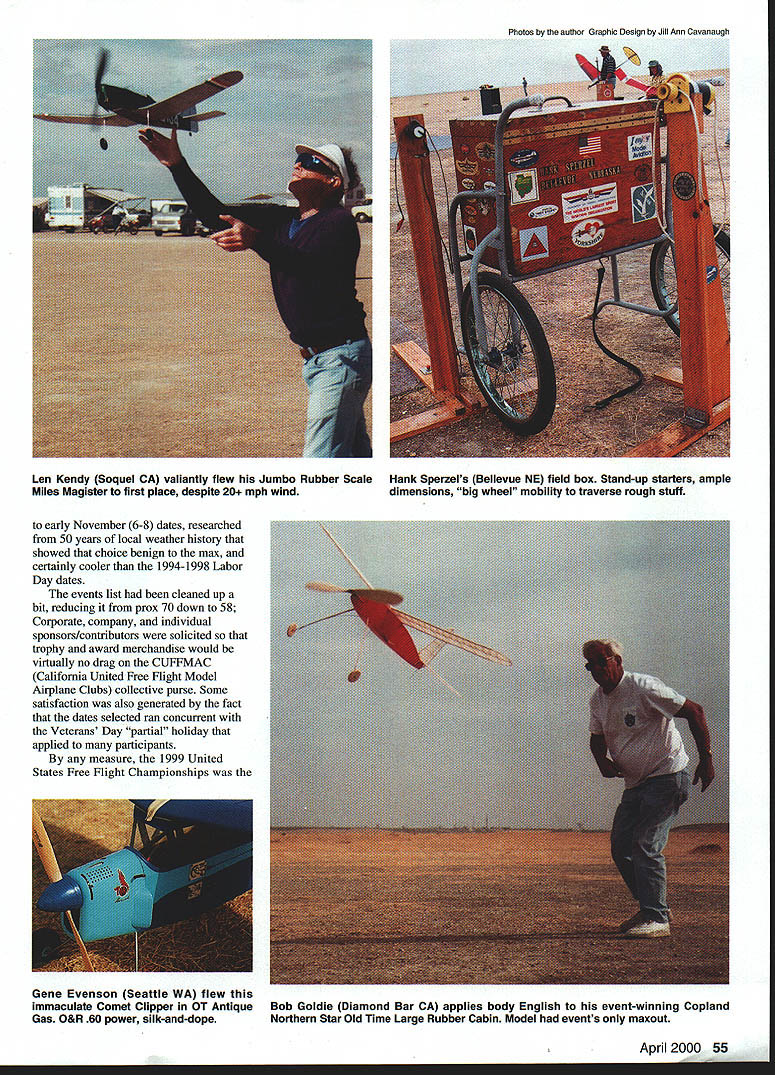
USFFC standouts must include Sweepstakes Champion Bob DeShields, who flew steadily through nine events ranging from Gas to Glider to Rubber, Modern, Old-Timer, and Special, winning none but collecting three seconds, three thirds, two fourths, and a sixth, showing great consistency and grit, all with his trademark superbly constructed-and-finished models.
Terry "Astrostar" Thorkildsen, in one of his "slowdownws," was nevertheless not far behind, scoring two firsts (1/2A Gas, C Gas), a second in A Gas, 10th in P-30, plus 13th in Catapult Glider—an eclectic effort!
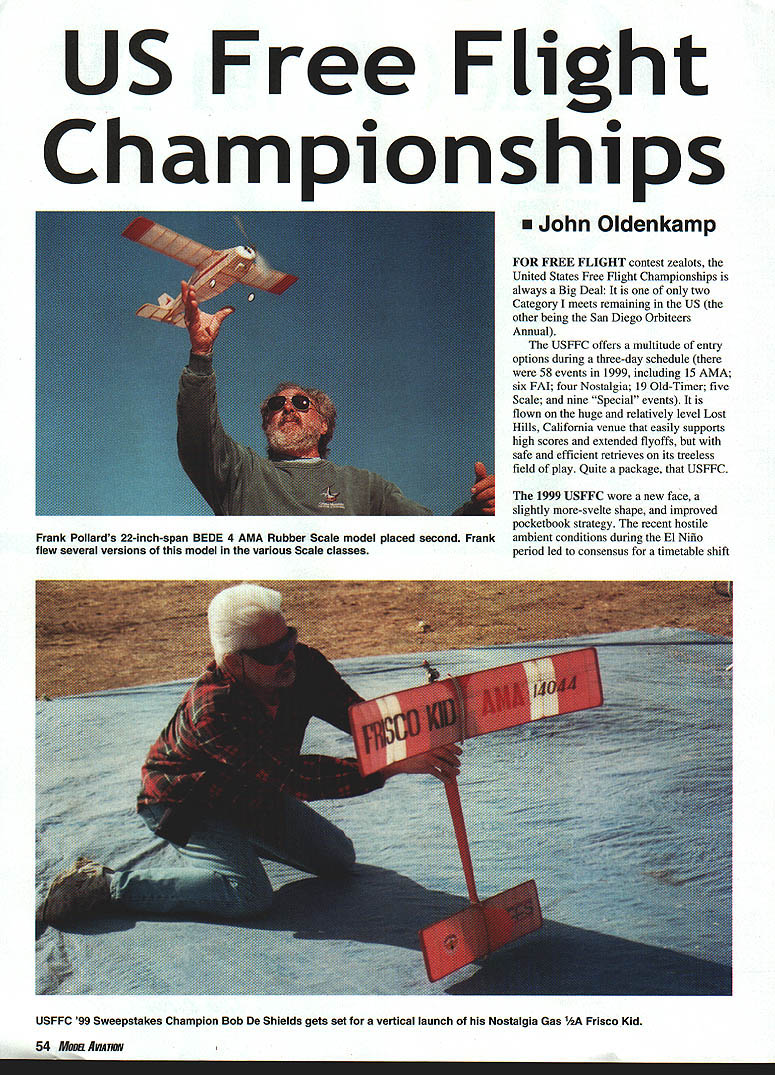
Frank Pollard came down from Port Townsend WA and certainly got his money's worth, placing in all nine events he entered with three firsts, two seconds, three thirds, and an eighth in P-30. He won F1K (CO2), AMA CO2 Large and Small, and AMA Power Scale. The winds took their toll on his airplanes, but Frank was determined, and so he succeeded brilliantly.
Trends/Views: The 1999 USFFC was difficult to assess, because so many held back owing to the weather negatives; however, it may be timely to note a strengthening split, or tilt: one away from, and another toward, the timeless polar elements of aeromodelling.
There are the Keep It Simple At All Cost events (Nostalgia Gas; Vintage this-and-that; the Plain Vanillas of P-30, Mulvihill, OT Stick and Cabin Rubber; locked-in AMA Gas and Slow Open Power), which appear to be gaining in interest and numbers. The more-complex, dollar-dependent categories (FAI "major" events, and the larger, automated AMA Gas classes) are definitely in a thinning-out mode. That, of course, is strictly the author's view, and although it may reflect certain aspects of the Southern California Free Flight scene, it does not apply to other regions—particularly in Europe, where the FAI categories are quite healthy, thanks. But the whispers and verbal chaff suggest that we may have created a few too many niches for comfortable future participation (the longterm health of Free Flight).
Sources:
AirShark P-30 kits, completely prefabricated including rolled-tube fuselage, machined parts and hardware. Numerous other innovative F/F components. Plans and instructions, trimming essays. Catalog/List, $2 to Stan Buddenbohm, 5652 Meinhardt Rd., Westminster CA 92683.
NFFS Plans Service (203 Chevro Ln., Bellevue NE 68005) has Nats-winning F1J plan and long list of other subjects. Send SAE.
Performance by Design: State-of-the-art F1J components, auto surface and bunt mechanisms, engine mounting systems, plans, and instructions. Double SASE for very complete 16-page catalog to Bill Lynch, 2279 Auburn Ravine Dr., Lincoln CA 95648.
John Oldenkamp 1625 Fern St. San Diego CA 92102
Transcribed from original scans by AI. Minor OCR errors may remain.

