
View from HQ - 2006/06
Rockwall RC Sport Flyers — a club in transition
The Rockwall RC Sport Flyers in Texas was founded by a group of 12 modelers nearly 20 years ago when a front yard served as the club's first flying field. The members eventually migrated to a larger field but encountered a few problems, which included cows eating the grass on the runway and pit area and a neighbor whose favorite sport seemed to be shooting at their airplanes. After long negotiations with the city of Rockwall, the club leased a site located on the city's landfill.
During its first 10 years, the club had roughly two dozen members, increasing to about 30 in the next few years. It elected officers, charged dues, wrote bylaws and safety rules, created a website, and put much effort into improving the flying field.
Two issues were a constant problem:
- Weather: Without sufficient rain the grass wilted and wide cracks opened in the land. Without diligent maintenance the field quickly became a dusty, bumpy dirt field.
- The 80/20 rule: In this largely informal organization, 20% of the members regularly performed 80% of the field-maintenance chores. Those doing all the work grew weary of watching other members who just paid their dues and flew their airplanes. Gradually maintenance that was once routine became less so.
In 2003 a program to again level the area and lay an asphalt-based, flexible Petromat runway was formulated but had to be approved by the city of Rockwall. Because the field sits on a landfill, the city had environmental concerns and placed strict limits on field improvements.
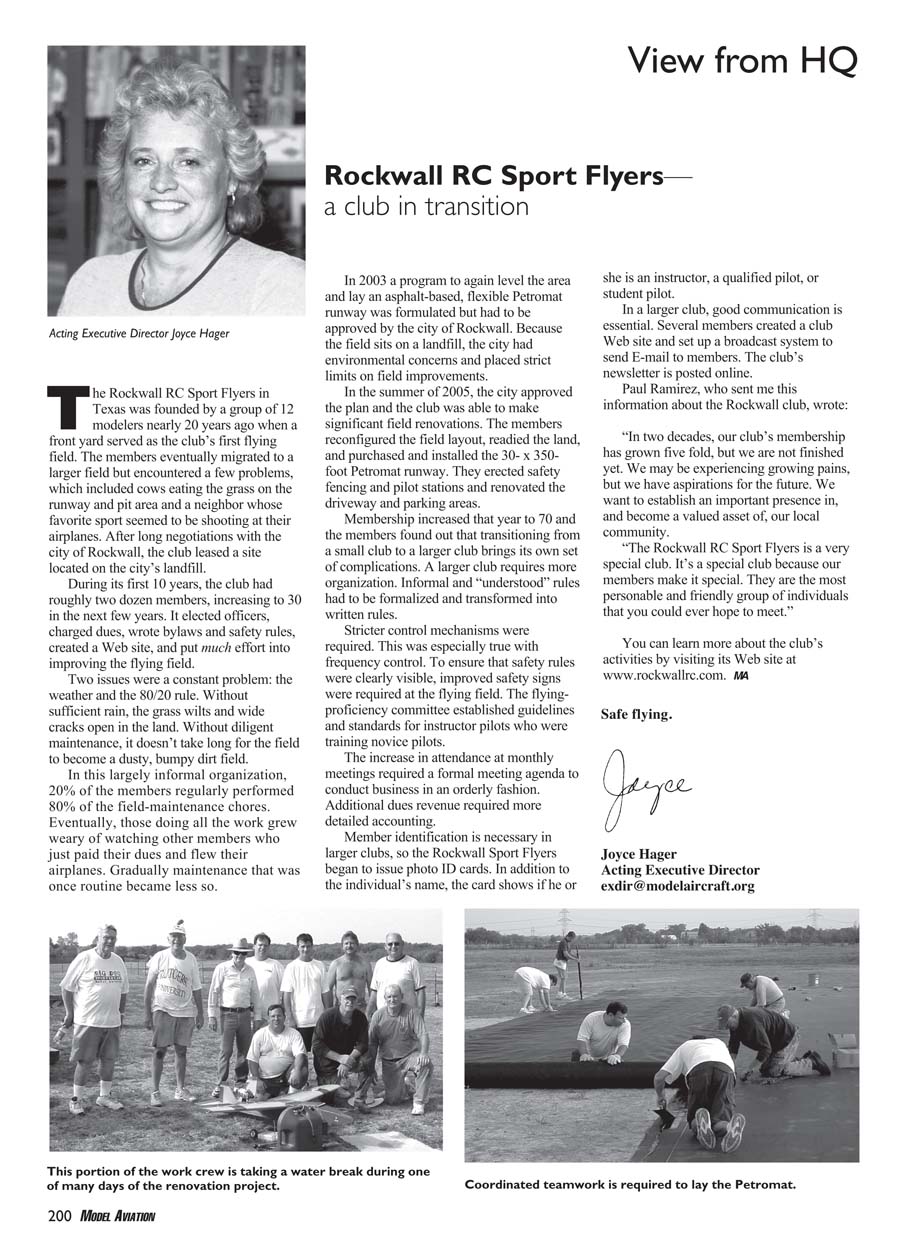
In the summer of 2005, the city approved the plan and the club was able to make significant field renovations. The members reconfigured the field layout, readied the land, and purchased and installed a 30-by-350-foot Petromat runway. They erected safety fencing and pilot stations and renovated the driveway and parking areas.
Membership increased that year to about 70, and the members found that transitioning from a small club to a larger club brings its own set of complications. A larger club requires more organization. Informal and "understood" rules had to be formalized and transformed into written rules. Stricter control mechanisms were required. This was especially true with frequency control. To ensure that safety rules were clearly visible, improved safety signs were required at the flying field. The flying-proficiency committee established guidelines and standards for instructor pilots who were training novice pilots. The increase in attendance at monthly meetings required a formal meeting agenda to conduct business in an orderly fashion. Additional dues revenue required more detailed accounting. Member identification became necessary, so the Rockwall RC Sport Flyers began to issue photo ID cards. In addition to the individual's name, the card shows if he or she is an instructor, a qualified pilot, or a student pilot.
In a larger club, good communication is essential. Several members created a club website and set up a broadcast system to send email to members. The club's newsletter is posted online.
Paul Ramirez, who sent information about the Rockwall club, wrote:
"In two decades, our club's membership has grown five fold, but we are not finished yet. We may be experiencing growing pains, but we have aspirations for the future. We want to establish an important presence in, and become a valued asset of, our local community.
"The Rockwall RC Sport Flyers is a very special club. It's a special club because our members make it special. They are the most personable and friendly group of individuals that you could ever hope to meet."
You can learn more about the club's activities by visiting its website at www.rockwallrc.com.
Safe flying.
Joyce Hager Acting Executive Director [email protected]
Transcribed from original scans by AI. Minor OCR errors may remain.

