
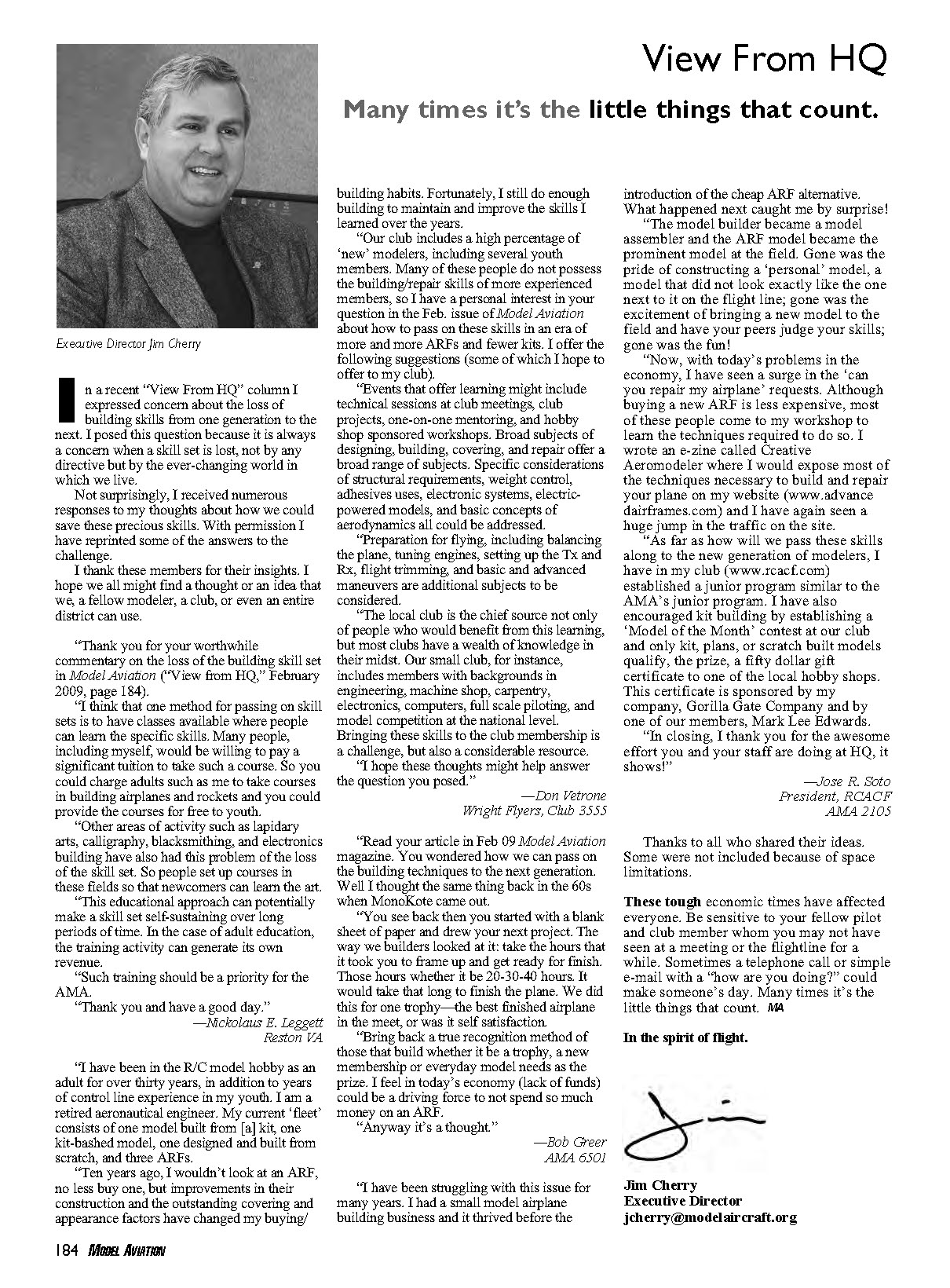
View From HQ - 2009/04
Many times it's the little things that count.
In a recent "View From HQ" column I expressed concern about the loss of building skills from one generation to the next. I posed this question because it is always a concern when a skill set is lost—not by any directive but by the ever-changing world in which we live.
Not surprisingly, I received numerous responses to my thoughts about how we could save these precious skills. With permission I have reprinted some of the answers to the challenge. I thank these members for their insights. I hope we all might find a thought or an idea that we, a fellow modeler, a club, or even an entire district can use.
Letter — Nickolaus E. Leggett, Reston, VA
Thank you for your worthwhile commentary on the loss of the building skill set in Model Aviation ("View From HQ," February 2009, page 184).
I think that one method for passing on skill sets is to have classes available where people can learn the specific skills. Many people, including myself, would be willing to pay a significant tuition to take such a course. So you could charge adults such as me to take courses in building airplanes and rockets and you could provide the courses for free to youth.
Other areas of activity such as lapidary arts, calligraphy, blacksmithing, and electronics building have also had this problem of the loss of the skill set. So people set up courses in these fields so that newcomers can learn the art.
This educational approach can potentially make a skill set self-sustaining over long periods of time. In the case of adult education, the training activity can generate its own revenue.
Such training should be a priority for the AMA.
Thank you and have a good day.
— Nickolaus E. Leggett Reston, VA
Letter — Don Vetrone, Wright Flyers, Club 3555
I have been in the R/C model hobby as an adult for over thirty years, in addition to years of control-line experience in my youth. I am a retired aeronautical engineer. My current "fleet" consists of one model built from a kit, one kit-bashed model, one designed and built from scratch, and three ARFs.
Ten years ago, I wouldn’t look at an ARF, no less buy one, but improvements in their construction and the outstanding covering and appearance factors have changed my buying/building habits. Fortunately, I still do enough building to maintain and improve the skills I learned over the years.
Our club includes a high percentage of "new" modelers, including several youth members. Many of these people do not possess the building/repair skills of more experienced members, so I have a personal interest in your question in the Feb. issue of Model Aviation about how to pass on these skills in an era of more and more ARFs and fewer kits. I offer the following suggestions (some of which I hope to offer to my club).
Events that offer learning might include:
- Technical sessions at club meetings
- Club projects
- One-on-one mentoring
- Hobby shop–sponsored workshops
Broad subjects could include designing, building, covering, and repair. Specific considerations might cover structural requirements, weight control, adhesive use, electronic systems, electric-powered models, and basic concepts of aerodynamics.
Preparation for flying is another area of instruction, including balancing the plane, tuning engines, setting up the transmitter (Tx) and receiver (Rx), flight trimming, and basic and advanced maneuvers.
The local club is the chief source not only of people who would benefit from this learning, but most clubs have a wealth of knowledge in their midst. Our small club, for instance, includes members with backgrounds in engineering, machine shop, carpentry, electronics, computers, full-scale piloting, and model competition at the national level. Bringing these skills to the club membership is a challenge, but also a considerable resource.
I hope these thoughts might help answer the question you posed.
— Don Vetrone Wright Flyers, Club 3555
Letter — Bob Greer, AMA 6501
I read your article in the Feb. 2009 Model Aviation magazine. You wondered how we can pass on the building techniques to the next generation. Well, I thought the same thing back in the '60s when Monokote came out.
Back then you started with a blank sheet of paper and drew your next project. The way we builders looked at it: take the hours that it took you to frame up and get ready for finish. Those hours—whether 20–40 hours—would take that long to finish a plane. We did this for one trophy—the best finished airplane in the meet—or for self-satisfaction.
Bring back a true recognition method for those that build, whether it be a trophy, a new membership, or everyday model needs as the prize. I feel in today’s economy (lack of funds) this could be a driving force to choose kit building over spending so much money on an ARF.
Anyway, it’s a thought.
— Bob Greer AMA 6501
Letter — Jose R. Soto, President, RCACF, AMA 2105
I have been struggling with this issue for many years. I had a small model airplane building business and it thrived before the introduction of the cheap ARF alternative. What happened next caught me by surprise!
The model builder became a model assembler and the ARF model became the prominent model at the field. Gone was the pride of constructing a "personal" model, a model that did not look exactly like the one next to it on the flight line; gone was the excitement of bringing a new model to the field and having your peers judge your skills; gone was the fun!
Now, with today’s problems in the economy, I have seen a surge in the "can you repair my airplane" requests. Although buying a new ARF is less expensive, most of these people come to my workshop to learn the techniques required to do so. I wrote an e-zine called Creative Aeromodeler where I expose many of the techniques necessary to build and repair your plane on my website (www.advanceairframes.com), and I have again seen a huge jump in traffic to the site.
As far as how we will pass these skills along to the new generation of modelers, I have in my club (www.rcacf.com) established a junior program similar to the AMA’s junior program. I have also encouraged kit building by establishing a "Model of the Month" contest at our club; only kit, plans, or scratch-built models qualify. The prize is a $50 gift certificate to one of the local hobby shops. This certificate is sponsored by my company, Gorilla Gate Company, and by one of our members, Mark Lee Edwards.
In closing, I thank you for the awesome effort you and your staff are doing at HQ—it shows!
— Jose R. Soto President, RCACF AMA 2105
Thanks to all who shared their ideas. Some were not included because of space limitations.
These tough economic times have affected everyone. Be sensitive to your fellow pilot and club member whom you may not have seen at a meeting or the flight line for a while. Sometimes a telephone call or simple e-mail with a "How are you doing?" could make someone’s day. Many times it’s the little things that count.
In the spirit of flight,
Jim Cherry Executive Director [email protected]
Transcribed from original scans by AI. Minor OCR errors may remain.

