
VINTAGE RADIO CONTROL SOCIETY
The Vintage Radio Control Society (VRCS) was formed in 1989 and held its first reunion in 1990. Since those first gatherings in Selinsgrove, Pennsylvania, the society has grown and has become an AMA-recognized Special Interest Group.
The VRCS holds events throughout the U.S. The society’s objective is to preserve and promote the memory of RC aeromodeling activity as it was in the past.
Members do this by building and flying airplanes that were designed for RC at least 35 years ago. Models designed by Hal deBolt, Lew Andrews, Carl Goldberg, Joe Bridi, Phil Kraft, Bill Winter, and many others can be found flying at many VRCS events across the country.
The forefathers of VRCS believed that those early airplane designs were better than what could be demonstrated with the limited radio technology of the time. VRCS does not emphasize using vintage radios; it encourages using modern radio systems so the full potential of the early airplane designs can be appreciated.
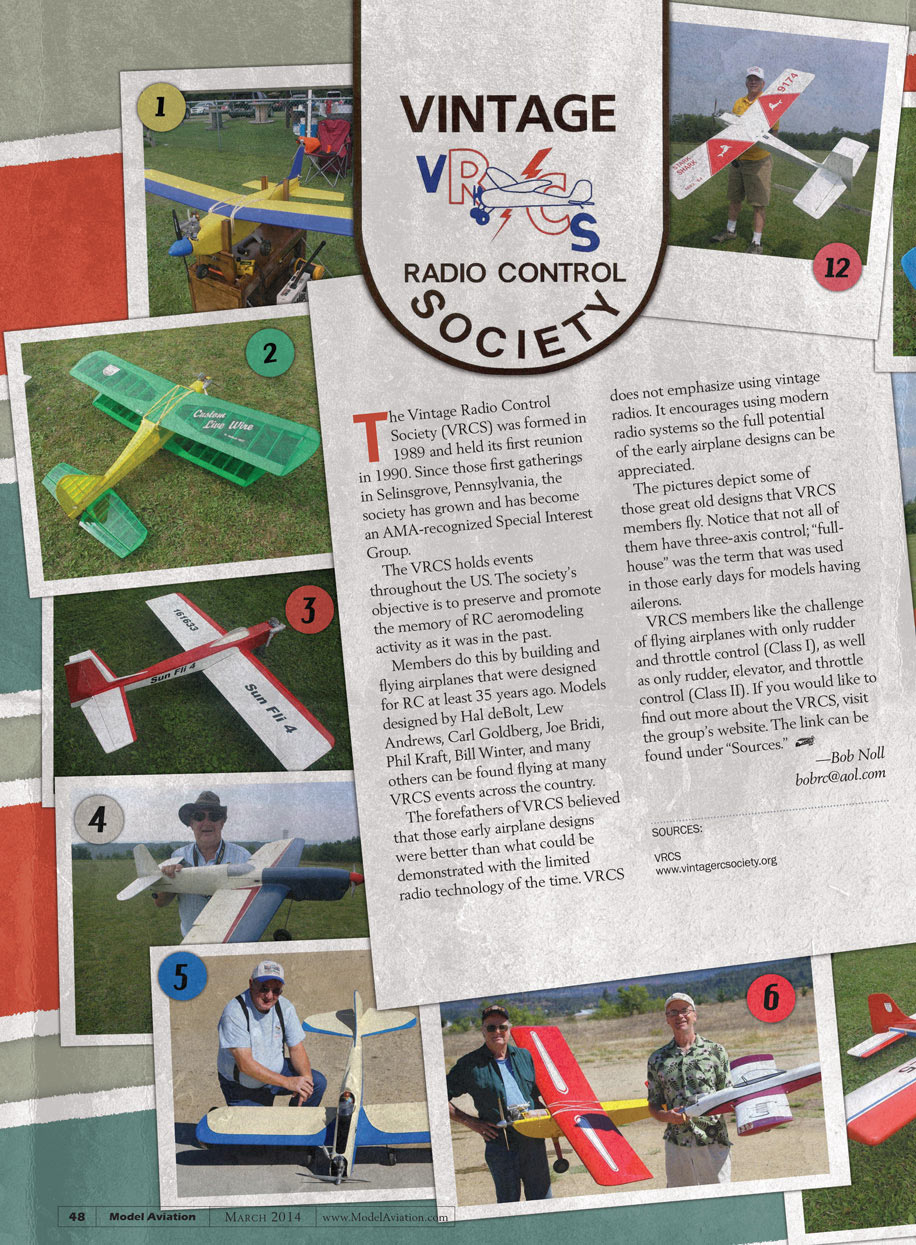
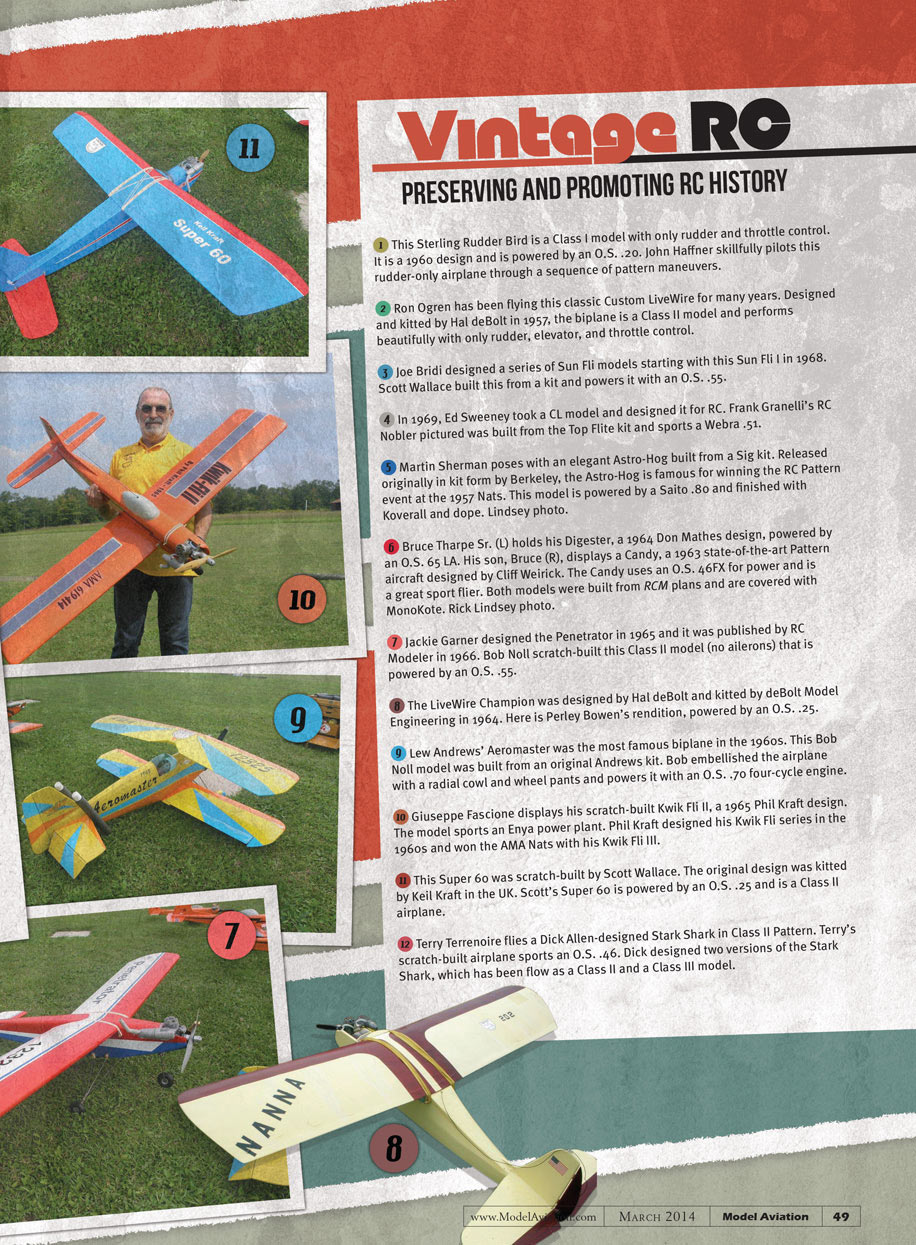
The pictures depict some of those great old designs that VRCS members fly. Notice that not all of them have three-axis control; "full-house" was the term used in those early days for models having ailerons. VRCS members like the challenge of flying airplanes with only rudder and throttle control (Class I), as well as with only rudder, elevator, and throttle control (Class II). If you would like to find out more about the VRCS, visit the group's website (see Sources).
— Bob Noll [email protected]
Sources
Photo captions
- This Sterling Rudder Bird is a Class I model with only rudder and throttle control. It is a 1960 design and is powered by an O.S. .20. John Hafner skillfully pilots this rudder-only airplane through a sequence of pattern maneuvers.
- Ron Ogren has been flying this classic Custom LiveWire for many years. Designed and kitted by Hal deBolt in 1957, the biplane is a Class II model and performs beautifully with only rudder, elevator, and throttle control.
- Joe Bridi designed a series of Sun Fli models, starting with this Sun Fli I in 1968. Scott Wallace built this from a kit and powers it with an O.S. .55.
- In 1969, Ed Sweeney took a control-line model and adapted it for RC. Frank Granelli’s RC Nobler pictured was built from the Top Flite kit and sports a Webra .51.
- Martin Sherman poses with an elegant Astro-Hog built from a Sig kit. Released originally in kit form by Berkeley, the Astro-Hog is famous for winning the RC Pattern event at the 1957 Nats. This model is powered by a Saito .80 and finished with Koverall and dope. (Lindsey photo)
- Bruce Tharpe Sr. (L) holds his Digester, a 1964 Don Mathes design, powered by an O.S. .65 I.A. His son, Bruce (R), displays a Candy, a 1963 state-of-the-art pattern aircraft designed by Cliff Weirick. The Candy uses an O.S. .46FX for power and is a great sport flier. Both models were built from RCM plans and are covered with MonoKote. (Rick Lindsey photo)
- Jackie Garner designed the Penetrator in 1965 and it was published by RC Modeler in 1966. Bob Noll scratch-built this Class II model (no ailerons) that is powered by an O.S. .55.
- The LiveWire Champion was designed by Hal deBolt and kitted by deBolt Model Engineering in 1964. Here is Perley Bowen’s rendition, powered by an O.S. .25.
- Lew Andrews’ Aeromaster was the most famous biplane in the 1960s. This Bob Noll model was built from an original Andrews kit. Bob embellished the airplane with a radial cowl and wheel pants and powers it with an O.S. .70 four-cycle engine.
- Giuseppe Fascione displays his scratch-built Kwik Fli II, a 1965 Phil Kraft design. The model sports an Enya power plant. Phil Kraft designed his Kwik Fli series in the 1960s and won the AMA Nats with his Kwik Fli III.
- This Super 60 was scratch-built by Scott Wallace. The original design was kitted by Keil Kraft in the U.K. Scott’s Super 60 is powered by an O.S. .25 and is a Class II airplane.
- Terry Terrenoire flies a Dick Allen–designed Stark Shark in Class II pattern. Terry’s scratch-built airplane sports an O.S. .46. Dick designed two versions of the Stark Shark, which has been flown as both a Class II and a Class III model.
Transcribed from original scans by AI. Minor OCR errors may remain.

