
The Weak Signals Toledo Show
The Weak Signals Show in Toledo, Ohio, is now a memory, but the motivation that comes from attending such an event lasts a long time. This month I'll take a break from some of the electronic stuff and review the show. I know the Model Aviation editors were there working hard, and there are video interviews available on YouTube.
Toledo Weak Signals 2012
My overall impression of the show this year was good. I can't honestly say there were as many new product releases as in previous years, but there was plenty of new stuff to see. The big names were there and some names from previous years were missing.
FMA Direct was not there this year, and I've received a number of emails asking if the company is out of business. It is not out of business, but you'll have to go to the FMA website to view its products.
This has become a trend lately with people becoming more comfortable viewing and buying things online. I'm still old school and want to touch and feel things while I talk to the manufacturers and vendors.
Electrics are mainstream now and nearly every vendor at the show had products to entice me.
Stevens AeroModel
This company had some great kits, complete with power systems and advice for all who needed it. Bill Stevens has come up with a unique subscription plan for modelers: you pay a set price and every three months you receive a kit in the mail.
The price at the show was $99, so that's an airplane every quarter for $25. It's a very cool idea, and his kits build and fly beautifully.
Dragons Do Exist!
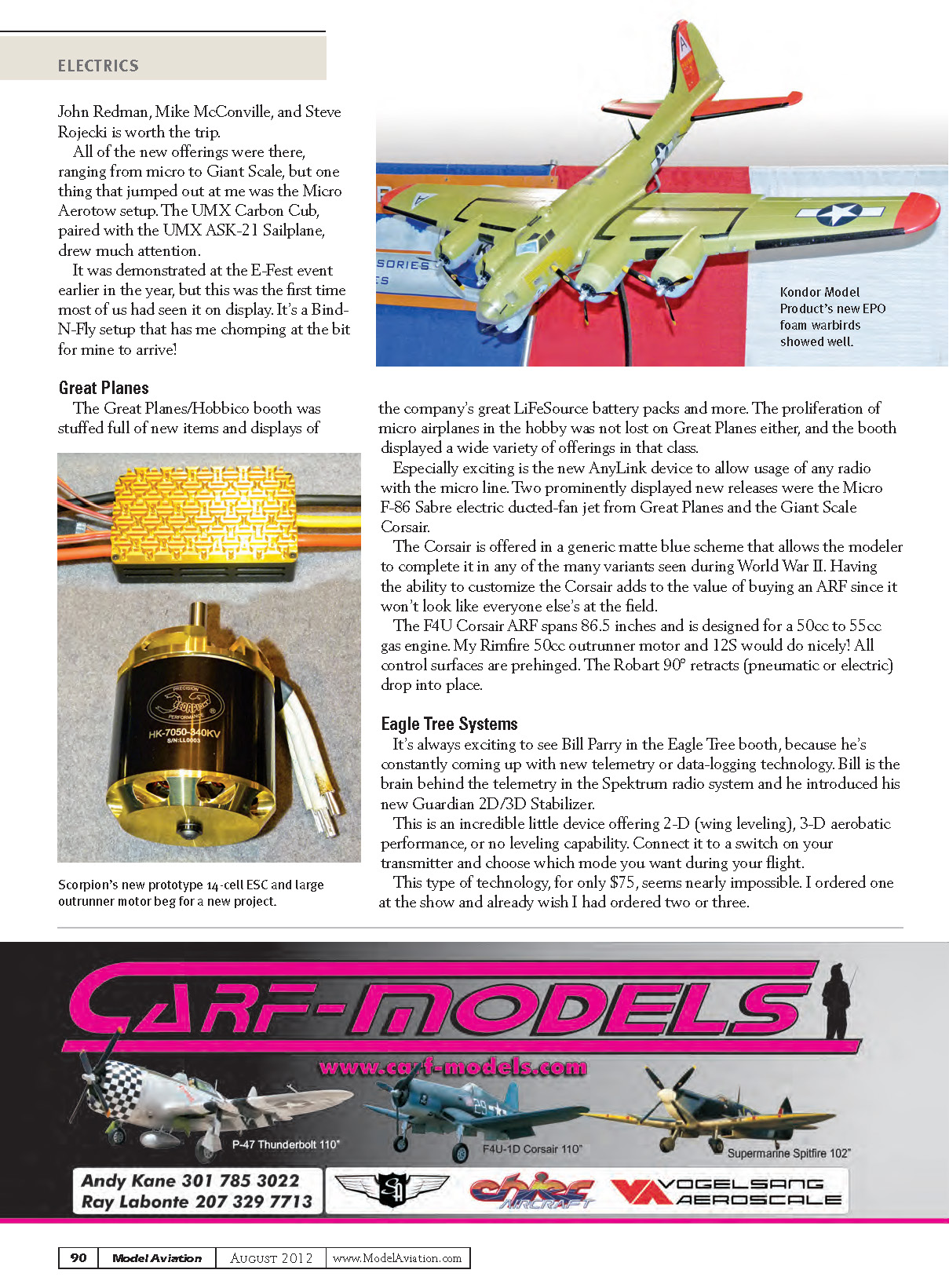
The award for Best in Show went to Rick Hamel's incredible turbine-powered dragon. This work of art is vacuum-bag molded fiberglass and Nomex honeycomb in 62 molds. It has a 9-foot span, a 30-pound flying weight, and JetCat P80 power. The finish is R-M automotive paint, and painting it took more than 100 hours.
The head turns and breathes fire using liquid propane and a 50,000-volt Taser in the lower fangs for ignition. This beauty has to be seen to be appreciated.
This is the second version after the initial prototype flew successfully. Rick tweaked the airfoil (yes, it's a real airfoil) and adjusted how the head moves in conjunction with the tail for directional control.
Multiple safety mechanisms are built into the dragon, including glowing red eyes, to let Rick know that the fire-breathing system is armed and ready.
Horizon Hobby
Horizon Hobby always has a great booth with many of the show pilots and designers on hand to answer questions. Visiting the booth to talk with people such as David Payne, Quique Somenzini, John Redman, Mike McConville, and Steve Rojecki is worth the trip.
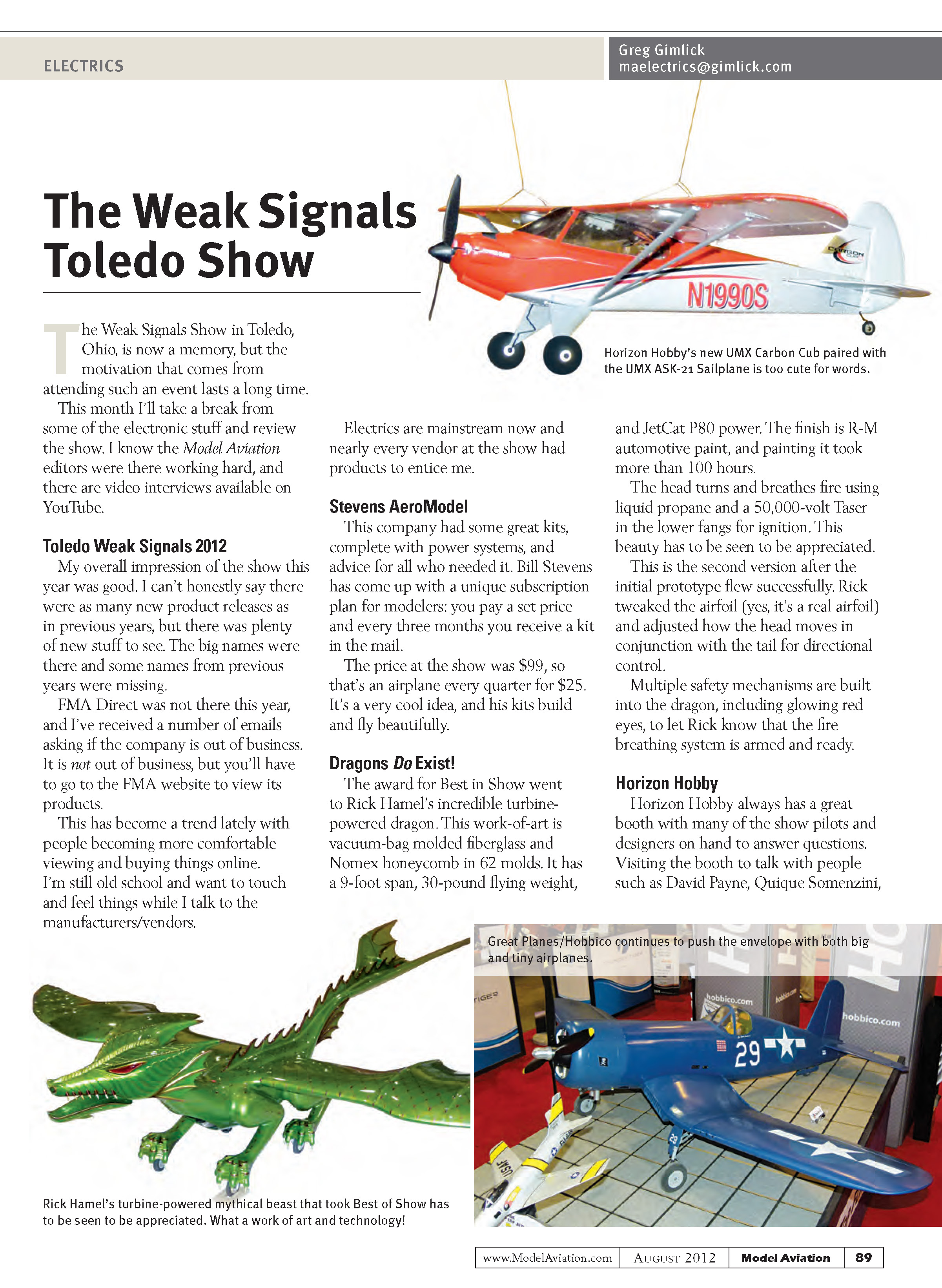
All of the new offerings were there, ranging from micro to giant scale, but one thing that jumped out at me was the Micro Aerotow setup. The UMX Carbon Cub, paired with the UMX ASK-21 sailplane, drew much attention. It was demonstrated at the E-Fest event earlier in the year, but this was the first time most of us had seen it on display. It's a Bind-N-Fly setup that has me chomping at the bit for mine to arrive!
Great Planes
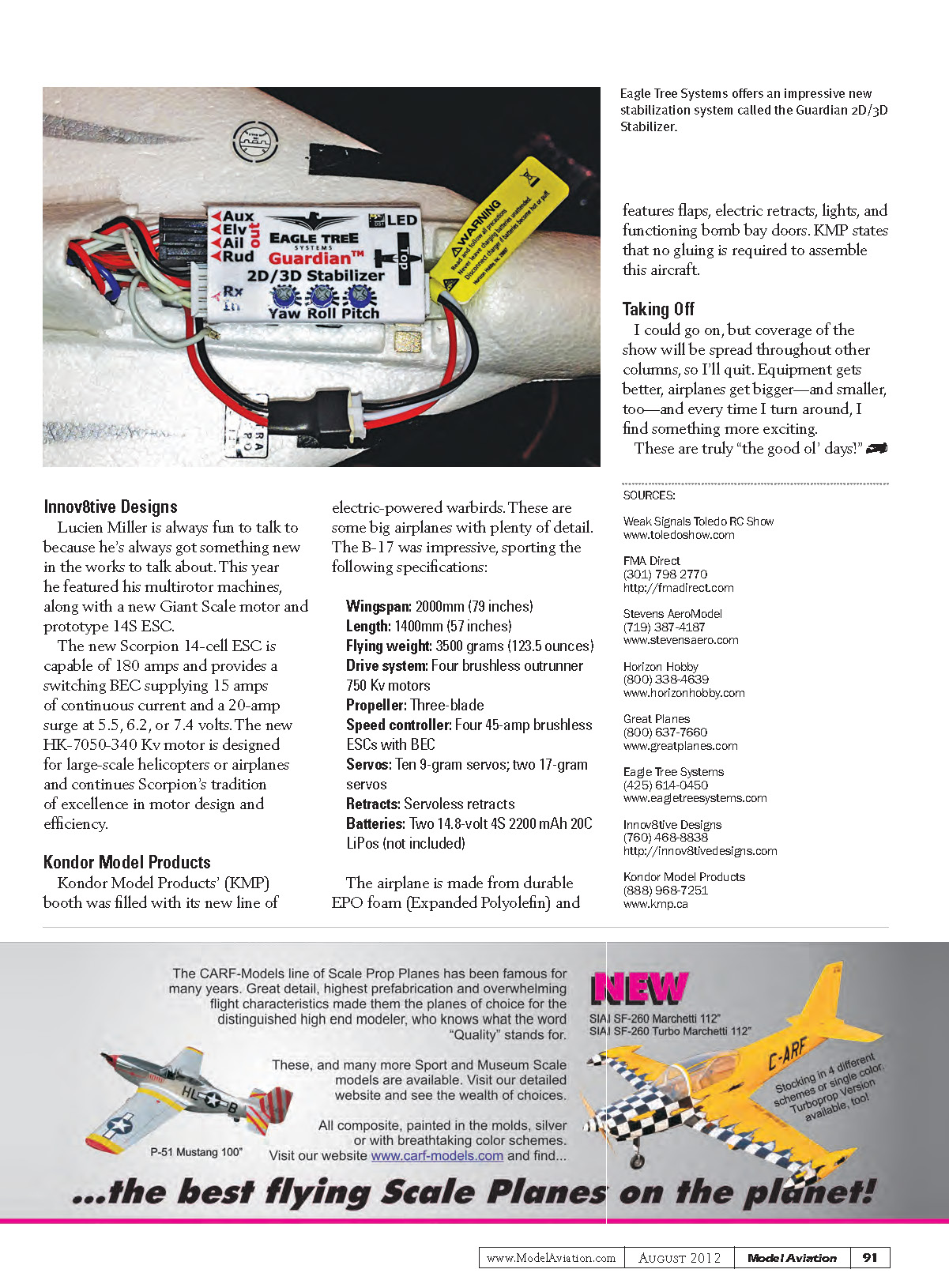
The Great Planes/Hobbico booth was stuffed full of new items and displays of the company's great LiFeSource battery packs and more. The proliferation of micro airplanes in the hobby was not lost on Great Planes either, and the booth displayed a wide variety of offerings in that class. Especially exciting is the new AnyLink device to allow usage of any radio with the micro line.
Two prominently displayed new releases were the Micro F-86 Sabre electric ducted-fan jet from Great Planes and the Giant Scale Corsair. The Corsair is offered in a generic matte blue scheme that allows the modeler to complete it in any of the many variants seen during World War II. Having the ability to customize the Corsair adds to the value of buying an ARF since it won't look like everyone else's at the field.
The F4U Corsair ARF spans 86.5 inches and is designed for a 50cc to 55cc gas engine. My Rimfire 50cc outrunner motor and 12S would do nicely. All control surfaces are pre-hinged. The Robart 90° retracts (pneumatic or electric) drop into place.
Eagle Tree Systems
It's always exciting to see Bill Parry in the Eagle Tree booth, because he's constantly coming up with new telemetry and data-logging technology. Bill is the brain behind the telemetry in the Spektrum radio system and he introduced his new Guardian 2D/3D Stabilizer.
This is an incredible little device offering 2-D (wing leveling), 3-D aerobatic performance, or no leveling capability. Connect it to a switch on your transmitter and choose which mode you want during your flight.
This type of technology, for only $75, seems nearly impossible. I ordered one at the show and already wish I had ordered two or three.
Innovative Designs
Lucien Miller is always fun to talk to because he's always got something new in the works. This year he featured his multirotor machines, along with a new giant-scale motor and a prototype 14S ESC.
The new Scorpion 14-cell ESC is capable of 180 amps and provides a switching BEC supplying 15 amps of continuous current and a 20-amp surge at 5.5, 6.2, or 7.4 volts. The new HK-7050-340 Kv motor is designed for large-scale helicopters or airplanes and continues Scorpion's tradition of excellence in motor design and efficiency.
Kondor Model Products
Kondor Model Products' (KMP) booth was filled with its new line of electric-powered warbirds. These are some big airplanes with plenty of detail. The B-17 was impressive, sporting the following specifications:
- Wingspan: 2000 mm (79 inches)
- Length: 1400 mm (57 inches)
- Flying weight: 3500 grams (123.5 ounces)
- Drive system: Four brushless outrunner 750 Kv motors
- Propeller: Three-blade
- Speed controller: Four 45-amp brushless ESCs with BEC
- Servos: Ten 9-gram servos; two 17-gram servos
- Retracts: Servoless retracts
- Batteries: Two 14.8-volt (4S) 2200 mAh 20C LiPos (not included)
The airplane is made from durable EPO foam (Expanded Polyolefin) and features flaps, electric retracts, lights, and functioning bomb bay doors. KMP states that no gluing is required to assemble this aircraft.
Taking Off
I could go on, but coverage of the show will be spread throughout other columns, so I'll quit. Equipment gets better, airplanes get bigger—and smaller, too—and every time I turn around, I find something more exciting.
These are truly "the good ol' days!"
SOURCES
- Weak Signals Toledo RC Show — www.toledoshow.com
- FMA Direct — (301) 798-2770 — http://fmadirect.com
- Stevens AeroModel — (719) 387-4187 — www.stevensaero.com
- Horizon Hobby — (800) 338-4639 — www.horizonhobby.com
- Great Planes — (800) 637-7660 — www.greatplanes.com
- Eagle Tree Systems — (425) 614-0450 — www.eagletreesystems.com
- Innovative Designs — (760) 468-8838 — http://innov8tivedesigns.com
- Kondor Model Products — (888) 968-7251 — www.kmp.ca
Transcribed from original scans by AI. Minor OCR errors may remain.

