
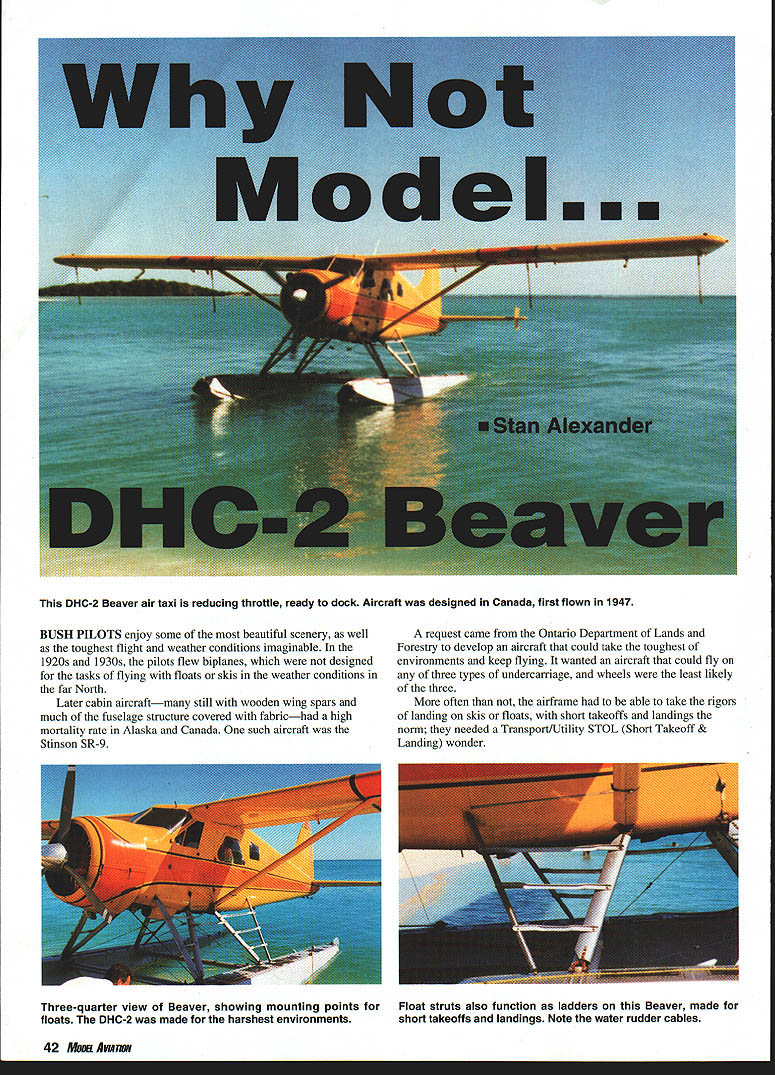
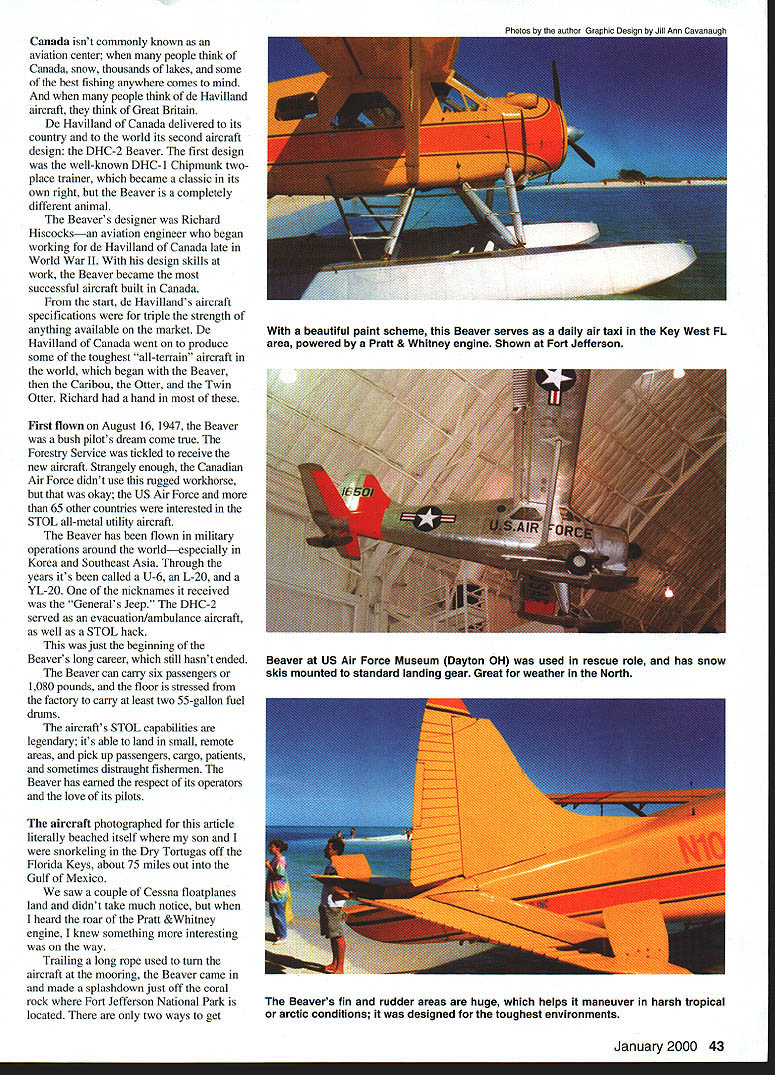
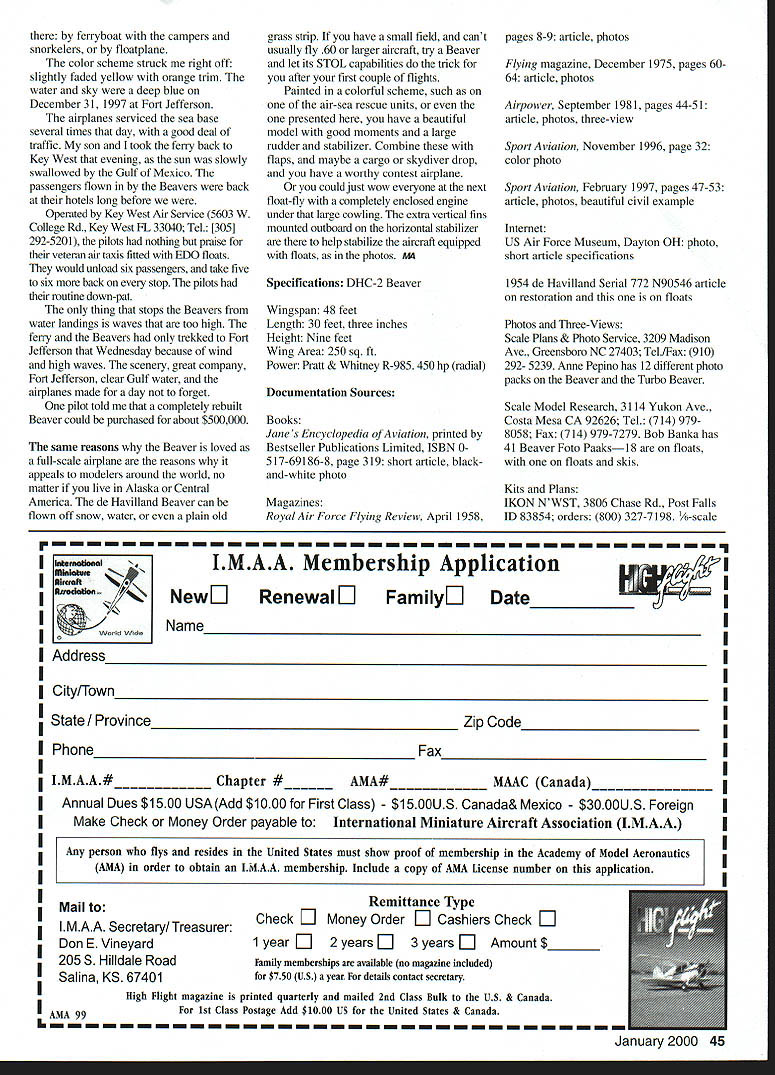
Why Not Model... DHC-2 Beaver
Stan Alexander
BUSH PILOTS enjoy some of the most beautiful scenery, as well as the toughest flight and weather conditions imaginable. In the 1920s and 1930s, the pilots flew biplanes, which were not designed for the tasks of flying with floats or skis in the weather conditions in the Far North.
Later cabin aircraft—many still with wooden wing spars and much of the fuselage structure covered with fabric—had a high mortality rate in Alaska and Canada. One such aircraft was the Stinson SR-9.
A request came from the Ontario Department of Lands and Forestry to develop an aircraft that could take the toughest of environments and keep flying. It wanted an aircraft that could fly on any of three types of undercarriage, and wheels were the least likely of the three.
More often than not, the airframe had to be able to take the rigors of landing on skis or floats, with short takeoffs and landings the norm; they needed a transport/utility STOL (Short Takeoff & Landing) wonder.
First flown on August 16, 1947, the Beaver was a bush pilot's dream come true. The Forestry Service was tickled to receive the new aircraft. Strangely enough, the Canadian Air Force didn't use this rugged workhorse, but that was okay; the US Air Force and more than 65 other countries were interested in the STOL all-metal utility aircraft.
The Beaver has been flown in military operations around the world—especially in Korea and Southeast Asia. Through the years it's been called a U-6, an L-20, and a YL-20. One of the nicknames it received was the "General's Jeep." The DHC-2 served as an evacuation/ambulance aircraft, as well as a STOL truck.
This was just the beginning of the Beaver's long career, which still hasn't ended. The Beaver can carry six passengers or 1,080 pounds, and the floor is stressed from the factory to carry at least two 55-gallon fuel drums.
The aircraft's STOL capabilities are legendary; it's able to land in small, remote areas, and pick up passengers, cargo, patients, and sometimes distraught fishermen. The Beaver has earned the respect of its operators and the love of its pilots.
The aircraft photographed for this article literally beached itself where my son and I were snorkeling in the Dry Tortugas off the Florida Keys, about 75 miles out into the Gulf of Mexico.
We saw a couple of Cessna floatplanes land and didn't take much notice, but when I heard the roar of the Pratt & Whitney engine, I knew something more interesting was on the way.
Trailing a long rope used to turn the aircraft at the mooring, the Beaver came in and made a splashdown just off the coral rock where Fort Jefferson National Park is located. There are only two ways to get there: by ferryboat with the campers and snorkelers, or by floatplane.
The color scheme struck me right off: slightly faded yellow with orange trim. The water and sky were a deep blue on December 31, 1997 at Fort Jefferson.
The airplanes serviced the sea base several times that day, with a good deal of traffic. My son and I took the ferry back to Key West that evening, as the sun was slowly swallowed by the Gulf of Mexico. The passengers flown in by the Beavers were back at their hotels long before we were.
Operated by Key West Air Service (5603 W. College Rd., Key West, FL 33040; Tel.: (305) 292-5201), the pilots had nothing but praise for their veteran air taxis fitted with EDO floats. They would unload six passengers, and take five to six more back on every stop. The pilots had their routine down pat.
The only thing that stops the Beavers from water landings is waves that are too high. The ferry and the Beavers had only the docked to Fort Jefferson that Wednesday because of wind and high waves. The scenery, great company, Fort Jefferson, clear Gulf water, and the airplanes made for a day not to forget.
One pilot told me that a completely rebuilt Beaver could be purchased for about $500,000.
The same reasons why the Beaver is loved as a full-scale airplane are the reasons why it appeals to modelers around the world, no matter if you live in Alaska or Central America. The de Havilland Beaver can be flown off snow, water, or even a plain old grass strip. If you have a small field, and can't usually fly .60 or larger aircraft, try a Beaver and let its STOL capabilities do the trick for you after your first couple of flights.
Painted in a colorful scheme, such as on one of the air-sea rescue units, or even the one presented here, you have a beautiful model with good moments and a large rudder and stabilizer. Combine these with flaps, and maybe a cargo or skydiver drop, and you have a worthy contest airplane.
Or you could just wow everyone at the next float-fly with a completely enclosed engine under that large cowling. The extra vertical fins mounted outboard on the horizontal stabilizer are there to help stabilize the aircraft equipped with floats, as in the photos.
MA
Specifications: DHC-2 Beaver
- Wingspan: 48 feet
- Length: 30 feet, 3 inches
- Height: 9 feet
- Wing Area: 250 sq. ft.
- Power: Pratt & Whitney R-985, 450 hp (radial)
Documentation Sources
Books
- Jane's Encyclopedia of Aviation, Bestseller Publications Limited, ISBN 0-517-69186-8, page 319: short article, black-and-white photo
Magazines
- Royal Air Force Flying Review, April 1958, pages 8-9: article, photos
- Flying magazine, December 1975, pages 60-64: article, photos
- Airpower, September 1981, pages 44-51: article, photos, three-view
- Sport Aviation, November 1996, page 32: color photo
- Sport Aviation, February 1997, pages 47-53: article, photos, beautiful civil example
Internet
- US Air Force Museum, Dayton, OH: photo, short article, specifications
1954 de Havilland serial 772 N90546 article on restoration; this one is on floats.
Photos and Three-Views
- Scale Plans & Photo Service, 3209 Madison Ave., Greensboro, NC 27403, Tel/Fax: (910) 292-5239. Anne Pepino has 12 different photo packs on the Beaver and the Turbo Beaver, with one on floats and skis.
- Scale Model Research, 3114 Yukon Ave., Costa Mesa, CA 92626; Tel.: (714) 979-8058; Fax: (714) 979-7279. Bob Banks has 41 Beaver Foto Packs—18 are on floats, with one on floats and skis.
Kits and Plans
- IKON N'WST, 3806 Chase Rd., Post Falls, ID 83854; orders: (800) 327-7198.
Transcribed from original scans by AI. Minor OCR errors may remain.

