
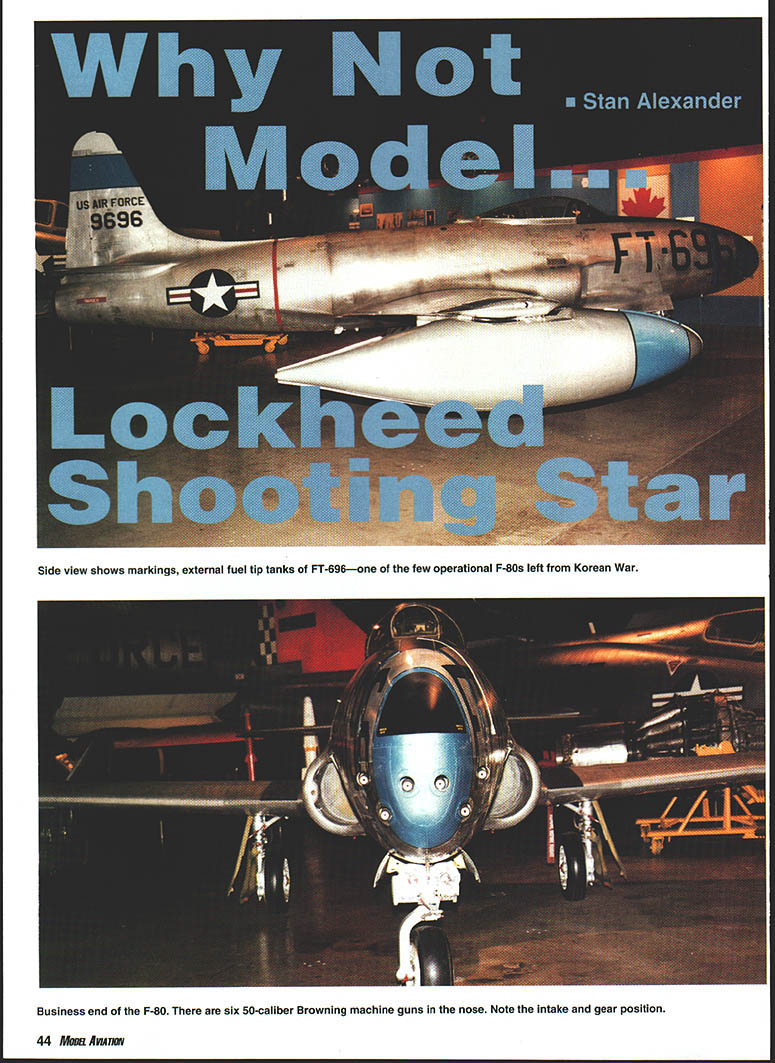
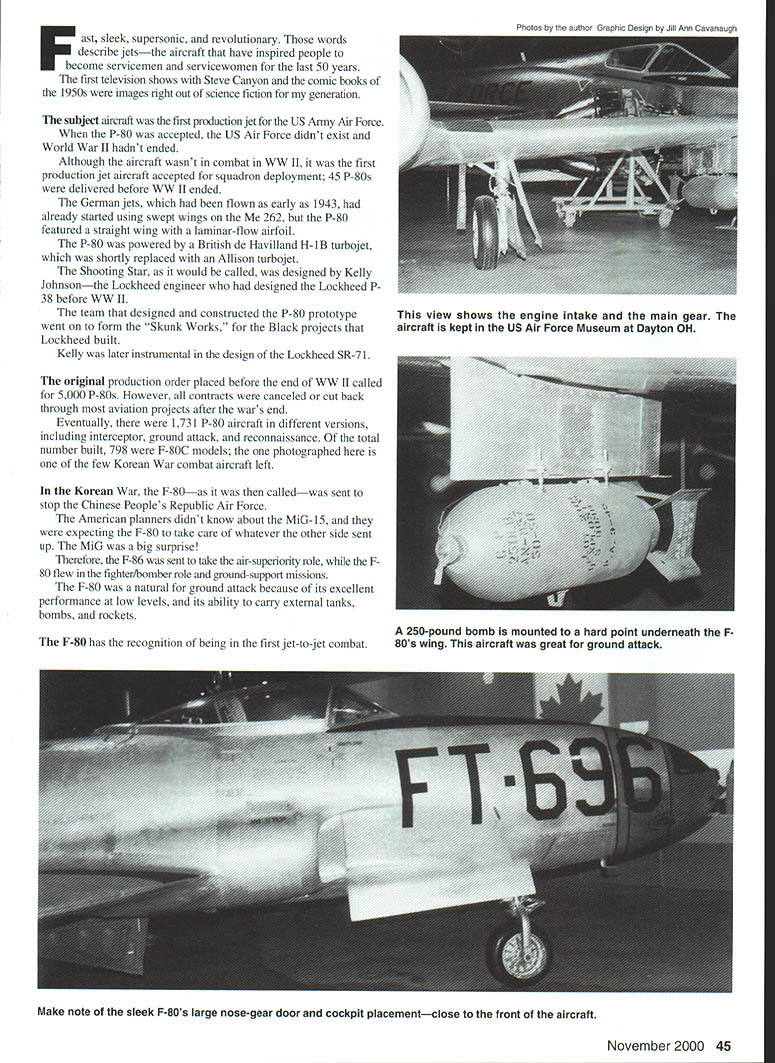
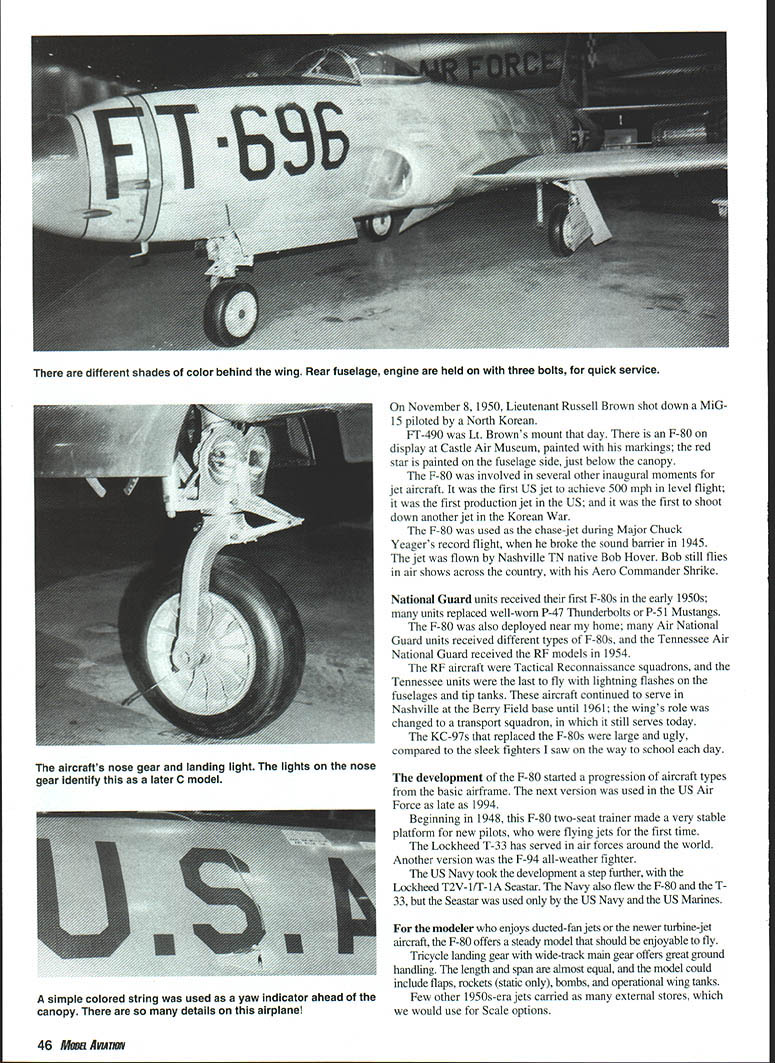

Why Not Model ... Lockheed Shooting Star
Stan Alexander
Fast, sleek, supersonic, and revolutionary. Those words describe jets—the aircraft that have inspired people to become servicemen and servicewomen for the last 50 years. The first television shows with Steve Canyon and the comic books of the 1950s were images right out of science fiction for my generation.
The subject aircraft was the first production jet for the US Army Air Force. When the P-80 was accepted, the US Air Force didn't exist and World War II hadn't ended.
Although the aircraft wasn't in combat in WWII, it was the first production jet aircraft accepted for squadron deployment; 45 P-80s were delivered before WWII ended.
The German jets, which had been flown as early as 1943, had already started using swept wings on the Me 262, but the P-80 featured a straight wing with a laminar-flow airfoil.
The P-80 was powered by a British de Havilland H-1B turbojet, which was shortly replaced with an Allison turbojet.
The Shooting Star, as it would be called, was designed by Kelly Johnson, the Lockheed engineer who had designed the Lockheed P-38 before WWII.
The team that designed and constructed the P-80 prototype went on to form the "Skunk Works" for the black projects that Lockheed built.
Kelly was later instrumental in the design of the Lockheed SR-71.
The original production order placed before the end of WWII called for 5,000 P-80s. However, all contracts were canceled or cut back through most aviation projects after the war's end.
Eventually, there were 1,731 P-80 aircraft in different versions, including interceptor, ground attack, and reconnaissance. Of the total number built, 798 were F-80C models; the one photographed here is one of the few Korean War combat aircraft left.
In the Korean War, the F-80—as it was then called—was sent to stop the Chinese People's Republic Air Force.
The American planners didn't know about the MiG-15, and they were expecting the F-80 to take care of whatever the other side sent up. The MiG was a big surprise.
Therefore, the F-86 was sent to take the air-superiority role, while the F-80 flew in the fighter/bomber role and ground-support missions.
The F-80 was a natural for ground attack because of its excellent performance at low levels, and its ability to carry external tanks, bombs, and rockets.
The F-80 has the recognition of being in the first jet-to-jet combat. On November 8, 1950, Lieutenant Russell Brown shot down a MiG-15 piloted by a North Korean.
FT-490 was Lt. Brown’s mount that day. There is an F-80 on display at Castle Air Museum, painted with his markings; the red star is painted on the fuselage side, just below the canopy.
The F-80 was involved in several other inaugural moments for jet aircraft. It was the first US jet to achieve 500 mph in level flight; it was the first production jet in the US; and it was the first to shoot down another jet in the Korean War.
The F-80 was used as the chase-jet during Major Chuck Yeager’s record flight, when he broke the sound barrier in 1945. The jet was flown by Nashville, TN native Bob Hoover. Bob still flies in air shows across the country, with his Aero Commander Shrike.
National Guard units received their first F-80s in the early 1950s; many units replaced well-worn P-47 Thunderbolts or P-51 Mustangs. The F-80 was also deployed near my home; many Air National Guard units received different types of F-80s, and the Tennessee Air National Guard received the RF models in 1954.
The RF aircraft were tactical reconnaissance squadrons, and the Tennessee units were the last to try lightning flashes on the fuselages and tip tanks. These aircraft continued to serve in Nashville at the Berry Field base until 1961; the wing’s role was changed to a transport squadron, and the aircraft were sent elsewhere.
The KC-97s that replaced the F-80s were large and ugly, compared to the sleek fighters I saw on the way to school each day.
The development of the F-80 started a progression of aircraft types from the basic airframe. The next version was used in the US Air Force as late as 1994.
Beginning in 1948, this F-80 two-seat trainer made a very stable platform for new pilots, who were flying jets for the first time. The Lockheed T-33 has served in air forces around the world. Another version was the F-94 all-weather fighter.
The US Navy took the development a step further with the Lockheed T2V-1/T-1A Seastar. The Navy also flew the F-80 and the T-33, but the Seastar was used only by the US Navy and the US Marines.
For the modeler who enjoys ducted-fan jets or the newer turbo-jet aircraft, the F-80 offers a steady model that should be enjoyable to fly. Tricycle landing gear with wide-track main gear offers great ground handling. The length and span are almost equal, and the model could include flaps, rockets (static only), bombs, and optional wing tanks.
Few other 1950s-era jets carried as many external stores, which we would use for scale options.
There are kits for the F-80, and several kits for the T-33. For a jet with design stability in flight, either aircraft should make a wonderful model.
MA
Specifications
- Wingspan: 39 feet, 6 inches
- Length: 34 feet, 6 inches
- Height: 11 feet, 4 inches
- Maximum Weight: 16,856 pounds
- Maximum Speed: 580 mph
- Cruise Speed: 437 mph
- Ceiling: 42,750 feet
- Armament: eight five-inch rockets or 2,000 pounds of bombs and six .50-caliber machine guns
Documentation Sources
Three-view Drawings
- By Paul Matt, courtesy of Aviation Heritage, Box 1445, Niceville FL 32588
- Tel.: (800) 999-0141
- Fax: (850) 729-1111
- E-mail: [email protected]
- Web site: www.aviation-heritage.com
- All Paul Matt three-views are available from Aviation Heritage.
Books
- Lockheed T2V-1/T-1A Seastar by Steve Ginter, published by Steve Ginter, 1999. ISBN 0-942612-42-6; 73 pages, soft-bound, color and black-and-white, multiview drawings. History on this development from the F-80/T-33.
- Lockheed P-80/F-80 Shooting Star "A Photo Chronicle" by David R. McLaren, published by Schiffer Military History Books, 1996. ISBN 0-88740-907-5; 184 pages, history, color and black-and-white photos, no drawings.
- Lockheed T-33 "A Photo Chronicle" by David R. McLaren, published by Schiffer Military History Books, 1998. ISBN 0-7643-0646-4; 124 pages, history, color and black-and-white photos, no drawings.
Magazines
- Airpower, March 1985, cover/color, "Shooting Stars Over Korea" by Warren Thompson on pages 22–43: great photos, black-and-white and color.
- Aviation, January 1993, cover/color, "Defining the Jet" by Jon Guttman on pages 38–47: history of early jet aircraft.
Photo Documentation
- Scale Plans & Photo Service, 3209 Madison Ave., Greensboro NC 27403; Tel.: (336) 292-5239. Anne Pepino has three-views and four photo packs for the P/F-80.
- Scale Model Research, 3114 Yukon Ave., Costa Mesa CA 92626; Tel.: (714) 979-8058; Fax: (714) 979-7279. Bob Banka has three-views and eight photo packs for the P/F-80.
Kits
- Bob Violett Models
- Tel.: (407) 327-6333
- Fax: (407) 327-5020
- Web site: www.bvmjets.com
- F-80 kits with 72-inch spans for turbine or ducted-fan power. Performance for ducted fan: 30–150 mph; turbine power: 30–170 mph. Operational tip tanks. Hard points available.
- T-33 kit with 80-inch span, 69-inch length, 16- to 18-pound turbine kits for turbine or ducted-fan power. Performance for ducted fan: 30–150 mph; for turbine: 30–170 mph.
- Jet Model Products, 211 North Mullen Rd., Belton MO 64012; Tel.: (816) 331-0356; Fax: (816) 331-3960. T-33 kit spans 85 inches, weighs 29 pounds, length is 76½ inches, for 18- to 22-pound-thrust turbine.
- Kyosho, distributed by Great Planes Model Distributors, 2904 Research Rd., Champaign IL 61826; Tel.: (217) 398-6300; Fax: (217) 398-0008. T-33 kit with a 46-inch wingspan and a 35-inch length. Electric fan-powered sport Almost Ready-to-Fly model.
Organizations
- Jet Pilots’ Organization (JPO), Box 784, Caddo Mills TX 75135. Annual dues are $25, includes quarterly newsletter. Check out the JPO Web site for the latest safety updates, news, and tips for jet modeling at www.jetpilots.org.
Author Contact
Stan Alexander 3709 Valley Ridge Rd. Nashville TN 37211-3831
Transcribed from original scans by AI. Minor OCR errors may remain.

