
Why Not Model... Travel Air Mystery Ship
Aircraft during the last century sparked the imagination of designers, pilots, engineers, and modelers. A few aircraft designs literally set the aviation industry on its ear, and this month's subject was one of them.
The Model R Mystery Ship is known by its nickname, rather than by its maker. When introduced, it was shielded from the public—and especially from its competition.
This and many other special airplanes manufactured from the 1920s until the outbreak of World War II were part of what we call the "Golden Age of Air Racing."
Walter Beech, Lloyd Stearman, William Snook, and Clyde Cessna formed the Travel Air Company in 1924. Travel Air produced a large line of aircraft in its short history, including biplanes and monoplanes. The company was absorbed into the Curtiss-Wright Corporation after the 1929 Cleveland National Air Races.
Beginning operations in 1925, Travel Air's idea was to use steel tubing instead of wood for aircraft construction. The primary building material had been wood until near the end of WW I.
The most glaring exceptions to the use of wood were Anthony Fokker's WW I biplane fighters, such as the Fokker D.VII. This was the only German aircraft specifically named in the treaty at the end of the war.
The Model R Mystery Ship was designed by Herbert Rawdon. He and coworker Walter Burnham worked on the design in their spare time after hours; they didn't bring the design to Walter Beech until it was almost finished and ready for construction.
As with many racers of that era, the construction had to be rushed. Test flights on the two aircraft were completed shortly before the races.
The US Army Air Force was in for a shock to the status quo at the 1929 National Air Races.
The Model R was a purpose-built aircraft. Walter Beech kept it hidden in the Travel Air hangar until just before the Open Class race at Cleveland; no photos were taken, and no one was allowed to get a good look at the new racer.
The Mystery Ship was faster and more maneuverable than the US Army's best biplanes. It was powered by a Wright 300 hp radial engine.
However, the military pursuit aircraft flown at the National Air Races were also specially prepared! They were further streamlined and polished, and their liquid-cooled high-performance V-12 engines were tweaked and modified just for the competition.
The race was 50 miles on a five-mile course, for a trophy and prize money. Thompson Products Company and Fred Crawford were the main sponsors.
The Mystery Ship was clocked at 194.9 mph on a triangular course that weekend. It has been reported that the aircraft was also timed in Cleveland that year at more than 208 mph.
Flying the Travel Air Mystery Ship, it took well-known air racer Doug Davis less than 15 minutes to end the domination of military biplanes.
When Doug thought he cut a pylon during the race, he was far enough ahead to go back around the pylon, not once, but twice—to make sure he didn't miss it.
Imagine how much faster his time would have been compared to the rest of the field if he hadn't thought he had missed the one pylon.
Doug correctly rounded the pylon three times, opening up the Nationals for others who wanted to try new designs. The military aircraft were not a consistent factor in the National Air Races again until after WW II.
Five Travel Air Mystery Ships were built, and two remain.
The Texaco No. 13 hangs in the Museum of Science and Industry in Chicago, IL. The other airplane belongs to Pancho Barnes, and to the best of my knowledge, is still unassembled in California.
These aircraft are well-documented, and there are plenty of photos. Each Mystery Ship had a different color scheme, although R-614K's and R-613K's were similar.
Travel Air Model R Mystery Ships
- R-613K
- Built at the same time as R-614K, but was powered by the inline air-cooled Chevrolair engine.
- R-613K lacked power, with a top speed of only approximately 150 mph.
- R-613K was sold to Pancho Barnes, and by that time the inline engine had been replaced with a Wright radial.
- Pancho had R-613K repainted at the Travel Air factory in 1930, in a scheme similar to that of R-614K.
- R-614K
- Built for and flown by Doug Davis in the 1929 National Air Races.
- Paint scheme was red and black, with a green trim stripe.
- Powered by a Wright Whirlwind 400 hp radial engine.
- The aircraft was lost in 1931, when it caught fire and crashed.
- NR-482V
- Built for the Shell Oil Company, to specifications set by Lieutenant Colonel Jimmy Doolittle.
- There were more than 30 modifications to the basic Mystery Ship design, including aileron horns, stabilizer spar, wheel brakes, an Eclipse starter and an adjustable step.
- The airplane was flown mostly by company pilot James (Jimmy) Haislip; he performed at many air shows and races.
- In 1930, the Shell Travel Air Mystery Ship finished second in the Thompson Trophy Race to Earl “Speed” Holman.
- NR-482V crashed in November 1930. Jimmy Doolittle bought the aircraft, rebuilt and further modified it to try to set a speed record for land-based aircraft.
- After the complete rebuild, including a new fuselage, the airplane was lost in its first flight because of aileron flutter.
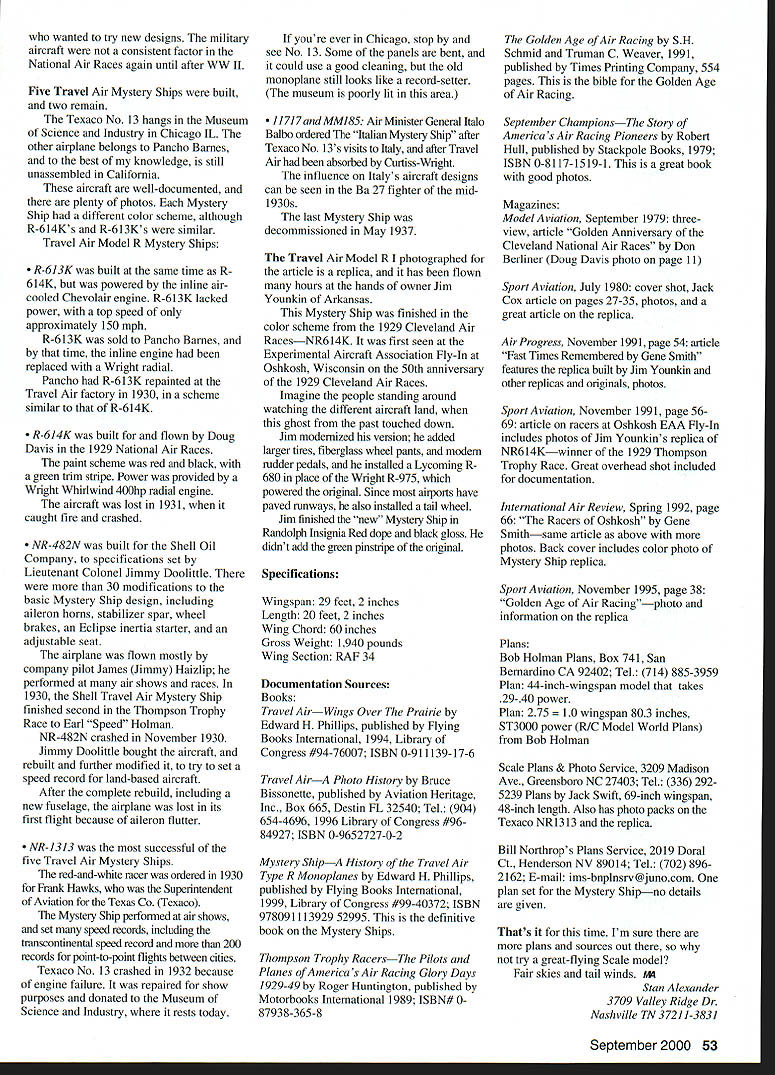
- NR-1313 (Texaco No. 13)
- The most successful of the five Travel Mystery Ships.
- Ordered in 1930 for Frank Hawks, who was the Superintendent of Aviation for the Texas Co. (Texaco).
- The red-and-white racer performed well in air shows and set many speed records, including the transcontinental speed record and more than 200 records for point-to-point flights between cities.
- Texaco No. 13 crashed in 1932 because of engine failure. It was repaired for show purposes and donated to the Museum of Science and Industry, where it rests today.
- If you’re ever in Chicago, stop by and see No. 13. Some of the panels are bent, and it could use a good cleaning, but the old monoplane still looks like a record-setter. (The museum is poorly lit in this area.)
- 11717 and MM185 (Italian Mystery Ship)
- Air Minister General Italo Balbo ordered the “Italian Mystery Ship” after Texaco No. 13’s visits to Italy, and after Travel Air had been absorbed by Curtiss-Wright.
- The influence on Italy’s aircraft designs can be seen in the Ba 27 fighter of the mid-1930s.
- The last Mystery Ship was decommissioned in May 1937.
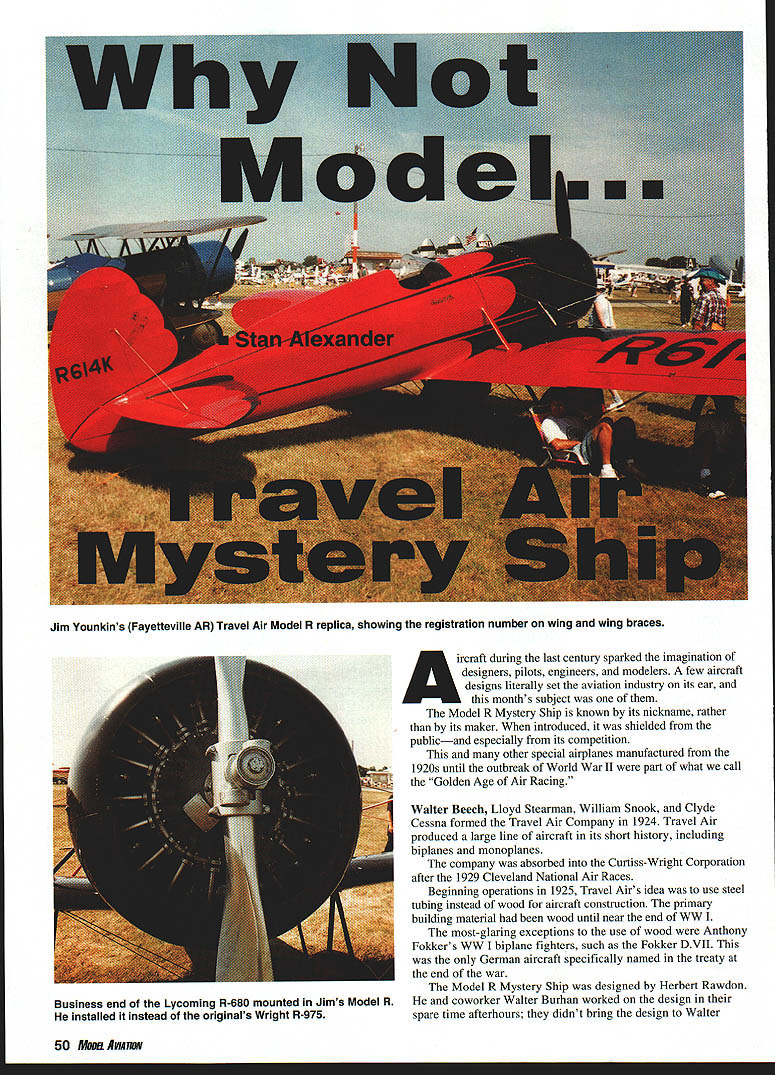
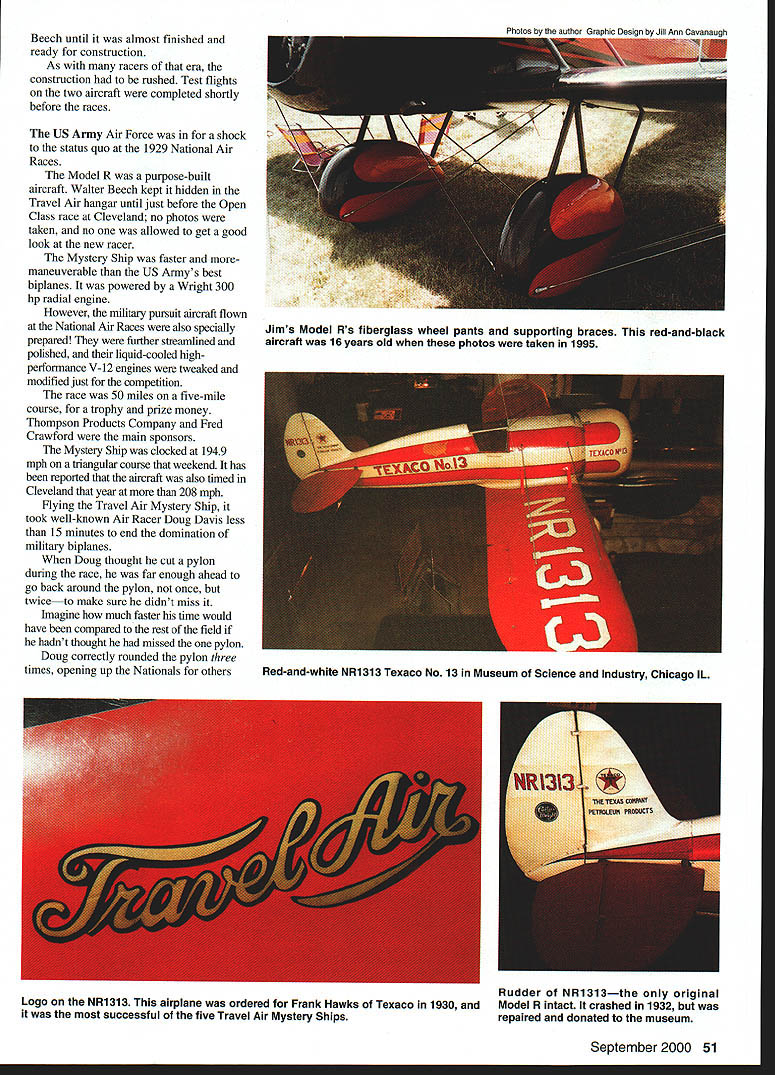
The Travel Air Model R I photographed for the article is a replica, and it has been flown many hours at the hands of owner Jim Younkin of Arkansas.
This Mystery Ship was finished in the color scheme from the 1929 Cleveland Air Races—NR614K. It was first seen at the Experimental Aircraft Association Fly-In at Oshkosh, Wisconsin on the 50th anniversary of the 1929 Cleveland Air Races.
Imagine the people standing around watching the different aircraft land, when this ghost from the past touched down. Jim modernized his version; he added larger tires, fiberglass wheel pants, and modern rudder pedals, and he installed a Lycoming R-680 in place of the Wright R-975, which powered the original. Since most airports have paved runways, he also installed a tail wheel.
Jim finished the “new” Mystery Ship in Randolph Insignia Red dope and gloss. He didn’t add the green pinstripe of the original.
Specifications
- Wingspan: 29 feet, 2 inches
- Length: 20 feet, 2 inches
- Wing Chord: 60 inches
- Gross Weight: 1,940 pounds
- Wing Section: RAF 34
Documentation Sources
Books:
- Travel Air—Wings Over The Prairie by Edward H. Phillips, published by Flying Books International, 1994, Library of Congress #94-76007; ISBN 0-911139-17-6
- Travel Air—A Photo History by Bruce Bissonette, published by Aviation Heritage, Inc., Destin, FL; 1996 Library of Congress #96-84927; ISBN 0-9652727-0-2
- Mystery Ship—A History of the Travel Air Type R Monoplanes by Edward H. Phillips, published by Flying Books International, 1999, Library of Congress #99-40372, ISBN 9780911139299. This is the definitive book on the Mystery Ships.
- Thompson Trophy Racers—The Pilots and Planes of America’s Air Racing Glory Days 1929–49 by Roger Huntington, published by Motorbooks International 1989; ISBN 0-87938-365-8
- The Golden Age of Air Racing by S.H. Schmid and Truman C. Weaver, 1991, published by Times Printing Company. This is the bible for the Golden Age of Air Racing.
- September Champions—The Story of America’s Air Racing Pioneers by Robert Hull, published by Stackpole Books, 1979; ISBN 0-8117-1519-1. This is a great book with good photos.
Magazines:
- Model Aviation, September 1979: three-view, article “Golden Anniversary of the Cleveland National Air Races” by Don Berliner (Doug Davis photo on page 11)
- Sport Aviation, July 1980: cover shot, Jack Cox article on pages 27–35, photos, and a great article on the replica.
- Air Progress, November 1991, page 54: article “Fast Times Remembered” by Gene Smith features the replica built by Jim Younkin and other replicas and originals, photos.
- Sport Aviation, November 1991, pages 56–69: article on racers at Oshkosh EAA Fly-In includes shots of Jim Younkin’s replica of NR614K—winner of the Thompson Trophy Race. Great overhead shot included for documentation.
- International Air Review, Spring 1992, page 66: “The Racers of Oshkosh” by Gene Smith—same article as above with more photos. Back cover includes color photo of Mystery Ship replica.
- Sport Aviation, November 1995, page 38: “Golden Age of Air Racing”—photo and information on the replica.
Plans:
- Bob Holman Plans, Box 741, San Bernardino, CA 92402; Tel.: (714) 885-3959
- Plan: 44-inch wingspan model that takes .20–.40 power.
- Plan: 27.5 = 1.0 wingspan 80.3 inches, .375–.50 power (R/C Model World Plans) from Bob Holman
- Scale Plans & Photo Service, 3209 Madison Ave., Greensboro, NC 27403; Tel.: (336) 292-5239
- Plans by Jack Swift; 69-inch wingspan, 48-inch length. Also has photo packs on the Texaco NR1313 and the replica.
- Bill Northrop’s Plans Service, 2010 Doral Ct., Henderson, NV 89014; Tel.: (702) 896-2162; E-mail: [email protected].
- One plan set for the Mystery Ship—no details are given.
That’s it for this time. I’m sure there are more plans and sources out there, so why not try a great-flying scale model?
Fair skies and tail winds. Stan Alexander 3709 Valley Ridge Dr. Nashville, TN 37211-3831
Transcribed from original scans by AI. Minor OCR errors may remain.

