
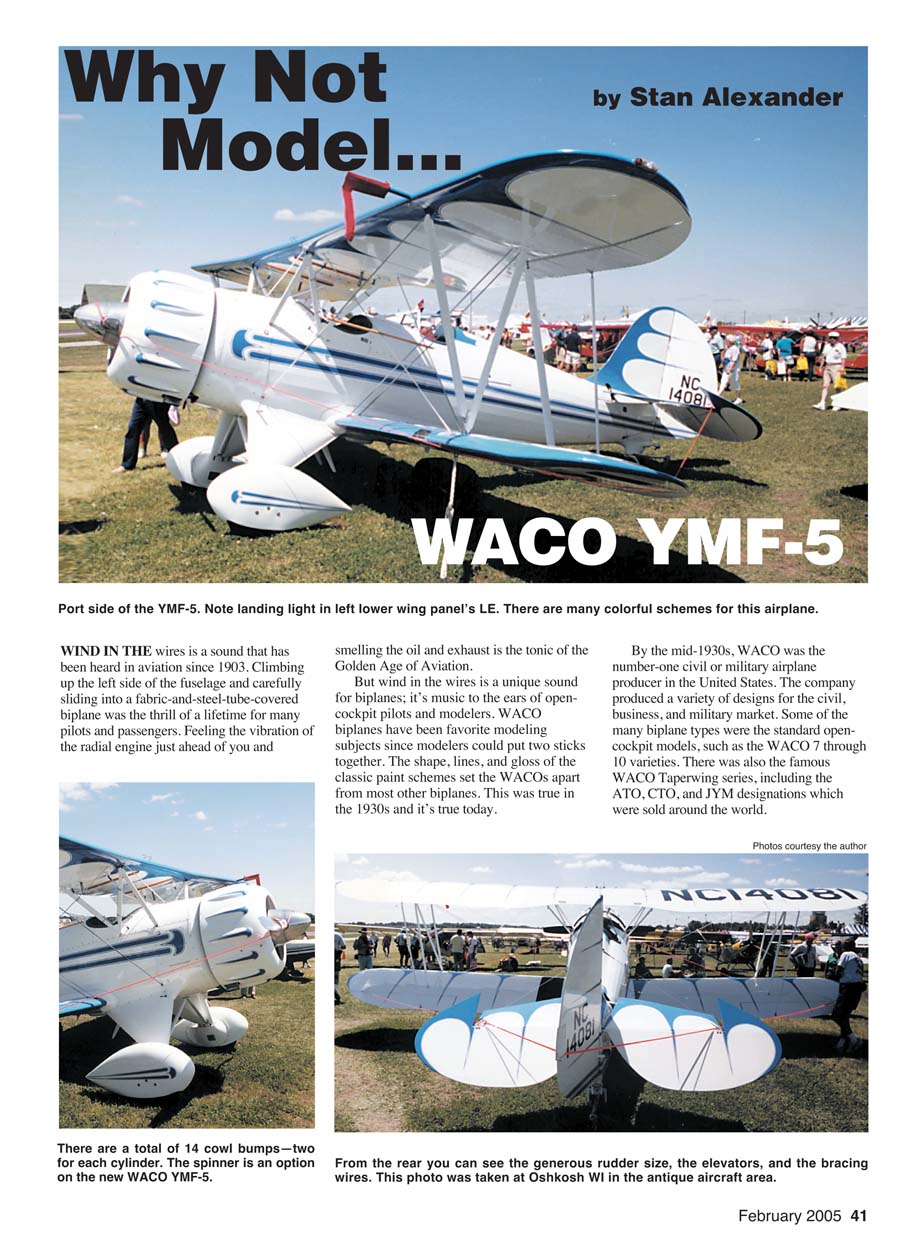
Why Not Model... WACO YMF-5
by Stan Alexander
WIND IN THE wires is a sound that has been heard in aviation since 1903. Climbing up the left side of the fuselage and carefully sliding into a fabric-and-steel-tube-covered biplane was the thrill of a lifetime for many pilots and passengers. Feeling the vibration of the radial engine just ahead of you and smelling the oil and exhaust is the tonic of the Golden Age of Aviation.
But wind in the wires is a unique sound for biplanes; it's music to the ears of open-cockpit pilots and modelers. WACO biplanes have been favorite modeling subjects since modelers could put two sticks together. The shape, lines, and gloss of the classic paint schemes set the WACOs apart from most other biplanes. This was true in the 1930s and it's true today.
Early history and range of models
By the mid-1930s, WACO was the number-one civil or military airplane producer in the United States. The company produced a variety of designs for the civil, business, and military markets. Some of the many biplane types were the standard open-cockpit models, such as the WACO 7 through 10 varieties. There was also the famous WACO Taperwing series, including the ATO, CTO, and JYM designations which were sold around the world.
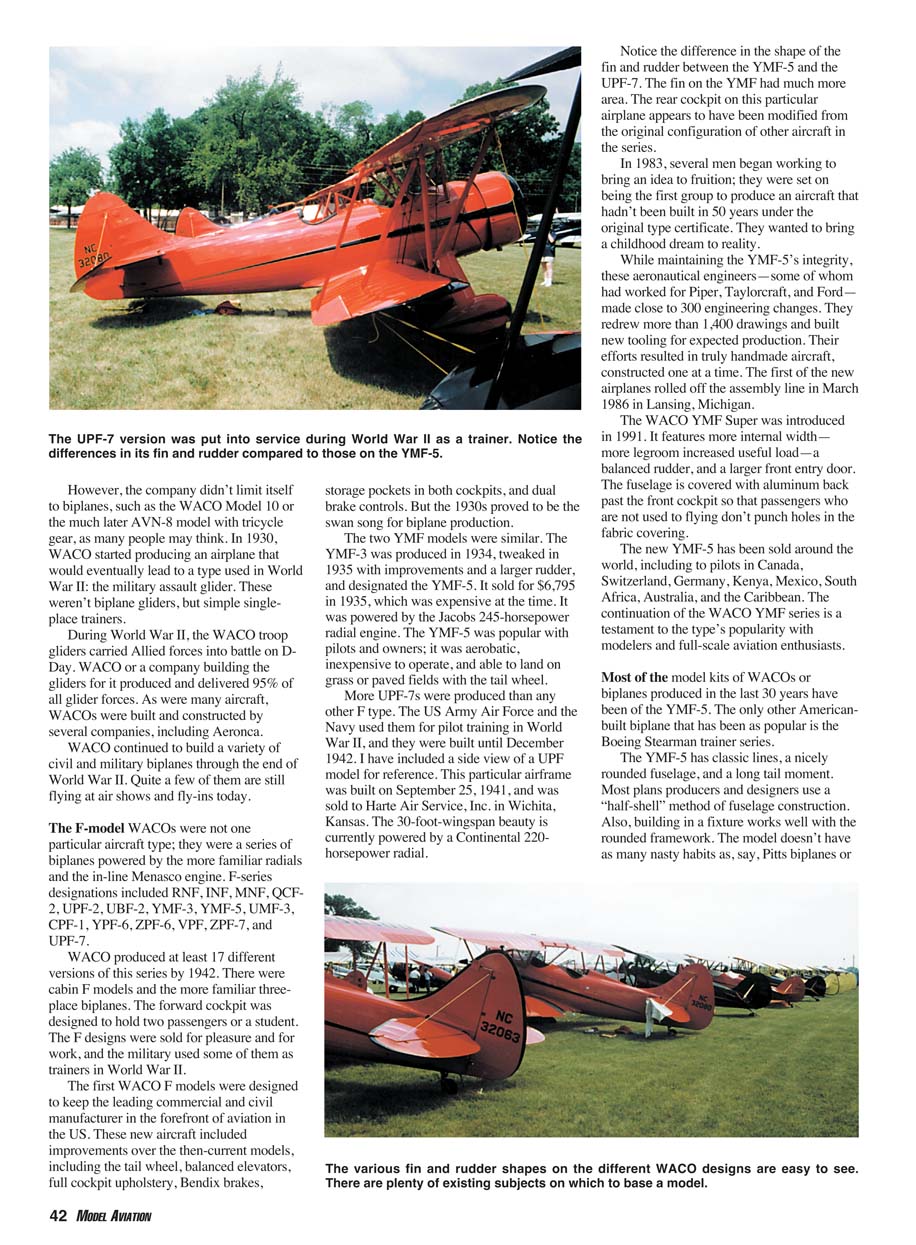
The UPF-7 version was put into service during World War II as a trainer. Notice the differences in its fin and rudder compared to those on the YMF-5. The various fin and rudder shapes on the different WACO designs are easy to see. There are plenty of existing subjects on which to base a model.
WACO did not limit itself to biplanes. In 1930 WACO started producing an airplane that eventually led to a type used in World War II: the military assault glider. These weren't biplane gliders, but simple single-place trainers. During World War II, WACO troop gliders carried Allied forces into battle on D-Day. WACO, or the company building the gliders for it, produced and delivered 95% of all glider forces.
As with many aircraft of the era, WACOs were built and constructed by several companies, including Aeronca. WACO continued to build a variety of civil and military biplanes through the end of World War II. Quite a few of them are still flying at air shows and fly-ins today.
The F-series and the YMF-5
The F-model WACOs were not a single aircraft type; they were a series of biplanes powered by familiar radial engines and by the in-line Menasco engine. F-series designations included RNF, INF, MNF, QCF-2, UPF-2, UBF-2, YMF-3, YMF-5, UMF-3, CPF-1, YPF-6, ZPF-6, VPF, ZPF-7, and UPF-7. WACO produced at least 17 different versions of this series by 1942. There were cabin F models and the more familiar three-place biplanes. The forward cockpit was designed to hold two passengers or a student. The F designs were sold for pleasure and for work, and the military used some of them as trainers in World War II.
The first WACO F models included improvements over the then-current models: a tail wheel, balanced elevators, full cockpit upholstery, Bendix brakes, storage pockets in both cockpits, and dual brake controls. But the 1930s proved to be the swan song for biplane production.
The two YMF models were similar. The YMF-3 was produced in 1934, tweaked in 1935 with improvements and a larger rudder, and designated the YMF-5. It sold for $6,795 in 1935, which was expensive at the time. It was powered by the Jacobs 225-horsepower radial engine. The YMF-5 was popular with pilots and owners; it was aerobatic, inexpensive to operate, and able to land on grass or paved fields with the tail wheel.
More UPF-7s were produced than any other F type. The US Army Air Forces and the Navy used them for pilot training in World War II, and they were built until December 1942. One particular UPF airframe built on September 25, 1941, was sold to Hartz Air Service, Inc. in Wichita, Kansas. The 30-foot-wingspan beauty is currently powered by a Continental 220-horsepower radial.
Notice the difference in the shape of the fin and rudder between the YMF-5 and the UPF-7. The fin on the YMF had much more area. The rear cockpit on some airframes appears to have been modified from the original configuration found on other aircraft in the series.
Revival and modern production
In 1983, several men began working to bring an idea to fruition: to produce an aircraft that hadn't been built in 50 years under the original type certificate. While maintaining the YMF-5's integrity, these aeronautical engineers—some of whom had worked for Piper, Taylorcraft, and Ford—made close to 300 engineering changes. They redrew more than 1,400 drawings and built new tooling for expected production. Their efforts resulted in truly handmade aircraft, constructed one at a time. The first of the new airplanes rolled off the assembly line in March 1986 in Lansing, Michigan.
The WACO YMF Super was introduced in 1991. It features greater internal width for more legroom and increased useful load, a balanced rudder, and a larger front entry door. The fuselage is covered with aluminum back past the front cockpit so that passengers who are not used to flying don't damage the fabric covering.
The new YMF-5 has been sold around the world, including to pilots in Canada, Switzerland, Germany, Kenya, Mexico, South Africa, Australia, and various Caribbean nations. The continuation of the WACO YMF series is a testament to the type's popularity with modelers and full-scale aviation enthusiasts.
Modeling the YMF-5
Most of the model kits of WACOs or biplanes produced in the last 30 years have been of the YMF-5. The only other American-built biplane that has been as popular is the Boeing Stearman trainer series.
The YMF-5 has classic lines, a nicely rounded fuselage, and a long tail moment. Most plans producers and designers use a "half-shell" method of fuselage construction. Building in a fixture also works well with the round fuselage. The model doesn't have as many nasty habits as, say, Pitts biplanes or other purpose-built aerobatic biplanes, which are usually compact and short-coupled.
Color schemes for the YMF-5 abound, and there are several sizes to pick from if you want to build a kit. The WACO is aerobatic although it's not a purpose-built aerobatic biplane. For a beautiful silhouette in the air with a four-stroke in the cowl, add some smoke; they sound and look great! Try a WACO and remember that real airplanes have two wings and round engines.
The aircraft shown is a WACO Classic that is currently produced in Battle Creek, Michigan, under the same type license as the earlier models. It retains the classic lines of the earlier WACO YMF-5.
Fair skies and tailwinds.
Stan Alexander 3709 Valley Ridge Dr. Nashville, TN 37211 [email protected]
WACO YMF-5 specifications
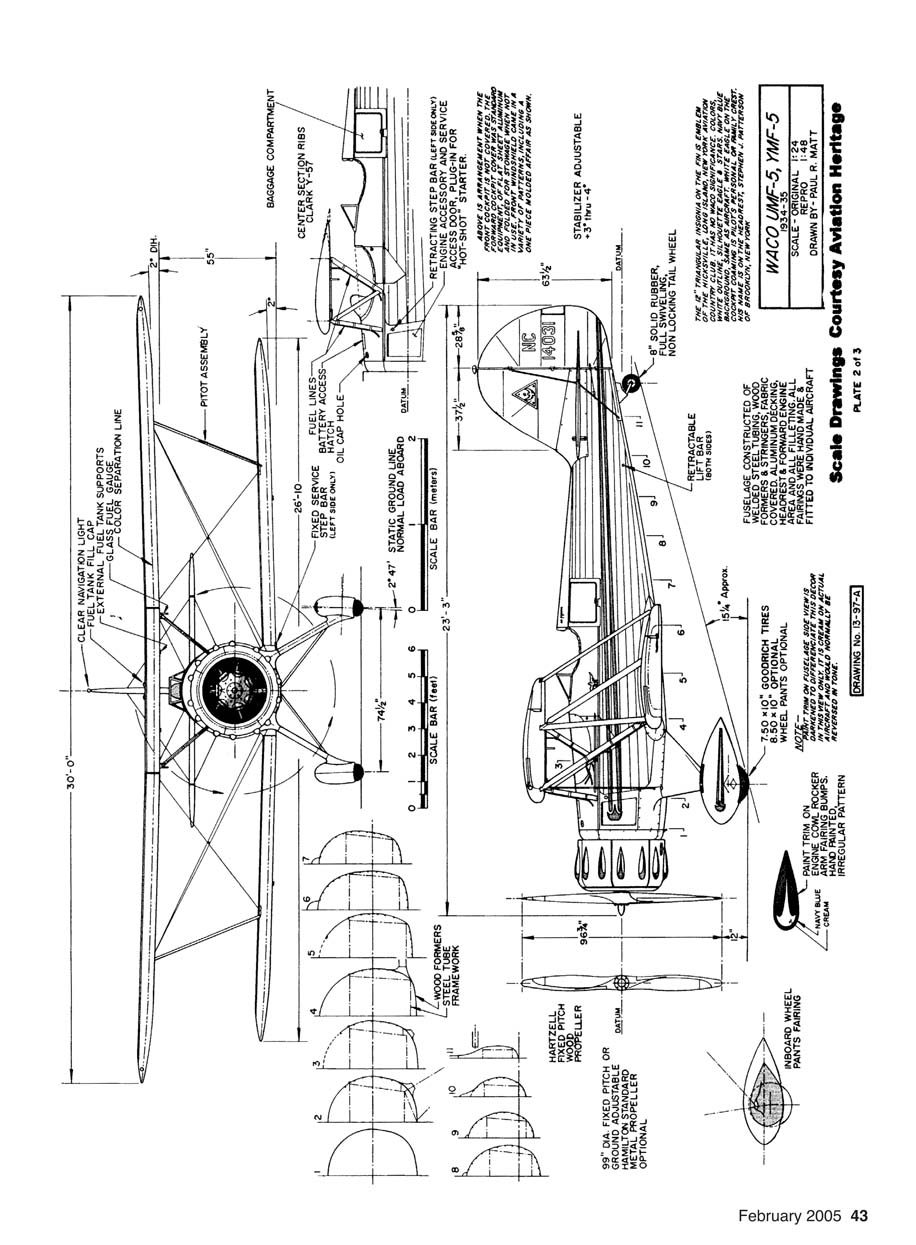
- Wingspan: 30 feet
- Length: 23 feet, 3½ inches
- Height: 8 feet, 5⅜ inches
- Chord: 57 inches
- Airfoil: Clark Y
- Engine: Jacobs L-4, 225-horsepower radial
- Top speed: 148 mph
- Cruising speed: 130 mph
- Landing speed: 47 mph
Paul Matt scale three-views courtesy of Wind Canyon Books Inc. (formerly Aviation Heritage)
- Box 1445, Niceville, FL 32588
- Phone: (800) 952-7007
- Email: [email protected]
- Web: www.windcanyon.com, www.aviation-heritage.com
WACO Organizations
- WACO Field
- 1956 N. County Road 25A, Troy, OH 45373
- Directions: Take I-75 to Exit 69, then go roughly two miles north on County Road 25A toward Troy; it's on your right.
- Private airport open by appointment only. For information contact Dave Bucher at (937) 339-3345, Bob and Pat Wagner at (937) 698-3884, or Joe Balmer at (937) 335-1272.
- Modelers are welcome, provided they are WACO Historical Society and AMA members. Check with an official before flying.
- WACO Museum
- 105 S. Market St. (just outside Troy Square), Troy, OH 45373
- Phone: (937) 355-WACO (9226)
- WACO Historical Society
- Box 62, Troy, OH 45373
- Membership rates: Individual or family $30/year; student $10/year.
- Contact: Bill Jackson at [email protected]
- WACO Classic Aircraft Corporation
- Box 1229, Battle Creek, MI 49016
- Email: [email protected]
- Phone: (616) 565-1000
- Fax: (616) 565-1100
Books
- WACO Airplanes: Ask Any Pilot — The Authentic History of WACO by Ray Brandly
- ISBN: 0960273468
- 213 pages; published 1989 by Zenith Aviation Books
- Contains WACO history and black-and-white photos.
- The Famous "F" Series by Raymond Brandly
- ISBN: 0960273417
- 60 pages; published 1980 by Times Publishing Company
- Contains history of the complete F series of WACO aircraft, with black-and-white photos.
Magazines
- International WACO Association, Volume 1, Number 1, Spring 1990
- Also available from Aviation Heritage (see Wind Canyon Books address above)
- Contains three-view and article on page 5.
- Model Aviation
- Stan Alexander wrote "Classic Aircraft's WACO," published in the August 1994 issue on pages 25–29. It contains photos and three-views.
Contact Wind Canyon Books for information about availability of WACO magazines that offer a wealth of information on these aircraft.
Documentation
- Bob's Aircraft Documentation
- 3114 Yukon Ave., Costa Mesa, CA 92626
- Phone: (714) 979-8058
- Fax: (714) 979-7279
- Carries views of the YMF-5 and more than 14 Foto Paks. One Pak contains the interior and instruments.
- Jim Pepino's Scale Plans & Photo Service
- 3209 Madison Ave., Greensboro, NC 27403
- Tel./Fax: (336) 292-5239
- Carries eight photo packs and three-views.
Kit source
- Pica Enterprises
- 2657 NE 188th St., Miami, FL 33180
- Phone: (305) 935-1436
- Fax: (305) 937-2322
- Offers two WACO kits: one with a 60-inch wingspan for .60–.75 power and one with a 72-inch wingspan suitable for a good .120 four-stroke engine. Check with your local hobby shop.
Plans
- Jim Pepino's Scale Plans & Photo Service (see Documentation above)
- Plans by Jim Pepino for a 90-inch-span model are $35 plus $6 shipping and handling for mailing tube. Several kit cutters also produce these kits.
- Bill Northrop's Plans Service
- 2019 Doral Ct., Henderson, NV 89014
- Phone: (702) 896-2162
- Fax: (702) 897-7775
- Bill has plans for a 40-inch-span YMF-5 designed for a .25 engine by Al Wheeler.
Transcribed from original scans by AI. Minor OCR errors may remain.

