
World Soaring Masters
by Gordon Buckland
The World Soaring Masters (WSM) is held every two years in late September at the amazing Soaring site that is the International Aeromodelling Center (IAC) in Muncie, Indiana. It is the perfect opportunity for all RC Soaring pilots to test their skills against the best pilots in the world.
Last year's WSM, held September 21-23, saw plenty of drama with near-perfect conditions one day, then air so tough that only two aircraft landed on the field in one flight group the following day!
Twelve preliminary rounds were flown each morning, with groups of eight to 10 pilots launching together in a man-on-man format for a 12-minute max and a precision landing. Eighty points was the hunskie (perfect landing score), with one point for every second up to 720, and one point deducted for every second over the max.
Time was measured to the 10th of a second for better accuracy. The time points were added to the landing points to make 800 possible points each flight with the highest score for each flight group normalized to 1,000 and the others in that group each getting a percentage of the highest score.
The well-organized event was directed and run by the hard-working League of Silent Flight (LSF) volunteer crew. It was a huge effort by many including Marna and Larry Jeffries, John Lyndsay, Gil Gauger, Johnny Berlin, and CD Mark Nankivil. The amazing generosity of Horizon Hobby and the efforts of Peter Goldsmith ensured that this event could be conducted with excellent cash prizes and trophies for the top 10 places.
It was also an opportunity for Horizon Hobby to showcase its new, excellent-flying electric sailplane: the 2.9-meter E-flite Mystique. Unfortunately, the fun-fly Mystique contest planned for Saturday evening was canceled. Windy conditions had brought a halt to proceedings midafternoon.
Pilots traveled from across the country to fly in this prestigious event. Representation from Canada included Dave Webb, Doug Pike, and Ray Munro. New Zealand's Joe Wurts, the 2010 winner and current F3K world champion, also attended. This event couldn't be called a masters competition without legendary five-time world champion, Daryl Perkins, who was there with his new F3J creation, the V-tailed Vixen.
Friday saw pilots arriving before dawn to set up their tents and prepare for the 8:30 a.m. pilots' meeting. Mark got proceedings underway on time and called the first group to the flightline for the first round at 9 a.m. The early-morning conditions were what Soaring pilots dream of, with buoyant air upwind over the trees. Merely floating with camber was often enough to achieve 12 minutes without the pilot making a turn during Round 1.
In spite of the pleasant conditions, drama began early. Daryl Perkins took an uncustomary low pop-off on his first launch. He was flying the lightweight 4-meter X2 Xplorer in the light air and the aggressive F3J stabilizer-launch settings caused the mishap, resulting in a 2-minute, 19-second flight, meaning Daryl had already banked his throw-out flight.
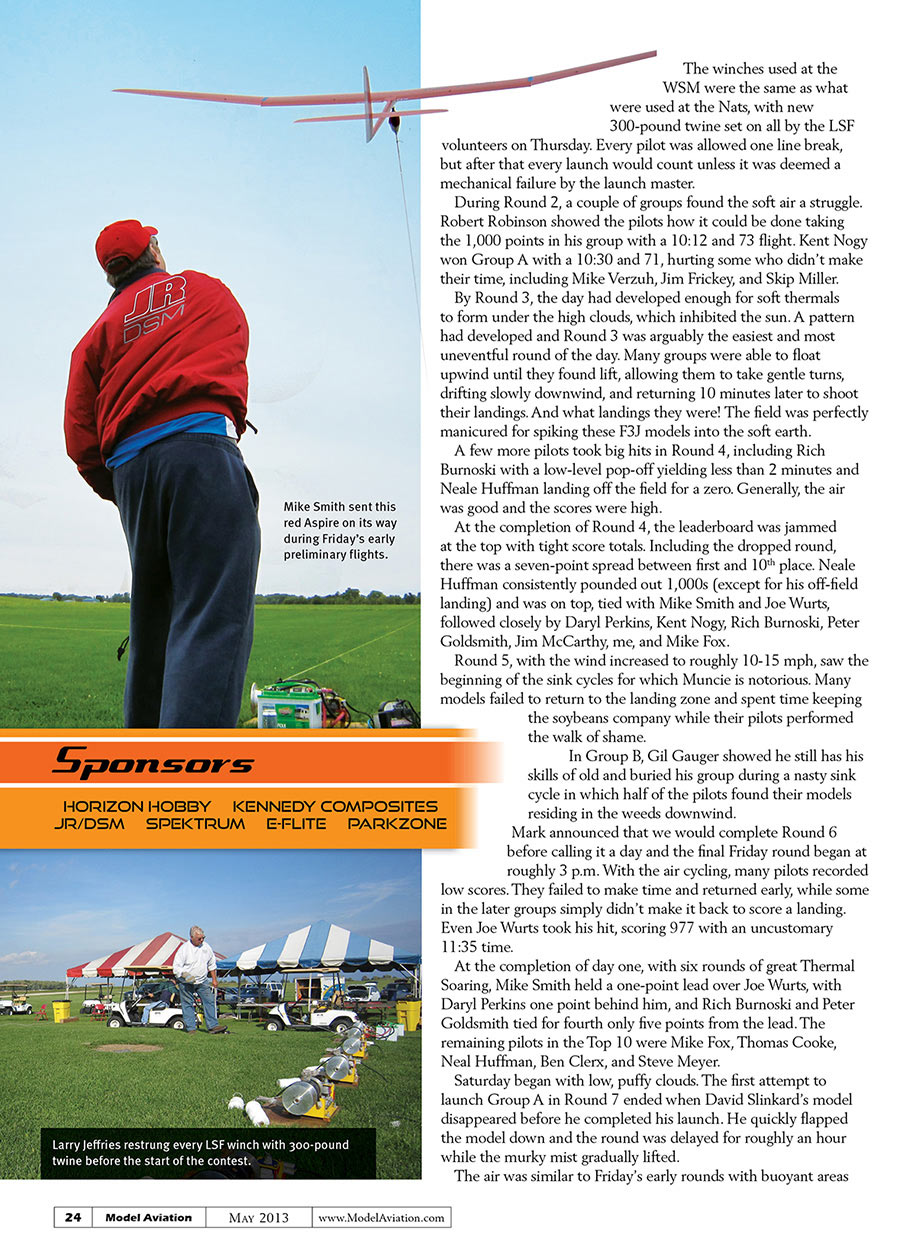
The winches used at the WSM were the same as what were used at the Nats, with new 300-pound twine set on all by the LSF volunteers on Thursday. Every pilot was allowed one line break, but after that every launch would count unless it was deemed a mechanical failure by the launch master.
During Round 2, a couple of groups found the soft air a struggle. Robert Robinson showed the pilots how it could be done taking the 1,000 points in his group with a 10:12 and 73 flight. Kent Nogy won Group A with a 10:30 and 71, hurting some who didn't make their time, including Mike Verzuh, Jim Frickey, and Skip Miller.
By Round 3, the day had developed enough for soft thermals to form under the high clouds, which inhibited the sun. A pattern had developed and Round 3 was arguably the easiest and most uneventful round of the day. Many groups were able to float upwind until they found lift, allowing them to take gentle turns, drifting slowly downwind, and returning 10 minutes later to shoot their landings. And what landings they were! The field was perfectly manicured for spiking these F3J models into the soft earth.
A few more pilots took big hits in Round 4, including Rich Burnoski with a low-level pop-off yielding less than 2 minutes and Neale Huffman landing off the field for a zero. Generally, the air was good and the scores were high.
At the completion of Round 4, the leaderboard was jammed at the top with tight score totals. Including the dropped round, there was a seven-point spread between first and 10th place. Neale Huffman consistently pounded out 1,000s (except for his off-field landing) and was on top, tied with Mike Smith and Joe Wurts, followed closely by Daryl Perkins, Kent Nogy, Rich Burnoski, Peter Goldsmith, Jim McCarthy, me, and Mike Fox.
Round 5, with the wind increased to roughly 10-15 mph, saw the beginning of the sink cycles for which Muncie is notorious. Many models failed to return to the landing zone and spent time keeping the soybeans company while their pilots performed the walk of shame.
In Group B, Gil Gauger showed he still has his skills of old and buried his group during a nasty sink cycle in which half of the pilots found their models residing in the weeds downwind.
Mark announced that we would complete Round 6 before calling it a day and the final Friday round began at roughly 3 p.m. With the air cycling, many pilots recorded low scores. They failed to make time and returned early, while some in the later groups simply didn't make it back to score a landing. Even Joe Wurts took his hit, scoring 977 with an uncustomary 11:35 time.
At the completion of day one, with six rounds of great Thermal Soaring, Mike Smith held a one-point lead over Joe Wurts, with Daryl Perkins one point behind him, and Rich Burnoski and Peter Goldsmith tied for fourth only five points from the lead. The remaining pilots in the Top 10 were Mike Fox, Thomas Cooke, Neal Huffman, Ben Clerx, and Steve Meyer.
Saturday began with low, puffy clouds. The first attempt to launch Group A in Round 7 ended when David Slinkard's model disappeared before he completed his launch. He quickly flapped the model down and the round was delayed for roughly an hour while the murky mist gradually lifted.
The air was similar to Friday's early rounds with buoyant areas to fly but with more variable sink between the "puffs." Many pilots had trouble making the finish with the right amount of height to attempt a spot landing. A few pilots piled into the soybeans on Saturday as well, including Mark Emmons and Jeff Simon, keeping many models aloft for the 10 minutes with barely any input from the pilots. Some Round 7 groups weren't so lucky, but Group D saw Scott Shaw make the right choice to max out while his entire group foundered and sank. It was soon evident that the first couple of rounds were going to be the highest scoring of the day.
Round 8 began in more active conditions with regular lift cycles blowing through. The wind gradually increased during the round to roughly 10 mph. The difficulty factor increased as the round went on and the wind began to blow.
The most notable, Group F, launched into a significant sink cycle and those who chased downwind to find the previous thermal found a huge sinkhole coming home. Gavin Trussell and Peter Goldsmith found soybeans in what became the greatest example of Muncie madness I have witnessed. Peter Baumeler won Group F with a 1,000 for his 4:50 time.
Group H saw Don Richmond make a great 11:59/79 to take the 1,000 points.
With the wind steadily increasing, Round 9 began with Joe Wurts burying his group with a sortie way out to the right-side crosswind to hook up and take it a long way downwind. Joe showed his skill on this flight. Coming home he got dangerously low a long way out, but made a low save to gain enough altitude to bring the model back for a 12:01/79. Thomas Cooke was the nearest score in his group with a 9:50.
Ron Kukral also made a memorable flight by making a low-level save near the landing zone and extending his flight by an extra 5 minutes to bury his group.
By the time Group F launched, the wind meters were regularly in use and at times with a 25-plus mph wind speed, it looked as though many pilots were under-ballasted. Mike Verzuh won Group F with an 8:47. Jim McNeal took the 1,000 in Group G with a 4:29 and a zero landing, while Group H was won by Daryl Perkins' 6:40/74. Few pilots were making it back to the landing zone and many were taking zeros.
At this point, many of us hoped that the CD would put a hold on the contest with the wind gusts often exceeding the FAI and AMA maximums, but it was decided to continue because it wasn't consistently above the limit.
Group A of Round 10 launched at roughly 3:15 p.m. and every aircraft was loaded to the max with ballast. Joe was in that group and he showed incredible skills to take huge air back downwind twice and return to make the only 12-minute max of the round and the first since Group E in Round 9! John Diniz surfed air to get an 8:45, while the others barely found 5 minutes of air.
Group B launched in even windier conditions. Savvy pilots were not taking the lift but staying in the winch area to ensure a score. Kent Nogy took the 1,000 in B with a 6:29 and Peter Goldsmith won Group C with an 8:48.
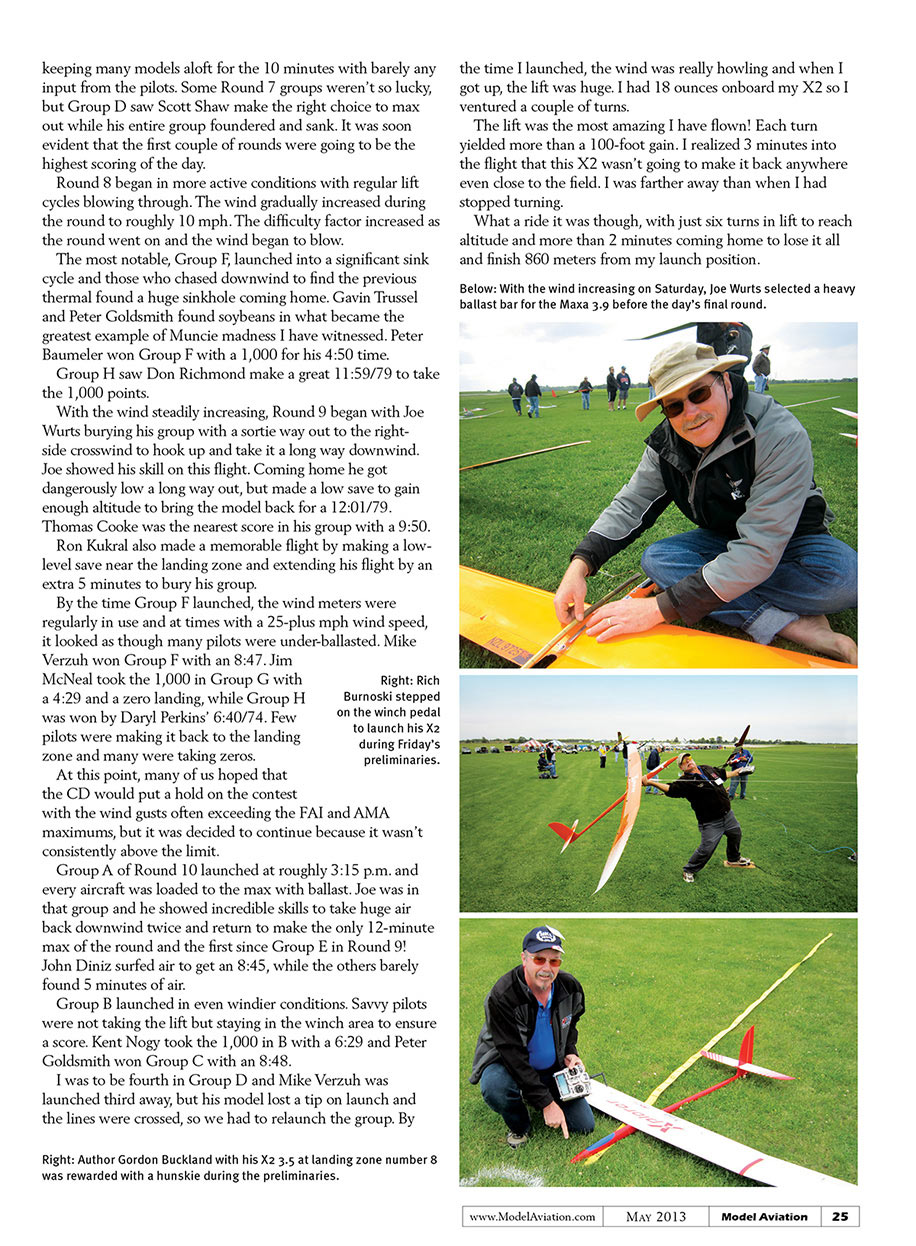
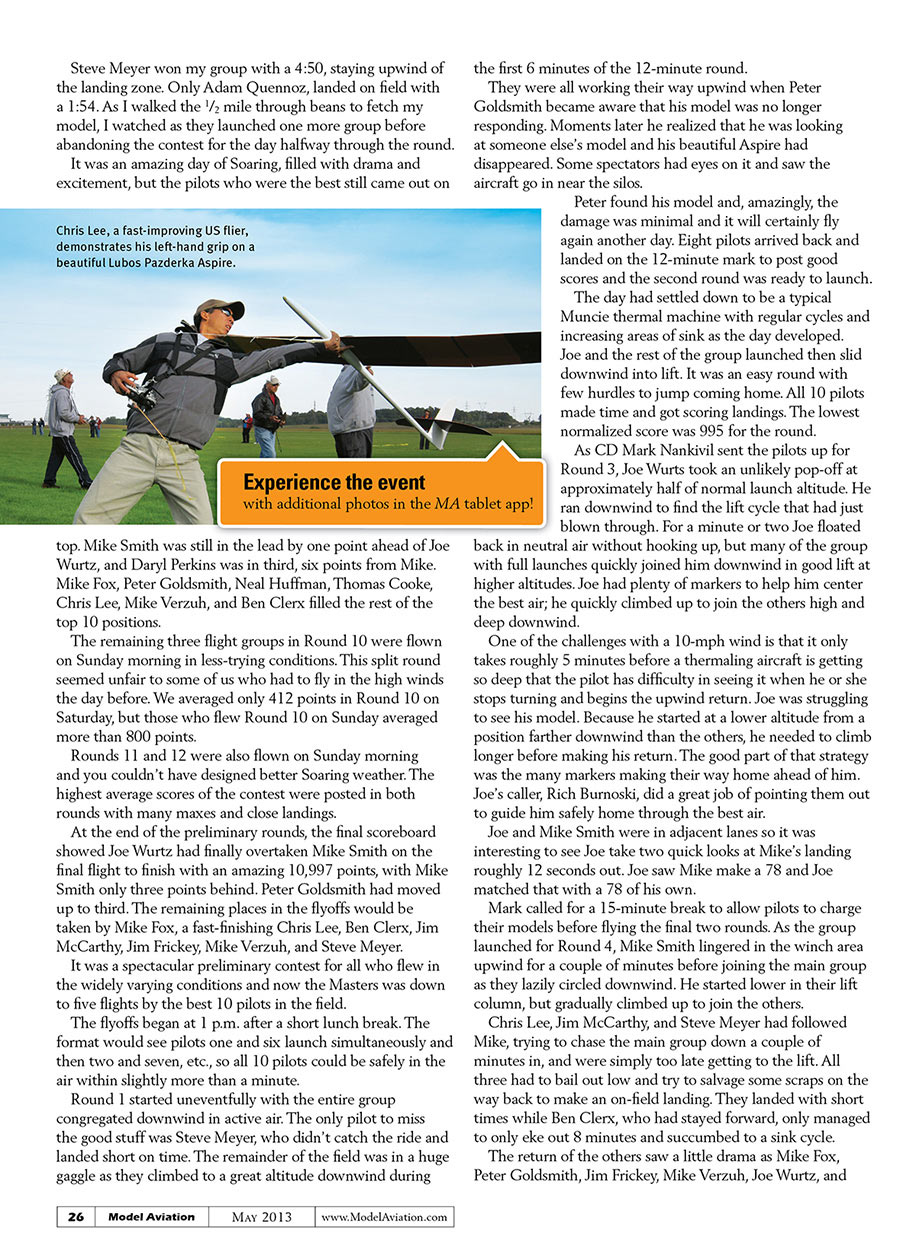
I was to be fourth in Group D and Mike Verzuh was launched third away, but his model lost a tip on launch and the lines were crossed, so we had to relaunch the group. By the time I launched, the wind was really howling and when I got up, the lift was huge. I had 18 ounces onboard my X2 so I ventured a couple of turns.
The lift was the most amazing I have flown! Each turn yielded more than a 100-foot gain. I realized 3 minutes into the flight that this X2 wasn't going to make it back anywhere even close to the field. I was farther away than when I had stopped turning.
What a ride it was though, with just six turns in lift to reach altitude and more than 2 minutes coming home to lose it all and finish 860 meters from my launch position.
Steve Meyer won my group with a 4:50, staying upwind of the landing zone. Only Adam Quennoz landed on field with a 1:54. As I walked the ½ mile through beans to fetch my model, I watched as they launched one more group before abandoning the contest for the day halfway through the round.
It was an amazing day of Soaring, filled with drama and excitement, but the pilots who were the best still came out on top. Mike Smith was still in the lead by one point ahead of Joe Wurtz, and Daryl Perkins was in third, six points from Mike. Mike Fox, Peter Goldsmith, Neal Huffman, Thomas Cooke, Chris Lee, Mike Verzuh, and Ben Clerx filled the rest of the top 10 positions.
The remaining three flight groups in Round 10 were flown on Sunday morning in less-trying conditions. This split round seemed unfair to some of us who had to fly in the high winds the day before. We averaged only 412 points in Round 10 on Saturday, but those who flew Round 10 on Sunday averaged more than 800 points.
Rounds 11 and 12 were also flown on Sunday morning and you couldn’t have designed better Soaring weather. The highest average scores of the contest were posted in both rounds with many maxes and close landings.
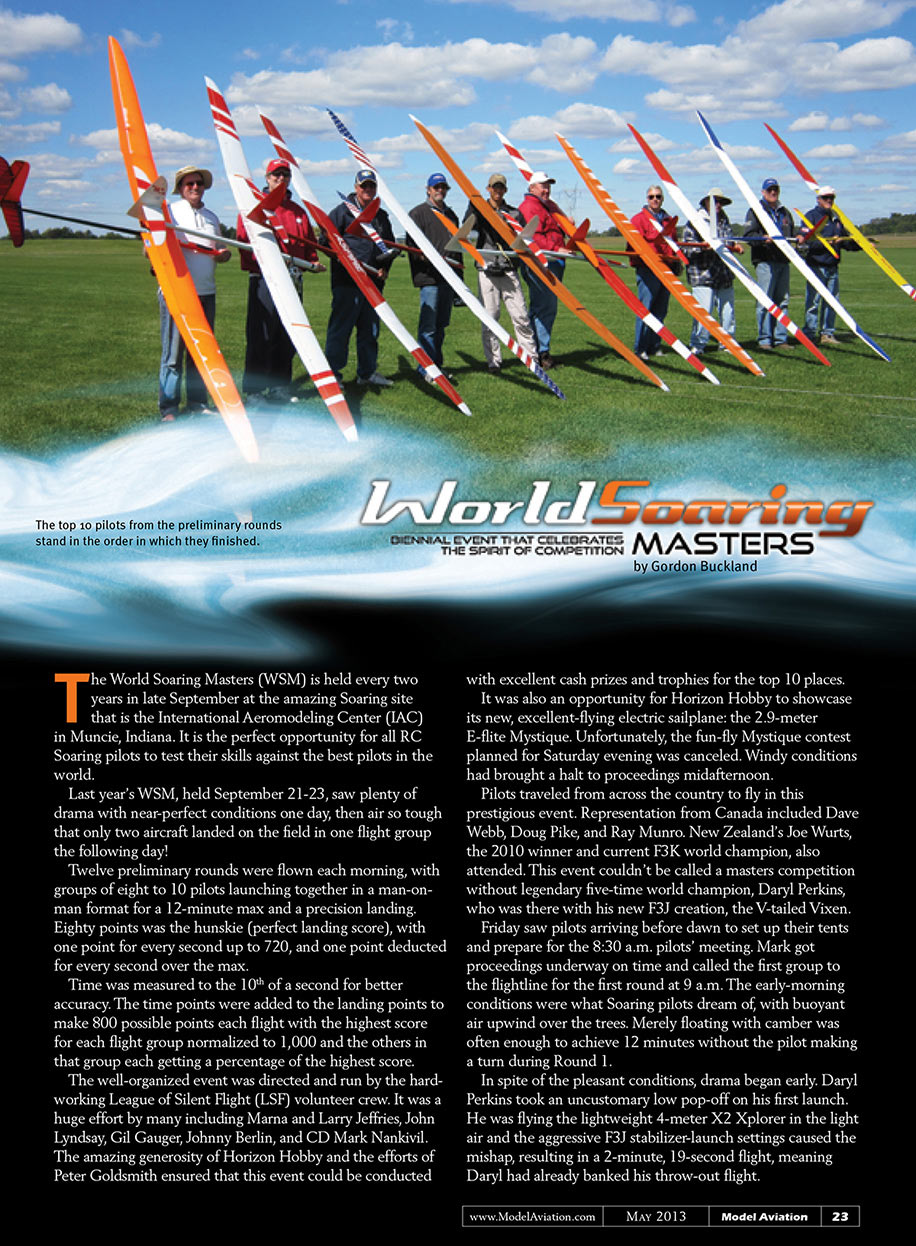
At the end of the preliminary rounds, the final scoreboard showed Joe Wurtz had finally overtaken Mike Smith on the final flight to finish with an amazing 10,997 points, with Mike Smith only three points behind. Peter Goldsmith had moved up to third. The remaining places in the playoffs would be taken by Mike Fox, a fast-finishing Chris Lee, Ben Clerx, Jim McCarthy, Jim Frickey, Mike Verzuh, and Steve Meyer.
It was a spectacular preliminary contest for all who flew in the widely varying conditions and now the Masters was down to five flights by the best 10 pilots in the field.
The flyoffs began at 1 p.m. after a short lunch break. The format would see pilots one and six launch simultaneously and then two and seven, etc., so all 10 pilots could be safely in the air within slightly more than a minute.
Round 1 started uneventfully with the entire group congregated downwind in active air. The only pilot to miss the good stuff was Steve Meyer, who didn’t catch the ride and landed short on time. The remainder of the field was in a huge gaggle as they climbed to a great altitude downwind during the first 6 minutes of the 12-minute round.
They were all working their way upwind when Peter Goldsmith became aware that his model was no longer responding. Moments later he realized that he was looking at someone else’s model and his beautiful Aspire had disappeared. Some spectators had eyes on it and saw the aircraft go in near the silos.
Peter found his model and, amazingly, the damage was minimal and it will certainly fly again another day. Eight pilots arrived back and landed on the 12-minute mark to post good scores and the second round was ready to launch.
The day had settled down to be a typical Muncie thermal machine with regular cycles and increasing areas of sink as the day developed. Joe and the rest of the group launched then slid downwind into lift. It was an easy round with few hurdles to jump coming home. All 10 pilots made time and got scoring landings. The lowest normalized score was 995 for the round.
As CD Mark Nankivil sent the pilots up for Round 3, Joe Wurtz took an unlikely pop-off at approximately half of normal launch altitude. He ran downwind to find the lift cycle that had just blown through. For a minute or two Joe floated back in neutral air without hooking up, but many of the group with full launches quickly joined him downwind in a good lift at higher altitudes. Joe had plenty of markers to help him center the best air; he quickly climbed up to join the others high and deep downwind.
One of the challenges with a 10-mph wind is that it only takes roughly 5 minutes before a thermaling aircraft is getting so deep that the pilot has difficulty in seeing it when he or she stops turning and begins the upwind return. Joe was struggling to see his model. Because he started at a lower altitude from a position farther downwind than the others, he needed to climb longer before making his return. The good part of that strategy was the many markers making their way home ahead of him. Joe’s caller, Rich Burnoski, did a great job of pointing them out to guide him safely home through the best air.
Joe and Mike Smith were in adjacent lanes so it was interesting to see Joe take two quick looks at Mike’s landing roughly 12 seconds out. Joe saw Mike make a 78 and Joe matched that with a 78 of his own.
Mark called for a 15-minute break to allow pilots to charge their models before flying the final two rounds. As the group launched for Round 4, Mike Smith lingered in the winch area upwind for a couple of minutes before joining the main group as they lazily circled downwind. He started lower in their lift column, but gradually climbed up to join the others.
Chris Lee, Jim McCarthy, and Steve Meyer had followed Mike, trying to chase the main group down a couple of minutes in, and were simply too late getting to the lift. All three had to bail out low and try to salvage some scraps on the way back to make an on-field landing. They landed with short times while Ben Clerx, who had stayed forward, only managed to only eke out 8 minutes and succumbed to a sink cycle.
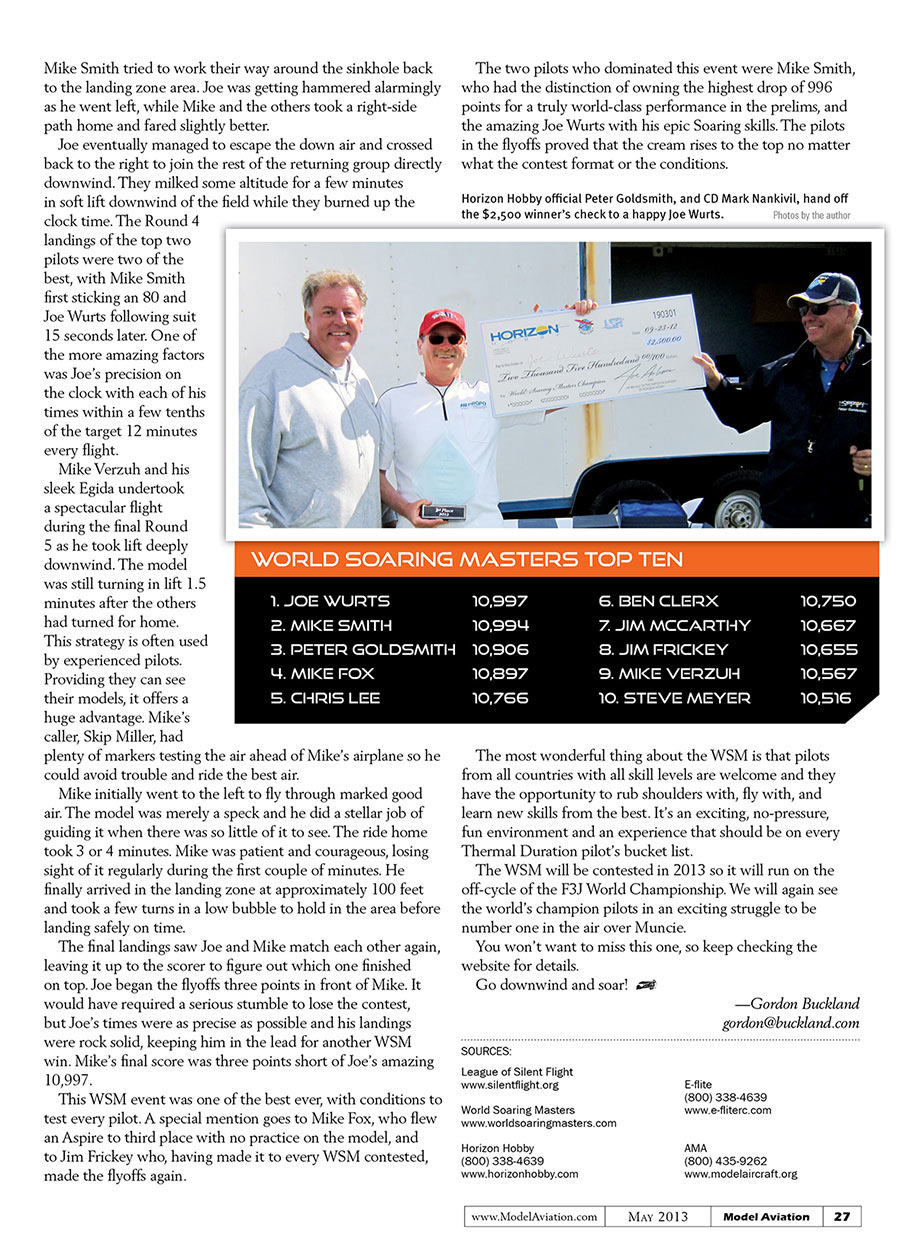
The return of the others saw a little drama as Mike Fox, Peter Goldsmith, Jim Frickey, Mike Verzuh, Joe Wurtz were all in the mix for the final landing sequence. They made safe landings with Mike Fox leading the parade with a 79 for the round. Joe Wurts and Mike Smith were separated by three points going into the flyoffs. Both pilots were in top form, and the flyoffs were spectacular. Joe took first place with a final score of 10,997 and Mike finished second with 10,994. Peter Goldsmith, Mike Fox, and Chris Lee rounded out the top five.
Mike Smith tried to work their way around the sinkhole back to the landing zone area. Joe was getting hammered alarmingly as he went left, while Mike and the others took a right-side path home and fared slightly better.
Joe eventually managed to escape the down air and crossed back to the right to join the rest of the returning group directly downwind. They milked some altitude for a few minutes in soft lift downwind of the field while they burned up the clock time. The Round 4 landings of the top two pilots were two of the best, with Mike Smith first sticking an 80 and Joe Wurts following suit 15 seconds later. One of the more amazing factors was Joe's precision on the clock with each of his times within a few tenths of the target 12 minutes every flight.
Mike Verzuh and his sleek Egida undertook a spectacular flight during the final Round 5 as he took lift deeply downwind. The model was still turning in lift 1.5 minutes after the others had turned for home. This strategy is often used by experienced pilots. Providing they can see their models, it offers a huge advantage. Mike's caller, Skip Miller, had plenty of markers testing the air ahead of Mike's airplane so he could avoid trouble and ride the best air.
Mike initially went to the left to fly through marked good air. The model was merely a speck and he did a stellar job of guiding it when there was so little of it to see. The ride home took 3 or 4 minutes. Mike was patient and courageous, losing sight of it regularly during the first couple of minutes. He finally arrived in the landing zone at approximately 100 feet and took a few turns in a low bubble to hold in the area before landing safely on time.
The final landings saw Joe and Mike match each other again, leaving it up to the scorer to figure out which one finished on top. Joe began the flyoffs three points in front of Mike. It would have required a serious stumble to lose the contest, but Joe's times were as precise as possible and his landings were rock solid, keeping him in the lead for another WSM win. Mike's final score was three points short of Joe's amazing 10,997.
This WSM event was one of the best ever, with conditions to test every pilot. A special mention goes to Mike Fox, who flew an Aspire to third place with no practice on the model, and to Jim Frickey who, having made it to every WSM contested, made the flyoffs again.
The two pilots who dominated this event were Mike Smith, who had the distinction of owning the highest drop of 996 points for a truly world-class performance in the prelims, and the amazing Joe Wurts with his epic Soaring skills. The pilots in the flyoffs proved that the cream rises to the top no matter what the contest format or the conditions.
WORLD SOARING MASTERS TOP TEN
- 1. JOE WURTS — 10,997
- 2. MIKE SMITH — 10,994
- 3. PETER GOLDSMITH — 10,906
- 4. MIKE FOX — 10,897
- 5. CHRIS LEE — 10,766
- 6. BEN CLERX — 10,750
- 7. JIM MCCARTHY — 10,667
- 8. JIM FRICKEY — 10,655
- 9. MIKE VERZUH — 10,567
- 10. STEVE MEYER — 10,516
The most wonderful thing about the WSM is that pilots from all countries with all skill levels are welcome and they have the opportunity to rub shoulders with, fly with, and learn new skills from the best. It's an exciting, no-pressure, fun environment and an experience that should be on every Thermal Duration pilot's bucket list.
The WSM will be contested in 2013 so it will run on the off-cycle of the F3J World Championship. We will again see the world's champion pilots in an exciting struggle to be the number one in the air over Muncie.
You won't want to miss this one, so keep checking the website for details.
Go downwind and soar!
—Gordon Buckland [email protected]
SOURCES:
- League of Silent Flight
- World Soaring Masters
- Horizon Hobby
(800) 338-4639 www.horizonhobby.com
- E-flite
(800) 338-4639 www.e-fliterc.com
- AMA
(800) 435-9262 www.modelaircraft.org
Transcribed from original scans by AI. Minor OCR errors may remain.

