
World’s Largest Helicopter Fun-Fly
by Mark Fadely
Have you ever wondered what heaven would be like for RC helicopter pilots? Don't laugh, but it might be spending eternity at the AMA flying site in Muncie, Indiana. It would be August year-round, except there would be unusually low humidity with temperatures in the mid-80s, a light breeze at your back, and no tornadoes.
Young, attractive angels clad in exotic helicopter attire would be milling about, handing out free stuff. For the ladies, there would be many hunky helicopter guys. (Cough!)
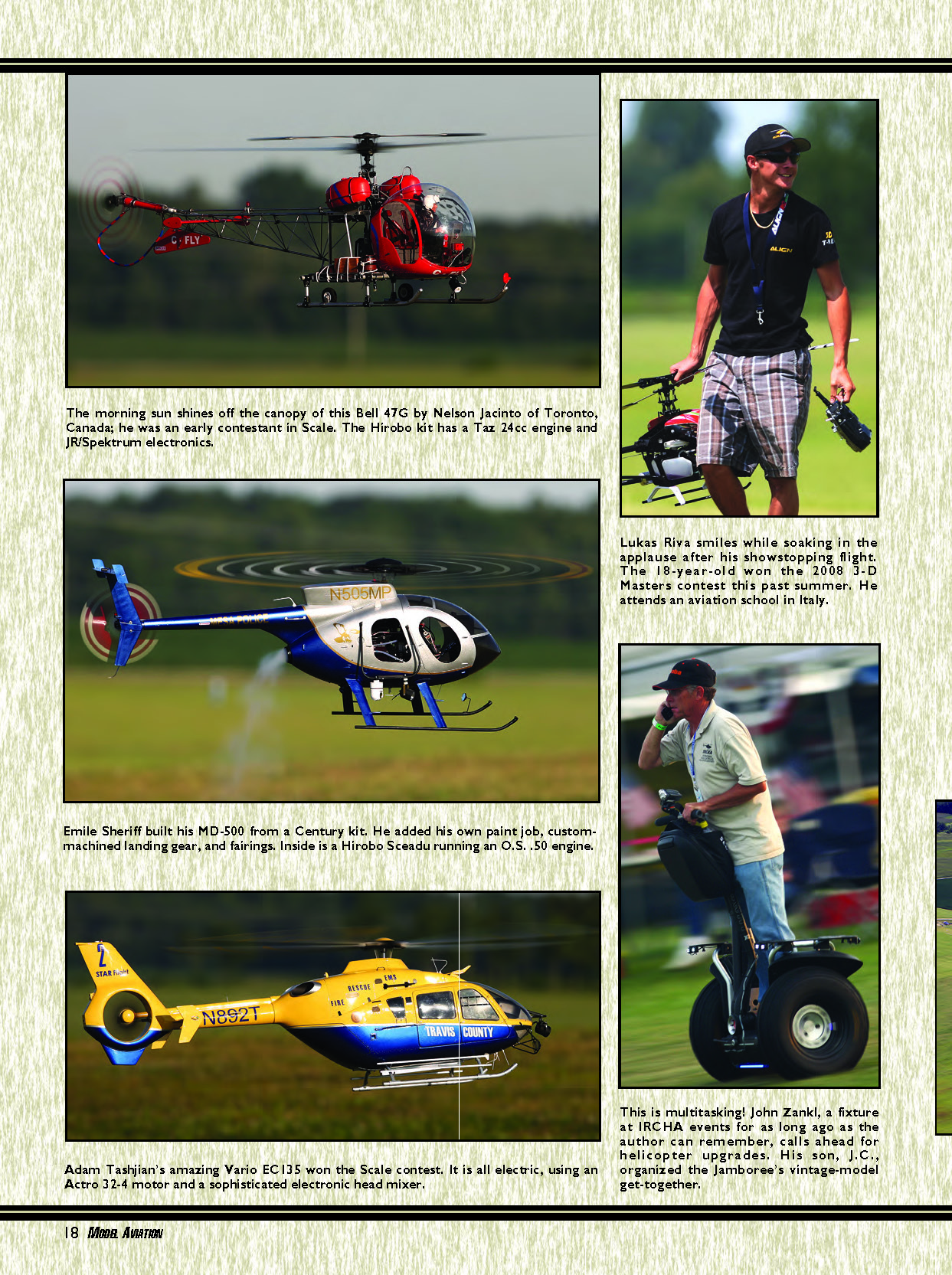
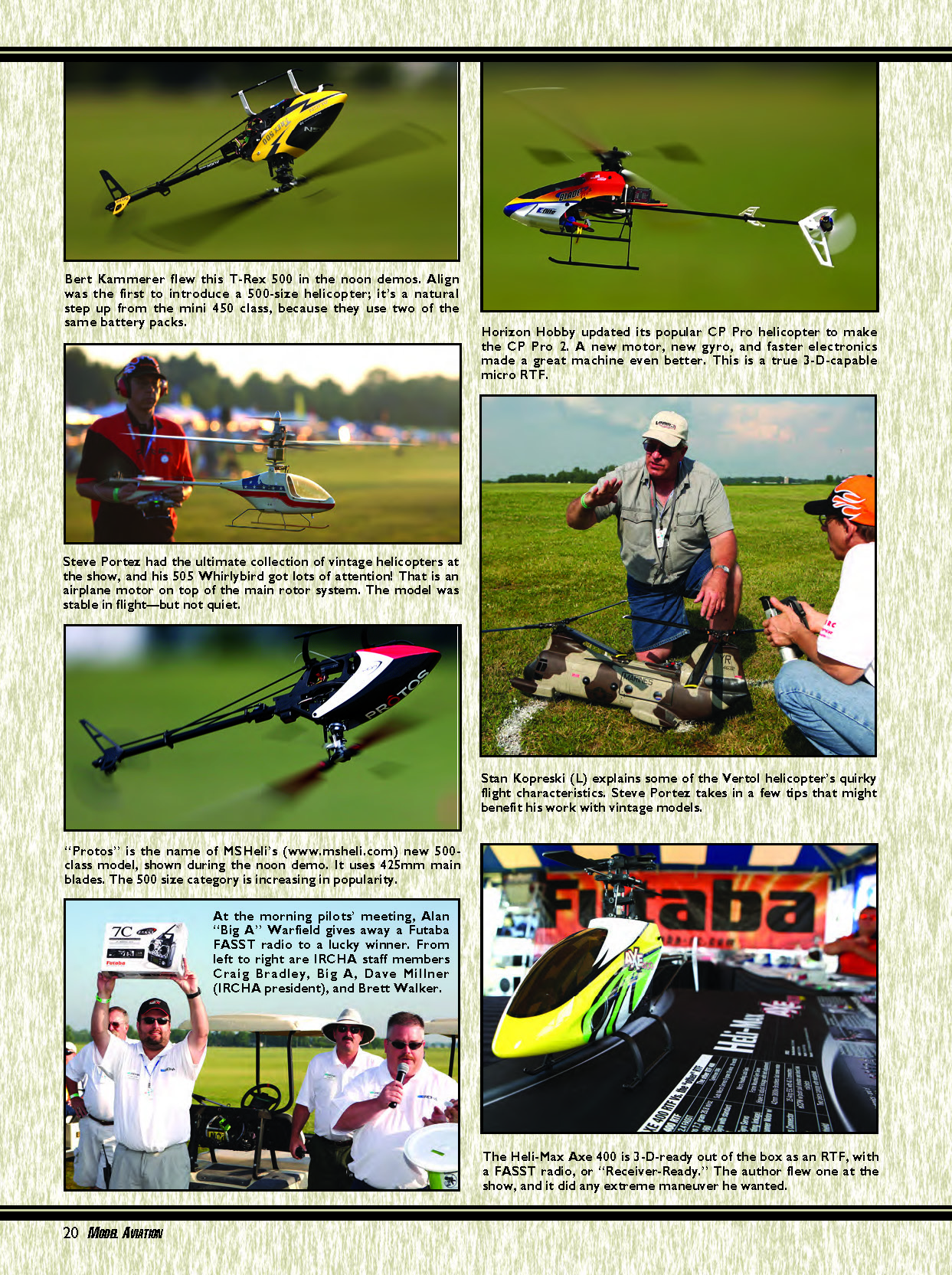
If you have not guessed what I am referring to, it is the IRCHA (International Radio Controlled Helicopter Association) Jamboree. This year, it was all the things I listed and more. The gathering is, and has been, the largest RC event in the world. The flightline was more than 1/4-mile long, and there were 17 flight stations.
The 2008 Jamboree blew the doors off the attendance record, eclipsing 2007's. To the disbelief of many, it was announced late Saturday afternoon that IRCHA Jamboree 2008 had topped all RC events with a final pilot count of 780. When you add thousands of spectators and a few hundred vendor and media people to that tally, it makes for a super-sized fun-fly.
Jamboree History: The first IRCHA fun-flys began in the early 1990s in Dayton, Ohio, with only a handful of pilots. Imagine yourself driving to the flying field, listening to Michael Jackson and Guns N' Roses on the radio. (I was rocking out to much cooler stuff such as Metallica, of course.) When you got there, you might have seen a helicopter pilot wearing parachute pants and learning basic 3-D moves on a revolutionary new model called the “Concept 30 DX.” This was the first Taya-designed Kyosho plastic helicopter, and it would have a profound impact on the future of RC helicopters.
I was lucky enough to have attended many Jamborees starting in the mid-1990s. By that time, the IRCHA Jamboree had moved to Hebron, Ohio, just east of Columbus. Jeff Robb owned a full-scale airport that made a fantastic venue at which to increase the event's size. That field became the birthplace, and sometimes the killing field, of many newly designed models. Several of the latest 3-D maneuvers were debuted there. Numerous pilots looked forward to those annual pilgrimages. You would meet scores of great people who sometimes became lifelong friends, even though you might see them only once a year.
Eight years ago, the AMA International Aeromodeling Center became the Jamboree's home. Southeast Muncie's wide-open spaces have made the area a dreamland for model-aviation enthusiasts.
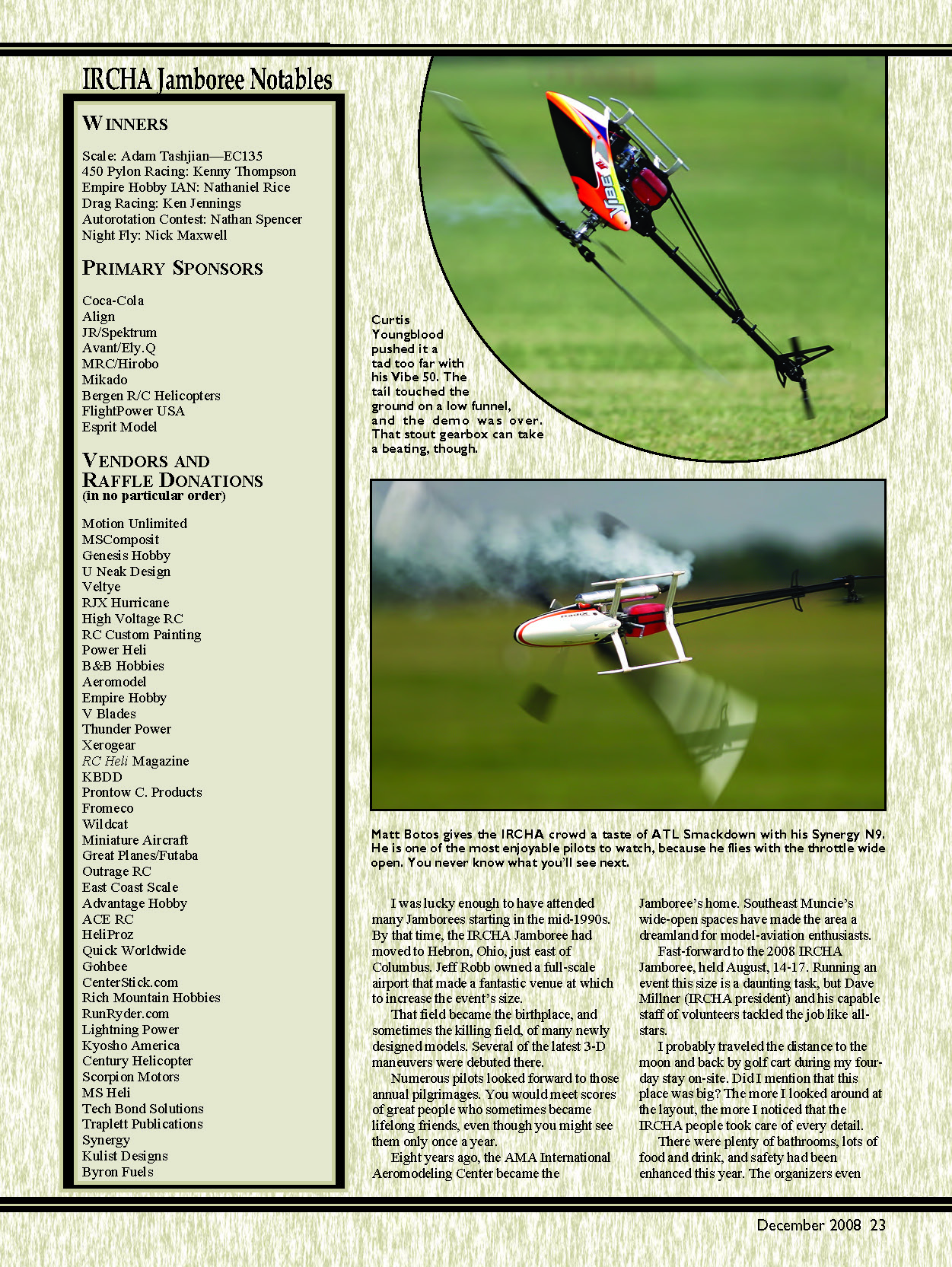
Fast-forward to the 2008 IRCHA Jamboree, held August 14–17. Running an event this size is a daunting task, but Dave Millner (IRCHA president) and his capable staff of volunteers tackled the job like all-stars. I probably traveled the distance to the moon and back by golf cart during my four-day stay on-site. Did I mention that this place was big? The more I looked around at the layout, the more I noticed that the IRCHA people took care of every detail. There were plenty of bathrooms, lots of food and drink, and safety had been enhanced this year. The organizers even provided transportation to and from the parking areas. Great job to all the people who helped out.
Prizes were given away continuously during the event. Fully operational 3-D helicopters were handed out as grand prizes on Saturday evening, and more than $40,000 in helicopter merchandise was distributed. That is impressive!
Vintage Helicopters
Our hobby is maturing as the years pass; I am not maturing much, though. Inside I am still the same 7-year-old boy who loves things that fly. I just have gray hair now. I blame my kids for that, though. Only kidding. RC helicopters have definitely matured in recent years. The modern designs we fly today have their roots in machines that were developed 35 years ago.
In the early years, there were companies such as Schluter, Kavan, GMP, Du-Bro, Graupner, and American Helicopters. Nobody had a gyro, so keeping track of the tail while fighting all the other controls was more than most pilots could handle. In 1975, you were a top dog if you even hovered a helicopter.
The majority of average flights in those days were spent waiting for the next part to fail. Then when the inevitable happened, all you could do was watch as your pride and joy ripped itself apart doing the chicken dance.
When the dust settled, it was time to get down on your hands and knees and search every square inch of the ground for parts that were thrown off during the model’s self-abuse session. You secretly hoped no airplane pilots were there to witness the massacre so you could quietly pack up the twisted metal carcass and head home for another rebuild. In those days, you had to want to fly a helicopter badly to put up with all the trials.
It was inspiring to see a lot of vintage models in the air at this year’s Jamboree. Most had been updated with new gyros and the latest DSM electronics. The older machines generated much more radio-frequency noise, making them twitchy and prone to glitching in the flight controls. Our new 2.4 GHz radios eliminate those glitch problems and make the old helicopters finally fly smoothly.
J.C. Zankl organized an informal get-together just for the vintage-model fliers; he communicated with them online before the event. The IRCHA staff provided a large tent on the flightline for vintage stuff. I was amazed to see all the old helicopters. A large number of people enjoy restoring and flying the classic machines.
I also enjoyed seeing so many young pilots stop by to chat with the old—I mean vintage—pilots. This is going to be a growing special-interest segment of our sport.
Scale Helicopters
If you are into Scale RC helicopters, you would have loved being at the Jamboree this year. There were more beautiful Scale models than ever.
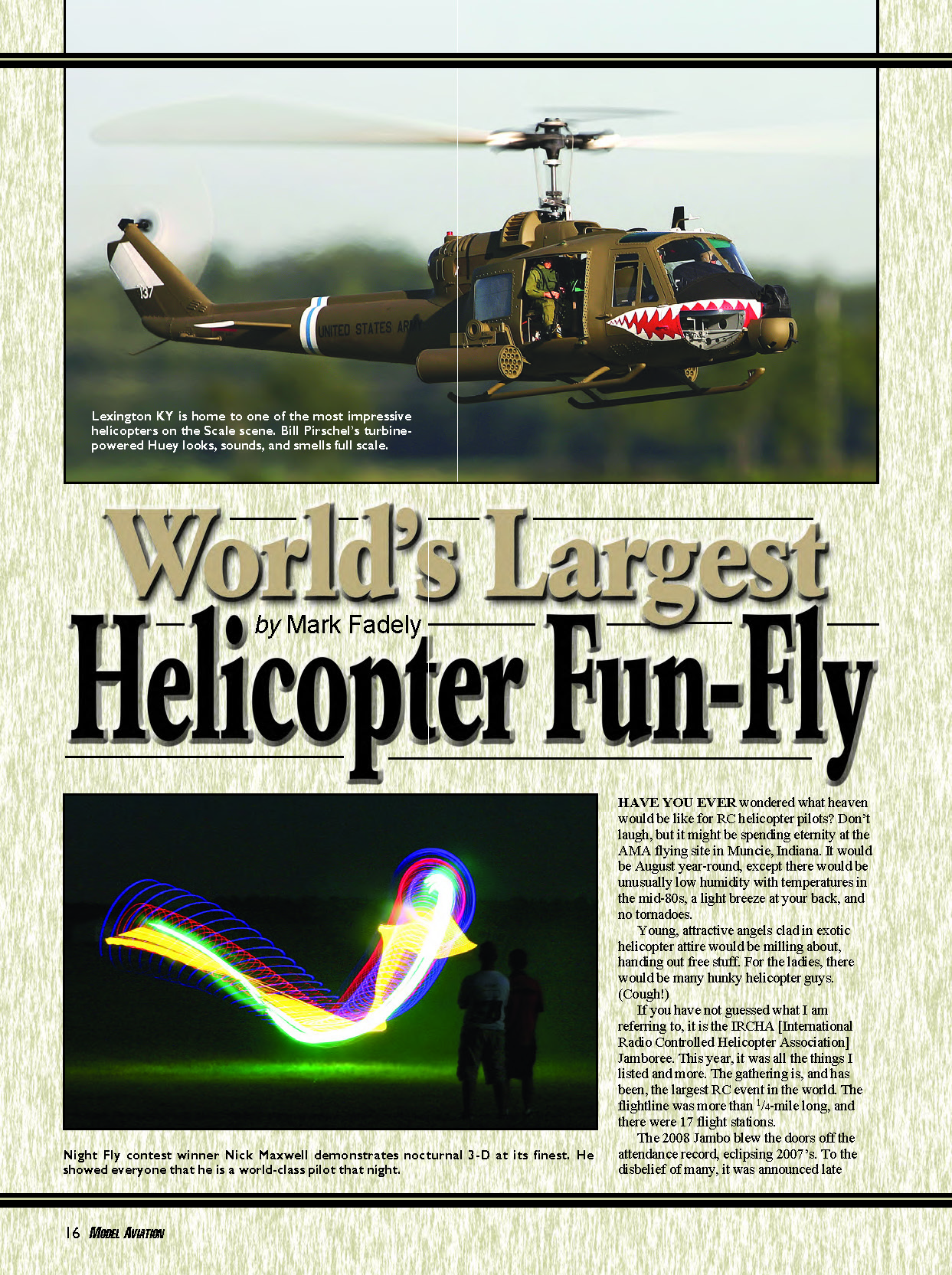
Many helicopter manufacturers are expanding their scale body lines to keep up with increasing demand. There are plenty of nice fuselages for any size machine. All kinds of prefinished bodies are even available for the 450-size mini electrics, such as Hueys, Cobras, Apaches, Jet Rangers, MD 500s, and even Chinooks.
The large-scale helicopters stole the show, though. Peter Wales flew his Bell 47 and giant turbine-powered Hirobo Lama during the noon demonstrations.
There were way too many new products at the gathering to list in this article. It is a reflection on our sport’s health to see so many new helicopters and accessories. It truly is the best time in history to be flying model helicopters.
3-D Happenings
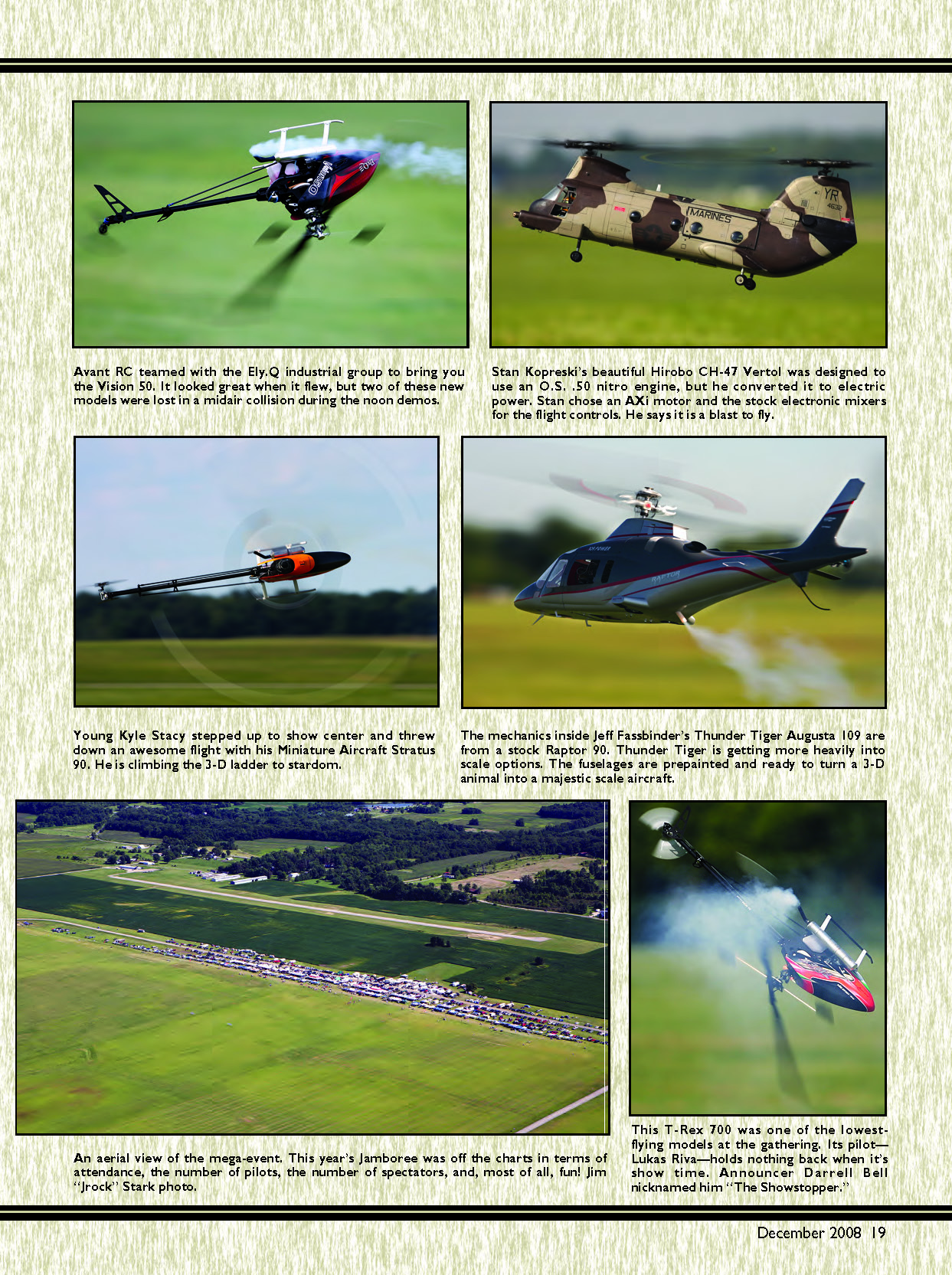
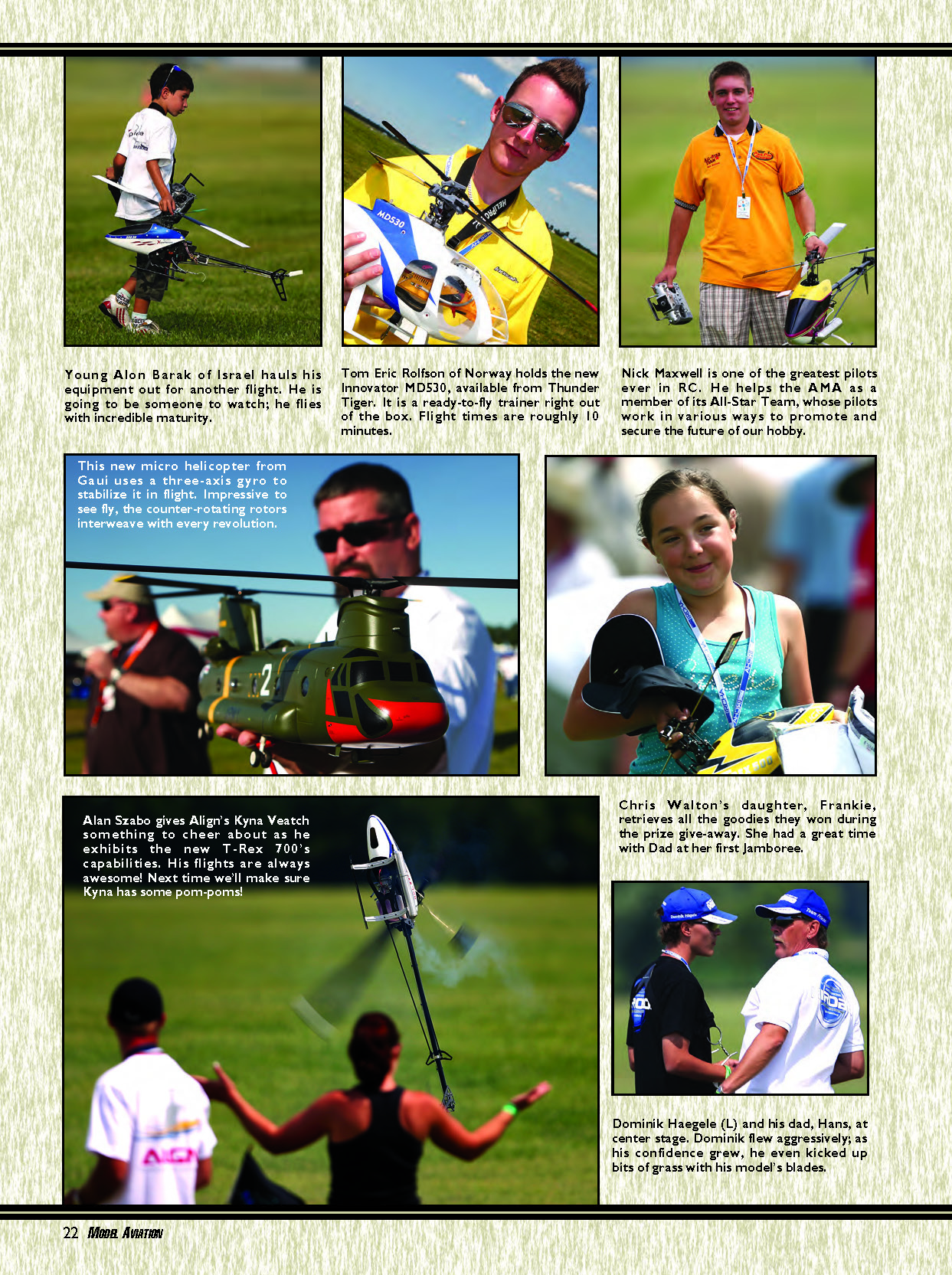
The best 3-D pilots in the world showed up this year and flew radical demos that got lower and more extreme as the crowd chanted, “Lower!” Dominik Haegle of Germany (Extreme Flight Championships [XFC] winner) was joined by Israel’s Lukas Riva (3D Masters champion), and they laid down the hardest, most technical flights I had ever seen.
Bits of grass went flying when the helicopters’ blades sliced up the well-manicured runway during super low segments of their routines. That is low! These guys know what it takes to win a contest, but they are at their best when they can forget the contest rules and let ’er rip. The intense action floored the gallery of spectators.
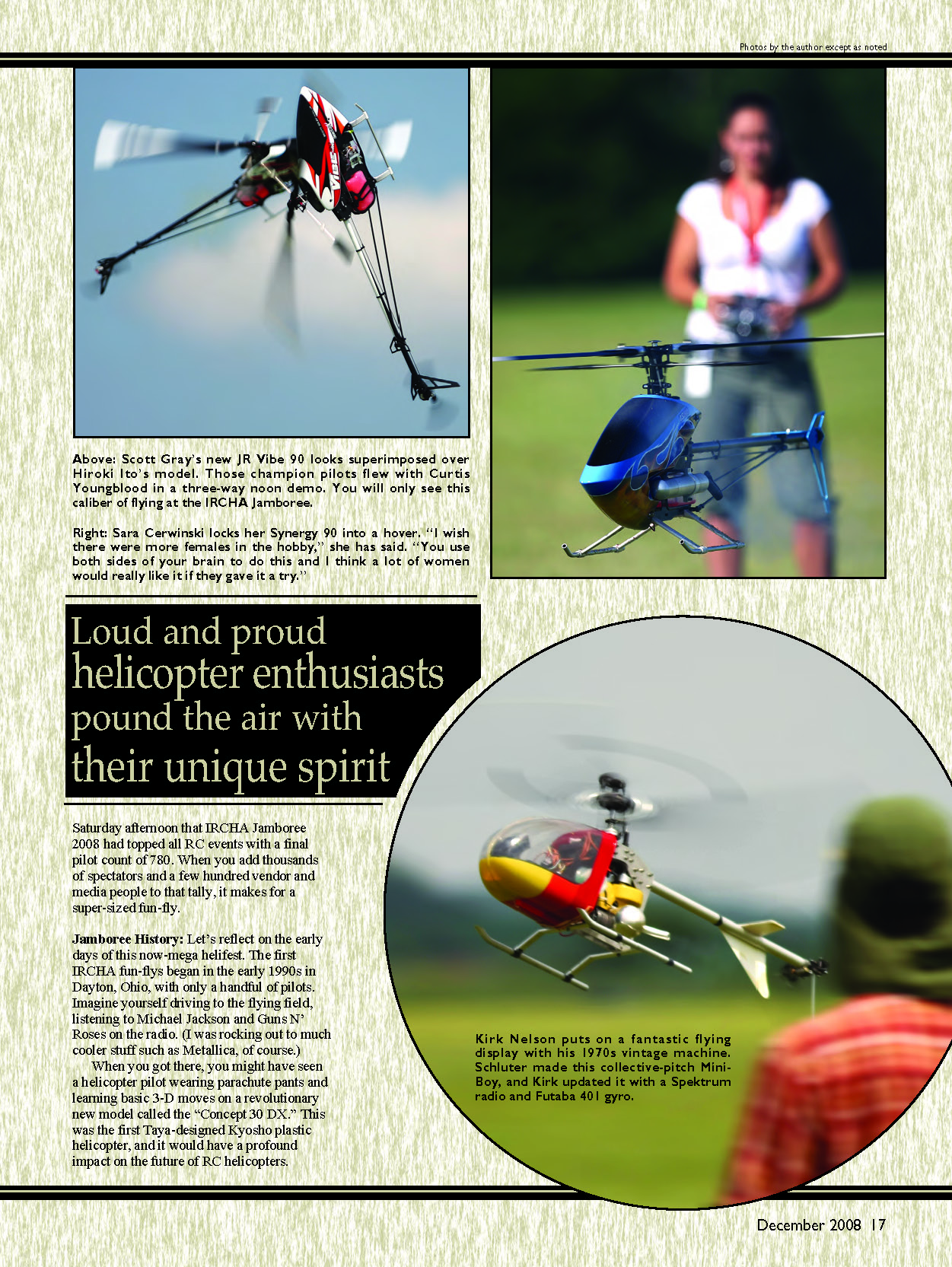
When you want to see wicked 3-D, you call out Americans Bobby Watts, Nick Maxwell, Bert Kammerer, Kyle Stacy, and Alan Szabo. They pulled off incredible flights. Those pilots not only flew, but they also painted the sky with hard-core 3-D style.
All those who performed during this year’s demos were the best ever. Observers were on the edge of their seats for an hour.
Actually, you didn’t have to wait until the noon demonstration hour, because this extreme flying could be seen at any time, anywhere on the flightline. There are many great up-and-coming pilots.
Amateur 3-D Contest
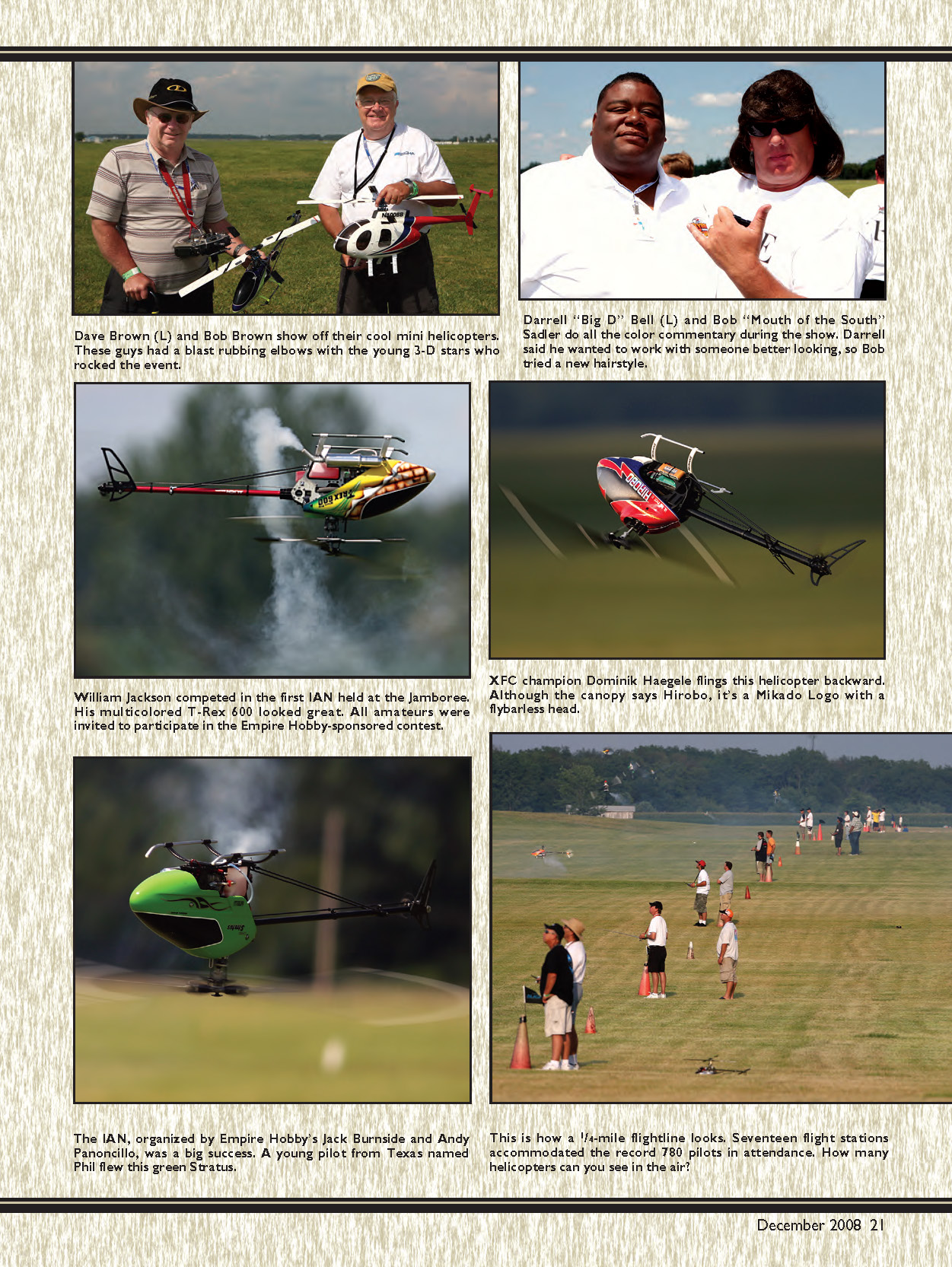
Empire Hobby organized a 3-D contest specifically for unsponsored pilots: the IRCHA Amateur Nationals, or IAN. Andy Ponnanclo ran the event. Any pilot who was not already flying for a company was welcome to join.
Before the contest started, Andy drove his golf cart up and down the flightline watching various pilots fly. When he saw someone who was impressive, he invited that person to participate in the contest. The winning pilot received a one-year Empire Hobby sponsorship, a trophy, and an invitation to the next XFC.
I watched the competitors battle it out; they flew amazingly. Nathaniel Rice of Spring Mills, Pennsylvania, earned first place. Wendell Adkins of the XFC staff was there to help judge. This competition was a great way for up-and-coming pilots to be recognized.
I could go on forever telling you about this event, because there was so much to see and learn. Some of the activities I didn’t mention were the 450-size pylon races, night-flying, helicopter drag races, and even an autorotation contest. I will touch on some of these special events in future MA RC helicopter columns.
You should plan on attending the 2009 IRCHA Jamboree. The dates are already set, and they are August 12–16. That means there will be five full days of helicopter heaven. See you there!
Mark Fadely [email protected]
Transcribed from original scans by AI. Minor OCR errors may remain.

