
Worth a Closer Look
ShowTime 4D 90 ARF
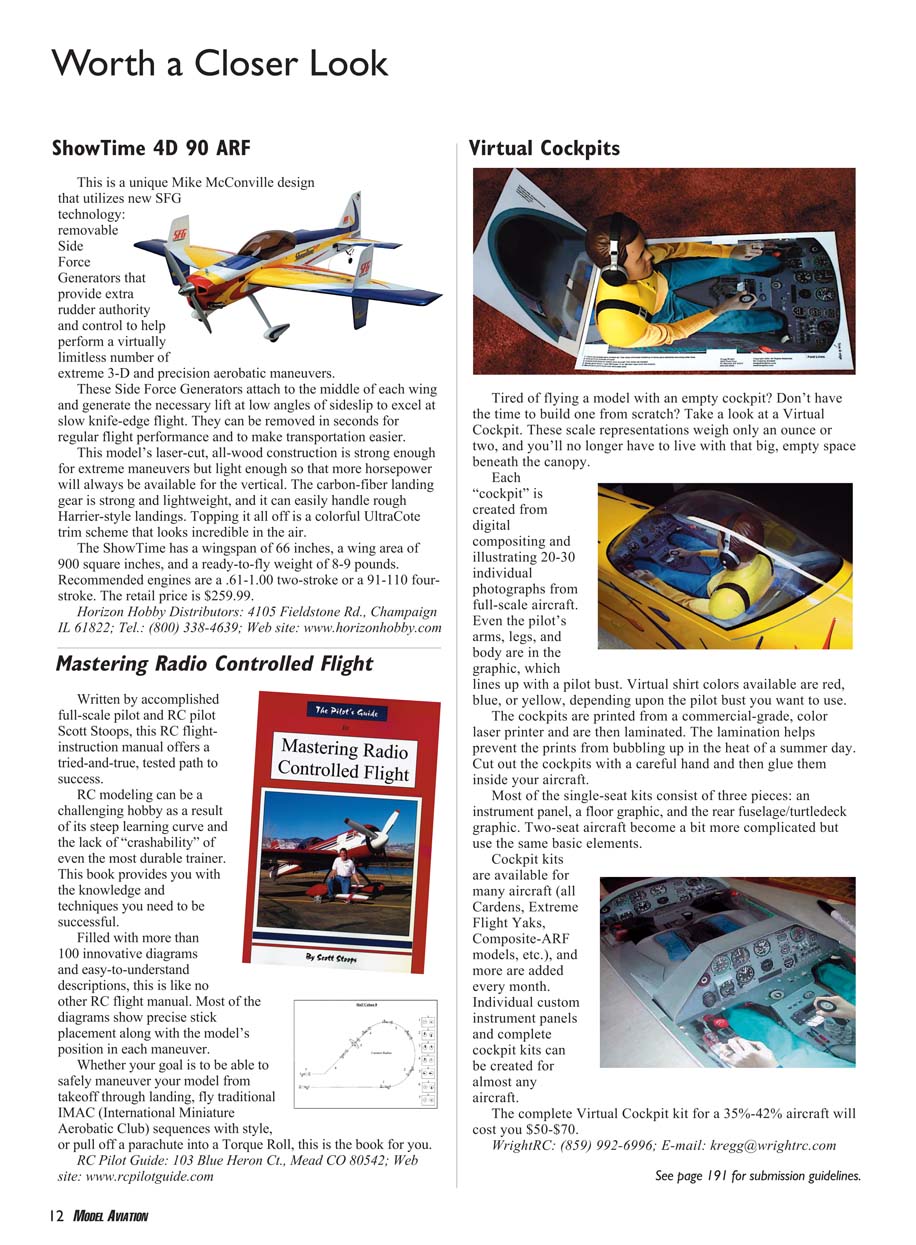
This is a unique Mike McConville design that utilizes new SFG technology: removable Side Force Generators that provide extra rudder authority and control to help perform a virtually limitless number of extreme 3-D and precision aerobatic maneuvers.
These Side Force Generators attach to the middle of each wing and generate the necessary lift at low angles of sideslip to excel at slow knife-edge flight. They can be removed in seconds for regular flight performance and to make transportation easier.
This model's laser-cut, all-wood construction is strong enough for extreme maneuvers but light enough so that more horsepower will always be available for the vertical. The carbon-fiber landing gear is strong and lightweight, and it can easily handle rough Harrier-style landings. Topping it all off is a colorful UltraCote trim scheme that looks incredible in the air.
The ShowTime has a wingspan of 66 inches, a wing area of 900 square inches, and a ready-to-fly weight of 8–9 pounds. Recommended engines are a .61–1.00 two-stroke or a 91–110 four-stroke. The retail price is $259.99.
Horizon Hobby Distributors; 4105 Fieldstone Rd., Champaign IL 61822; Tel: (800) 338-4639; Web site: www.horizonhobby.com
Mastering Radio Controlled Flight
Written by accomplished full-scale pilot and RC pilot Scott Stoops, this RC flight-instruction manual offers a tried-and-true, tested path to success.
RC modeling can be a challenging hobby as a result of its steep learning curve and the lack of "crashability" of even the most durable trainer. This book provides you with the knowledge and techniques you need to be successful.
Filled with more than 100 innovative diagrams and easy-to-understand descriptions, this is like no other RC flight manual. Most of the diagrams show precise stick placement along with the model's position in each maneuver.
Whether your goal is to be able to safely maneuver your model from takeoff through landing, fly traditional IMAC (International Miniature Aerobatic Club) sequences with style, or pull off a parachute into a Torque Roll, this is the book for you.
RC Pilot Guide; 103 Blue Heron Ct., Mead CO 80542; Web site: www.rcpilotguide.com
Virtual Cockpits
Tired of flying a model with an empty cockpit? Don't have the time to build one from scratch? Take a look at a Virtual Cockpit. These scale representations weigh only an ounce or two, and you'll no longer have to live with that big, empty space beneath the canopy.
Each "cockpit" is created from digital compositing and illustrating 20–30 individual photographs from full-scale aircraft. Even the pilot's arms, legs, and body are in the graphic, so he lines up with a pilot bust. Virtual shirt colors available are red, blue, or yellow, depending upon the pilot bust you want to use.
The cockpits are printed from a commercial-grade, color laser printer and are then laminated. The lamination helps prevent the prints from bubbling up in the heat of a summer day. Cut out the cockpits with a careful hand and then glue them inside your aircraft.
Most of the single-seat kits consist of three pieces: an instrument panel, a floor graphic, and the rear fuselage/turtledeck graphic. Two-seat aircraft become a bit more complicated but use the same basic elements.
Cockpit kits are available for many aircraft (all Cardens, Extreme Flight Yaks, Composite-ARF models, etc.), and more are added every month. Individual custom instrument panels and complete cockpit kits can be created for almost any aircraft.
The complete Virtual Cockpit kit for a 35%–42% aircraft will cost you $50–$70.
WrightRC; (859) 992-6996; E-mail: [email protected]
Real-Time Flight Telemetry System
Eagle Tree has developed an interesting flight-data telemetry system for use with model aircraft and RC cars and boats. This is a "real-time" system in the sense that it samples data taken onboard your aircraft and then transmits it back to the ground where it can be displayed on a receiving device and fed into a laptop computer. Data can be read directly off of the laptop screen or stored for analysis at a later time.
The key point is that data taken onboard the model is available to you while it is still in the air. This isn’t just a recording device that lets you play back information after the airplane has landed.
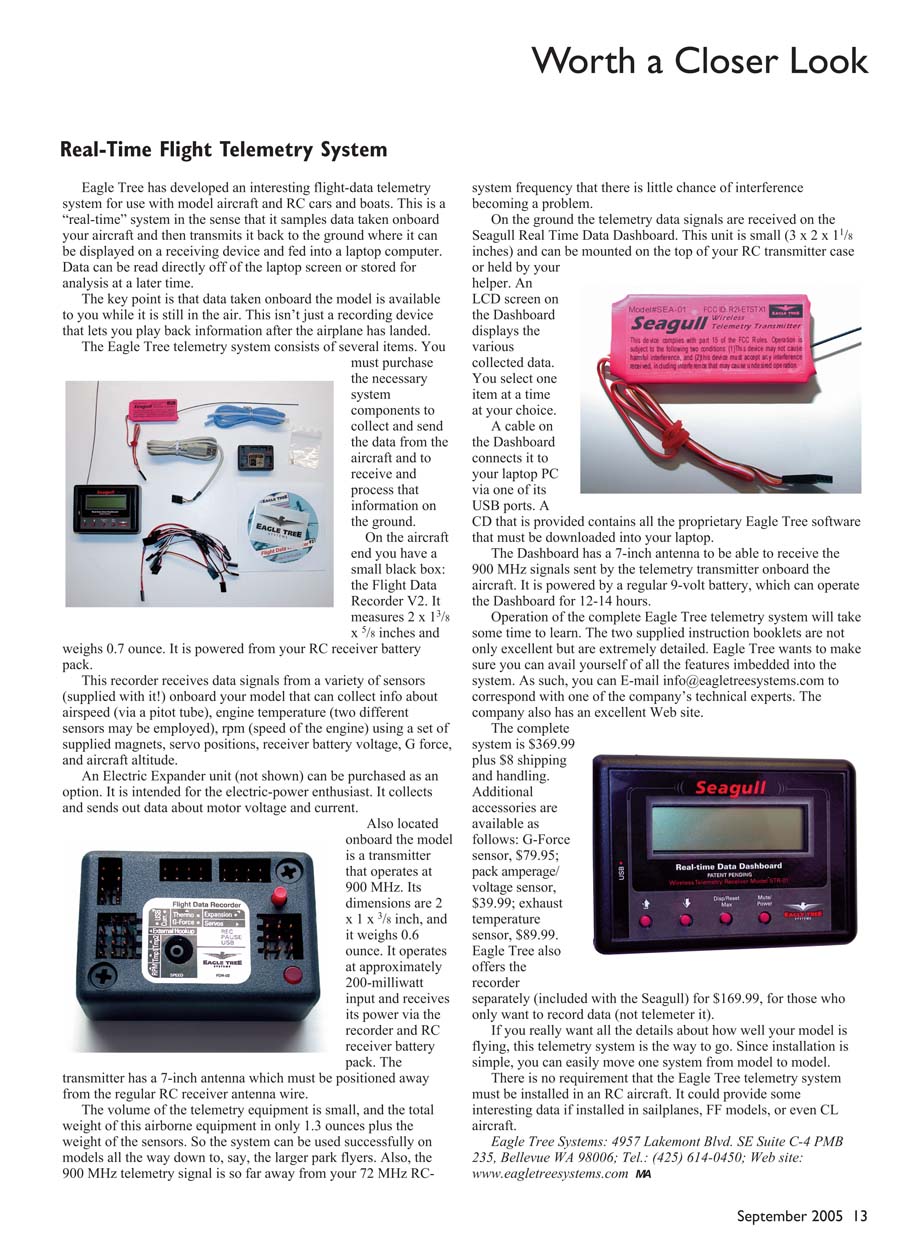
The Eagle Tree telemetry system consists of several items. You must purchase the necessary system components to collect and send the data from the aircraft and to receive and process that information on the ground.
On the aircraft end you have a small black box: the Flight Data Recorder V2. It measures 2 x 1 3/8 x 5/8 inches and weighs 0.7 ounce. It is powered from your RC receiver battery pack.
This recorder receives data signals from a variety of sensors (supplied with it!) onboard your model that can collect info about airspeed (via a pitot tube), engine temperature (two different sensors may be employed), rpm (speed of the engine) using a set of supplied magnets, servo positions, receiver battery voltage, G force, and aircraft altitude.
An Electric Expander unit (not shown) can be purchased as an option. It is intended for the electric-power enthusiast. It collects and sends out data about motor voltage and current.
Also located onboard the model is a transmitter that operates at 900 MHz. Its dimensions are 2 x 1 x 3/8 inch, and it weighs 0.6 ounce. It operates at approximately 200-milliwatt input and receives its power via the recorder and RC receiver battery pack. The transmitter has a 7-inch antenna which must be positioned away from the regular RC receiver antenna wire.
The volume of the telemetry equipment is small, and the total weight of this airborne equipment in only 1.3 ounces plus the weight of the sensors. So the system can be used successfully on models all the way down to, say, the larger park flyers. Also, the 900 MHz telemetry signal is so far away from your 72 MHz RC system frequency that there is little chance of interference becoming a problem.
On the ground the telemetry data signals are received on the Seagull Real Time Data Dashboard. This unit is small (3 x 2 x 1/8 inches) and can be mounted on the top of your RC transmitter case or held by your helper. An LCD screen on the Dashboard displays the various collected data. You select one item at a time at your choice.
A cable on the Dashboard connects it to your laptop PC via one of its USB ports. A CD that is provided contains all the proprietary Eagle Tree software that must be downloaded into your laptop.
The Dashboard has a 7-inch antenna to be able to receive the 900 MHz signals sent by the telemetry transmitter onboard the aircraft. It is powered by a regular 9-volt battery, which can operate the Dashboard for 12–14 hours.
Operation of the complete Eagle Tree telemetry system will take some time to learn. The two supplied instruction booklets are not only excellent but are extremely detailed. Eagle Tree wants to make sure you can avail yourself of all the features imbedded into the system. As such, you can E-mail [email protected] to correspond with one of the company's technical experts. The company also has an excellent Web site.
The complete system is $369.99 plus $8 shipping and handling. Additional accessories are available as follows: G-Force sensor, $79.95; pack amperage/voltage sensor, $39.99; exhaust temperature sensor, $89.99. Eagle Tree also offers the recorder separately (included with the Seagull) for $169.99, for those who only want to record data (not telemetry).
If you really want all the details about how well your model is flying, this telemetry system is the way to go. Since installation is simple, you can easily move one system from model to model.
There is no requirement that the Eagle Tree telemetry system must be installed in an RC aircraft. It could provide some interesting data if installed in sailplanes, FF models, or even CL aircraft.
Eagle Tree Systems: 4957 Lakemont Blvd. SE Suite C-4 PMB 235, Bellevue WA 98006; Tel.: (425) 614-0450; Web site: www.eagletreesystems.com
Transcribed from original scans by AI. Minor OCR errors may remain.

