
Worth a Closer Look
Tiny Trojan
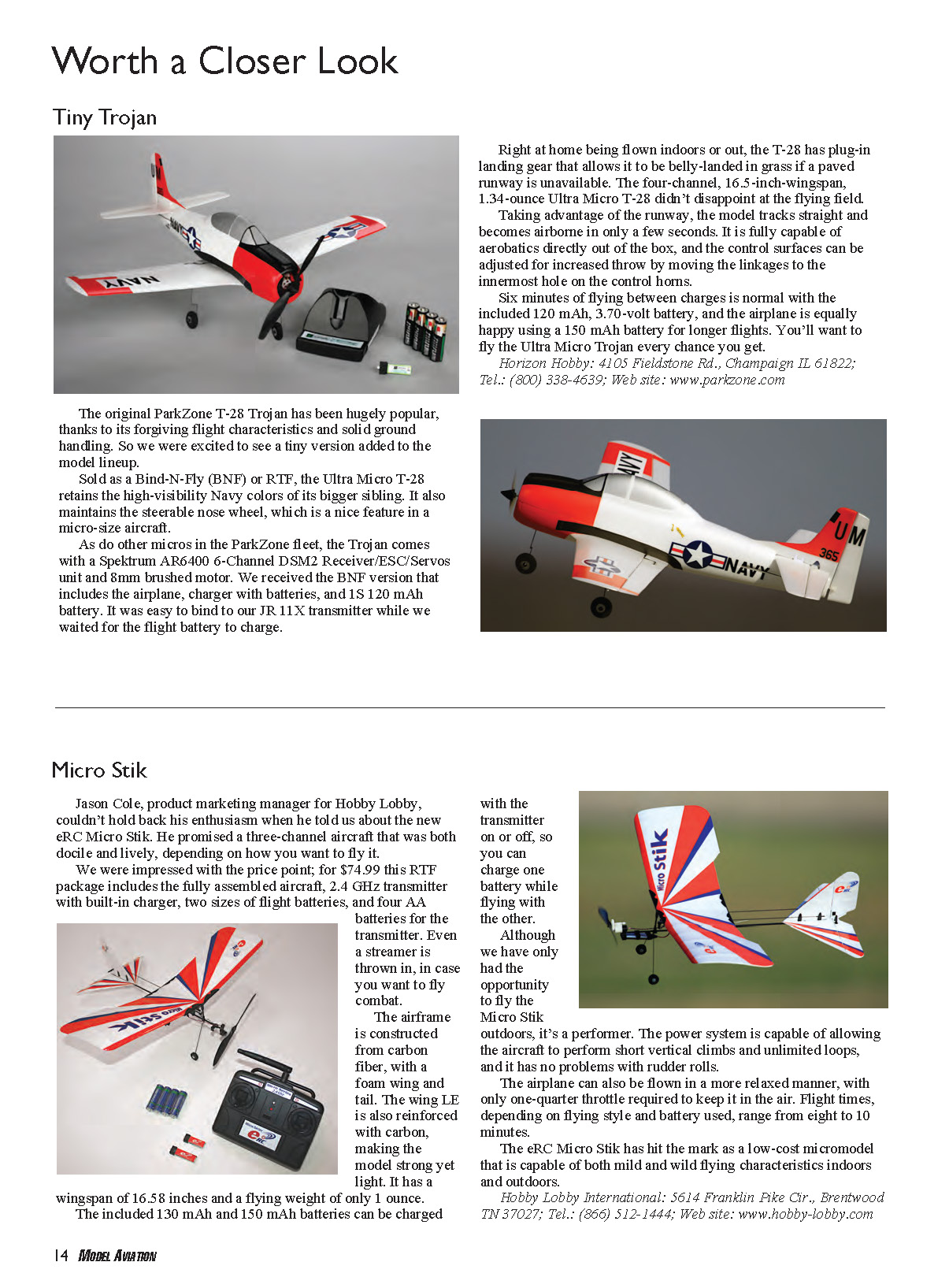
The original ParkZone T-28 Trojan has been hugely popular, thanks to its forgiving flight characteristics and solid ground handling. We were excited to see a tiny version added to the model lineup.
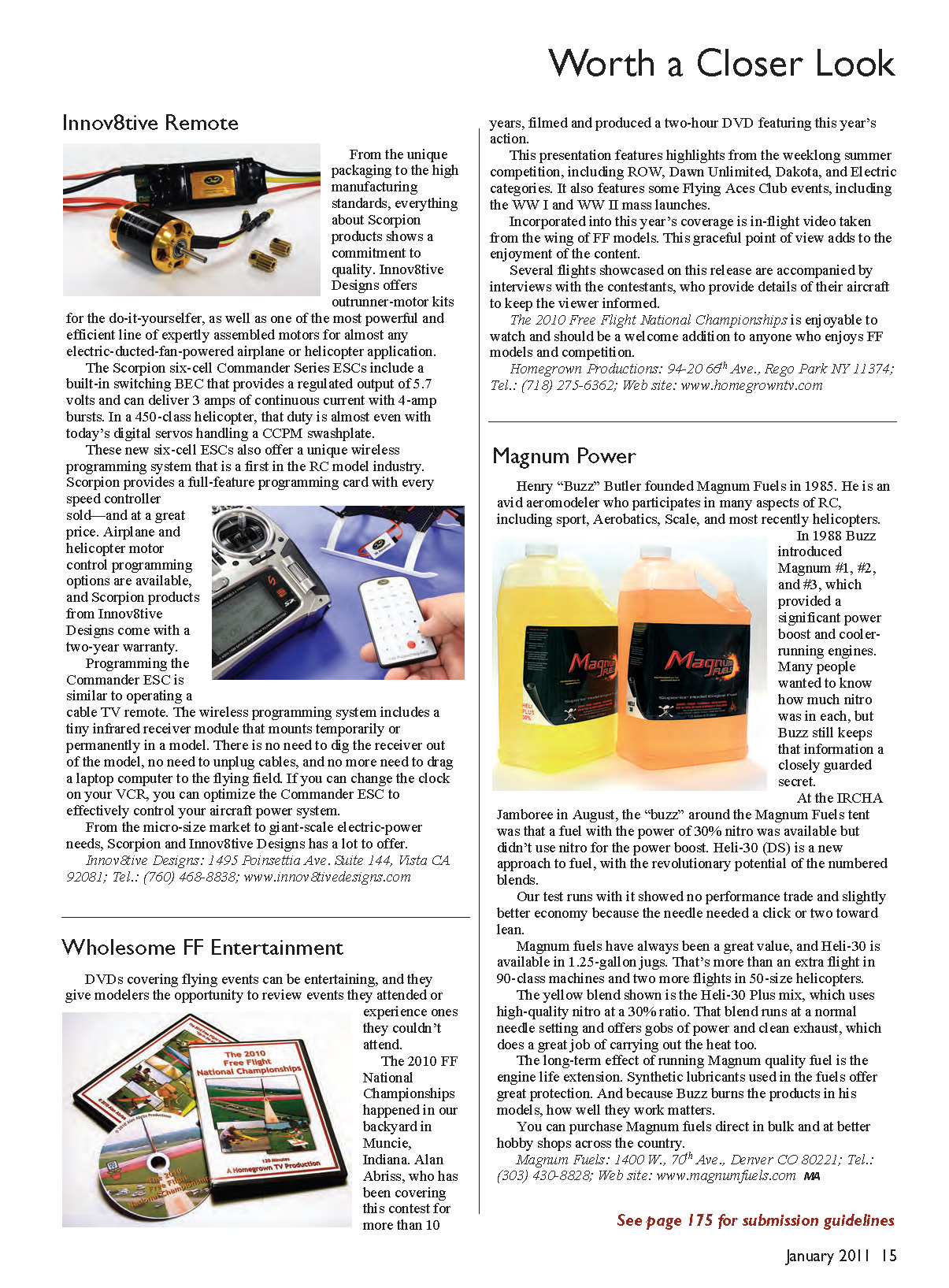
Sold as a Bind-N-Fly (BNF) or RTF, the Ultra Micro T-28 retains the high-visibility Navy colors of its bigger sibling. It also maintains the steerable nose wheel, which is a nice feature in a micro-size aircraft.
Like other micros in the ParkZone fleet, the Trojan comes with a Spektrum AR6400 6-channel DSM2 receiver/ESC/servos unit and an 8 mm brushed motor. We received the BNF version, which includes the airplane, charger, and a 1S 120 mAh battery. It was easy to bind to our JR 11X transmitter while we waited for the flight battery to charge.
Right at home being flown indoors or out, the T-28 has plug-in landing gear that allows it to be belly-landed in grass if a paved runway is unavailable. The four-channel, 16.5-inch wingspan, 1.34-ounce Ultra Micro T-28 didn't disappoint at the flying field.
Taking advantage of a runway, the model tracks straight and becomes airborne in only a few seconds. It is fully capable of aerobatics directly out of the box, and the control surfaces can be adjusted for increased throw by moving the linkages to the innermost hole on the control horns.
Six minutes of flying between charges is normal with the included 120 mAh, 3.70-volt battery, and the airplane is equally happy using a 150 mAh battery for longer flights. You'll want to fly the Ultra Micro Trojan every chance you get.
- Horizon Hobby: 4105 Fieldstone Rd., Champaign, IL 61822; Tel.: (800) 338-4639; Web site: www.parkzone.com
Micro Stik
Jason Cole, product marketing manager for Hobby Lobby, couldn't hold back his enthusiasm when he told us about the new eRC Micro Stik. He promised a three-channel aircraft that was both docile and lively, depending on how you want to fly it.
We were impressed with the price point: for $74.99 this RTF package includes the fully assembled aircraft, a 2.4 GHz transmitter with built-in charger, two sizes of flight batteries, and four AA batteries for the transmitter. Even a streamer is included in case you want to fly combat.
The airframe is constructed from carbon fiber, with a foam wing and tail. The wing leading edge (LE) is also reinforced with carbon, making the model strong yet light. It has a wingspan of 16.58 inches and a flying weight of only 1 ounce.
The included 130 mAh and 150 mAh batteries can be charged with the transmitter on or off, so you can charge one battery while flying with the other.
Although we have only had the opportunity to fly the Micro Stik outdoors, it's a performer. The power system is capable of short vertical climbs and unlimited loops, and it has no problems with rudder rolls.
The airplane can also be flown in a more relaxed manner, with only one-quarter throttle required to keep it in the air. Flight times, depending on flying style and battery used, range from eight to ten minutes.
The eRC Micro Stik has hit the mark as a low-cost micromodel that is capable of both mild and wild flying characteristics indoors and outdoors.
- Hobby Lobby International: 5614 Franklin Pike Cir., Brentwood, TN 37027; Tel.: (866) 512-1444; Web site: www.hobby-lobby.com
Worth a Closer Look
Innov8tive Remote
From the unique packaging to the high manufacturing standards, everything about Scorpion products shows a commitment to quality. Innov8tive Designs offers outrunner-motor kits for the do-it-yourselfer, as well as one of the most powerful and efficient lines of expertly assembled motors for almost any electric-ducted-fan-powered airplane or helicopter application.
The Scorpion six-cell Commander Series ESCs include a built-in switching BEC that provides a regulated output of 5.7 volts and can deliver 3 amps of continuous current with 4-amp bursts. In a 450-class helicopter, that duty is almost even with today’s digital servos handling a CCPM swashplate.
These new six-cell ESCs also offer a unique wireless programming system that is a first in the RC model industry. Scorpion provides a full-feature programming card with every speed controller sold — and at a great price. Airplane and helicopter motor-control programming options are available, and Scorpion products from Innov8tive Designs come with a two-year warranty.
Programming the Commander ESC is similar to operating a cable-TV remote. The wireless programming system includes a tiny infrared receiver module that mounts temporarily or permanently in a model. There is no need to dig the receiver out of the model, unplug cables, or drag a laptop computer to the flying field. If you can change the clock on your VCR, you can optimize the Commander ESC to effectively control your aircraft power system.
From the micro-size market to giant-scale electric-power needs, Scorpion and Innov8tive Designs have a lot to offer.
- Innov8tive Designs: 1495 Poinsettia Ave., Suite 144, Vista, CA 92081; Tel.: (760) 468-8838; Web site: www.innov8tivedesigns.com
Wholesome FF Entertainment
DVDs covering flying events can be entertaining, and they give modelers the opportunity to review events they attended or experience ones they couldn’t attend.
The 2010 FF National Championships happened in our backyard in Muncie, Indiana. Alan Abriss, who has been covering this contest for more than 10 years, filmed and produced a two-hour DVD featuring this year’s action.
This presentation features highlights from the weeklong summer competition, including ROW, Dawn Unlimited, Dakota, and Electric categories. It also features some Flying Aces Club events, including the WW I and WW II mass launches.
Incorporated into this year’s coverage is in-flight video taken from the wing of FF models. This graceful point of view adds to the enjoyment of the content.
Several flights showcased on this release are accompanied by interviews with the contestants, who provide details of their aircraft to keep the viewer informed.
The 2010 Free Flight National Championships is enjoyable to watch and should be a welcome addition to anyone who enjoys FF models and competition.
- Homegrown Productions: 94-20 66th Ave., Rego Park, NY 11374; Tel.: (718) 275-6362; Web site: www.homegrowntv.com
Magnum Power
Henry "Buzz" Butler founded Magnum Fuels in 1985. He is an avid aeromodeler who participates in many aspects of RC, including sport, aerobatics, scale, and most recently helicopters.
In 1988 Buzz introduced Magnum #1, #2, and #3, which provided a significant power boost and cooler-running engines. Many people wanted to know how much nitro was in each, but Buzz still keeps that information a closely guarded secret.
At the IRCHA Jamboree in August, the “buzz” around the Magnum Fuels tent was that a fuel with the power of 30% nitro was available but didn’t use nitro for the power boost. Heli-30 (DS) is a new approach to fuel, with the revolutionary potential of the numbered blends.
Our test runs with it showed no performance trade-off and slightly better economy because the needle needed a click or two toward lean.
Magnum fuels have always been a great value, and Heli-30 is available in 1.25-gallon jugs. That’s more than an extra flight in 90-class machines and two more flights in 50-size helicopters.
The yellow blend shown is the Heli-30 Plus mix, which uses high-quality nitro at a 30% ratio. That blend runs at a normal needle setting and offers gobs of power and clean exhaust, which does a great job of carrying out the heat to the head.
The long-term effect of running Magnum-quality fuel is extended engine life. Synthetic lubricants used in the fuels offer great protection. And because Buzz burns the products in his models, how well they work matters.
You can purchase Magnum fuels direct in bulk and at better hobby shops across the country.
- Magnum Fuels: 1400 W. 70th Ave., Denver, CO 80221; Tel.: (303) 430-8828; Web site: www.magnumfuels.com
Transcribed from original scans by AI. Minor OCR errors may remain.

