
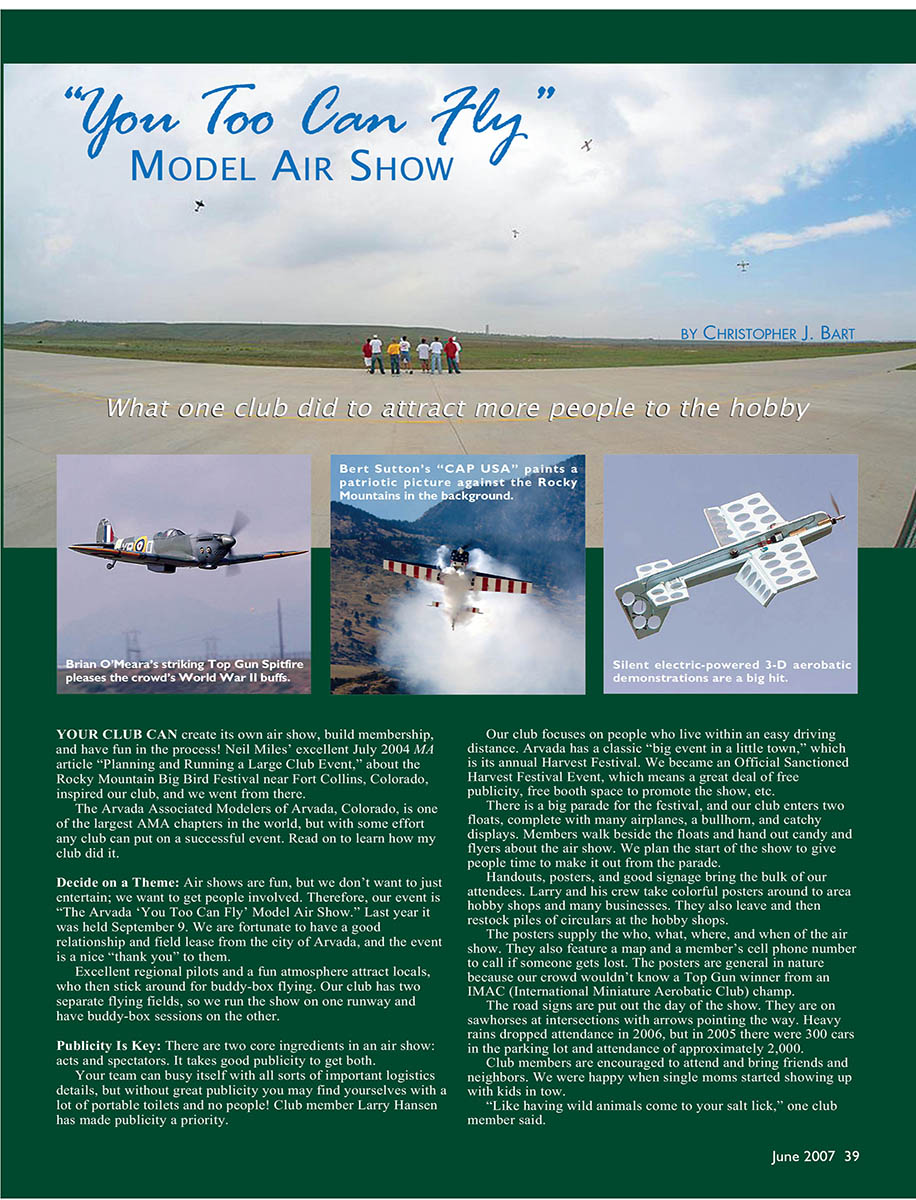
"You Too Can Fly" Model Air Show
BY CHRISTOPHER J. BART
Your club can create its own air show, build membership, and have fun in the process! Neil Miles' July 2004 MA article "Planning and Running a Large Club Event," about the Rocky Mountain Big Bird Festival near Fort Collins, Colorado, inspired our club, and we went from there.
The Arvada Associated Modelers of Arvada, Colorado, is one of the largest AMA chapters in the world, but with some effort any club can put on a successful event. Read on to learn how my club did it.
Decide on a Theme
Air shows are fun, but we don't want to just entertain; we want to get people involved. Therefore, our event is "The Arvada 'You Too Can Fly' Model Air Show." Last year it was held September 9. We are fortunate to have a good relationship and a field lease from the city of Arvada, and the event is a nice "thank you" to them. Excellent regional pilots and a fun atmosphere attract locals, who then stick around for buddy-box flying. Our club has two separate flying fields, so we run the show on one runway and have buddy-box sessions on the other.
Publicity Is Key
There are two core ingredients in an air show: acts and spectators. It takes good publicity to get both. Your team can busy itself with all sorts of important logistics details, but without great publicity you may find yourselves with a lot of portable toilets and no people! Club member Larry Hansen has made publicity a priority.
Our club focuses on people who live within an easy driving distance. Arvada has a classic "big event in a little town," its annual Harvest Festival. We became an Official Sanctioned Harvest Festival Event, which means a great deal of free publicity and free booth space to promote the show. There is a big parade for the festival, and our club enters two floats, complete with many airplanes, a bullhorn, and catchy displays. Members walk beside the floats and hand out candy and flyers about the air show. We plan the start of the show to give people time to make it out from the parade.
Handouts, posters, and good signage bring the bulk of our attendees. Larry and his crew take colorful posters to area hobby shops and many businesses. They also leave and then restock piles of circulars at the hobby shops. The posters supply the who, what, where, and when of the air show. They also feature a map and a member's cell phone number to call if someone gets lost. The posters are general in nature because our crowd wouldn't know a Top Gun winner from an IMAC (International Miniature Aerobatic Club) champ.
The road signs are put out the day of the show. They are on sawhorses at intersections with arrows pointing the way. Heavy rains dropped attendance in 2006, but in 2005 there were 300 cars in the parking lot and attendance of approximately 2,000. Club members are encouraged to attend and bring friends and neighbors. We were happy when single moms started showing up with kids in tow. "Like having wild animals come to your salt lick," one club member said.
The air show is timed for right after the parade. The families have just enough time to pack up their lawn chairs and drive out to the field.
CL (control-line) demos are a great change of pace at the show. The crowd pressed hard against the fence and applauded loudly every time a model went up.
Having plenty of simulators provides a great ground school. It also keeps restless kids happy, particularly if the weather turns temporarily sour.
Model Air Show Tips
- Decide on a theme.
- Publicity is key. Use informative posters, flyers, and signs to advertise to people within an easy driving distance. Encourage club members to bring a neighbor family.
- Consider free admission.
- Get special interest groups involved. Feature them and they will support you.
- Make your layout crowd-friendly so they can see the models as much of the time as possible.
- Have a midway. People love the feel and they stay longer.
- Use catchy static displays to feature special interest groups and to build interest.
- Have RTFs as raffle prizes and keep the drawing simple.
- Get a good PA system and a good DJ. Move the generator far away to prevent distracting noise.
- Have a flexible flight schedule and put up a new act every four to six minutes.
- Brief the pilots for safety: "Fly at 80%."
- Use a blend of acts. Crowds want something new all the time.
- Use simulators to prepare the student pilots and to occupy them while they wait to be called to their buddy boxes.
- You can't have too many aircraft and buddy-box instructors. Make each pilot responsible for his or her own trainer.
- Get the names and information from student pilots and follow up with them after the show. Invite them to training night and to meetings.
—Christopher J. Bart
Our success has been mainly with fathers and their sons. We knew that if they came out they might bring their entire families. If mom or one of the kids asks to go home, we lose our chance to recruit dad.
Our farsighted board, headed by chairman Jim Wallen, approved a no-fee approach to everything. Even the food is almost free; a family of four eats for $12! A local real estate firm runs the entire concession stand, donates all the ingredients, and lets the club keep the proceeds. We also offer free chilled bottled water and sunscreen.
Local television and radio stations might be effective means of publicity if you have connections, but they have not been for us. The Arvada newspaper gives us good coverage, but the big Denver papers have not been interested. Club-member contacts work better than a shotgun approach.
Get Special Interest Groups Involved
Successful community theater and choral groups set as many people involved as possible in their events because their friends will go see them. We do the same.
The Civil Air Patrol (CAP) handles our parking, does an effective flag-raising ceremony at the opening, and runs its own booth in the midway. We get the cadets to walk through the crowd with each major prize item just before it is awarded.
A local rocket club uses our field for launches, and we want to involve it next year, perhaps at halftime. We figure the more groups that are involved, the more members we recruit. The process can take time, and few people sign up as members at the show, but it definitely works.
Two years ago we invited the Rocky Mountain Electric Flyers of Arvada to do a demonstration. It was enthusiastically received, and the club's booth was busy. A friendly dialogue grew between our groups, and when the club lost its flying field the members joined our club.
This year we plan to invite a local model-car club to put on a demonstration on the main runway at halftime. The group can have free pavilion space for a static display while signing up new members.
Layout
Traffic flow and visibility are important. Our greeter welcomes each carload and asks if there is a club member aboard. If so, that person gets a special prize ticket and all others get a general crowd ticket. The greeter tells visitors about the two fields and then directs them to the CAP cadets for parking.
We usually have a portable toilet at each flying field, but we bring in extras for the show. We make sure at least one is labeled "Women."
Next year we are thinking about buying bleachers to make the crowd more comfortable and improve sight lines.
Father-and-son members Lee and Brent Aga bring in portable cattle fencing each year to supplement our existing flightline fence.
We generally avoid having any buildings, banners, or tents that block the crowd’s view. Club-member "sag" areas are toward the ends of the runway, and the public-address (PA) stand is set back from the flightline.
No county fair is complete without a midway, so we planned one too. Special permission to sell goods and free booth space swells vendor attendance. Every spectator walks through the midway to enter or leave.
Booths that have sign-up areas are placed next to high-volume producers such as hobby shops. We position all the booths on the side away from the runway so the crowd and the booth tenders can see the show.
We always want a static display that is a big crowd draw. One year we featured a world-record-setting sailplane, complete with full computer gear to replay the flight. Another popular exhibit was the NASA CO2 rocket-powered proof-of-concept Mars airplane.
Prizes and Drawings
We have one or two RTF models as prizes for the crowd and shift all other donations to a low-key club-member drawing. The main drawing winner must be present to win. Since the tickets must be deposited in a drum to be eligible, only those who are interested have a chance to win.
Member prize awards can be picked up for 90 days after the show. That prevents club members from feeling slighted if they are on duty at the buddy-box line and don’t hear the announcements.
Equipment
A powerful PA system is a big benefit. We use eight speakers and a professional DJ. We have patriotic music for the flag-raising, and a copy of "Taps" for a humorous approach to crashes.
Our anchor announcer carries the show along, and remote commentators get the story where the action is. The DJ area and announcer’s stand are on a raised platform back from the flightline.
Our noisy generator needs 400 feet of heavy wire to get it away from the crowd. If you combine shorter cords, tie them together with slack at the plugs. Does the generator run on diesel or gas? We found out about that one the hard way!
Transmitter Impound
Some of our older members like the chance to make a serious contribution by tending the impound, and they don’t have to do much walking around. We use split shifts so no one gets pinned down for too long.
A Team Approach
The parade and other promotional activities have their own leaders. Club Treasurer Jerry Johnson budgets for a rain-out every three years. Even so, we broke even with iffy weather last year.
Now we have Events Chairman Don Sikkema overseeing the entire process. That has freed me to focus on the air show, which is my first love.
Don’t be surprised if people are cautious at first. We decided that our first year would be sort of a dry run. This defused many initial criticisms, and when a sizable crowd showed up we were pleased.
Scheduling
We spend hundreds of hours on preparation, but things never go as planned. We do much of the show setup the day before and allow time in the morning to do it all again if there is a weather problem.
There is a big pilots’ party the night before the event, with free food for all who help. It gives newer members a chance to see the "big guns" up close and learn a few tips. Many of the air-show acts like the chance to use the field ahead of time, and sometimes we have night flyers.
For one reason or another roughly 30% of the pledged air-show acts do not actually fly. Rescheduling impacts pilots and the crowd. No one wants a .40-sized glow model to follow a 40% 3-D gas-powered aircraft with full smoke, so one scratch can ripple through the lineup as we consider the right sequence to please the pilots and the crowd.
To help we placed a metal board with magnetic plates in the pits, where the flightline boss posts the flying order. The scheduler runs each pilot’s information sheet back to the main announcer.
Flightline
Americans are used to a "Top 40 radio style," so a new act takes off every four to six minutes. Flightline controller Howard Siebenrock and his team orchestrate a smooth, fast flow of pilots and airplanes. One taxiway is for models going out and another is for those coming in.
The scheduler must collect the pilot data and run it back to the PA stand every 15 minutes or so. The crew members are usually exhausted at the end of the day and swear they will never do it again, but they come back year after year.
The Big Day
We have a pilot briefing just before the air show. Safety is the focus. We emphasize fun and grace over technical prowess. We want "80% flying," not the wildest stuff a pilot can do.
Our crowd does not know the difference between knife-edge Snap Rolls in a Rolling Circle 5 feet above ground level and a nice basic 3-D demo, but they know a crash when they see one. Pilots love to fly at our show because they can do a nice routine, not risk their models, and get strong applause.
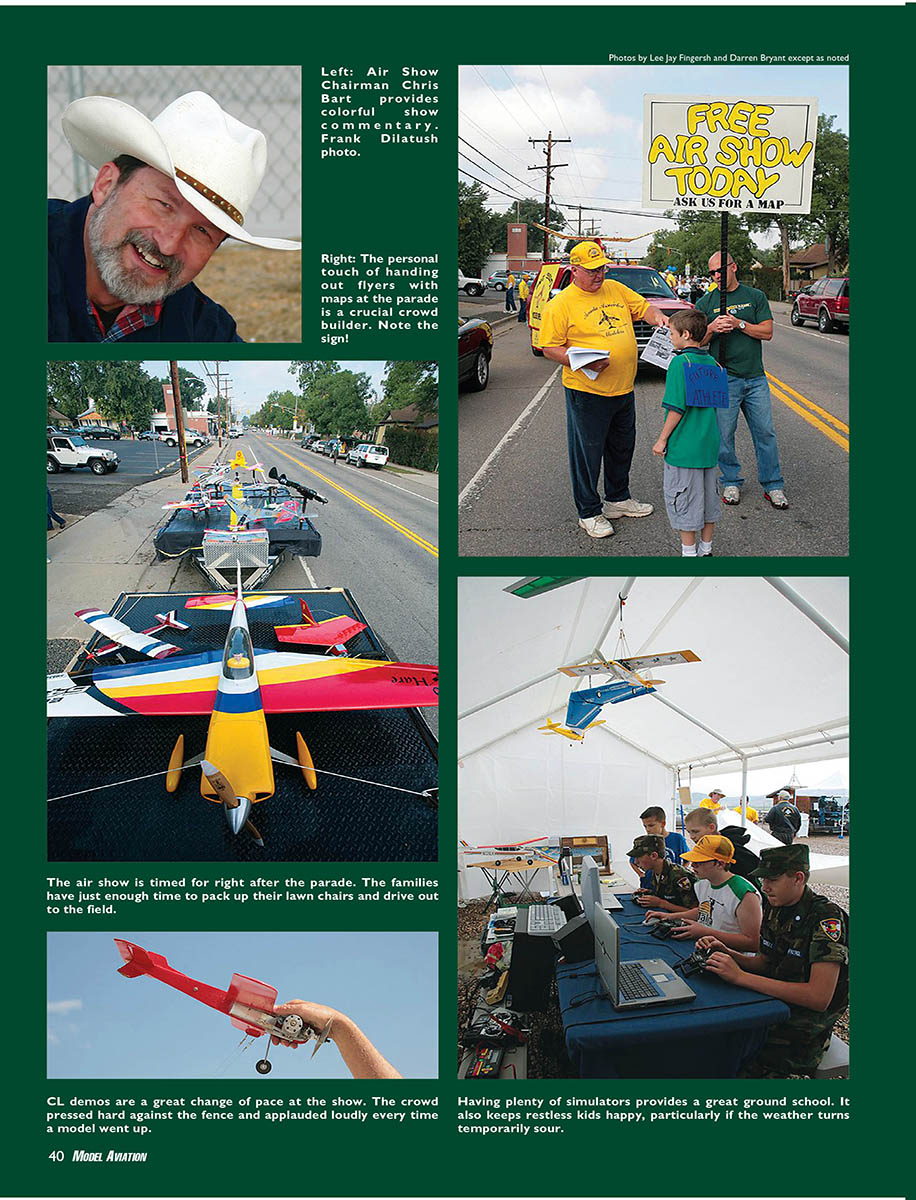
Popular local pilot Bert Sutton is the "pied piper" who led other pilots to us. His 40% Carden CAP, finished in a patriotic theme with full smoke and accompanied by great music tracks, opens the show every year.
Last year Brian Copfer and friends from Salt Lake City, Utah, orchestrated a four-model 3-D display that awed the crowd. Mark Dennis and Rocco Mariani of AeroWorks have also been featured pilots.
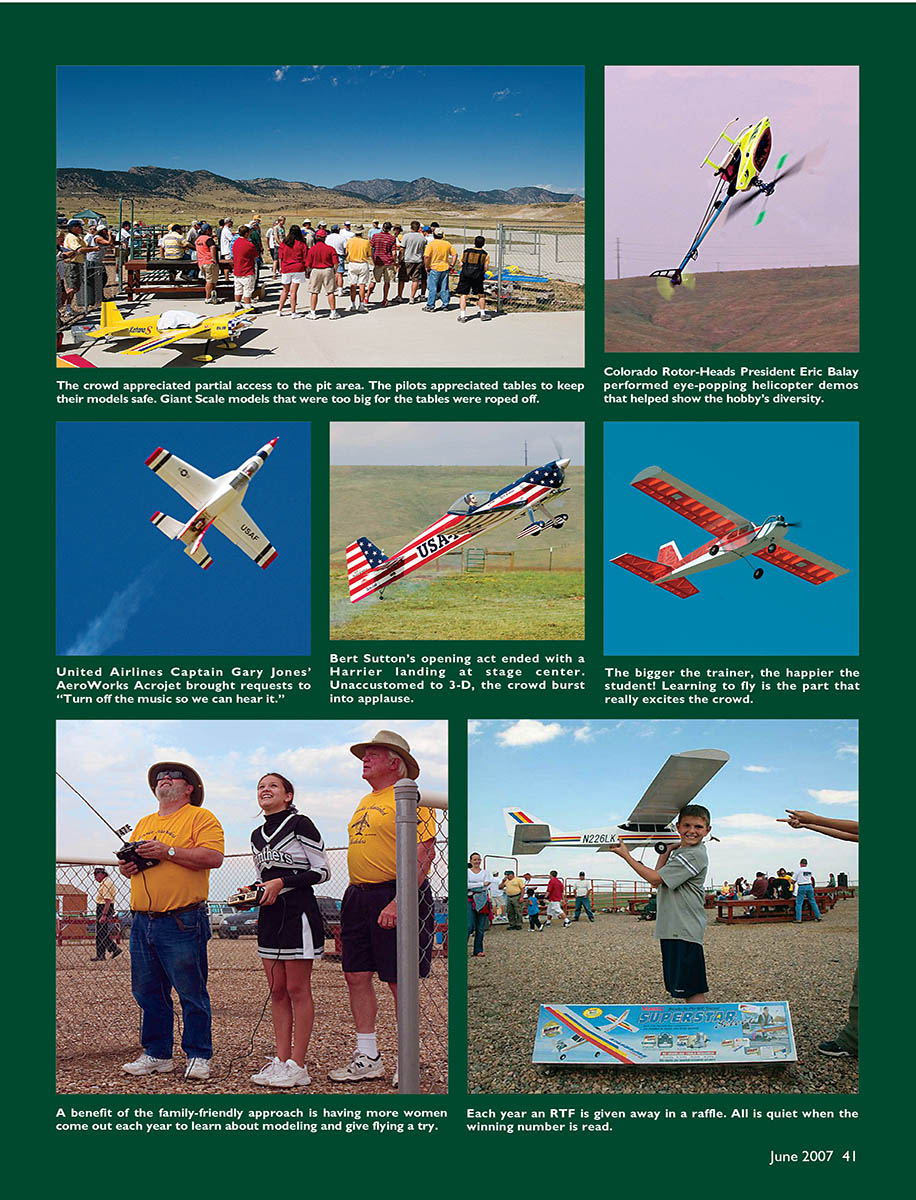
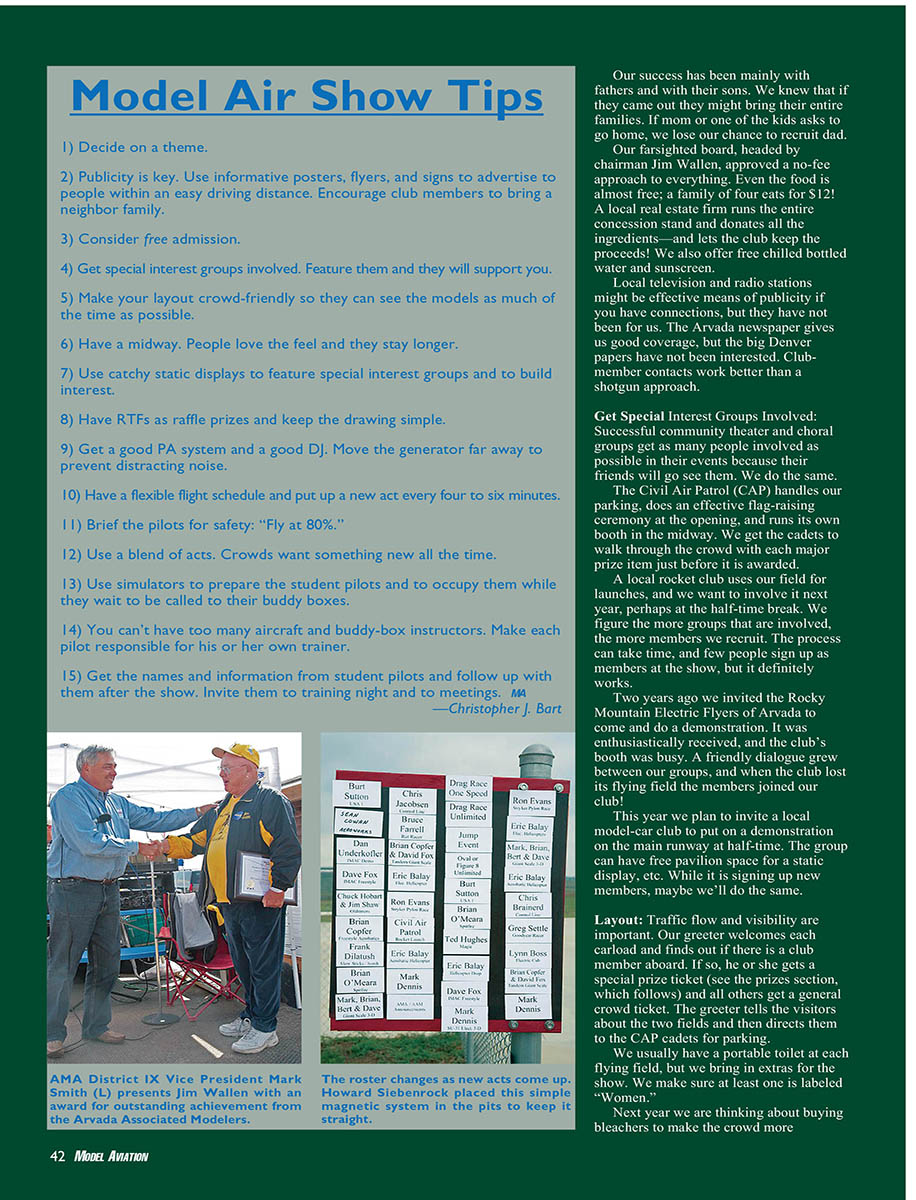
Club member and Top Gun winner Brian O’Meara entertains with his warbirds, and Gary Jones’ jet draws cheers every time he flies it. Eric Balay gives dazzling helicopter displays and drops toy soldiers by parachute. Watching the kids run out to claim their prizes after the helicopter is safely away is a real treat.
Ted Hughes and Leif Casey have two acts: one is a gas-powered model towing up a sailplane and the other is a "gas-electric shootout." Incidentally, the electric pilot won last year!
Members also put on a great display of CL flying, including a Speed demo. The crowd pressed up close when the fast little airplane was brought past last year.
Involve the Whole Club
In early years some felt this was not a "total club" event. Now we reserve the time while the crowd is rolling in and break it into separate 15-minute windows for electric-, glow-, and gas-powered models. Any club member can strut his or her stuff. We reopen the field immediately at the show’s end, and a good crowd stays to watch.
We run two complete grandstand shows in the afternoon so people and volunteers who are down at the training field get a chance to see a full performance. This also spreads out the buddy-box time so we can accommodate all interested new pilots.
"You Too Can Fly"
Stewart Garrett’s family sets up computers that run simulator software, which keeps the kids from getting bored. It also lets nervous would-be buddy-box pilots practice before tackling the real thing.
In early years the enthusiastic crowd quickly depleted airplanes, flight packs, and instructors. That created lines of frustrated would-be pilots. Pat Vachon and his team now use a dozen instructors and models, and staging occurs from the simulator area with a radio link to call small groups of students down as buddy boxes free up.
Do It!
As do numerous clubs, we have many wonderful "graying" members—and we have a nice mix of younger people coming along. Get involved and make the same thing happen at your club!
The 2007 Arvada "You Too Can Fly" Model Air Show will be held Saturday, September 8. To learn more, contact me via E-mail or call me at (303) 246-0536 (8 a.m.–8 p.m. Mountain Time).
Christopher J. Bart [email protected]
Transcribed from original scans by AI. Minor OCR errors may remain.

