
"YOU'RE ON THE CLOCK"
ANOTHER RC HOBBY
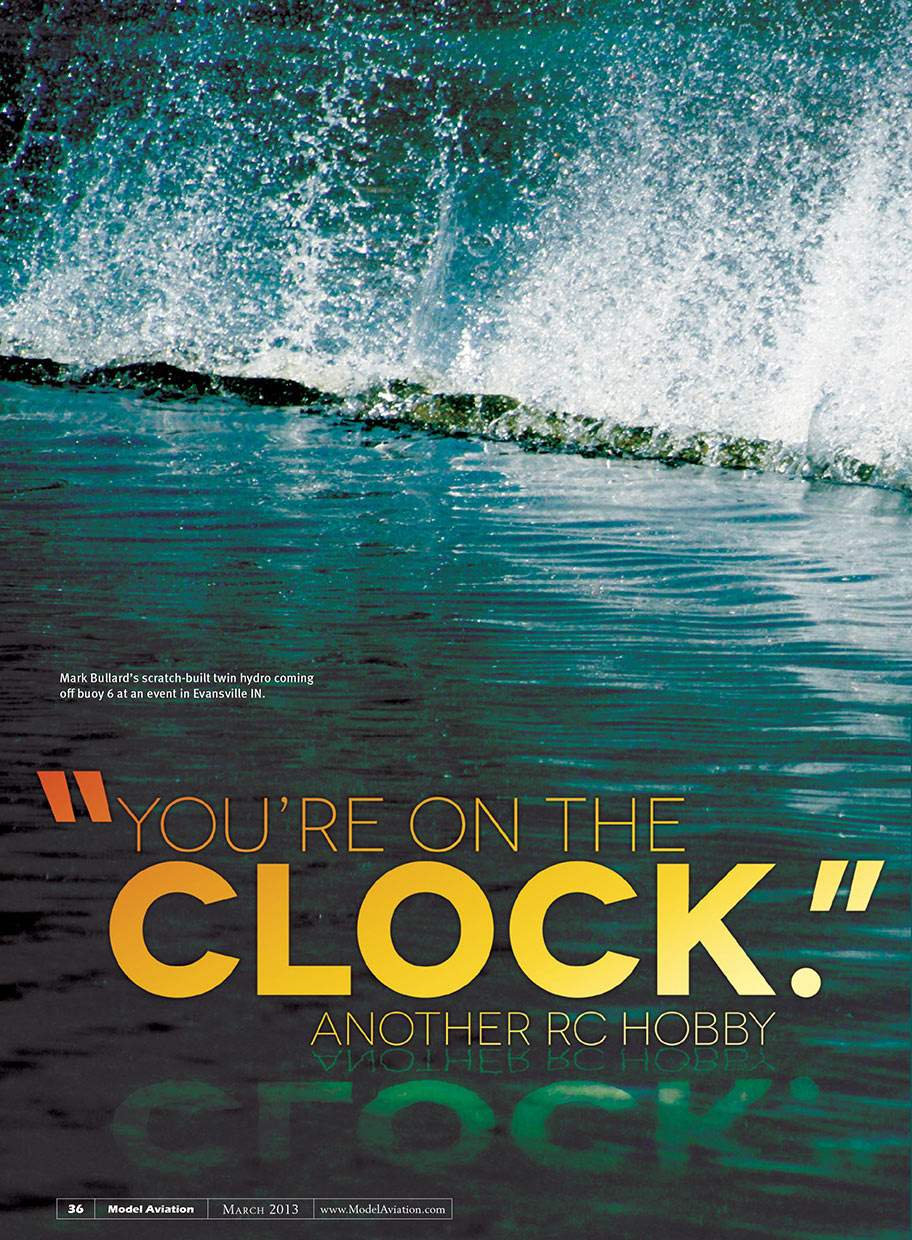
Mark Bullard's scratch-built twin hydro coming off buoy 6 at an event in Evansville, IN.
Over the microphone you hear the CD announce, “You’re on the clock!” You hear starters cranking engines and then pop ... pop ... your motor is running at high idle and sounds perfect. This is the big championship and you’re as ready as you have ever been.
As your pit man prepares to launch the boat, the clock ticks down. You drift off for a moment, thinking about how your boat has many races on it and that it has won many heats. Your confidence begins to rise. The CD is calling over the microphone, “Hold your lanes!”
This snaps you back to the unfolding heat. You make eye contact with your pit man and nod your head. You’re ready to go. He or she takes a look down the front chute to see if any boats are close or coming fast. The pit boss gives the all clear. Your pit man launches the boat flat, smooth, and on the plane. The smell of nitro fills the air. It is 30 seconds before the start, and you begin to position your boat in lane one. You’re on the clock and feeling confident.
Fifteen seconds to start. You realize you are a few seconds early, so you back off the power as the other five boats behind you are coming on strong. You start to get edgy and your knees feel weak.
You need a good start to win this heat. The competitor on your outside is a seven-time national champion. You need to win this heat to take home first place in the class!
Four … three … two … one … You hear the horn. The race is on and you’re at full power. You begin to question your decision to stay in lane one, because you know you cannot go into corners one and two wide open. You lift off the power as you enter the corner and read the water for holes, swells, and wake. The boat to your outside is carrying a ton of speed and is at full throttle. The turn fin on your boat strains to hold the boat in the corner.
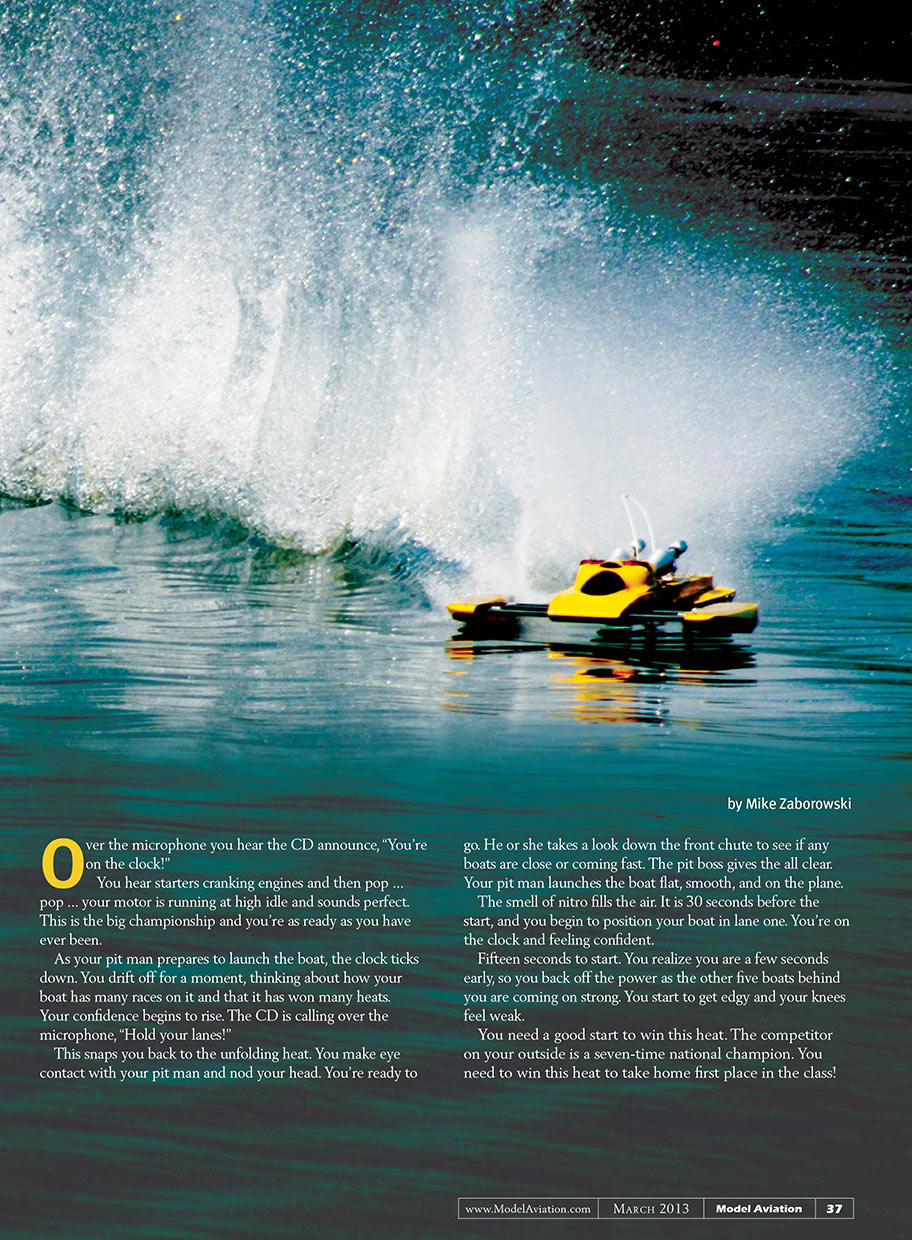
As the boats exit corners one and two you are at full power and all that you can see are huge rooster tails of water. You hear the CD call, “Dead boat!” You look to see where the dead boat is. It’s your friend and you feel bad, but you have to get your mind back into the race. Your boat, now halfway down the back chute, is running more than 70 mph. You’re in the lead as you come around corners three and four for the first lap. Five laps to go. How does it end? Who wins? Let’s learn more about the exciting hobby of RC boat racing!
RC Boat Racing Overview
The model boat hobby includes many different boat types, hull styles, and power systems. RC boat racing is one of the fastest and most exciting aspects of model boating. If you have seen an RC boat race, you probably noticed that our boats race in the opposite direction of full-scale racing.
Before radio control became common in model boating, the hobby was based around tether boats. Most tether boats were powered by converted ignition engines or handmade masterpieces by master machinists. These engines were designed to operate counterclockwise. Model boating adopted those standards and, as the hobby grew, propellers were cast to accommodate this design. It was natural to use existing propellers and take advantage of the torque the propeller places on the hull. Because of this, RC boats turn to the right better, and that style has been maintained.
Boat types and classes at a typical RC boat race vary widely. Like aeromodelers, model boaters use the A, B, C method of class identification. Classes start with A and end with T (skipping a few in between). We race electric- and gasoline-powered boats and the classes have adopted those standards.
There are different hull styles, including:
- monohulls
- tunnel hulls
- hydroplanes
- sport hydroplanes
- catamarans
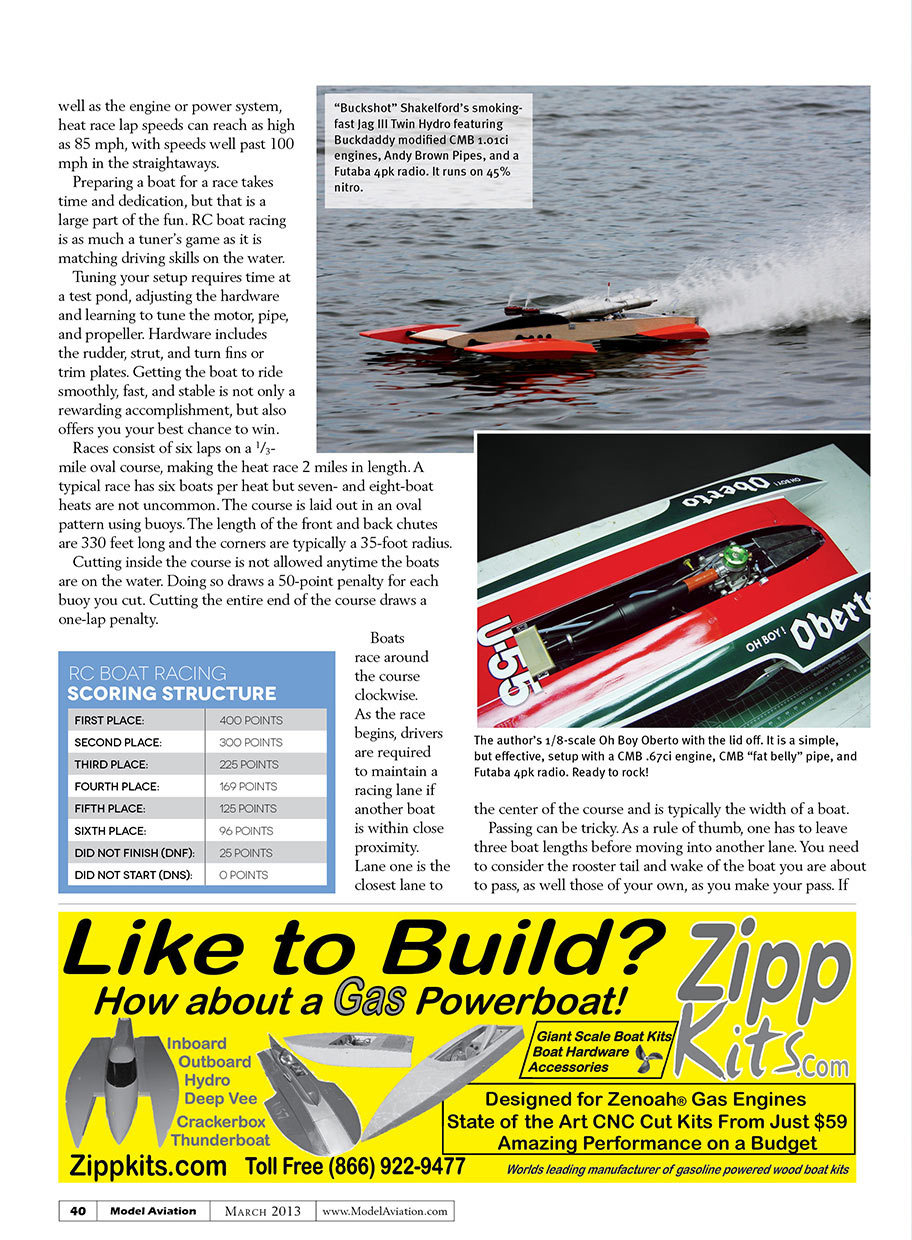
In this structure one might race a B Class tunnel hull, an E Class hydroplane, or a P Class sport hydroplane. Depending on hull style and power system, heat race lap speeds can reach as high as 85 mph, with speeds well past 100 mph in the pro classes on the straightaways.
RC boat racing has many fun aspects that other types of RC racing simply don't have. The scoring system is exciting, works well, and is unique. The water, the wakes, and the ever-changing surface make every lap a new challenge.
Preparing and Tuning
Preparing a boat for a race takes time and dedication, and that is a large part of the fun. RC boat racing is as much a tuner's game as it is a driving skills contest on the water.
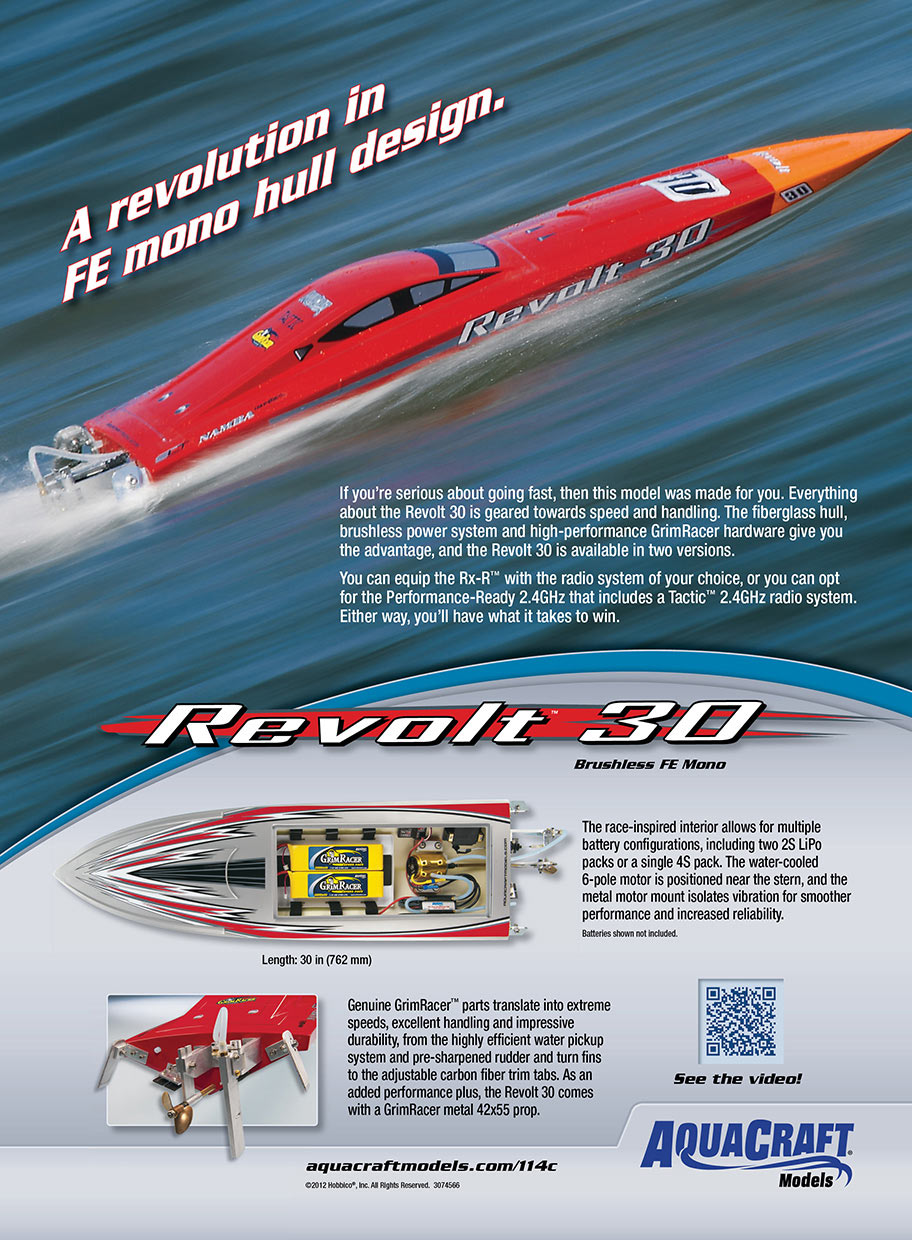
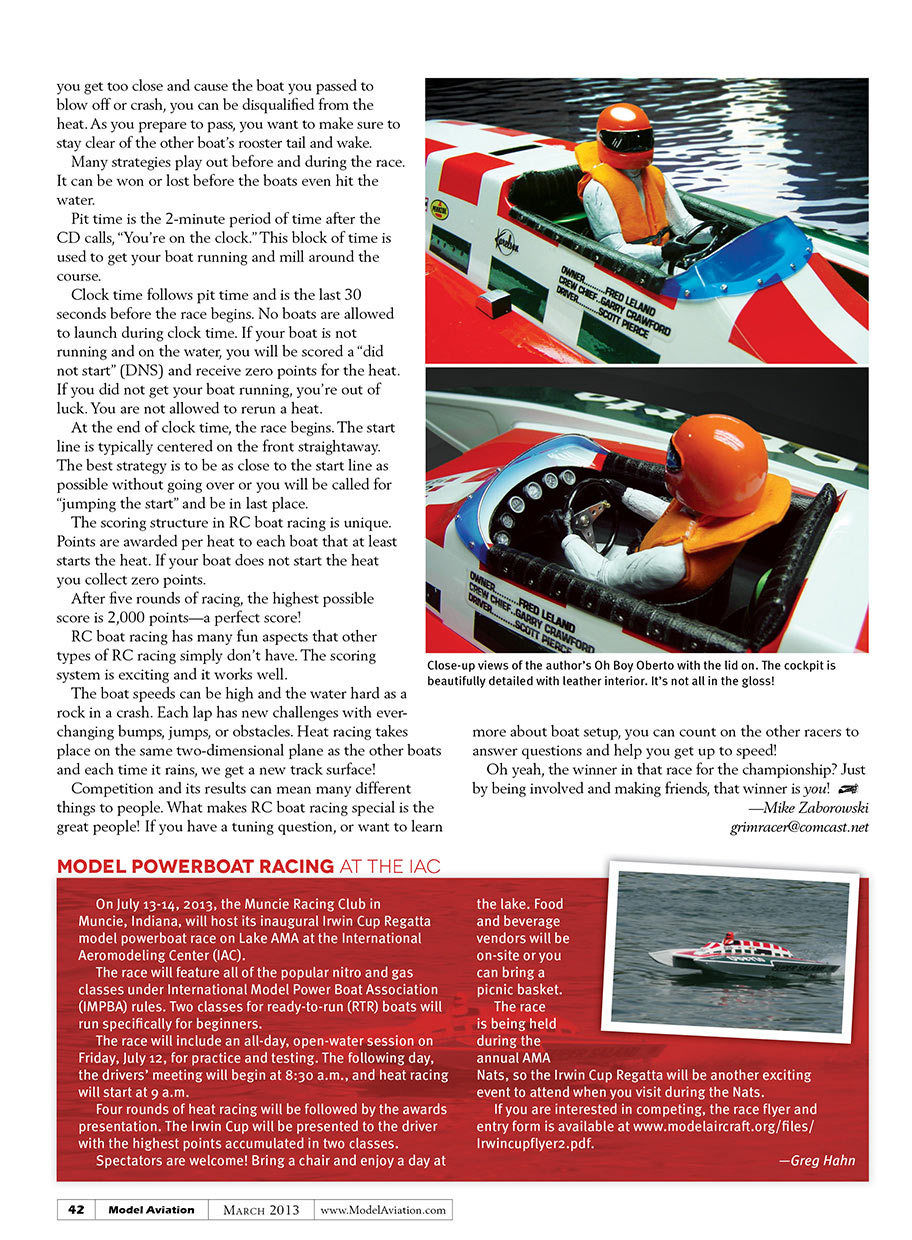
Tuning requires time at a test pond, adjusting hardware and learning to tune the motor, pipe, and propeller. Hardware includes the rudder, strut, and turn fins or trim plates. Getting the boat to ride smoothly, fast, and stable is both a rewarding accomplishment and your best chance to win.
Course, Race Format, and Rules
- Races consist of six laps on a 1/3-mile oval course, making the heat race approximately 2 miles in length.
- A typical heat has six boats, but seven- and eight-boat heats are not uncommon.
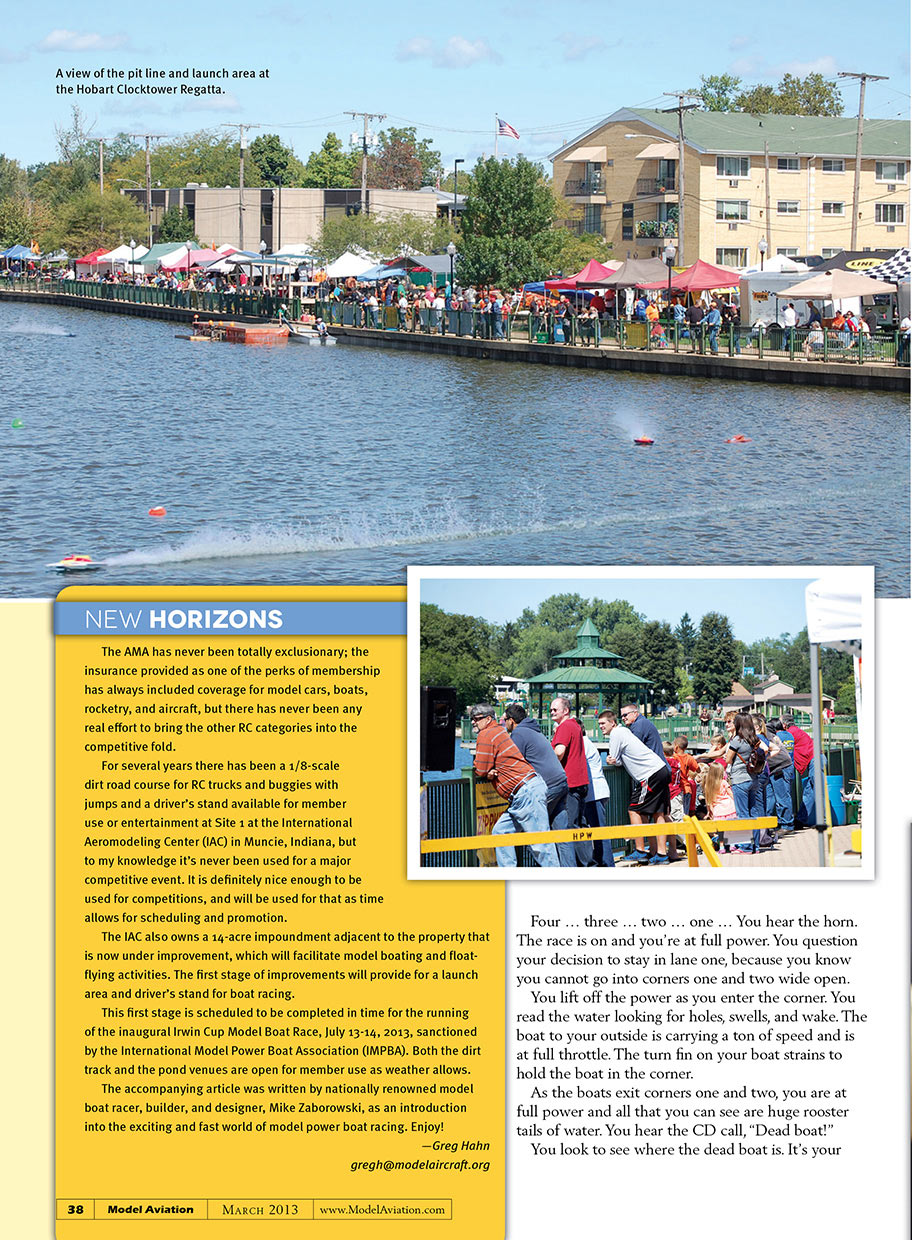
- The course is an oval pattern laid out with buoys. The front and back chutes are typically 330 feet long and the corners are usually a 35-foot radius.
- Boats race clockwise.
- Lane one is the closest lane to the center of the course and is typically the width of a boat.
- Drivers must maintain a racing lane if another boat is within close proximity.
- Passing: as a rule of thumb, leave three boat lengths before moving into another lane. Consider the other boat's rooster tail and wake, as well as your own. Getting too close and causing another boat to crash can lead to disqualification from the heat.
- Cutting inside the course is not allowed while boats are on the water. Penalties:
- 50-point penalty for each buoy cut.
- Cutting the entire end of the course draws a one-lap penalty.
Start Procedures, Pit Time, and Clock Time
- Pit time is the 2-minute period after the CD calls, "You're on the clock." This time is used to get your boat running and to mill around the course.
- Clock time follows pit time and is the last 30 seconds before the race begins. No boats may launch during clock time. If your boat is not running and on the water at the end of clock time, you will be scored a "Did Not Start" (DNS) and receive zero points for the heat. You are not allowed to rerun the heat.
- The start line is typically centered on the front straightaway. The best strategy is to be as close to the start line as possible without going over, or you will be called for "jumping the start" and be placed last.
Scoring Structure
- FIRST PLACE: 400 POINTS
- SECOND PLACE: 300 POINTS
- THIRD PLACE: 225 POINTS
- FOURTH PLACE: 169 POINTS
- FIFTH PLACE: 125 POINTS
- SIXTH PLACE: 96 POINTS
- DID NOT FINISH (DNF): 25 POINTS
- DID NOT START (DNS): 0 POINTS
Points are awarded per heat to each boat that at least starts the heat. After five rounds of racing, the highest possible score is 2,000 points (a perfect score).
Strategy and Community
Many strategies play out before and during a race. It can be won or lost before the boats even hit the water. The speeds can be high and a crash on the water can be brutal—each lap brings new bumps, jumps, and obstacles. Weather changes the track surface and forces drivers and tuners to adapt.
What makes RC boat racing special is the great people. If you have a tuning question or want to learn more about setup, you can count on other racers to answer questions and help you get up to speed.
Oh yeah, the winner in that championship race? Just by being involved and making friends, that winner is you!
— Mike Zaborowski [email protected]
Transcribed from original scans by AI. Minor OCR errors may remain.

