
District IV Report - 2005/04
District IV
- Delaware
- District of Columbia
- Maryland
- North Carolina
- Virginia
Contact
Bliss Teague Vice President 625 5th Ave., SW, Hickory, NC 28602-2812 Home: (828) 324-2164 Fax: (828) 267-0956 E-mail: [email protected]
For a listing of District IV officers, please see a previous issue of MA or consult the District IV Web page at http://www.amadistrictiv.org/
A Mutually Favorable Arrangement
In an era of increasing difficulty locating and securing real estate for flying sites, the Prince William County Radio Control Flyers (PWCRCF) in Northern Virginia worked out a mutually favorable arrangement with the National Capital Area Council, Boy Scouts of America. I attended an activity at the club’s field and was impressed by this unique relationship.
After spending several years migrating across a number of privately held locations, through the efforts of a few PWCRCF members the club forged an agreement with the Boy Scouts at Camp William B. Snyder, a 360-acre facility located approximately 40 miles west of Washington, D.C.
Through a series of informal negotiations, PWCRCF secured an area on Camp William B. Snyder for the establishment and maintenance of an RC flying field that meets the guidelines outlined in the AMA handbook. In return—and in lieu of monetary payments to the Scouts—the members conduct periodic Aviation Merit Badge clinics.
The Aviation Merit Badge is one of the Scouts’ most difficult to achieve—not just because the material is challenging, but because it is often hard to find knowledgeable people willing to share their expertise or find qualified merit-badge counselors. With the informal agreement between PWCRCF and the Scouts, these obstacles were overcome.
The club membership includes six certified merit badge counselors, aviation professionals, aerospace engineers, and many individuals who have learned the fundamentals of flight through the school of hard knocks. There is never a shortage of members willing to donate their time to help run the clinics—especially since it means the continued use of a fine flying site.
Aviation Merit Badge Clinics
The classroom-style morning session introduces Scouts to:
- Principles of powered flight, including generation of lift
- Basics of control surfaces and their effects
- Propulsion systems
- Instruments and how they are used
- Primary navigation aids and tools
- Differences between fixed- and rotary-wing flight
Scouts are encouraged to prepare by reading their merit badge booklet before attending.
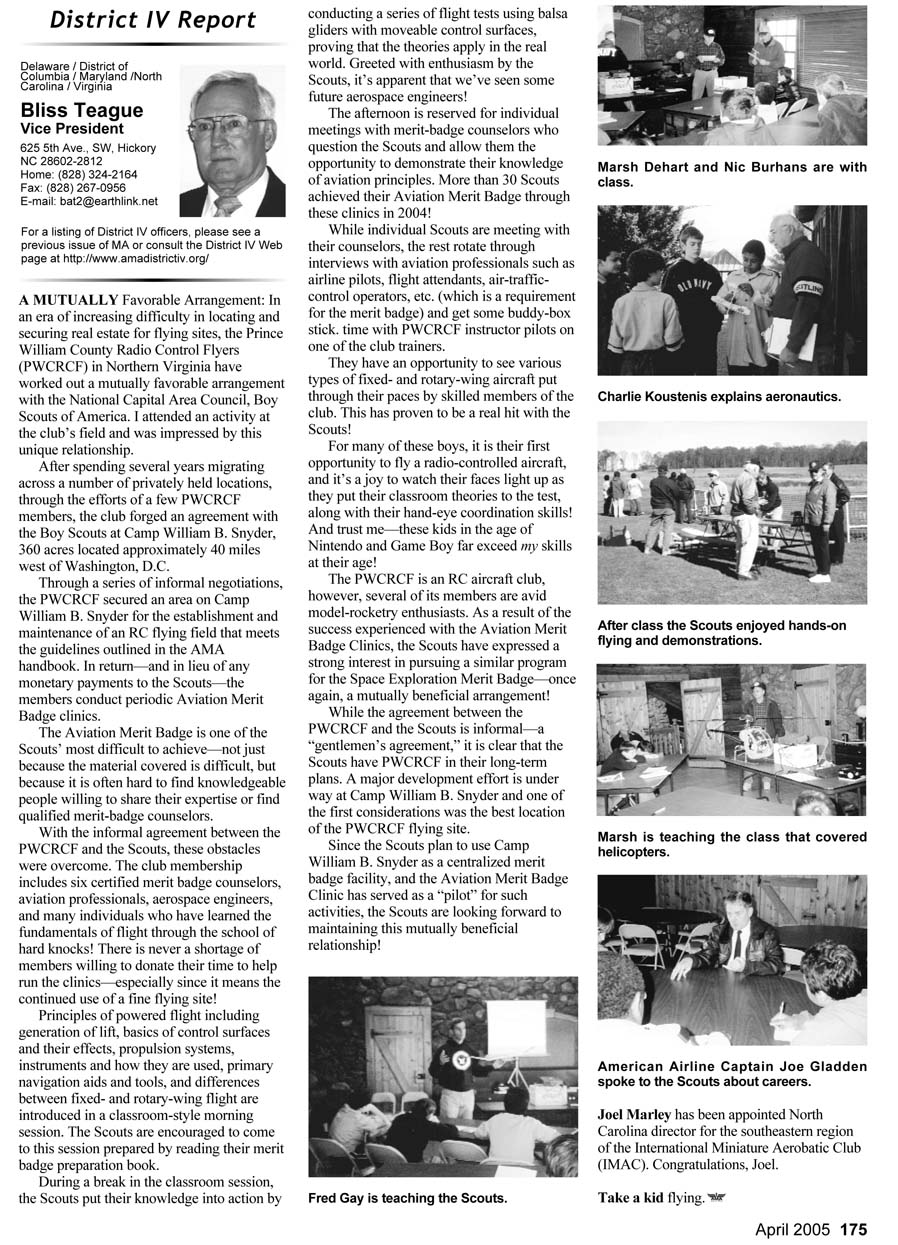
During a break in the classroom session, Scouts put their knowledge into action by conducting a series of flight tests using balsa gliders with movable control surfaces, proving that the theories apply in the real world. Greeted with enthusiasm, it’s apparent we’re seeing some future aerospace engineers.
The afternoon is reserved for individual meetings with merit-badge counselors who question the Scouts and allow them the opportunity to demonstrate their knowledge of aviation principles. More than 30 Scouts achieved their Aviation Merit Badge through these clinics in 2004.
While individual Scouts meet with their counselors, the rest rotate through interviews with aviation professionals such as airline pilots, flight attendants, and air-traffic-control operators (a requirement for the merit badge). They also get buddy-box stick time with PWCRCF instructor pilots on one of the club trainers.
Scouts also have the opportunity to see various types of fixed- and rotary-wing aircraft demonstrated by skilled club members. For many, it is their first opportunity to fly a radio-controlled aircraft, and it’s a joy to watch their faces light up as they put classroom theories to the test along with their hand-eye coordination skills.
Expansion and Future Plans
Although PWCRCF is primarily an RC aircraft club, several members are avid model-rocketry enthusiasts. As a result of the success of the Aviation Merit Badge Clinics, the Scouts have expressed strong interest in pursuing a similar program for the Space Exploration Merit Badge—another mutually beneficial prospect.
The agreement between PWCRCF and the Scouts is informal—a “gentlemen’s agreement”—but it is clear the Scouts have PWCRCF in their long-term plans. A major development effort is under way at Camp William B. Snyder, and one of the first considerations was the best location for the PWCRCF flying site.
Since the Scouts plan to use Camp William B. Snyder as a centralized merit badge facility, and the Aviation Merit Badge Clinic has served as a pilot for such activities, the Scouts are looking forward to maintaining this mutually beneficial relationship.
Transcribed from original scans by AI. Minor OCR errors may remain.

