
If It Flies ...
Dean Pappas | [email protected]
IF IT FLIES, you have probably spent some time trying to figure out what makes it tick. Pat yourself on the back; that's what it takes to make our aircraft fly better.
We tweak a little here and adjust there. Sometimes it works, while other times we try something else. In the extreme cases, we pick up the pieces.
That's one of the great things about aeromodeling. You can develop your test-pilot skills without resorting to a parachute or ejection seat, and you can test your mettle as a designer without asking anyone to endanger his or her life.
Inquiring minds will seize this opportunity and come up with all sorts of experiments—some cautious and others more adventurous. Some of you will take the opportunity to build novel aircraft with strange shapes, such as the slow-flying, psychedelically painted butterfly my buddy, Vinny, flew out of my backyard during a cookout the other weekend. Others will modify an airplane or build a variant of some previous design, looking earnestly for some small improvement in a flying characteristic almost no one else cares about.
Part of my unending enthusiasm for things that fly has to do with this pursuit of improvements, big and small, serious and silly. The assumption under which "If It Flies ..." (IIF) is written is that when you understand how something works, you can make it work better.
The reason this applies to aeromodeling of all sorts is that when our airplanes fly better, our enjoyment is enhanced. That's why we are here, trying to figure out what makes these flying machines work.
During our journey, sometimes we will discuss subjects that get a bit technical. As long as "IIF" has the mission described above, we will end up discussing ideas and concepts that are outside many people's everyday usage. After all, how many of you really use the algebra you learned in school? Not that many, I suspect.
In the future, when subjects such as physics are used that may not be familiar to all, I will try to include references to well-vetted sources and Web sites such as Wikipedia. See the source listing at the end of the column. This month I include several references regarding rotational inertia that may (or may not!) relieve some of the confusion on that subject.
In the October column, I described the relative importance of the several sources of "torque" in propeller-driven aircraft, and quite a few of you wrote in. Thanks for writing—all of you. Part of the problem is that so many scientific explanations we are given as students are wrong.
For some strange reason, under the guise that flight is complicated, gross oversimplifications or "sounds right" explanations are offered for subjects including the need for right thrust and right rudder on takeoff, or for why a wing makes lift. The explanation you were probably given in sixth grade was just plain wrong. If you want an excellent example of this, type the words "bad," "science," "wing," and "lift" into the Google search engine.
Although this month's discussion is about how a wing makes lift, the why is wrapped up in the Coanda effect. It is a flowing fluid's tendency to "stick to" a surface, even as that surface curves away from the initial flow direction.
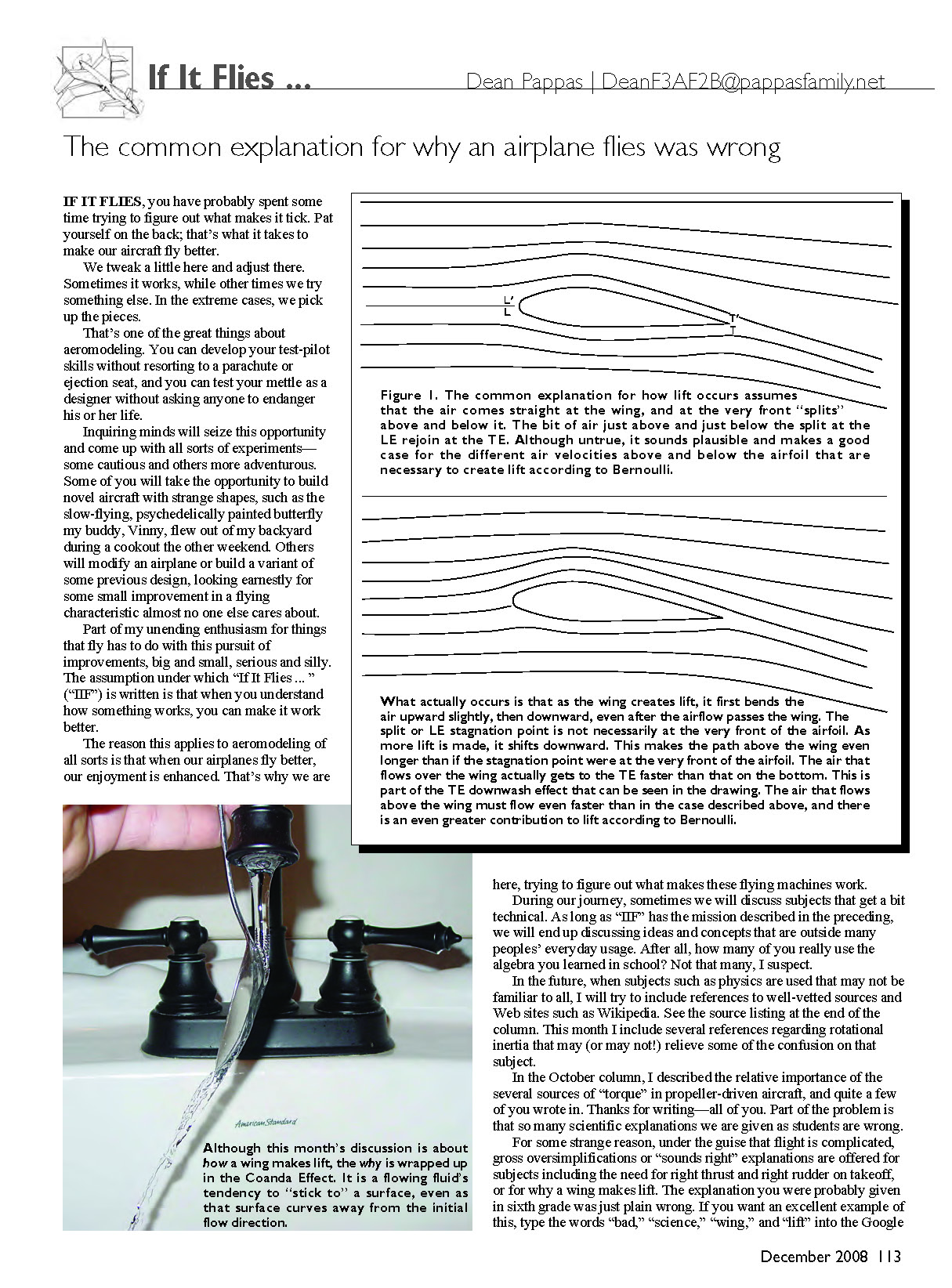
What actually occurs is that as the wing creates lift, it first bends the air upward slightly, then downward, even after the airflow passes the wing. The split or leading-edge stagnation point is not necessarily at the very front of the airfoil. As more lift is made, it shifts downward. This makes the path above the wing even longer than if the stagnation point were at the very front of the airfoil. The air that flows over the wing actually gets to the trailing edge faster than that on the bottom. This is part of the trailing-edge downwash effect that can be seen in the drawing. The air that flows above the wing must flow even faster than in the case described above, and there is an even greater contribution to lift according to Bernoulli.
Transcribed from original scans by AI. Minor OCR errors may remain.

