
If you've got it, Flaunt It!
by Dennis O. Norman
If you were around in the 1960s and the 1970s, you may remember the title of this article as one of the lines used by the late comedienne Jackie "Moms" Mabley. It makes a statement that is relevant to our interests.
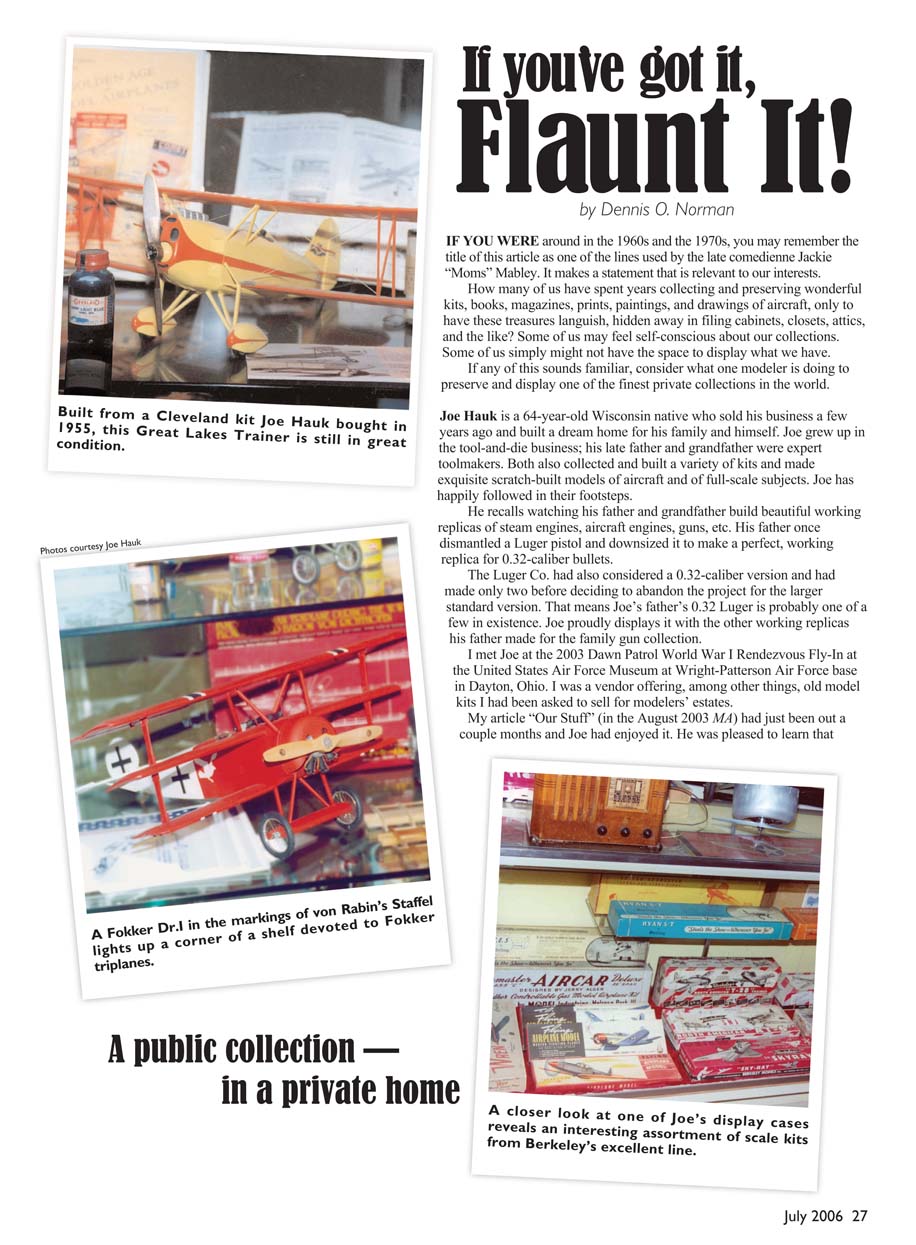
How many of us have spent years collecting and preserving wonderful kits, books, magazines, prints, paintings, and drawings of aircraft, only to have these treasures languish, hidden away in filing cabinets, closets, attics, and the like? Some of us may feel self-conscious about our collections. Some of us simply might not have the space to display what we have. If any of this sounds familiar, consider what one modeler is doing to preserve and display one of the finest private collections in the world.
Joe Hauk is a 64-year-old Wisconsin native who sold his business a few years ago and built a dream home for his family and himself. Joe grew up in the tool-and-die business; his late father and grandfather were expert toolmakers. Both also collected and built a variety of kits and made exquisite scratch-built models of aircraft and of full-scale subjects. Joe has happily followed in their footsteps.
He recalls watching his father and grandfather build beautiful working replicas of steam engines, aircraft engines, guns, etc. His father once dismantled a Luger pistol and downsized it to make a perfect, working replica for .32-caliber bullets.
The Luger Co. had also considered a .32-caliber version and had made only two before deciding to abandon the project for the larger standard version. That means Joe’s father’s .32 Luger is probably one of a few in existence. Joe proudly displays it with the other working replicas his father made for the family gun collection.
I met Joe at the 2003 Dawn Patrol World War I Rendezvous Fly-In at the United States Air Force Museum at Wright-Patterson Air Force Base in Dayton, Ohio. I was a vendor offering, among other things, old model kits I had been asked to sell for modelers’ estates. My article "Our Stuff" (in the August 2003 MA) had just been out a couple months and Joe had enjoyed it. He was pleased to learn that several rare kits had become available because of it and he purchased some of them.
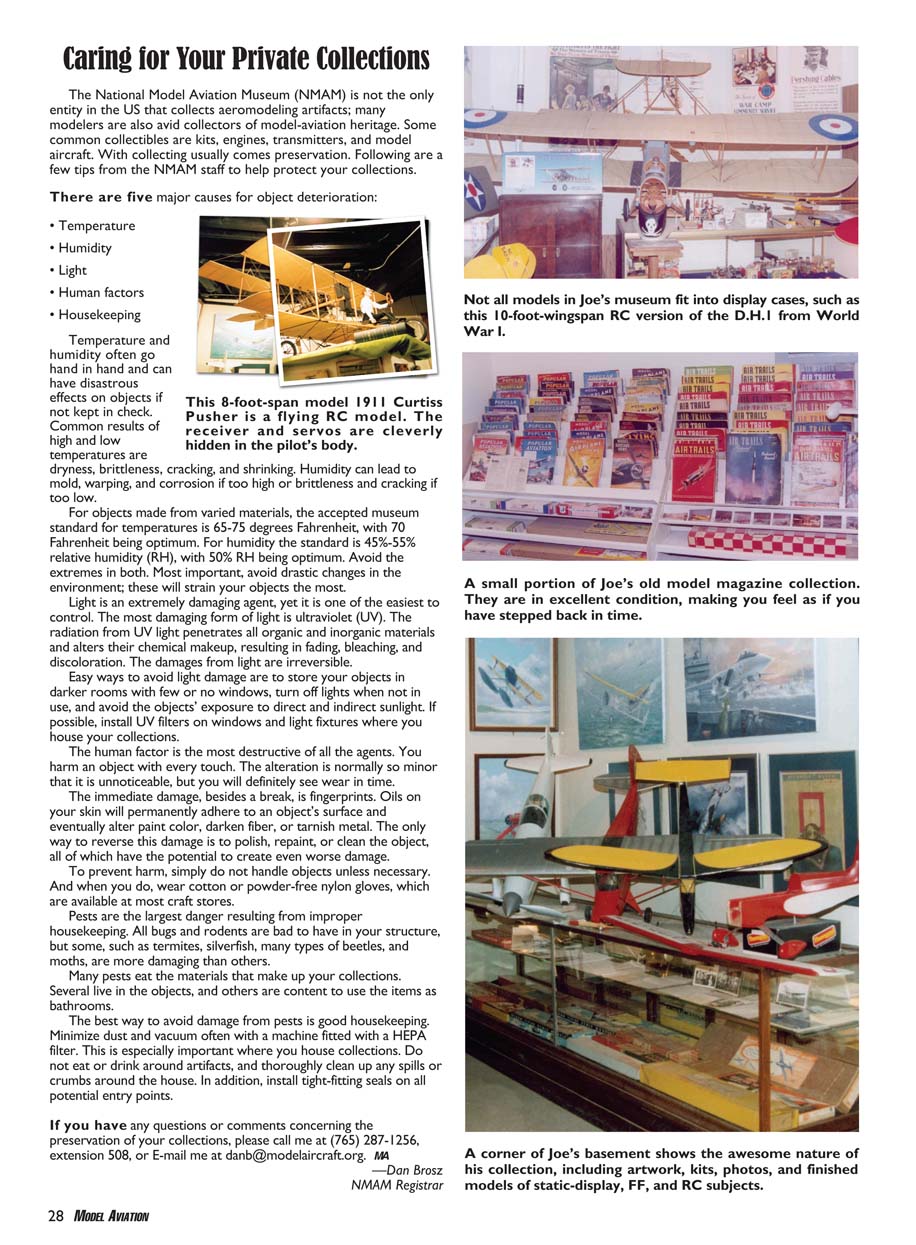
A few weeks later Joe sent me photos of his collection and a homemade videotape in which he described in detail the museum he built in the basement of his new home. The basement area is 2,100 square feet. As Joe was having it built, he placed the furnace and all related equipment centrally and enclosed it from view. This made what Joe describes as a "donut shaped area." He had the ceilings painted black to make them less noticeable. The floor was sealed and coated brown. The walls were finished with plaster.
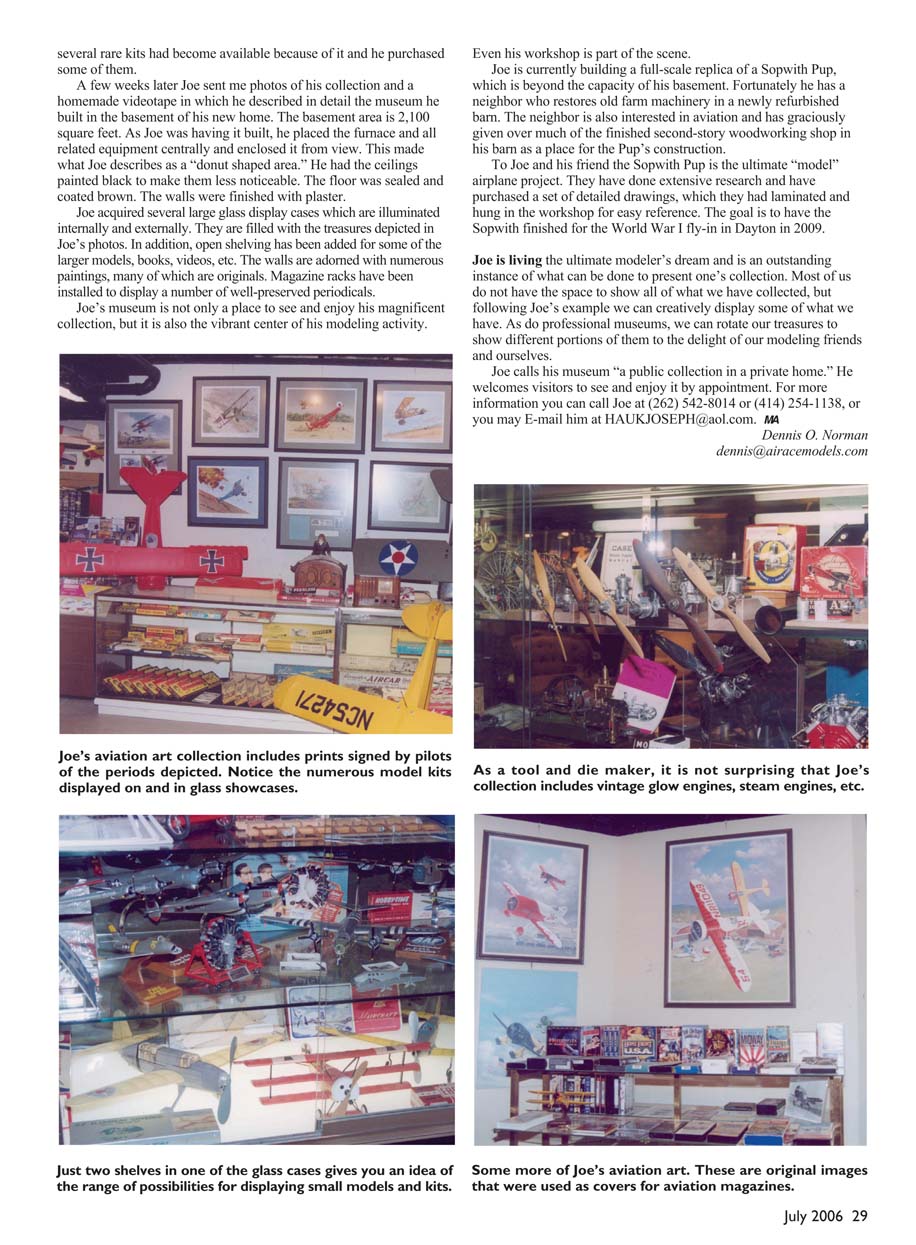
Joe acquired several large glass display cases which are illuminated internally and externally. They are filled with the treasures depicted in Joe's photos. In addition, open shelving has been added for some of the larger models, books, videos, etc. The walls are adorned with numerous paintings, many of which are originals. Magazine racks have been installed to display a number of well-preserved periodicals.
Joe’s museum is not only a place to see and enjoy his magnificent collection, but it is also the vibrant center of his modeling activity. Even his workshop is part of the scene.
Joe is currently building a full-scale replica of a Sopwith Pup, which is beyond the capacity of his basement. Fortunately he has a neighbor who restores old farm machinery in a newly refurbished barn. The neighbor is also interested in aviation and has graciously given over much of the finished second-story woodworking shop in his barn as a place for the Pup's construction.
To Joe and his friend the Sopwith Pup is the ultimate "model" airplane project. They have done extensive research and have purchased a set of detailed drawings, which they had laminated and hung in the workshop for easy reference. The goal is to have the Sopwith finished for the World War I fly-in in Dayton in 2009.
Joe is living the ultimate modeler's dream and is an outstanding example of what can be done to present one's collection. Most of us do not have the space to show all of what we have collected, but following Joe's example we can creatively display some of what we have. As do professional museums, we can rotate our treasures to show different portions of them to the delight of our modeling friends and ourselves.
Joe calls his museum "a public collection in a private home." He welcomes visitors to see and enjoy it by appointment. For more information you can call Joe at (262) 542-8014 or (414) 254-1138, or you may E-mail him at [email protected].
MA
Dennis O. Norman [email protected]
Caring for Your Private Collections
The National Model Aviation Museum (NMAM) is not the only entity in the US that collects aeromodeling artifacts; many modelers are also avid collectors of model-aviation heritage. Some common collectibles are kits, engines, transmitters, and model aircraft. With collecting usually comes preservation. Following are a few tips from the NMAM staff to help protect your collections.
Five major causes for object deterioration
- Temperature
- Humidity
- Light
- Human factors
- Housekeeping
Temperature and humidity often go hand in hand and can have disastrous effects on objects if not kept in check. Common results of high and low temperatures are dryness, brittleness, cracking, and shrinking. Humidity can lead to mold, warping, and corrosion if too high or brittleness and cracking if too low.
For objects made from varied materials, the accepted museum standard for temperatures is 65–75 degrees Fahrenheit, with 70 degrees Fahrenheit being optimum. For humidity the standard is 45%–55% relative humidity (RH), with 50% RH being optimum. Avoid the extremes in both. Most important, avoid drastic changes in the environment; these will strain your objects the most.
Light is an extremely damaging agent, yet it is one of the easiest to control. The most damaging form of light is ultraviolet (UV). The radiation from UV light penetrates all organic and inorganic materials and alters their chemical makeup, resulting in fading, bleaching, and discoloration. The damages from light are irreversible.
Easy ways to avoid light damage are to store your objects in darker rooms with few or no windows, turn off lights when not in use, and avoid the objects' exposure to direct and indirect sunlight. If possible, install UV filters on windows and light fixtures where you house your collections.
The human factor is the most destructive of all the agents. You harm an object with every touch. The alteration is normally so minor that it is unnoticeable, but you will definitely see wear in time.
The immediate damage, besides a break, is fingerprints. Oils on your skin will permanently adhere to an object's surface and eventually alter paint color, darken fiber, or tarnish metal. The only way to reverse this damage is to polish, repaint, or clean the object, all of which have the potential to create even worse damage.
To prevent harm, simply do not handle objects unless necessary. And when you do, wear cotton or powder-free nylon gloves, which are available at most craft stores.
Pests are the largest danger resulting from improper housekeeping. All bugs and rodents are bad to have in your structure, but some, such as termites, silverfish, many types of beetles, and moths, are more damaging than others.
Many pests eat the materials that make up your collections. Several live in the objects, and others are content to use the items as bathrooms.
The best way to avoid damage from pests is good housekeeping. Minimize dust and vacuum often with a machine fitted with a HEPA filter. This is especially important where you house collections. Do not eat or drink around artifacts, and thoroughly clean up any spills or crumbs around the house. In addition, install tight-fitting seals on all potential entry points.
If you have any questions or comments concerning the preservation of your collections, please call me at (765) 287-1256, extension 508, or E-mail me at [email protected].
—Dan Brosz NMAM Registrar
Transcribed from original scans by AI. Minor OCR errors may remain.

