
Multiplex Tucan
Jon Barnes [email protected]
The Embraer Tucano is a low-wing, turboprop-powered, full-scale, two-seat airplane used to train military pilots. It was designed and developed in Brazil and eventually found its way into the air forces of more than 15 different countries.
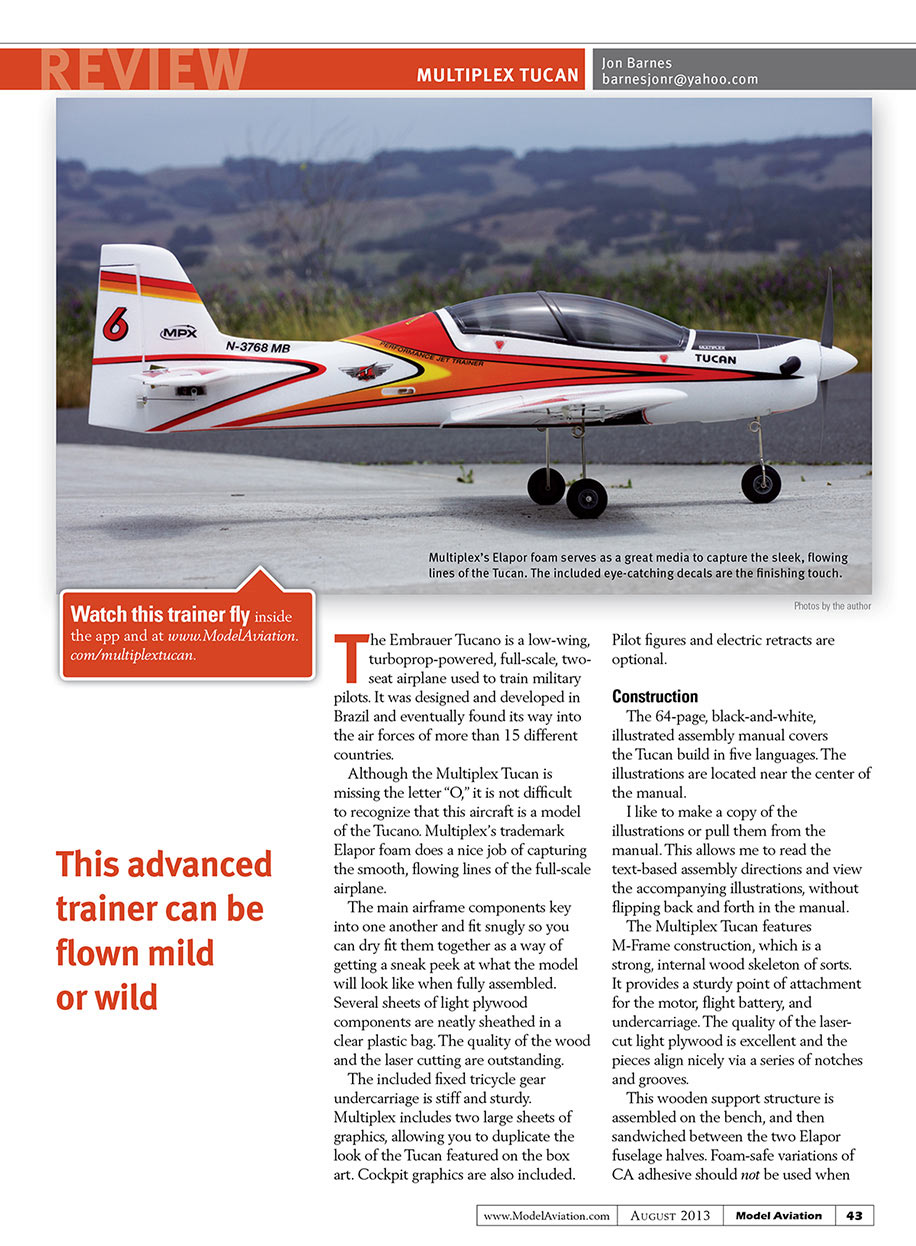
Although the Multiplex Tucan is missing the letter "O," it is not difficult to recognize that this aircraft is a model of the Tucano. Multiplex's trademark Elapor foam does a nice job of capturing the smooth, flowing lines of the full-scale airplane.
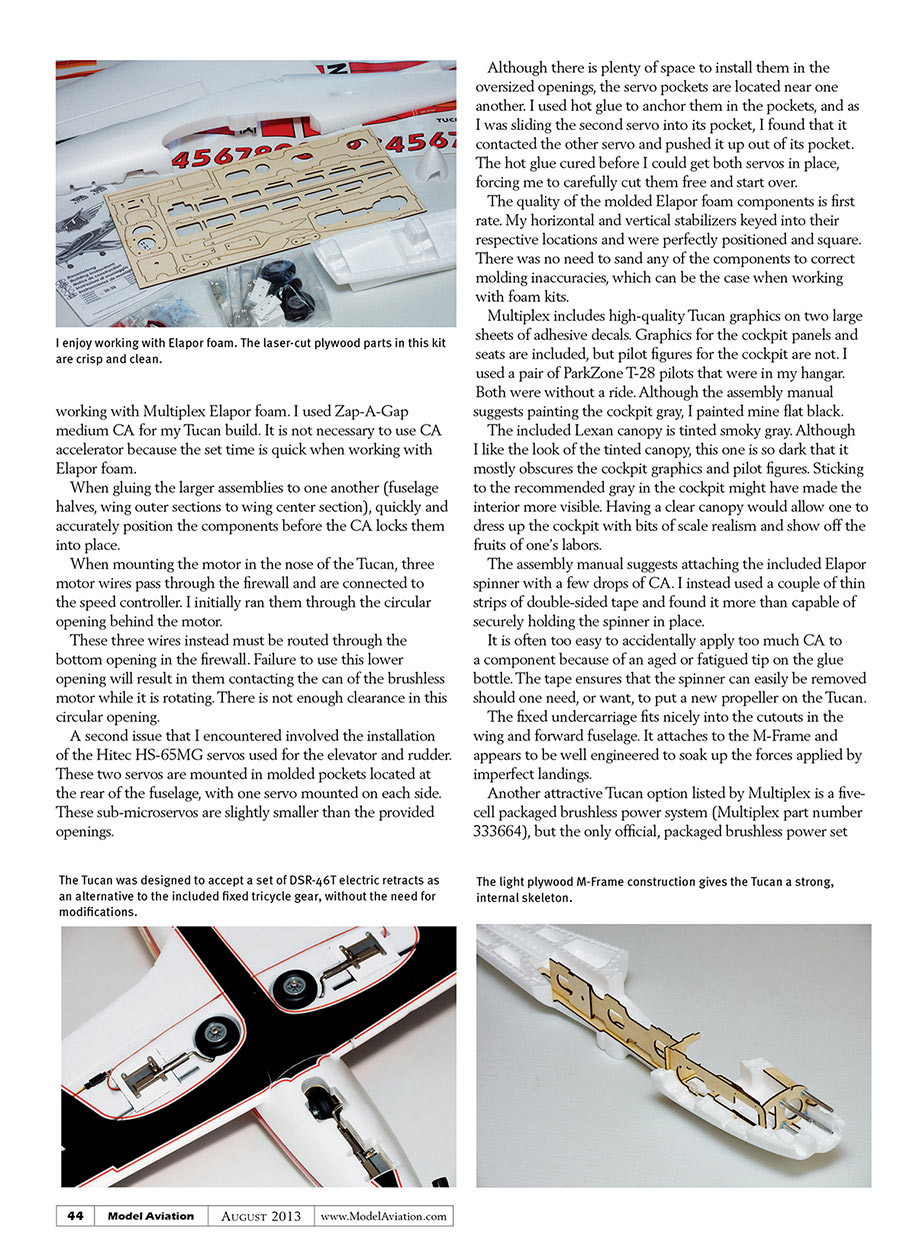
The main airframe components key into one another and fit snugly so you can dry fit them together as a way of getting a sneak peek at what the model will look like when fully assembled. Several sheets of light plywood components are neatly sheathed in a clear plastic bag. The quality of the wood and the laser cutting are outstanding.
The included fixed tricycle gear undercarriage is stiff and sturdy. Multiplex includes two large sheets of graphics, allowing you to duplicate the look of the Tucan featured on the box art. Cockpit graphics are also included.
Pilot figures and electric retracts are optional.
Construction
The 64-page, black-and-white, illustrated assembly manual covers the Tucan build in five languages. The illustrations are located near the center of the manual.
I like to make a copy of the illustrations or pull them from the manual. This allows me to read the text-based assembly directions and view the accompanying illustrations, without flipping back and forth in the manual.
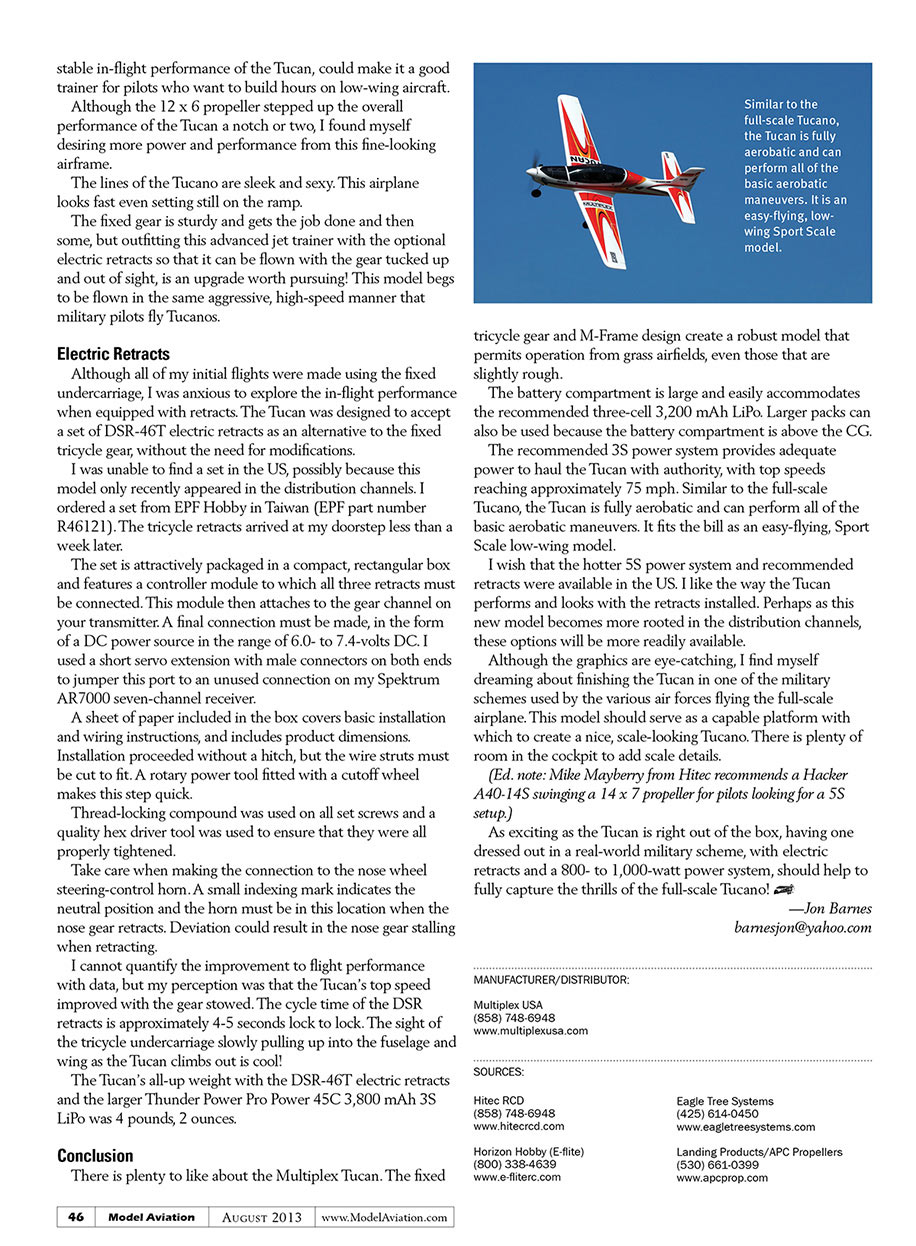
The Multiplex Tucan features M-Frame construction, which is a strong, internal wood skeleton of sorts. It provides a sturdy point of attachment for the motor, flight battery, and undercarriage. The quality of the laser-cut light plywood is excellent and the pieces align nicely via a series of notches and grooves.
This wooden support structure is assembled on the bench, and then sandwiched between the two Elapor fuselage halves. Foam-safe variations of CA adhesive should not be used when assembling the fuselage halves. They will attack the Elapor foam. Use only foam-safe CA or epoxy.
When gluing the larger assemblies to one another (fuselage halves, wing outer sections to wing center section), quickly and accurately position the components before the CA locks them into place.
When mounting the motor in the nose of the Tucan, three motor wires pass through the firewall and are connected to the speed controller. I initially ran them through the circular opening behind the motor.
These three wires instead must be routed through the bottom opening in the firewall. Failure to use this lower opening will result in them contacting the can of the brushless motor while it is rotating. There is not enough clearance in this circular opening.
A second issue that I encountered involved the installation of the Hitec HS-65MG servos used for the elevator and rudder. These two servos are mounted in molded pockets located at the rear of the fuselage, with one servo mounted on each side. These sub-micro servos are slightly smaller than the provided openings.
Although there is plenty of space to install them in the oversized openings, the servo pockets are located near one another. I used hot glue to anchor them in the pockets, and as I was sliding the second servo into its pocket, I found that it contacted the other servo and pushed it up out of its pocket. The hot glue cured before I could get both servos in place, forcing me to carefully cut them free and start over.
The quality of the molded Elapor foam components is first rate. My horizontal and vertical stabilizers keyed into their respective locations and were perfectly positioned and square. There was no need to sand any of the components to correct molding inaccuracies, which can be the case when working with foam kits.
Multiplex includes high-quality Tucan graphics on two large sheets of adhesive decals. Graphics for the cockpit panels and seats are included, but pilot figures for the cockpit are not. I used a pair of ParkZone T-28 pilots that were in my hangar. Both were without a ride. Although the assembly manual suggests painting the cockpit gray, I painted mine flat black.
The included Lexan canopy is tinted smoky gray. Although I like the look of the tinted canopy, this one is so dark that it mostly obscures the cockpit graphics and pilot figures. Sticking to the recommended gray in the cockpit might have made the interior more visible. Having a clear canopy would allow one to dress up the cockpit with bits of scale realism and show off the fruits of one’s labors.
The assembly manual suggests attaching the included Elapor spinner with a few drops of CA. I instead used a couple of thin strips of double-sided tape and found it more than capable of securely holding the spinner in place.
It is often too easy to accidentally apply too much CA to a component because of an aged or fatigued tip on the glue bottle. The tape ensures that the spinner can easily be removed should one need, or want, to put a new propeller on the Tucan.
The fixed undercarriage fits nicely into the cutouts in the wing and forward fuselage. It attaches to the M-Frame and appears to be well engineered to soak up the forces applied by imperfect landings.
Another attractive Tucan option listed by Multiplex is a five-cell packaged brushless power system (Multiplex part number 333664), but the only official, packaged brushless power set option available when I was building the Tucan was a three-cell version (Multiplex part number 332663).
Flying
The 3S power set included with the Tucan is also recommended for the Multiplex Mentor. It features a 35mm Himax brushless outrunner capable of 400-500 watts of power, a Castle Creations Thunderbird 54 ESC, and an APC E 11 x 5.5 propeller.
I made six flights on the Tucan with the supplied power set. My Eagle Tree eLogger showed a maximum power output of 400-425 watts using this setup. With this power system, the aerobatics performed on high rates are smooth. The roll rate is 2-3 seconds per rotation, with a quick touch of back stick required as one transitions through the inverted position to keep the maneuver clean.
Landing the Tucan is not difficult. The thick airfoil creates a model with a slow stall speed, and the Tucan is forgiving throughout the landing pattern. The undercarriage is capable of withstanding the impact of less-than-perfect landings and rough airfields.
I like the potentially long flights with the 3,200 mAh battery. My typical flights, with varied throttle settings, were 5-6 minutes. Typical battery replenishment currents after my flights were 1,600-1,900 mAh. Larger batteries can be used for longer flights.
Multiplex has engineered the Tucan so that the battery is located near the CG and there is ample room in the fuselage to adjust the battery’s position forward and aft, to correct the CG when using larger packs.
Because the Tucan is styled after a real-world, turboprop-powered advanced trainer, I found myself wanting more performance out of mine. The data chart for the Himax 3528-1000 motor shows that it can be flown on 3S with a 12 x 6 propeller. I swapped the 11 x 5.5 out for the slightly taller and steeper-pitched option.
Although the power increase was not extreme, there was noticeable improvement in speed and performance. My eLogger confirmed this by reporting a maximum power output of approximately 500 watts using the APC E 12 x 6 propeller. With an all-up weight of 4 pounds, the power-to-weight ratio of the Tucan is approximately 125 watts per pound.
The fixed tricycle gear struts feature spring struts that are made from heavy-gauge wire. They are securely anchored to the plastic gear receiver blocks, which are mounted to inset wooden gear-mounting blocks in the wings and the M-Frame structure in the fuselage.
The main gear’s wide stance helps create a model with good ground-handling manners. This power level, and the predictably
AT A GLANCE ...
SPECIFICATIONS
Model type: Sport Scale
Skill level: Intermediate builder; intermediate pilot
Wingspan: 51.2 inches
Wing area: 496 square inches
Length: 43.7 inches
Weight: 4 pounds
Power system: Himax HC3528 1,000 Kv brushless outrunner; Castle Creations Thunderbird 54 brushless speed controller; APC E 11 x 5.5 or 12 x 6 propeller
Radio: JR X9503 2.4 GHz DSM2 transmitter
Construction: Elapor foam
Covering/finish: Included Multiplex graphics
Street price: $179.99
TEST-MODEL DETAILS
Motor: Himax HC3528 1,000 Kv
Speed controller: Castle Creations Thunderbird 54
Battery: E-flite 3S 3,200 mAh
Propeller: APC E 11 x 5.5 or 12 x 6
Radio system: JR X9503 DSM2 transmitter, Spektrum AR7000 DSM2 receiver; four Hitec HS-65MG servos; one Hitec HS-85 servo
Ready-to-fly weight: 4 pounds, 2 ounces with electric retracts
Flight duration: 8-10 minutes using recommended 3S 3,200 mAh battery pack
PLUSES
- Multiplex’s version of the Embraer Tucano is a nice-size model.
- The positioning of the battery near the CG and ample space inside the fuselage allows for different sizes of battery packs.
- M-Frame light plywood framework creates strong internal support structure.
- Included fixed gear is sturdy.
MINUSES
- The canopy tinting is slightly dark, obscuring some cockpit details.
- No flap option provided.
- The retractable gear that the kit was designed around is not yet readily available.
Electric Retracts
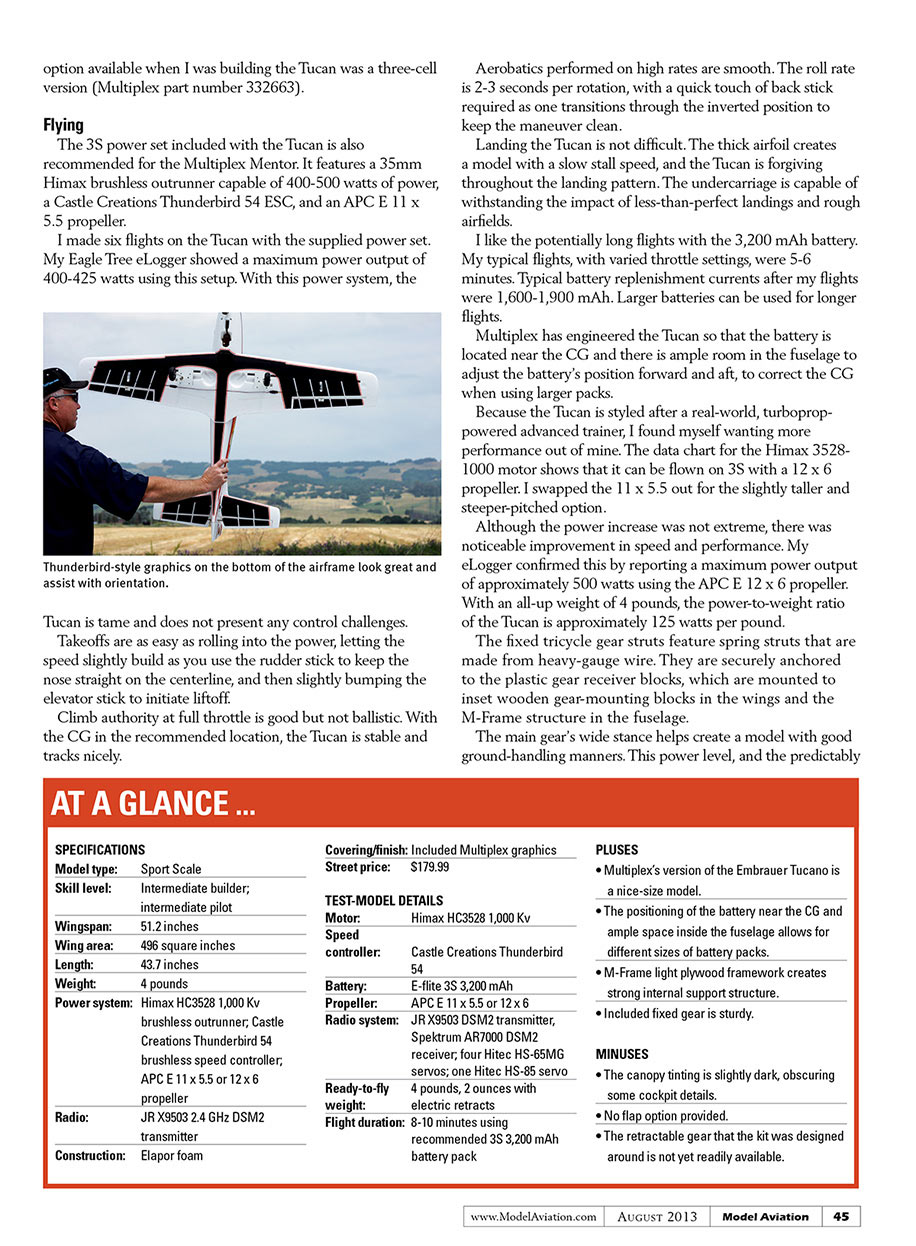
Although all of my initial flights were made using the fixed undercarriage, I was anxious to explore the in-flight performance when equipped with retracts. The Tucan was designed to accept a set of DSR-46T electric retracts as an alternative to the fixed tricycle gear, without the need for modifications.
I was unable to find a set in the US, possibly because this model only recently appeared in the distribution channels. I ordered a set from EPF Hobby in Taiwan (EPF part number R46121). The tricycle retracts arrived at my doorstep less than a week later.
The set is attractively packaged in a compact, rectangular box and features a controller module to which all three retracts must be connected. This module then attaches to the gear channel on your transmitter. A final connection must be made, in the form of a DC power source in the range of 6.0- to 7.4-volts DC. I used a short servo extension with male connectors on both ends to jumper this port to an unused connection on my Spektrum AR7000 seven-channel receiver.
A sheet of paper included in the box covers basic installation and wiring instructions, and includes product dimensions. Installation proceeded without a hitch, even with the wire struts must be cut to fit. A rotary power tool fitted with a cutoff wheel makes this step quick.
Thread-locking compound was used on all set screws and a quality hex driver tool was used to ensure that they were all properly tightened.
Take care when making the connection to the nose wheel steering-control horn. A small indexing mark indicates the neutral position and the horn must be in this location when the nose gear retracts. Deviation could result in the nose gear stalling when retracting.
I cannot quantify the improvement to flight performance with data, but my perception was that the Tucan’s top speed improved with the gear stowed. The cycle time of the DSR retracts is approximately 4-5 seconds lock to lock. The sight of the tricycle undercarriage slowly pulling up into the fuselage and wing as the Tucan climbs out is cool!
The Tucan’s all-up weight with the DSR-46T electric retracts and the larger Thunder Power Pro Power 45C 3,800 mAh 3S LiPo was 4 pounds, 2 ounces.
Conclusion
There is plenty to like about the Multiplex Tucan. The fixed tricycle gear and M-Frame design create a robust model that permits operation from grass airfields, even those that are slightly rough.
The battery compartment is large and easily accommodates the recommended three-cell 3,200 mAh LiPo. Larger packs can also be used because the battery compartment is above the CG.
The recommended 3S power system provides adequate power to haul the Tucan with authority, with top speeds reaching approximately 75 mph. Similar to the full-scale Tucano, the Tucan is fully aerobatic and can perform all of the basic aerobatic maneuvers. It fits the bill as an easy-flying, Sport Scale low-wing model.
I wish that the hotter 5S power system and recommended retracts were available in the US. I like the way the Tucan performs and looks with the retracts installed. Perhaps as this new model becomes more rooted in the distribution channels, these options will be more readily available.
Although the graphics are eye-catching, I find myself dreaming about finishing the Tucan in one of the military schemes used by the various air forces flying the full-scale airplane. This model should serve as a capable platform with which to create a nice, scale-looking Tucano. There is plenty of room in the cockpit to add scale details.
(Ed. note: Mike Mayberry from Hitec recommends a Hacker A40-14S swinging a 14 x 7 propeller for pilots looking for a 5S setup.)
As exciting as the Tucan is right out of the box, having one dressed out in a real-world military scheme, with electric retracts and a 800- to 1,000-watt power system, should help to fully capture the thrills of the full-scale Tucano!
—Jon Barnes [email protected]
MANUFACTURER/DISTRIBUTOR: Multiplex USA (858) 748-6948 www.multiplexusa.com
SOURCES: Hitec RCD (858) 748-6948 www.hitecrcd.com
Horizon Hobby (E-flite) (800) 338-4639 www.e-flite.com
Eagle Tree Systems (425) 614-0450 www.eagletreesystems.com
Landing Products/APC Propellers (530) 661-0399 www.apcprop.com
Transcribed from original scans by AI. Minor OCR errors may remain.

