
O.S. GT-33 Gas Engine
Jim Rice
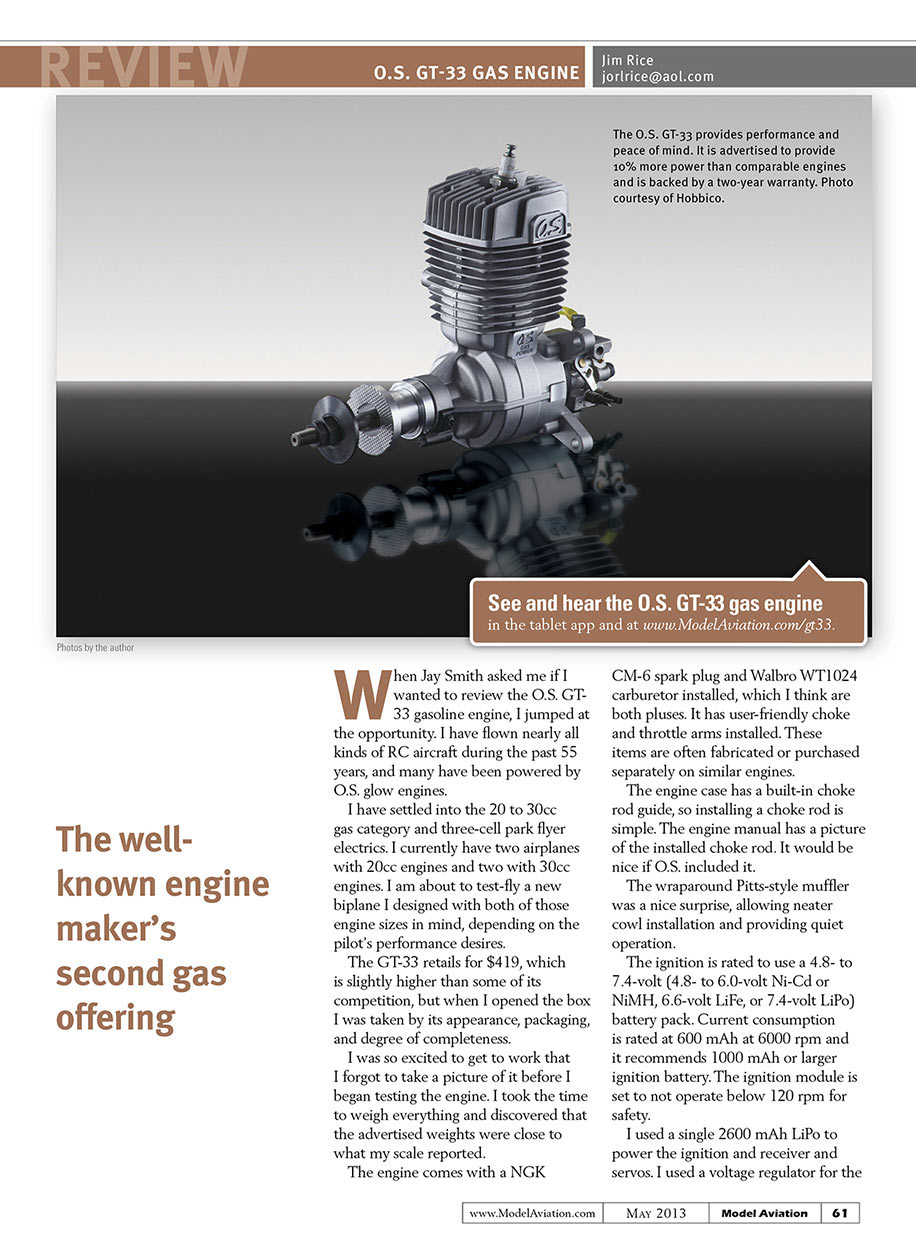
When Jay Smith asked me if I wanted to review the O.S. GT-33 gasoline engine, I jumped at the opportunity. I have flown nearly all kinds of RC aircraft during the past 55 years, and many have been powered by O.S. glow engines.
I have settled into the 20 to 30cc gas category and three-cell park flyer electrics. I currently have two airplanes with 20cc engines and two with 30cc engines. I am about to test-fly a new biplane I designed with both of those engine sizes in mind, depending on the pilot's performance desires.
The GT-33 retails for $419, which is slightly higher than some of its competition, but when I opened the box I was taken by its appearance, packaging, and degree of completeness.
I was so excited to get to work that I forgot to take a picture of it before I began testing the engine. I took the time to weigh everything and discovered that the advertised weights were close to what my scale reported.
The engine comes with a NGK CM-6 spark plug and Walbro WTL024 carburetor installed, which I think are both pluses. It has user-friendly choke and throttle arms installed. These items are often fabricated or purchased separately on similar engines.
The engine case has a built-in choke rod guide, so installing a choke rod is simple. The engine manual has a picture of the installed choke rod. It would be nice if O.S. included it.
The wraparound Pitts-style muffler was a nice surprise, allowing neater cowl installation and providing quiet operation.
The ignition is rated to use a 4.8- to 7.4-volt (4.8- to 6.0-volt Ni-Cd or NiMH, 6.6-volt LiFe, or 7.4-volt LiPo) battery pack. Current consumption is rated at 600 mA at 6000 rpm and it recommends 1000 mA·h or larger ignition battery. The ignition module should not operate below 120 rpm for safety.
I used a single 2600 mAh LiPo to power the ignition and receiver and servos. I used a voltage regulator for the flight system, but connected the ignition without a regulator.
I was excited to try the engine in my son's Sbach that had been setting on my bench without a radio or engine for approximately two months, waiting for me to return it to flying condition for him.
When I compared the mounting lugs for the GT-33 with those of the DLE-30 that had previously been on the airplane, I discovered they matched perfectly and all I needed was an extra 1/8-inch spacer to get the spinner backplate outside of the cowl. It went on with little effort and looks good.
The plug is canted toward the rear of the engine, which should help keep the plug wire away from propeller arc and inside the cowl. The cowl went back on the airplane with this engine and only required minor cutout modifications. It may not have required any, but I wanted to mount the muffler to the engine before installing the cowl and it wouldn't quite fit. The modification is unnoticeable, but it makes muffler/engine/cowl assembly much easier.
Regular gasoline with Evolution synthetic oil in a 32:1 ratio was used for all engine runs. For the first start, the choke was closed and the carburetor was opened with the ignition on and it fired after roughly six flips. When the choke was opened and the carburetor was closed, it started on the fourth flip, but died quickly.
That repeated for six or seven iterations with the low throttle at various settings. There were only minor differences in run time before it stopped. I was convinced that the carburetor needed to be full and the diaphragm soaked and it would run perfectly.
Finally, I reluctantly opened the low-end needle approximately a quarter turn and it immediately fired. A Vess 18 x 8S propeller provided good transition and fairly reliable idle with only minutes of run time.
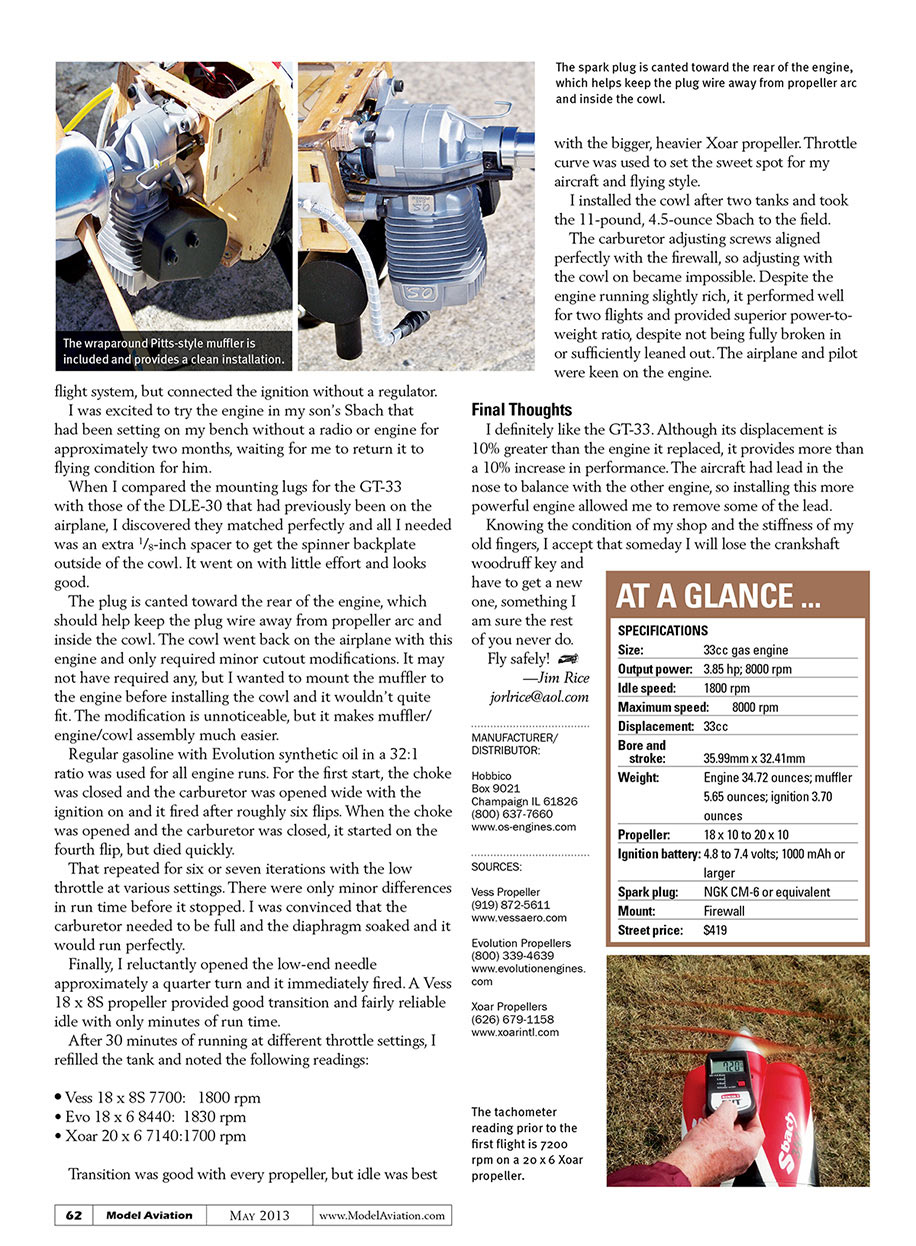
After 30 minutes of running at different throttle settings, I refilled the tank and noted the following readings:
- Vess 18 x 8S 7700: 1800 rpm
- Evo 18 x 6 8440: 1830 rpm
- Xoar 20 x 6 7140: 1700 rpm
Transition was good with every propeller, but idle was best with the bigger, heavier Xoar propeller. Throttle curve was used to set the sweet spot for my aircraft and flying style.
I installed the cowl after two tanks and took the 11-pound, 4.5-ounce Sbach to the field.
The carburetor adjusting screws aligned perfectly with the firewall, so adjusting with the cowl on became impossible. Despite the engine running slightly rich, it performed well for two flights and provided superior power-to-weight ratio, despite not being fully broken in or sufficiently leaned out. The airplane and pilot were keen on the engine.
Final Thoughts
I definitely like the GT-33. Although its displacement is 10% greater than the engine it replaced, it provides more than a 10% increase in performance. The aircraft had lead in the nose to balance with the other engine, so installing this more powerful engine allowed me to remove some of the lead.
Knowing the condition of my shop and the stiffness of my old fingers, I accept that someday I will lose the crankshaft woodruff key and have to get a new one, something I am sure the rest of you never do.
Fly safely! — Jim Rice [email protected]
MANUFACTURER/DISTRIBUTOR: Hobbico Box 9021 Champaign IL 61826 (800) 637-7660 www.os-engines.com
SOURCES: Vess Propeller (919) 872-5611 www.vessare.com
Evolution Propellers (800) 339-4639 www.evolutionengines.com
Xoar Propellers (626) 679-1158 www.xoarintl.com
AT A GLANCE ...
SPECIFICATIONS
- Size: 33cc gas engine
- Output power: 3.85 hp; 8000 rpm
- Idle speed: 1800 rpm
- Maximum speed: 8000 rpm
- Displacement: 33cc
- Bore and stroke: 35.99mm x 32.41mm
- Weight: Engine 34.72 ounces; muffler 5.65 ounces; ignition 3.70 ounces
- Propeller: 18 x 10 to 20 x 10
- Ignition battery: 4.8 to 7.4 volts; 1000 mAh or larger
- Spark plug: NGK CM-6 or equivalent
- Mount: Firewall
- Street price: $419
Transcribed from original scans by AI. Minor OCR errors may remain.

