
Radio Control Aerobatics
Albert and A.C. Glenn [[email protected]]
Setup tips for inside the aircraft
In past columns we have shared tips for properly trimming your model. This month we will show you how to do internal setup for your airplane to increase its longevity. Proper internal setup minimizes downtime and maximizes time between repairs.
Through the years we have been to many contests and have seen a lot of models. The pilots who have done the best in RC Aerobatics (Pattern) have rarely had to work on their airplanes. These fliers use the same equipment as everyone else, but they position it efficiently so it lasts longer and doesn't present problems such as chafing, cut fuel lines, or components coming loose. A neatly set-up airplane is the key to winning and consistently performing your best.
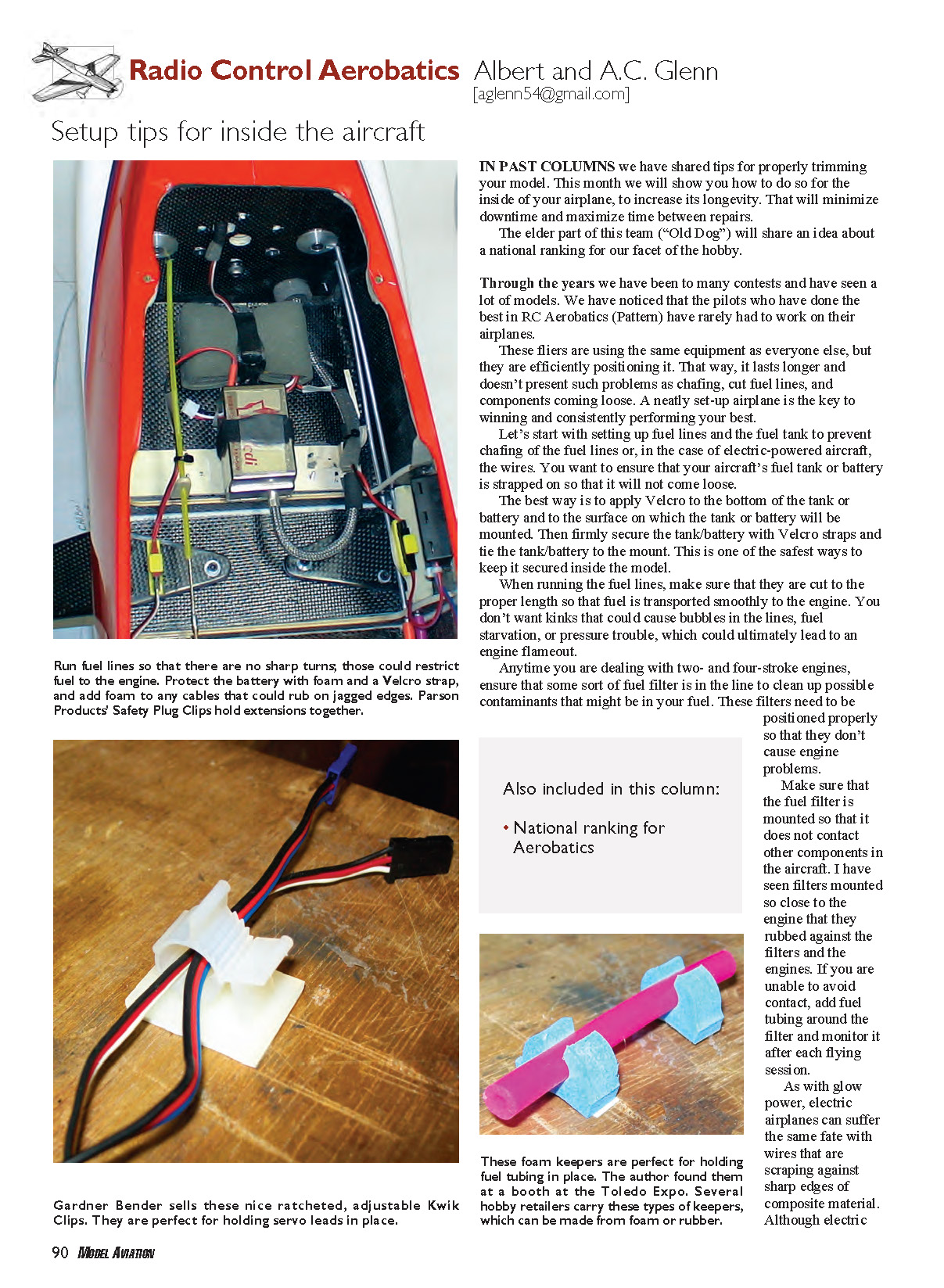
Start with fuel lines and the fuel tank (or battery and wiring for electric aircraft). Ensure the tank or battery is strapped on so it will not come loose. The best method is to apply Velcro to the bottom of the tank/battery and to the mounting surface. Then firmly secure the tank/battery with Velcro straps and tie it to the mount. This is one of the safest ways to keep it secured inside the model.
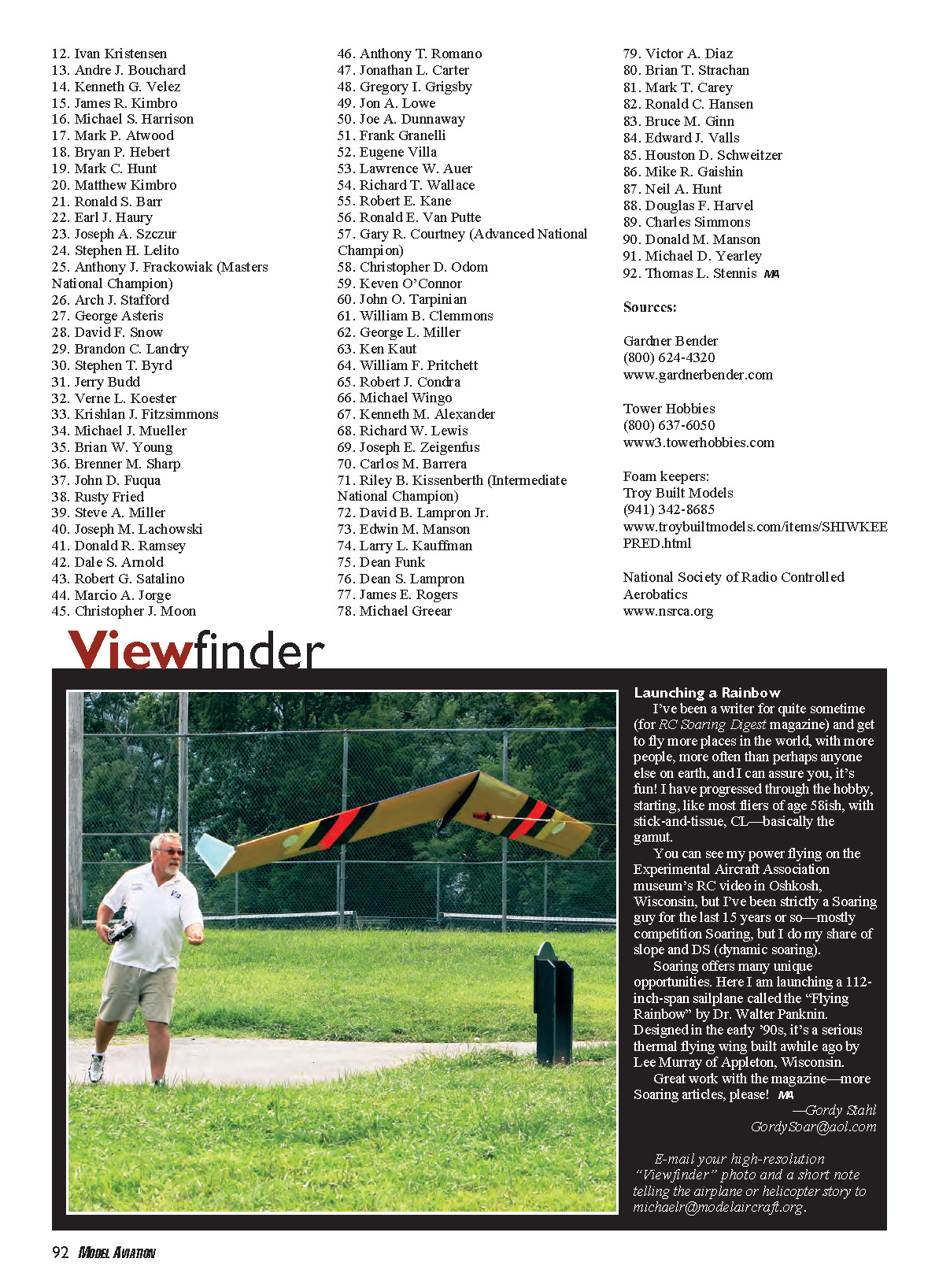
When running fuel lines, cut them to the proper length so fuel flows smoothly to the engine. Avoid kinks that could cause bubbles, fuel starvation, or pressure trouble, which can lead to engine flameouts. Anytime you are dealing with two- or four-stroke engines, use a fuel filter to catch contaminants. Position filters so they don't cause engine problems or contact other components. I have seen filters mounted so close to the engine that they rubbed against it; if you cannot avoid contact, add fuel tubing around the filter and monitor it after each flying session.
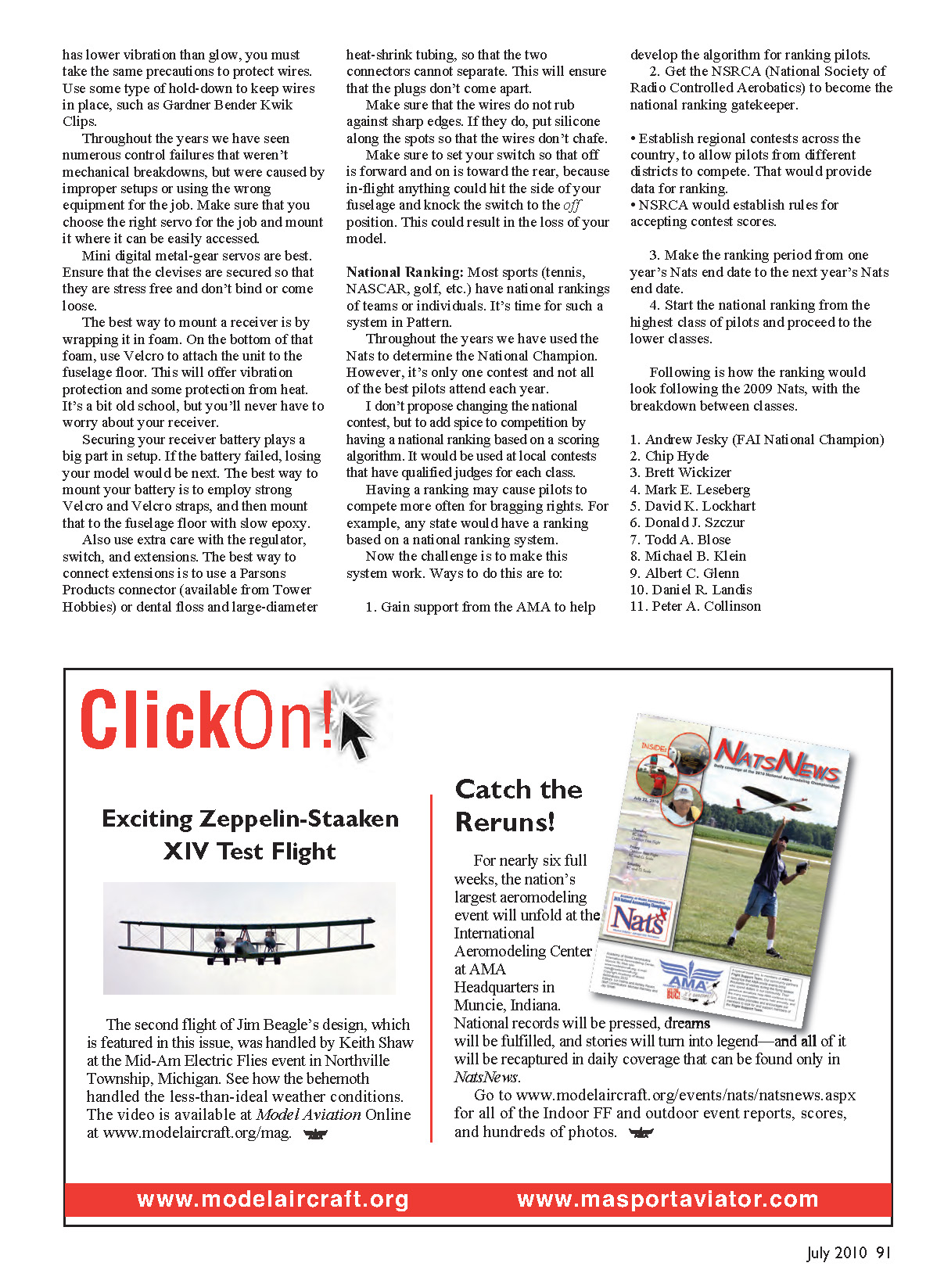
Electric airplanes face similar hazards where wires can scrape against sharp composite edges. Although electric setups typically have lower vibration than glow engines, take the same precautions to protect wires. Use hold-downs such as Gardner Bender Kwik Clips to keep wires in place.
Over the years we have seen numerous control failures caused not by mechanical breakdowns but by improper setups or using the wrong equipment. Make sure you choose the right servo for the job and mount it where it can be easily accessed. Mini digital metal-gear servos are often best. Ensure clevises are secured so they are stress-free and don't bind or come loose. The best way to mount a receiver is by wrapping it in foam and using Velcro on the bottom to attach it to the fuselage floor—this offers good vibration protection.
Securing your receiver battery is critical. If the battery fails, losing your model is likely. Mount the battery using strong Velcro and Velcro straps, and secure that to the fuselage floor with slow epoxy. Also use extra care with the regulator, switch, and extension leads. The best ways to secure extensions are using a Parsons Products connector (available from Tower Hobbies) or using dental floss and large-diameter heat-shrink tubing so the two connectors cannot separate. This helps ensure plugs don't come apart.
Make sure wires do not rub against sharp edges; if they do, apply silicone to prevent chafing. Set your switch so that OFF is forward and ON is toward the rear—during flight something could hit the fuselage side and knock a forward-mounted switch to OFF, which could result in loss of the model.
Also included in this column
- National ranking for Aerobatics
National ranking
Most sports (tennis, NASCAR, golf, etc.) have national rankings of teams or individuals. It's time for such a system in Pattern. Historically we've used the Nats to determine the National Champion, but it is only one contest and not all of the best pilots attend every year. I don't propose changing the national contest, but adding a national ranking based on a scoring algorithm would add spice to competition and encourage pilots to compete more often for bragging rights. Each state could have a ranking based on the national system.
Ways to implement this:
- Gain support from the AMA to help develop the algorithm for ranking pilots.
- Get the NSRCA (National Society of Radio Controlled Aerobatics) to act as the national ranking gatekeeper.
- Establish regional contests across the country to allow pilots from different districts to compete and provide data for ranking.
- NSRCA would establish rules for accepting contest scores.
- Make the ranking period run from one year's Nats end date to the next year's Nats end date.
- Start the national ranking with the highest class of pilots and proceed to the lower classes.
Following is how the ranking would look following the 2009 Nats, with the breakdown between classes:
- Andrew Jesky (FAI National Champion)
- Chip Hyde
- Brett Wickizer
- Mark E. Leseberg
- David K. Lockhart
- Donald J. Szczur
- Todd A. Blose
- Michael B. Klein
- Albert C. Glenn
- Daniel R. Landis
- Peter A. Collinson
- Ivan Kristensen
- Andre J. Bouchard
- Kenneth G. Velez
- James R. Kimbro
- Michael S. Harrison
- Mark P. Atwood
- Bryan P. Hebert
- Mark C. Hunt
- Matthew Kimbro
- Ronald S. Barr
- Earl J. Haury
- Joseph A. Szczur
- Stephen H. Lelito
- Anthony J. Frackowiak (Masters National Champion)
- Arch J. Stafford
- George Asteris
- David F. Snow
- Brandon C. Landry
- Stephen T. Byrd
- Jerry Budd
- Verne L. Koester
- Krishlan J. Fitzsimmons
- Michael J. Mueller
- Brian W. Young
- Brenner M. Sharp
- John D. Fuqua
- Rusty Fried
- Steve A. Miller
- Joseph M. Lachowski
- Donald R. Ramsey
- Dale S. Arnold
- Robert G. Satalino
- Marcio A. Jorge
- Christopher J. Moon
- Anthony T. Romano
- Jonathan L. Carter
- Gregory I. Grigsby
- Jon A. Lowe
- Joe A. Dunnaway
- Frank Granelli
- Eugene Villa
- Lawrence W. Auer
- Richard T. Wallace
- Robert E. Kane
- Ronald E. Van Putte
- Gary R. Courtney (Advanced National Champion)
- Christopher D. Odom
- Keven O'Connor
- John O. Tarpinian
- William B. Clemmons
- George L. Miller
- Ken Kaut
- William F. Pritchett
- Robert J. Condra
- Michael Wingo
- Kenneth M. Alexander
- Richard W. Lewis
- Joseph E. Zeigenfus
- Carlos M. Barrera
- Riley B. Kissenberth (Intermediate National Champion)
- David B. Lampron Jr.
- Edwin M. Manson
- Larry L. Kauffman
- Dean Funk
- Dean S. Lampron
- James E. Rogers
- Michael Greear
- Victor A. Diaz
- Brian T. Strachan
- Mark T. Carey
- Ronald C. Hansen
- Bruce M. Ginn
- Edward J. Valls
- Houston D. Schweitzer
- Mike R. Gaishin
- Neil A. Hunt
- Douglas F. Harvel
- Charles Simmons
- Donald M. Manson
- Michael D. Yearley
- Thomas L. Stennis MA
Sources
- Gardner Bender
(800) 624-4320 www.gardnerbender.com
- Tower Hobbies
(800) 637-6050 www3.towerhobbies.com
- Foam keepers: Troy Built Models
(941) 342-8685 www.troybuiltmodels.com/items/SHIWKEEPRED.html
- National Society of Radio Controlled Aerobatics
Transcribed from original scans by AI. Minor OCR errors may remain.

