
RADIO CONTROL HELICOPTERS
Craig Bradley, 12400 Burlingame Dr., DeWitt MI 48820
Welcome to this year's version of the Nationals Radio Control (RC) Helicopters report.
Rather than rehash the statistics of the contest, which are reported elsewhere in this issue, I will cover some of the highlights.
Weather and attendance
This year the weather cooperated until the last day. Our record for not getting rained out is intact, but we did have a five-hour rain delay on Tuesday.
There was approximately the same number of competitors this year as last year — 48 — and they were predominantly in the upper classes. We need to find a way to increase interest in flying and attract new competitors for the lower classes.
New maneuvers and judging
This is the first year the RC Helicopter Nats was flown using the new Class I, Class II, and Class III maneuvers. It looks as if everyone has become acclimated to them.
For the first time in many years, there were seated judges for all helicopter classes — not just for FAI. The evaluations were consistent and fair, as they always are, but I'm not sure seated judges are always the way to go. We need some contestant judges to broaden the judging base, as in Scale. Some spectators were pressed into service.
This year we tried something new, in preparation for the 2001 World Championships. Taking the lead from RC Aerobatics (Pattern), a scanner was used to enter the scores. This created a few bugs, but Dan Monroe was able to work them out as we went along. His scoring program, CD Pro, gets better each year. Thanks for your help, Dan. We'll be ready for the 2001 World Champs.
Class I
I am disappointed in this category; there were only three contestants, and two of them were new!
This is the only class in which a .30-size helicopter was entered. (See, you don't have to have a .60-size helicopter to compete!) It would be nice to have some Raptor pilots come out and join us next year.
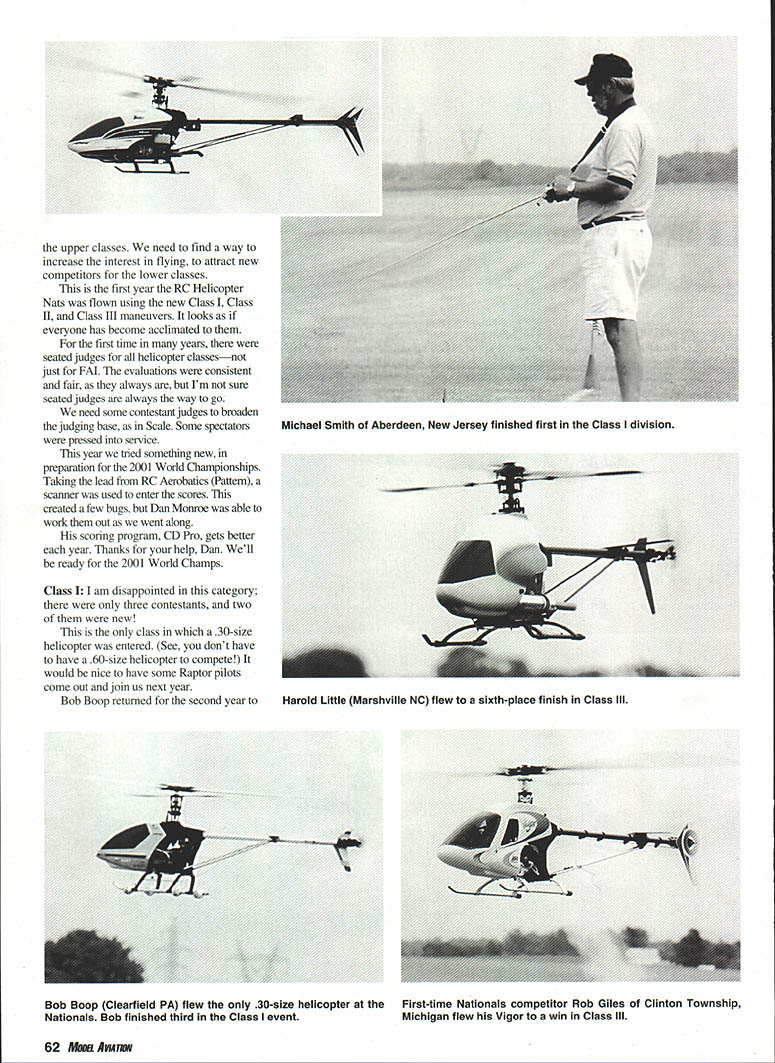
Bob Boop returned for the second year to compete with his .30-size helicopter, and he finished third. Mitch Davis took time from driving the World Wrestling Federation tour bus to compete and earn second place.
Mike Smith won this category. It was interesting to learn that he was an Air Cavalry pilot in Vietnam.
Class II
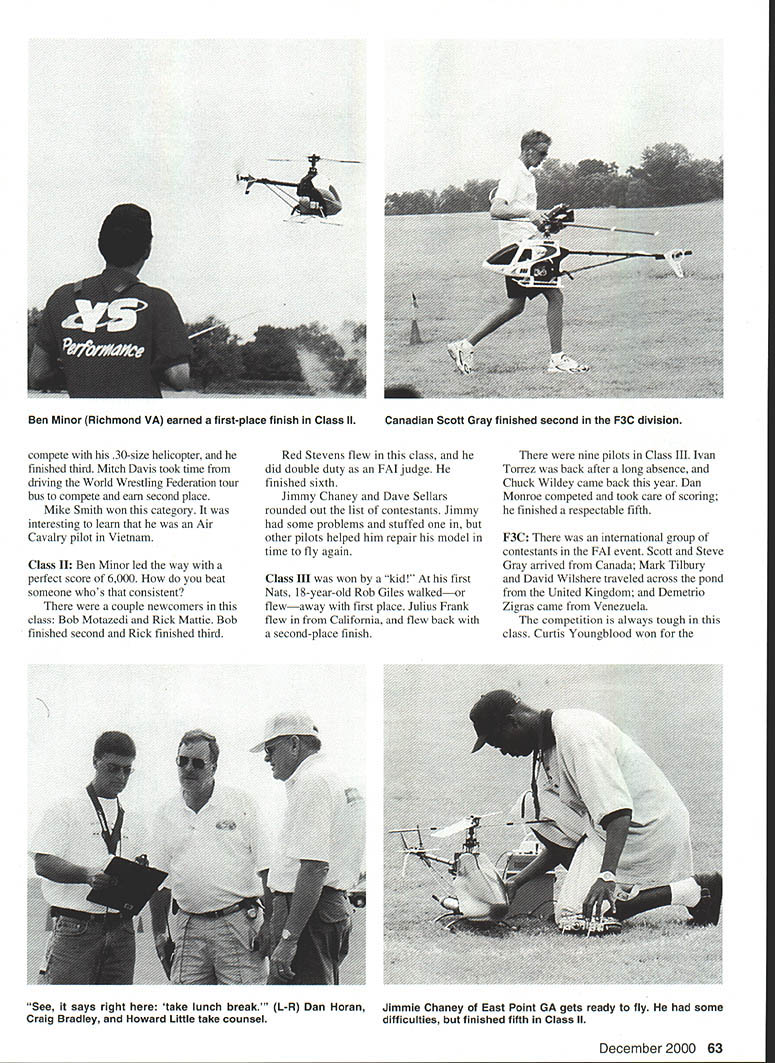
Ben Minor led the way with a perfect score of 6,000. How do you beat someone who's that consistent?
There were a couple newcomers in this class: Bob Motazed and Rick Mattie. Bob finished second and Rick finished third.
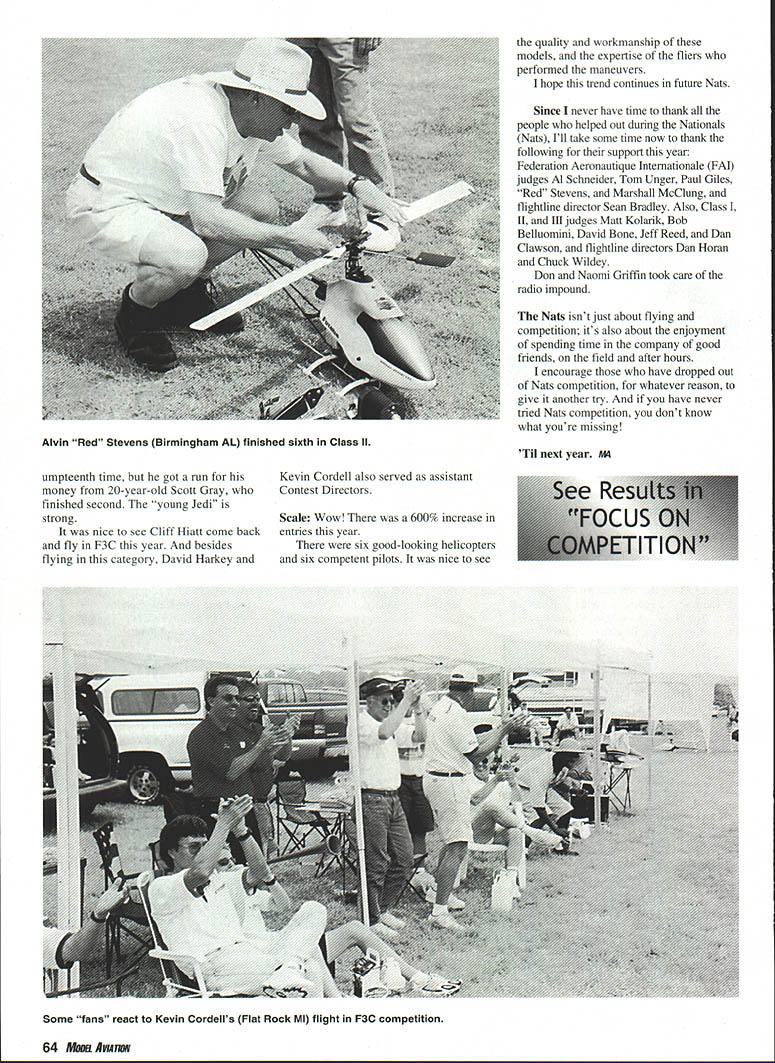
Red Stevens flew in this class, and he did double duty as an FAI judge. He finished sixth.
Jimmy Chaney and Dave Sellars rounded out the list of contestants. Jimmy had some problems and stuffed one in, but other pilots helped him repair his model in time to fly again.
Class III
Class III was won by a "kid!" At his first Nats, 18-year-old Rob Giles walked—or flew—away with first place. Julius Frank flew in from California and flew back with a second-place finish.
There were nine pilots in Class III. Ivan Torrez was back after a long absence, and Chuck Wildey came back this year. Dan Monroe competed and took care of scoring; he finished a respectable fifth.
F3C (FAI)
There was an international group of contestants in the FAI event. Scott and Steve Gray arrived from Canada; Mark Tilbury and David Wilshire traveled across the pond from the United Kingdom; and Demetrio Zigras came from Venezuela.
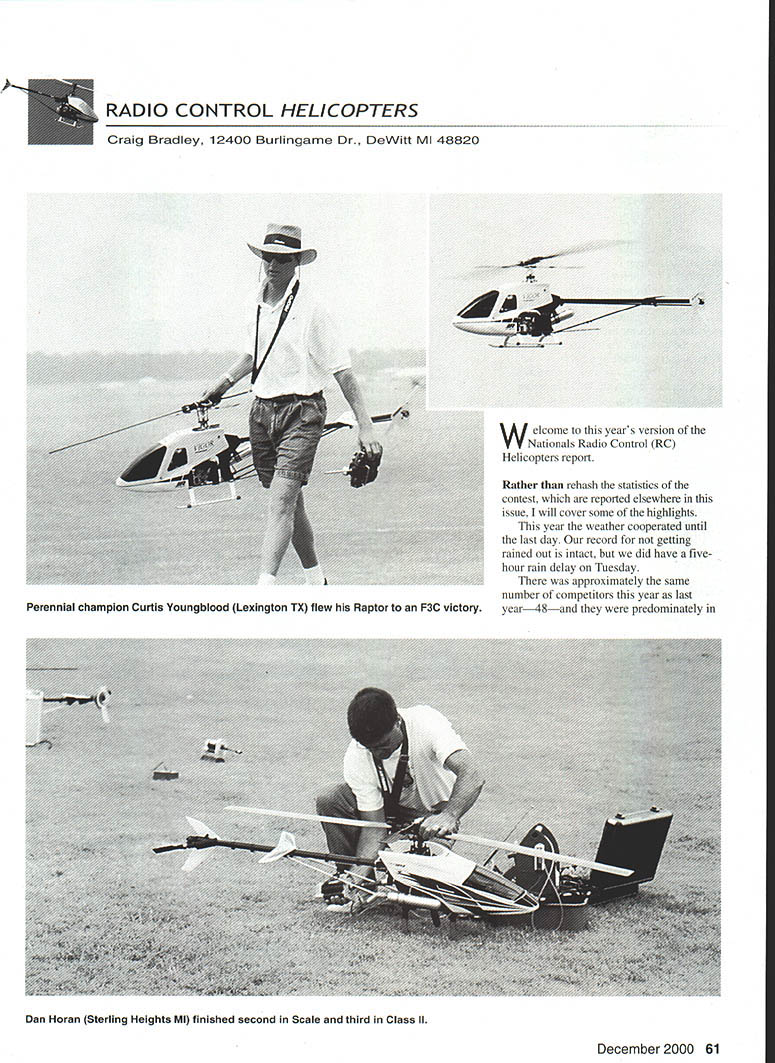
The competition is always tough in this class. Curtis Youngblood won for the third straight year. He was first in 1998 and 1999, too. His helicopter was a stock model, but tuned to perfection. Scott Gray finished second and Mark Tilbury third. Demetrio finished fourth.
It was the umpteenth time Curtis had won, but he got a run for his money from 20-year-old Scott Gray, who finished second. The "young Jedi" is strong.
It was nice to see Cliff Hiatt come back and fly in F3C this year. And besides flying in this category, David Harkey and Kevin Cordell also served as assistant contest directors.
Scale
Wow! There was a 600% increase in entries this year.
There were six good-looking helicopters and six competent pilots. It was nice to see the quality and workmanship of these models, and the expertise of the fliers who performed the maneuvers. I hope this trend continues in future Nats.
Acknowledgments
Since I never have time to thank all the people who helped out during the Nationals (Nats), I'll take some time now to thank the following for their support this year:
- FAI judges: Al Schneider, Tom Unger, Paul Giles, "Red" Stevens, and Marshall McClung
- Flightline director: Sean Bradley
- Class I, II, and III judges: Matt Kolarik, Bob Belluomini, David Bone, Jeff Reed, and Dan Clawson
- Flightline directors: Dan Horan and Chuck Wildey
- Don and Naomi Griffin: radio impound
- John and Mary Phalon: running the CD scoring
- Dan Monroe: assistance with scoring
The Nats isn't just about flying and competition; it's also about the enjoyment of spending time in the company of good friends, on the field and after hours.
I encourage those who have dropped out of Nats competition, for whatever reason, to give it another try. And if you have never tried Nats competition, you don't know what you're missing!
See you next year.
Transcribed from original scans by AI. Minor OCR errors may remain.

