
RC Helicopters
Craig Bradley, 12400 Burlingame Dr., DeWitt MI 48820
Welcome to the 2001 Radio Control Helicopters Nationals (Nats) contest report. I won't review the stats of each class because they are listed elsewhere in this issue; I'll just cover some of the highlights.
Our record for not being rained out is still intact, but it's a tad soggy. There was a five-hour "hold" the first day, waiting for the rain to stop before we even started flying the contest.
We also had to wait the second day, then we knocked off early while thunderstorms went through the area.
It's a scary thing, sitting inside that metal scoring trailer while a thunder and lightning storm rages outside, complete with 70 mph winds.
I hope to not have a chance to do that again.
There were 49 competitors this year, down slightly from past Nats.
For a change this year, there was an increase in pilots in Class I, with some first-time competitors. This is great! I hope it continues. And for the first time in years, new Juniors (15 years old and younger) and Seniors (16-19 years old) were competing in the lower classes. I hope this also continues; this is the way it should be.
There was an increase this year in competitors from the West Coast. Kevin Forsyth came in from British Columbia, and Chip Hyde (yes, RC Aerobatics flier Chip Hyde) brought some people with him from Arizona.
A couple of younger pilots from Las Vegas also joined us.
It's nice to see some attendees from the West Coast; there are times when I think this contest is just for those east to the Mississippi River. I hope this trend continues next year and into the future.
This year we went back to contestant judging for Classes I, II, III, and Scale. The pilots who were called to the judges' chairs did a very good job with consistent, fair judging.
This is a tough job to ask people to do, especially if they are also flying. Thanks to those pilots who took the challenge of doing both; we couldn't do it without you.
We still have a problem with getting good judges for Scale. It is really tough to ask competitors to bring these fine Scale machines and not have judges who are really competent to evaluate them.
We need to work on this situation before next year. If somebody out there would like to help with the Scale portion of the helicopter Nats, contact me so we can rectify the problem.
Class I: It was nice to see an increase in competitors for this category, with seven—two of which were "kids."
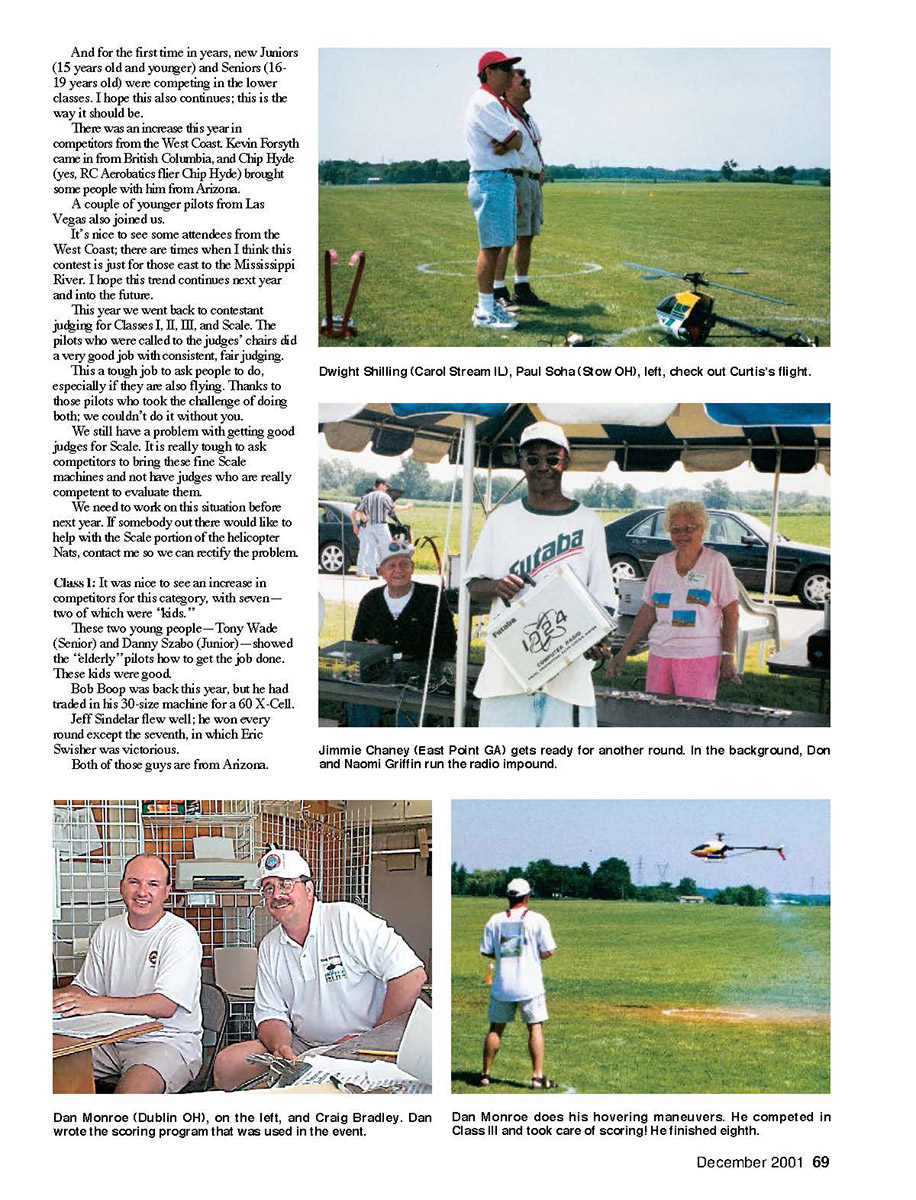
These two young people—Tony Wade (Senior) and Danny Szabo (Junior)—showed the "elderly" pilots how to get the job done. These kids were good.
Bob Boop was back this year, but he had traded in his 30-size machine for a 60 X-Cell.
Jeff Sindelar flew well; he won every round except the seventh, in which Eric Swisher was victorious.
Both of those guys are from Arizona. Maybe that's something to watch out for, or maybe it's because they can practice more often. No one knows, but it was nice to have them with us.
Todd Sheehan did a good job in his first Nats, and Michael Cross had a good start before he had to leave early.
Class II: Again, one of the "kids" prevailed: Alan Szabo, Danny's older brother, came away with a perfect score of 6,000 points. If Alan continues to fly this way, in the not-too-distant future he's going to be a force to reckon with in Class III.
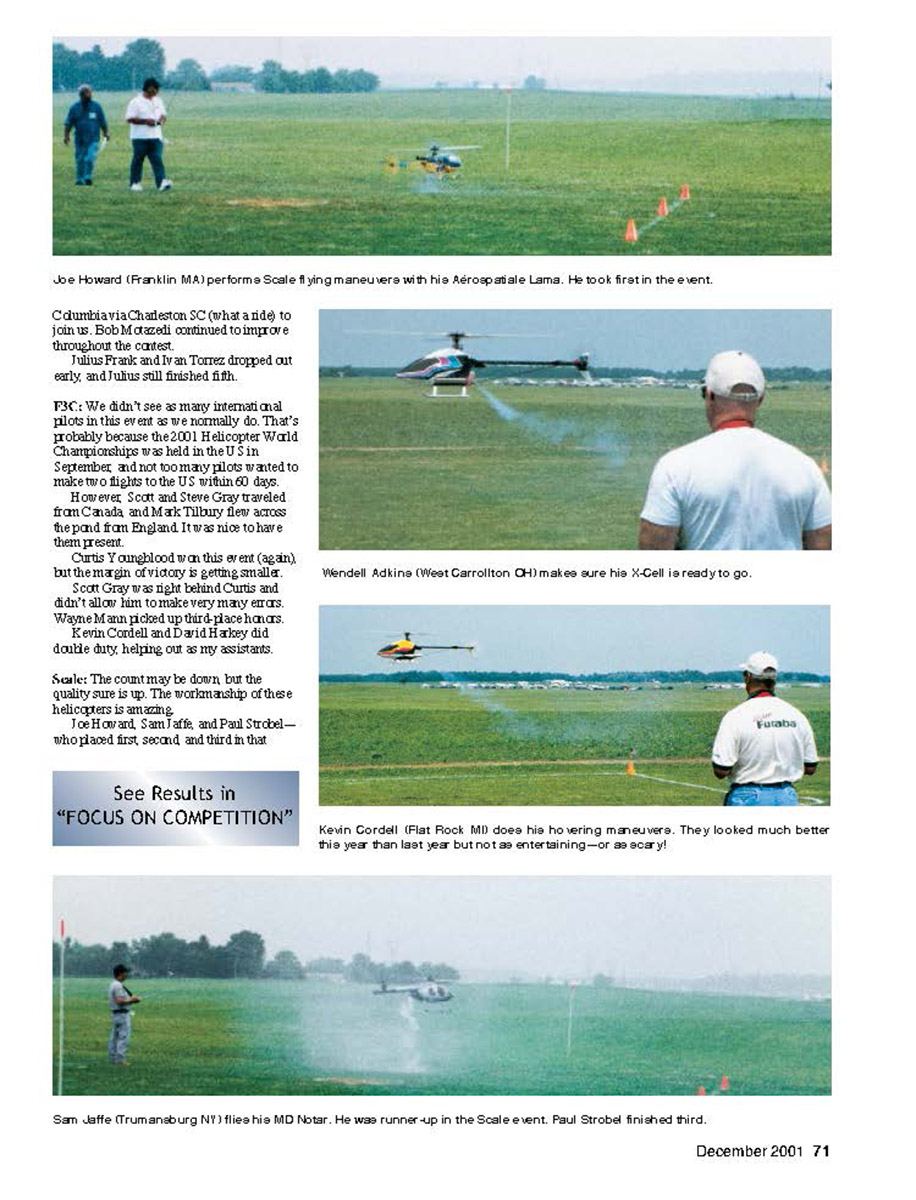
Jimmy Chaney continues to climb through the ranks in Class II, working steadily toward number one. Alex Arvizu, another one of the "Arizona 2," came in a close third.
Doug Trent took time out from flying the full-scale fixed wings for UPS to join us, finishing fourth.
Dave Seflasa (the 2001 F3C team manager), Mike Smith, and Jeff McPhail rounded out the list of competitors in Class II.
The only three (sore) helicopters came from this class. Jimmy Chaney, Mike Smith, and Jeff McPhail each put one in during the contest.
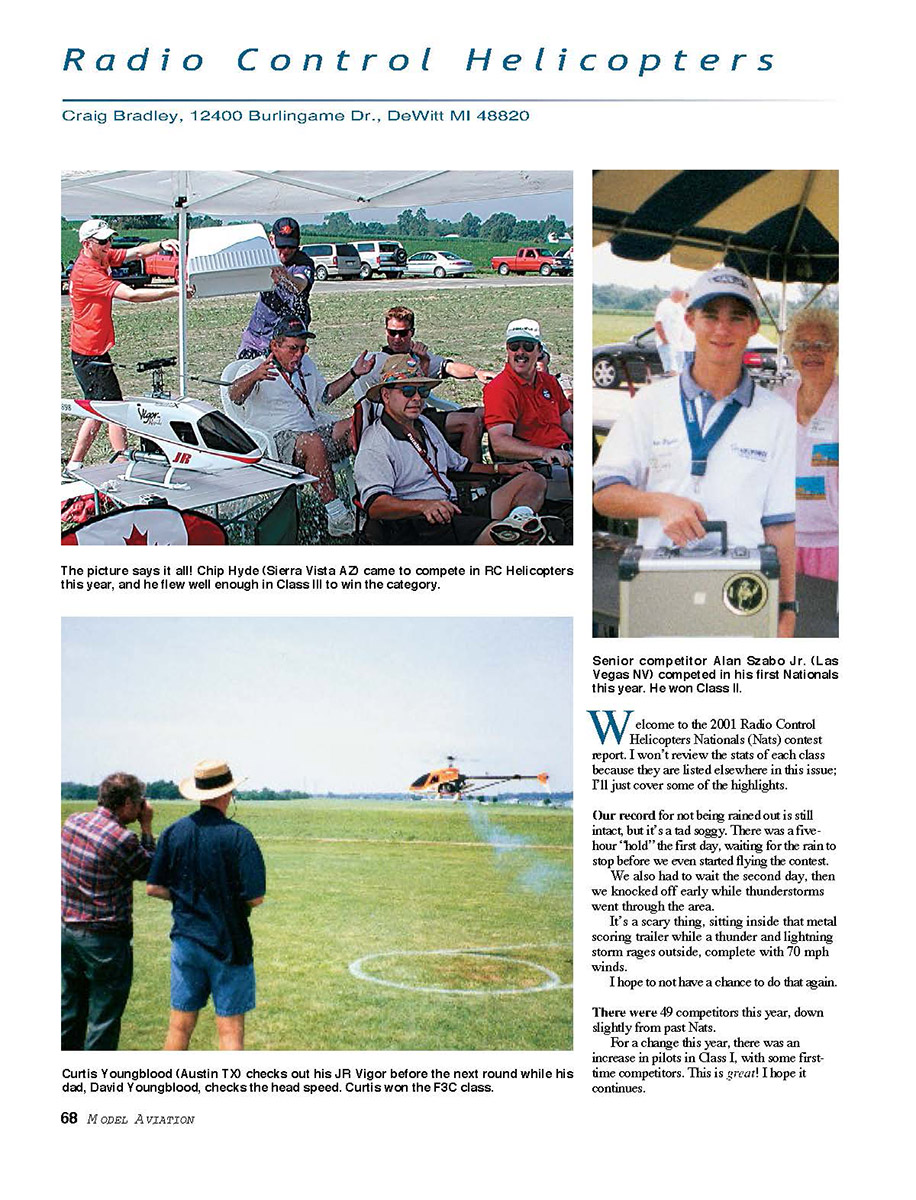
Class III: Chip Hyde came over from fixed-wing competition to join the great people who fly helicopters; he finished his first helicopter Nats in first place.
Chip wasn't too far ahead of last year's winner Rob Gilks (Senior) or recent move-up from Class II, Ben Minor; they finished second and third respectively.
Carey Shudey judged F3C and flew in this class. So did Dan Monroe, who did a great job keeping the scoring going. Dan Horan competed and kept the pilot's hopping as flight line director.
Dennis Purduski was back after taking a best year off. Kevin Forsyth flew in from British Columbia via Charleston SC (what a ride) to join us. Bob Motzaddi continued to improve throughout the contest.
Julius Frank and Ivan Torrez dropped out early, and Julius still finished fifth.
F3C: We didn't see as many international pilots in this event as we normally do. That's probably because the 2001 Helicopter World Championships was held in the U.S. in September, and not too many pilots wanted to make two flights to the U.S. within 60 days.
However, Scott and Steve Gray traveled from Canada, and Mark Tilbury flew across the pond from England. It was nice to have them present.
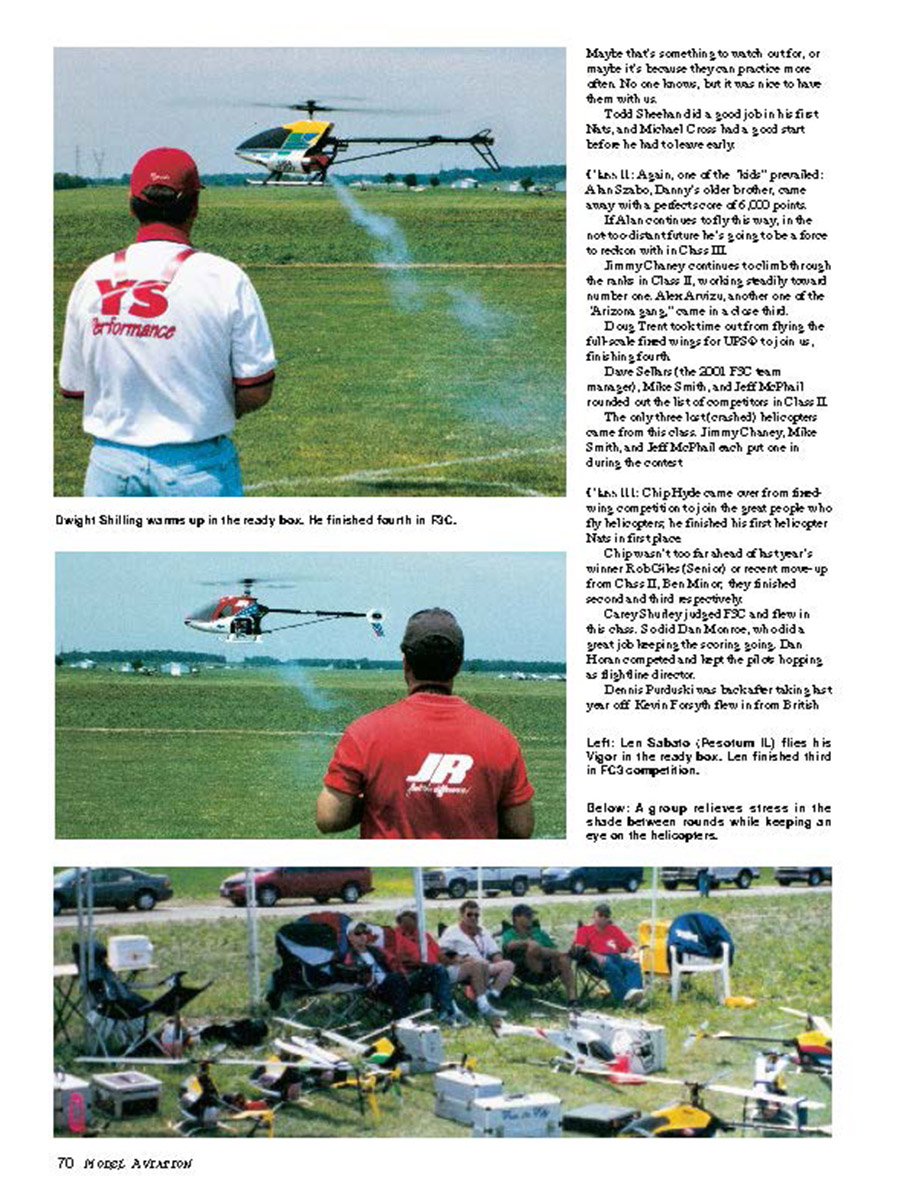
Curtis Youngblood won this event (again), then the margin of victory is getting smaller.
Scott Gray was right behind Curtis and didn't allow him to make very many errors. Wayne Mann picked up third-place honors.
Kevin Cordell and David Harkey did double duty, helping out as my assistants.
Scale: The count may be down, but the quality sure is up. The workmanship of these helicopters is amazing.
Joe Howard, Sam Jaffe, and Paul Strobel—who placed first, second, and third in that class—were outstanding.
Transcribed from original scans by AI. Minor OCR errors may remain.

