
Radio Control Helicopters
Craig Bradley, 12400 Burlingame Dr., Dewitt MI 48820
WELCOME TO THE 2002 Radio Control Helicopter Nationals (Nats) contest report. As I have done in past years, I won’t cover the stats (those are someplace else in this issue), I’ll just cover some of the highlights.
I don’t know how the folks at AMA do it, but the weather was great July 5-9. We were “rain-free” except for the last day, and even then it only held us up for approximately 45 minutes. In all the years I’ve been the event director, I don’t believe we have ever been rained out so that we couldn’t finish a contest. I sincerely hope this continues.
The number of entrants was down a little this year to 45, with two pilots competing in Scale and their regular classes. We maintained close to the same contestant count or a bit increase in participation in classes I, II, and III, and the pilot count for Fédération Aéronautique Internationale (FAI) was down.
We had one Junior (15 years and younger) and one Senior (16- to 19-year-olds) return for competition this year. These two “kids” are beginning to make a real impact. We need more of these young people getting involved in the competition scene. They are our future.
We continue to get a better turnout of contestants west of the Mississippi. I realize that it’s a hassle to get there, but I hope the trip was worth it and that they’ll join us again next year.
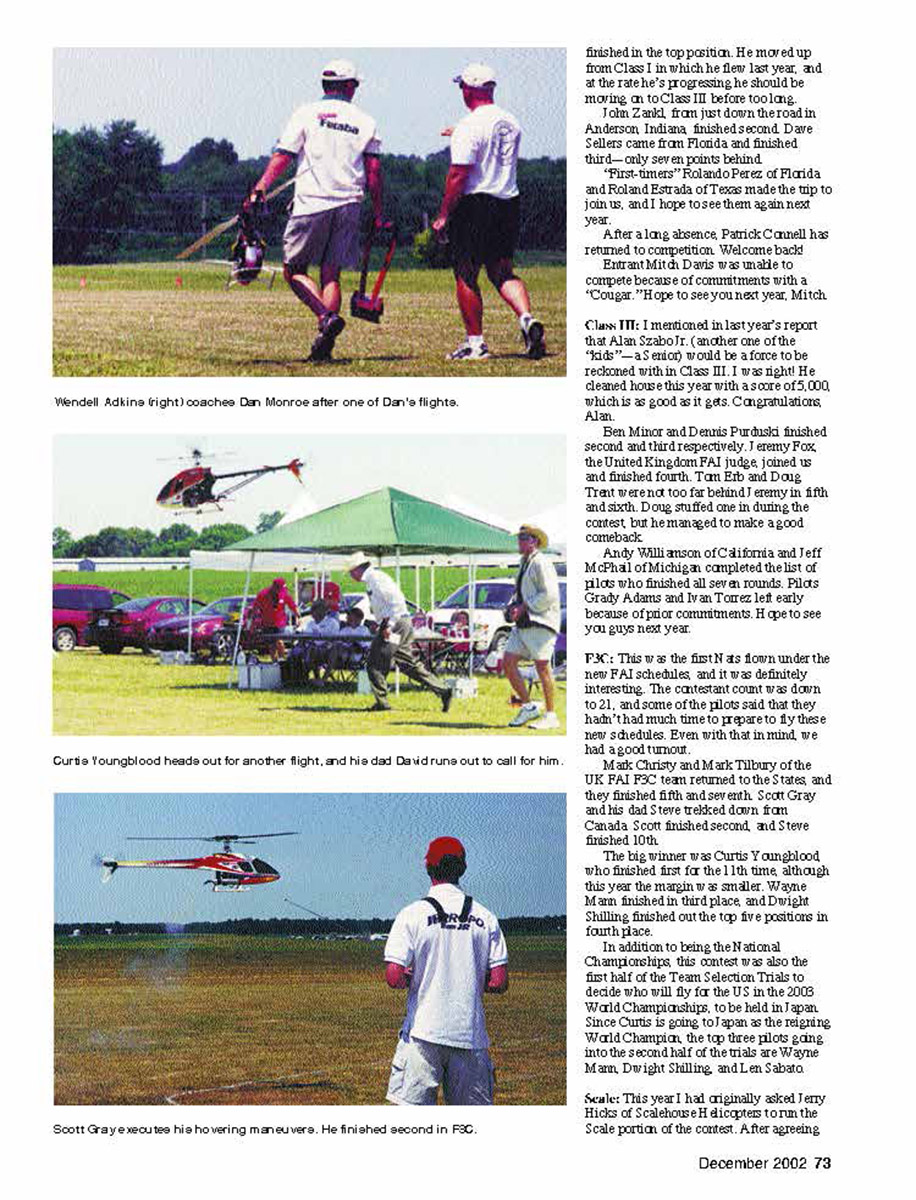
We used contestant judging for Classes I, II, and III and, as usual, the pilots who took their “duty” in the judge’s chairs did an admirable job; the judging was consistent and fair. All the pilots must be getting used to this type of judging because there were no real problems getting the chairs filled. It is still a tough job to ask pilots to do while they are maintaining focus on flying in their own classes. Without selfless people such as these, this contest couldn’t go on. I appreciate their efforts.
Scale judges Dave Davidson, Matt Kolank, and Gordie Meade did a superb job. It was nice to have judges with more Scale experience this year, and the scores showed it. There were no easy points awarded in this class, which is as it should be. Besides judging the static competition, they judged the flying portion of the contest. Thanks for the help, guys; it is appreciated.
On with the “meat” of the report.
Class I: The pilot count was down from seven to six this year but the quality of flying was certainly up. Mike Reed, who was a new contestant this year, came out the winner, and Junior Danny Szabo was only 42 normalized points behind. I pointed out that the “kids” are getting better. Danny finished fifth in Class I last year, and he continues to improve.
First-time competitors Terry Thomas and Ron Cummins came up from Alabama to compete, and they finished third and fourth respectively. I hope they come back next year. Bob Boop and Paul Strobel rounded out the class as they continue to improve.
Noticeably absent this year was Jimmie Chaney, who was last year’s second-place finisher. finished in the top position. He moved up from Class I in which he flew last year, and at the rate he's progressing he should be moving on to Class III before too long. John Zanki, from just down the road in Anderson, Indiana, finished second. Dave Sellers came from Florida and finished third—only seven points behind.
"First-timers" Rolando Perez of Florida and Roland Estrada of Texas made the trip to join us, and I hope to see them again next year.
After a long absence, Patrick Connell has returned to competition. Welcome back! Entrant Mitch Davis was unable to compete because of commitments with a "Cougar." Hope to see you next year, Mitch.
Class III: I mentioned in last year's report that Alan Szabo Jr. (another one of the "kids"—a senior) would be a force to be reckoned with in Class III. I was right! He cleaned house this year with a score of 5,000, which is as good as it gets. Congratulations, Alan.
Ben Minor and Dennis Purduksi finished second and third respectively. Jeremy Fox, the United Kingdom FAI judge, joined us and finished fourth. Tom Erb and Doug Treat were not too far behind. Jeremy in fifth and sixth. Doug stuffed one in during the contest, but he managed to make a good comeback.
Andy Williamson of California and Jeff McPhail of Michigan completed the list of pilots who finished all seven rounds. Pilots Grady Adams and Ivan Torres left early because of prior commitments. Hope to see you guys next year.
F3C: This was the first Nats flown under the new FAI schedules, and it was definitely interesting. The contestant count was down to 21, and some of the pilots said that they hadn't had much time to prepare to fly these new schedules. Even with that in mind, we had a good turnout.
Mark Christy and Mark Trilby of the UK FAI F3C team returned to the States, and they finished fifth and seventh. Scott Gray and his dad Steve trekked down from Canada. Scott finished second, and Steve finished 10th.
The big winner was Curtis Youngblood who finished first for the 11th time, although this year the margin was smaller. Wayne Mann finished in third place, and Dwight Shilling finished out the top five positions in fourth place.
In addition to being the National Championships, this contest was also the first half of the Team Selection Trials to decide who will fly for the US in the 2003 World Championships to be held in Japan. Since Curtis is going to Japan as the reigning World Champion, the top three pilots going into the second half of the trials are Wayne Mann, Dwight Shilling, and Len Sabato.
Scale: This year I had originally asked Jerry Hicks of Scalehouse Helicopters to run the Scale portion of the contest. After agreeing
RC Helicopters
There is no continuance of the main article text on this scanned page. The page contains only photographs and their captions; no additional article paragraphs follow the prior page's text. to take on this challenge, Jerry got his long-sought-after promotion, which meant that he needed to move to another state. No problem, except that he needed to be there the day the Nats started.
At the last minute International Radio Controlled Helicopter Association President Ron Kummer stepped up and took over to run the contest. He did an excellent job of keeping things going and trying to keep all three competitors happy.
Yup, three pilots. We are still having a problem getting Scale fliers to join us.
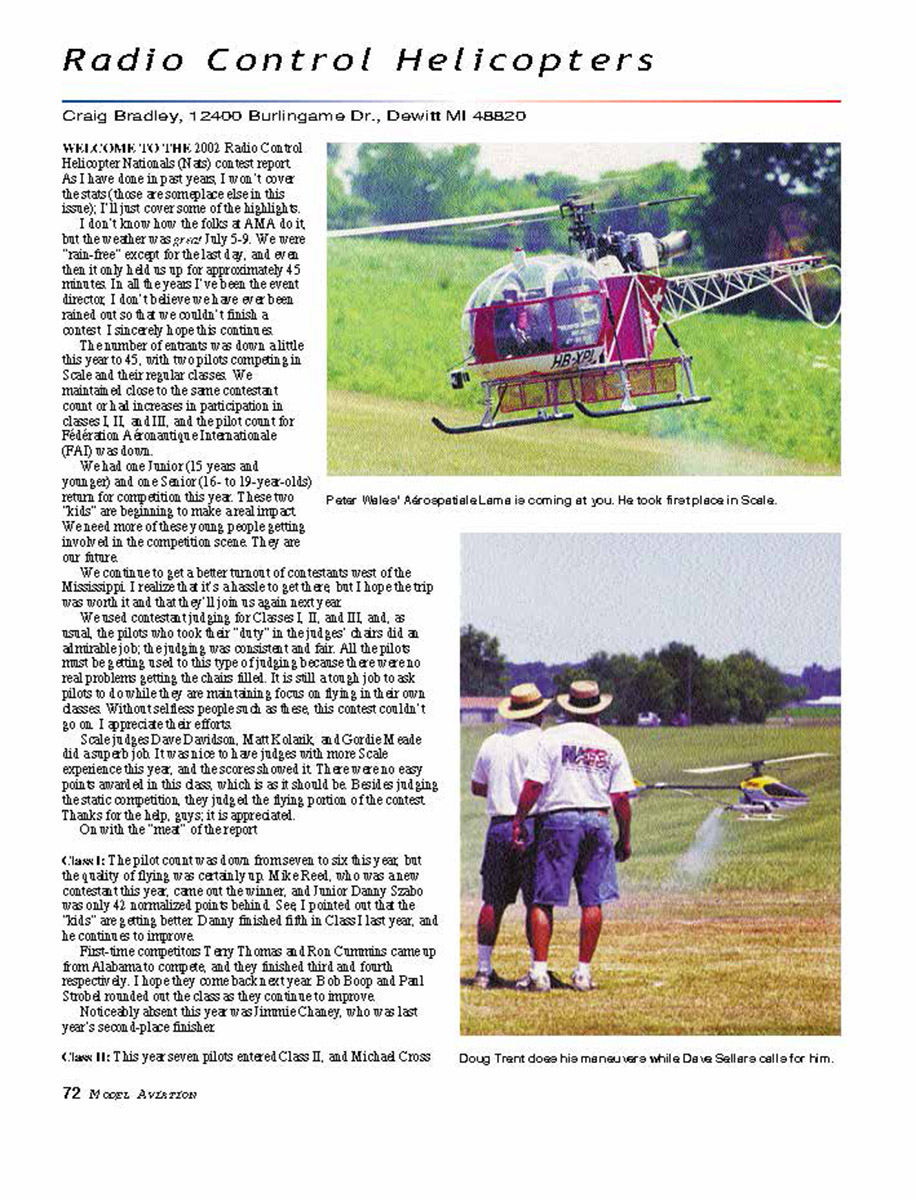
Those who did compete—Peter Wales, Alan Szabo, and Paul Strobel—finished first, second, and third respectively.
You would need to see Peter’s Aerospatiale Lama in person to really appreciate it because the quality is superb.
Another point worth mentioning is Alan Szabo’s flying maneuvers; he flew the pants off everyone there. If it weren’t for the exhaust smoke, a person would be hard-pressed to tell the difference between his Bell 222 and the full-scale helicopter.
You guys should all come back next year and bring some more entries.
As usual, I let the people who make the contest work get away without thanking them properly. This is my chance to thank them for giving so graciously of their time so that others could compete and enjoy flying.
Thanks to Kevin Cordell and David Harkey, my assistant event directors, who helped keep things rolling along. Thanks also to the FAI judges: “Red” Stevens, Tom Unger, and Don Wade, who put in long hours but did a great job of fair and consistent scoring.
I can’t forget Flightline Directors Tom Johnson and Sean Bradley. They kept the flow of pilots going. Tom just came to watch, and I put him to work. Thanks, Tom. Special thanks to those who staffed the radio impound: Don and Naomi Griffin. We couldn’t do the Nats without them. Thanks to Dan Monroe, whose scoring program (CD Pro) continues to improve with each contest.
These people make the Helicopter Nats happen. As contest director, I only keep an eye on things and get the credit for doing a good job.
Finally, I need to thank the competitors and spectators, all of whom stepped up to help out where needed to ensure that the contest went smoothly. Without everyone’s help, this event couldn’t have taken place.
The Nats is more than competition and flying; it’s also a chance to spend time with good friends at the field as well as after-hours. If you haven’t competed at the Nats, you owe it to yourself to give it a try. And if for some reason you have dropped out of Nats competition, come back and give it another shot. You don’t know what you’re missing.
If I have missed someone or something, I apologize. I’ll try again next year. MA
See results in “Focus on Competition”
Transcribed from original scans by AI. Minor OCR errors may remain.

