
SAM Champs 2004
by Charlie Reich
Background
This was the 38th year that the old-timers—men and models—gathered in early September for the Society of Antique Modelers (SAM) annual SAM Championships—an event based on the original Nationals held during the Golden Age of model aviation in the 1930s. The 2004 SAM Champs was held at the AMA flying site in Muncie, Indiana.
In the 1920s and early 1930s, contests were for gliders or rubber-powered models. In 1933, 18-year-old Maxwell Bassett entered a Mulvihill (rubber-model) contest with his schoolmate Bill Brown. Chaos erupted when Bill fired up a gas engine he had designed and built. The model Max designed, "Miss Philadelphia," was huge compared to the surrounding rubber-powered airplanes. There were no rules then concerning anything other than rubber-powered models, but officials reluctantly allowed the flight. Miss Philadelphia won the 1933 New York Nationals Mulvihill event with a 14:44 flight time. This was the first gas-powered aircraft to surprise the modeling fraternity and helped start the gas-model revolution in the USA.
The treasured "Miss Philly," designated B-111 on the tail and fitted with the Brown Jr. .60 ignition engine, is on display in the AMA National Model Aviation Museum. Maxwell Bassett—SAM member number 2—remains an active member.
The Event: SAM Champs 2004
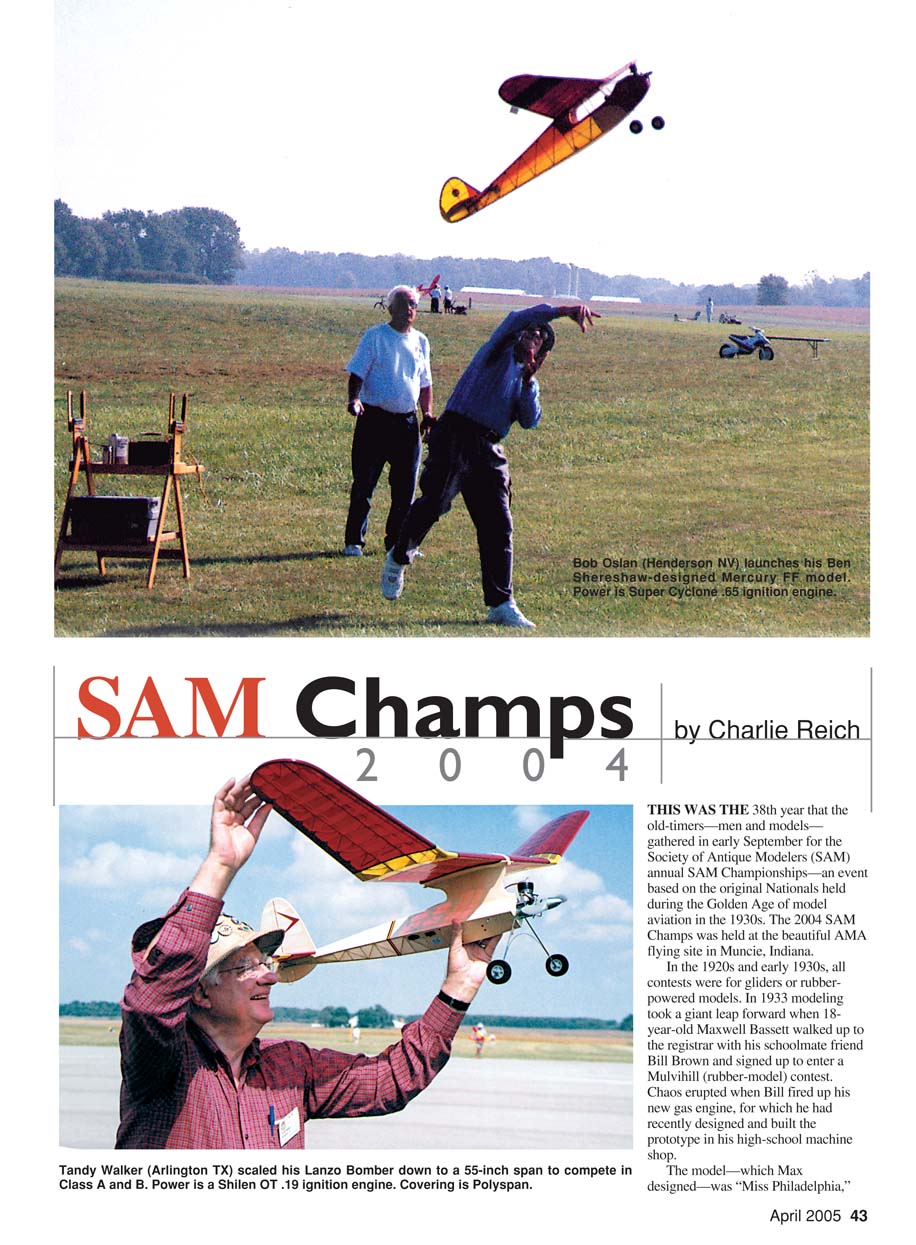
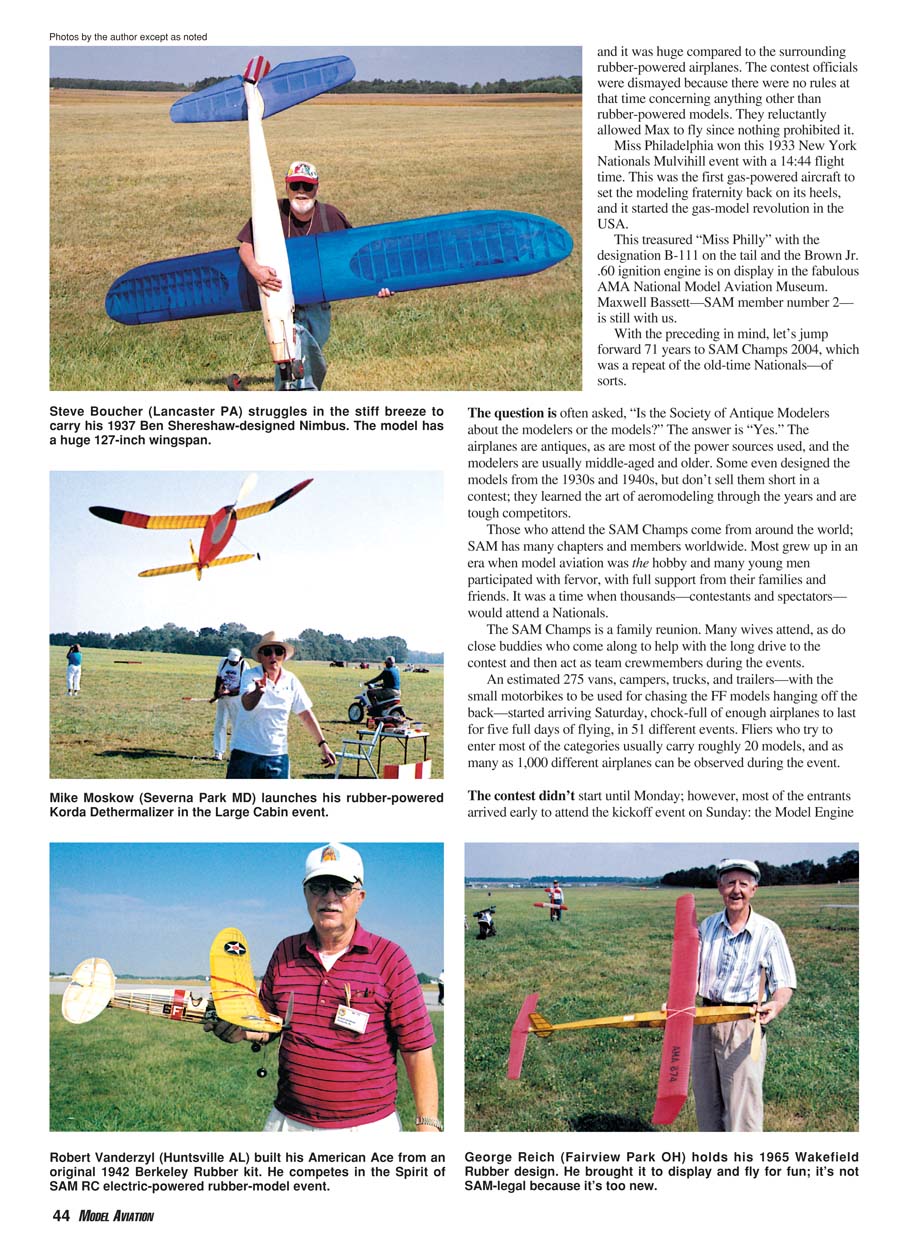
SAM Champs 2004 was a repeat, in spirit, of the old-time Nationals. The question often asked is, "Is the Society of Antique Modelers about the modelers or the models?" The answer is both. The airplanes and most power sources are antiques, and the modelers are usually middle-aged and older. Some attendees even designed the original 1930s–1940s models, and they remain fierce competitors. SAM draws participants worldwide.
Most grew up in an era when model aviation was a major hobby, supported by family and community. The SAM Champs is like a family reunion: many wives attend and close buddies help with the long drives and act as crewmembers. An estimated 275 vans, campers, trucks, and trailers—often with small motorbikes for chasing free-flight models—arrived Saturday, laden with enough airplanes for five days of flying across 51 events. Fliers who enter many categories typically bring roughly 20 models; observers may see as many as 1,000 different airplanes during the event.
Most entrants arrived early to attend the kickoff event on Sunday: the Model Engine Collectors Association (MECA) swap meet. Tables featured old-time ignition engines such as:
- Ardens
- Bantams
- Brown Jr.'s
- Ohlssons
- Super Cyclones
- McCoys
- Scores of other brands
Many were reasonably priced for antiques and often in excellent running condition. Some original ignition engines were even available new in the box. MECA is a major source of old, original ignition engines for SAM members.
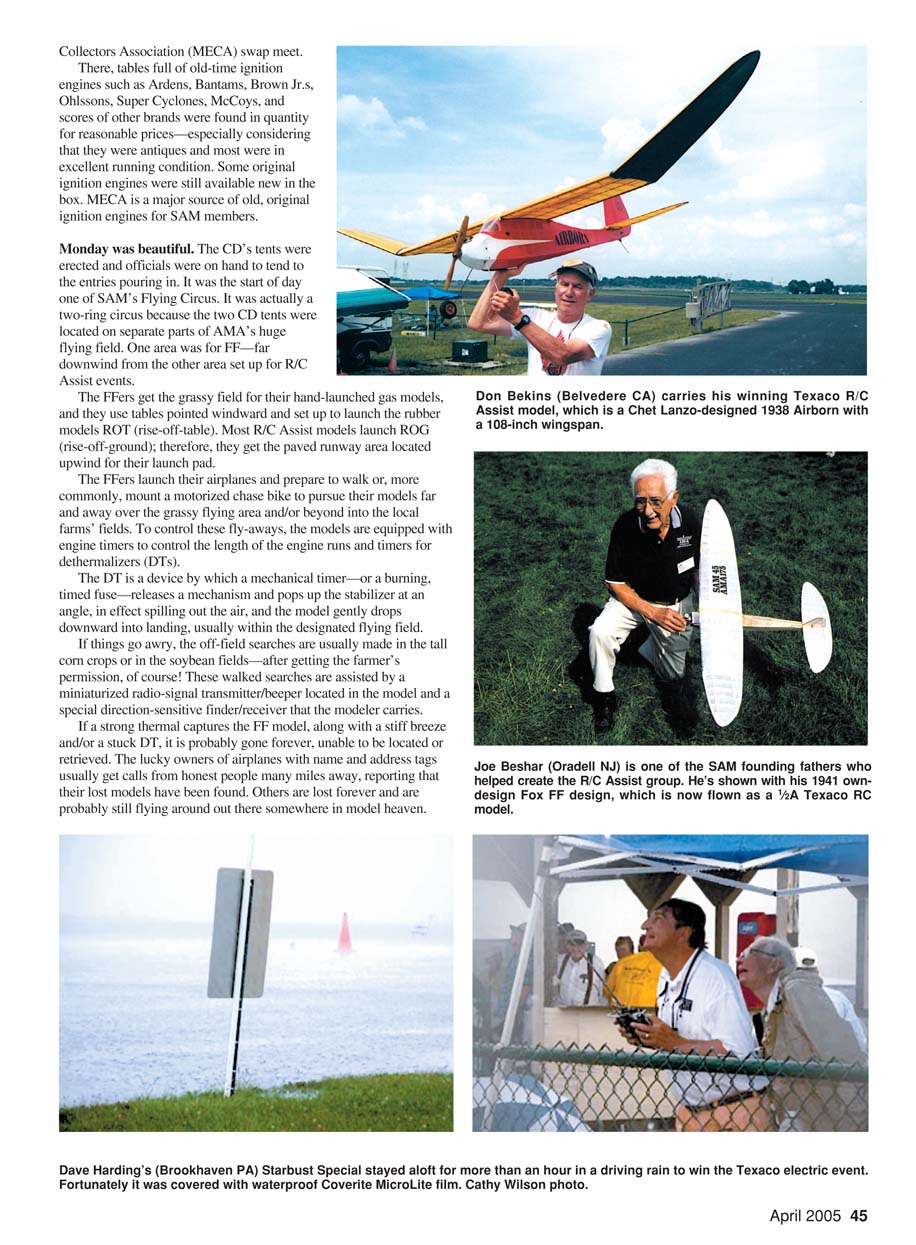
Monday was beautiful. Contest director tents were erected and officials handled entries as the flying began. The Champs operates as a two-ring "Flying Circus": one area for free flight (FF) and a separate area for R/C Assist events.
Field Layout and Launch Types
- FF models use the grassy field, launch by hand, and often use late posts pointed windward for rubber models to rise off table (ROT).
- R/C Assist models generally launch rise-off-ground (ROG) from the paved runway area upwind and have a designated grass landing area roughly half the size of a football field.
FF flyers launch their airplanes and then walk or ride motorized chase bikes to pursue models over the grassy area and into nearby farmland. To control fly-aways, models use engine timers and dethermalizers (DTs). The DT is a timer or burning fuse that releases a mechanism to pop up the stabilizer, spilling air so the model gently descends into the flying field.
If models go off-field, searches are often conducted in corn or soybean fields (after the farmer's permission). Searches are assisted by miniature radio beepers and direction-sensitive receivers carried by modelers. Strong thermals, stiff breeze, or stuck DTs can make a model unrecoverable. Models with name-and-address tags sometimes get returned by honest finders many miles away.
R/C Assist pilots are given a marked landing area; missing the mark results in a zero score. These pilots climb their models high to search for a strong thermal—often allowing models too far downwind and risking a zero score.
Events and Classes
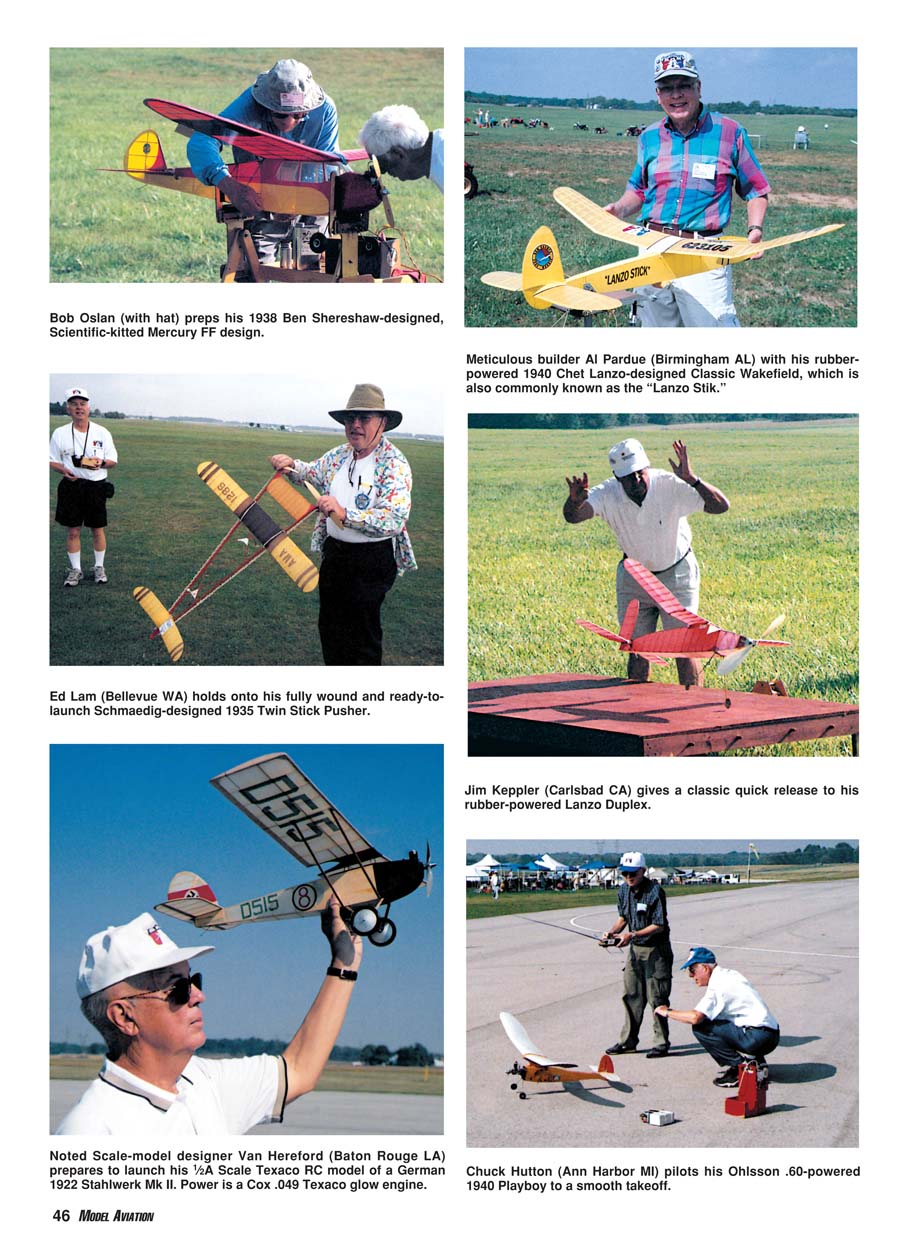
There are five FF events per day (including gas- and rubber-powered categories, Catapult Glider, and Hand Launched Glider) and five R/C Assist events per day. Examples of R/C Assist categories include:
- Ignition engine events
- Glow engine events
- Brown Jr. engine events
- Cox .049 engine events
- 1/2A Texaco
- Ohlsson .23 and .60 events
- Fox .35 glow engines
- Electric power
- Smaller rubber-powered designs with electric power and micro RC
- Towline Gliders
- Nostalgia events
Engine-size-class events are mixed with divisions A (up to .19), B (up to .29), and C (.30 and up) in both FF and RC, producing a large volume of flying activity.
FF vs R/C Assist: Traditions and Innovations
FF retains traditional old-time modeling rules, materials, and power plants—basically the same as in the 1930s and 1940s. Modern innovations in FF are minimal, limited mainly to built-in radio trackers for lost models. Typical characteristics:
- Rubber-powered models use tissue covering and nitrate dope, with carved-balsa propellers.
- FF gas models use silk or silkspan coverings and avoid modern plastic coverings.
- Glow engines and electric power are not allowed in FF (not used prior to 1942).
FF models are trimmed for a perfect uncontrolled climb, transition to a flat circling glide at engine shutoff, and to find thermals. The DTs then allow controlled descents inside the field.
R/C Assist was created in 1971 to incorporate multichannel RC into SAM while keeping old-time modeling spirit. Rules were adapted to allow glow engines and, later, modern covering materials in RC classes. As RC and electric micro-technology advanced, SAM introduced events for electric-powered old-timers and for rubber models converted to RC electric power—popular as small park flyers.
Contest Format and Scoring
- Events are climb-and-glide; scores are 1 point per second of flight time.
- Flight time starts at release for immediate takeoff and ends when the model touches the ground.
- Each event (except Texaco) has a maximum flight time (typically 3–15 minutes depending on event and wind). Scores use the total of official flights, usually with three maxes required.
- Texaco scoring is based on the longest flight, which can be an hour or more.
- Ties are settled by flyoffs; the contestant with the most total time in the air wins the tiebreaker.
Social Activities
SAM is about fun and fellowship. During the contest the wives have their own events:
- Tuesday: handicraft show
- Wednesday: chartered bus tour of Amish country (41 women attended)
Evening events across the five contest days included:
- Sunday: president's reception
- Monday: bean feed
- Tuesday: SAM swap meet and Concours event (awards for best-displayed models)
- Thursday: members' meeting
- Friday: banquet and awards ceremony
Looking Ahead and Membership
The group was tired but excited after the event and welcomed the announcement that SAM Champs 2005 would be held in Las Vegas, Nevada. There are thousands of rubber-power designs and more than 900 pre-1943 gas-model designs to choose from. Plans, custom-cut kits, and laser-cut kits with CAD-drawn parts are available, and many plans include RC modification guidance.
If you are interested in SAM, request a free SAM Introductory Packet by mail or email:
- Mail: SAM, Box 860236, Saint Augustine, FL 32086
- Email: [email protected]
The free packet includes a brochure, SAM charter list, source list for components, and a complimentary copy of SAM Speaks (a full-color, bimonthly members' magazine). To join immediately, send your information and $25 for a full year's membership.
Charlie Reich 310 Wisteria Rd. Saint Augustine, FL 32086
Transcribed from original scans by AI. Minor OCR errors may remain.

