
Trimming From the Ground Up Part 1
by Dean Pappas
YOU LEARN a lot from watching what happens at the flying field on a Sunday afternoon and even more from the beginners. You learn what the basic flying skills really are and, most important, you see the beginners struggling with their trainers' shortcomings.
In all fairness, even the best of these designs are often built (or assembled from ARF kits) by inexperienced enthusiasts. It would be almost impossible for it to be any other way!
So much hard-earned experience goes into building a well-behaved RC airplane, more goes into installing the mechanical and electronic systems, and even more goes into adjusting or trimming for best flight performance. The purpose of this "From the Ground Up" installment is to make it easier to gather that knowledge and experience.
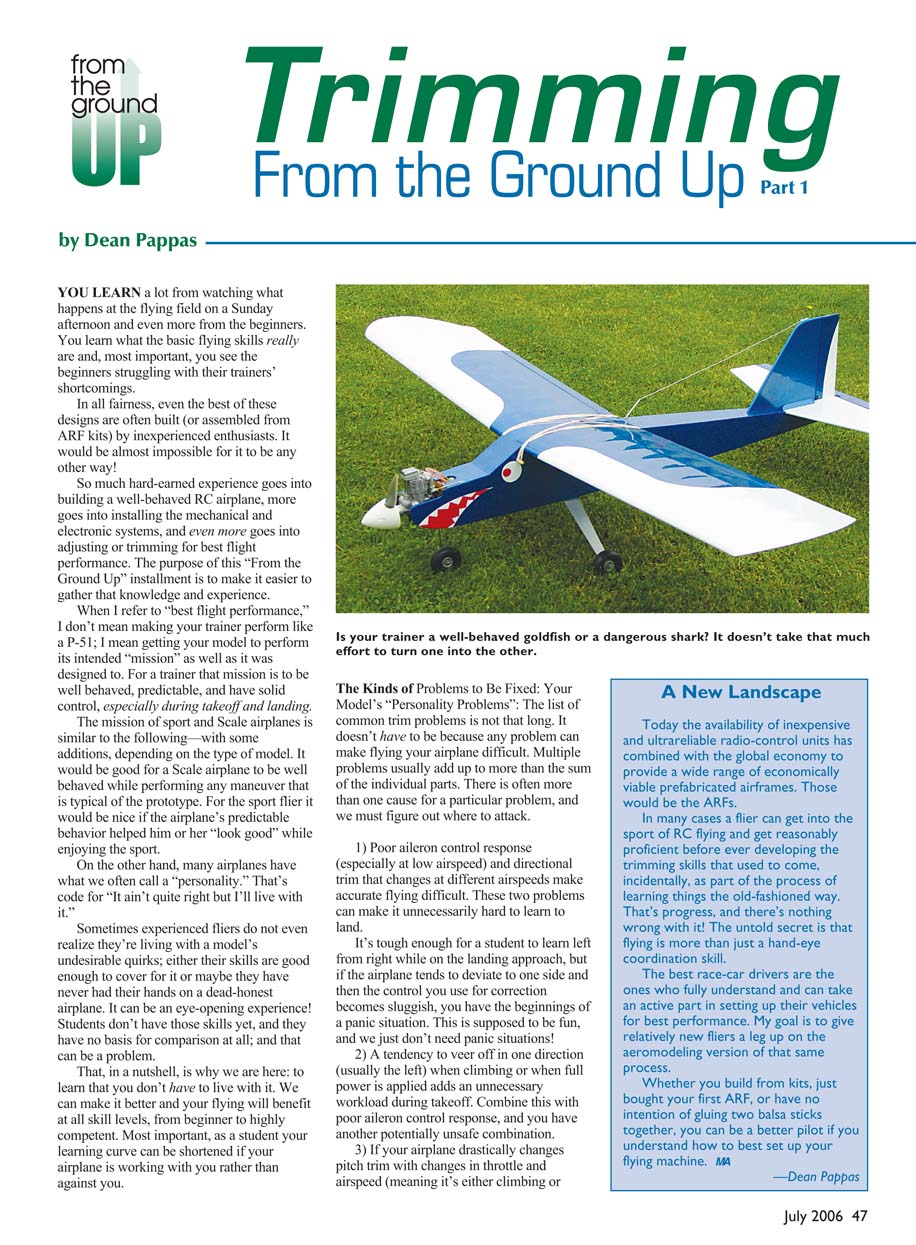
When I refer to "best flight performance," I don't mean making your trainer perform like a P-51; I mean getting your model to perform its intended "mission" as well as it was designed to. For a trainer that mission is to be well behaved, predictable, and have solid control, especially during takeoff and landing.
The mission of sport and scale airplanes is similar, with some additions depending on the type of model. It would be good for a scale airplane to be well behaved while performing any maneuver that is typical of the prototype. For the sport flier it would be nice if the airplane's predictable behavior helped him or her "look good" while enjoying the sport.
On the other hand, many airplanes have what we often call a "personality." That's code for "It ain't quite right but I'll live with it."
Sometimes experienced fliers do not even realize they're living with a model's undesirable quirks; either their skills are good enough to cover for it or maybe they have never had their hands on a dead-honest airplane. It can be an eye-opening experience!
Students don't have those skills yet, and they have no basis for comparison at all; and that can be a problem.
That, in a nutshell, is why we are here: to learn that you don't have to live with it. We can make it better and your flying will benefit at all skill levels, from beginner to highly competent. Most important, as a student your learning curve can be shortened if your airplane is working with you rather than against you.
The Kinds of Problems to Be Fixed: Your Model's "Personality Problems"
The list of common trim problems is not that long. It doesn't have to be because any problem can make flying your airplane difficult. Multiple problems usually add up to more than the sum of the individual parts. There is often more than one cause for a particular problem, and we must figure out where to attack.
- Poor aileron control response (especially at low airspeed) and directional trim that changes at different airspeeds make accurate flying difficult. These two problems can make it unnecessarily hard to learn to land.
- It's tough enough for a student to learn left from right while on the landing approach, but if the airplane tends to deviate to one side and the other control you use for correction becomes sluggish, you have the beginnings of a panic situation.
- A tendency to veer off in one direction (usually the left) when climbing or when full power is applied adds an unnecessary workload during takeoff. Combine this with poor aileron control response, and you have another potentially unsafe combination.
- If your airplane drastically changes pitch trim with changes in throttle and airspeed (meaning it's either climbing or diving without elevator input), it's a problem that can lead to a loss of airspeed and control at the wrong time. This can combine with both of the preceding to create even bigger problems.
- Depending on the airplane's mission, we often intentionally set it up to climb with full throttle (but not too steeply), to maintain level flight at cruise power (maybe a bit more than half throttle), and to finally descend at a gentle glide slope (with enough airspeed for good control) at a fast idle.
- If the airplane does not settle into a predictable glide slope when the throttle is reduced, this can add to the pilot's workload during final approach and landing. A proper glide has a predictable sink rate that is just steep enough to maintain adequate airspeed for good control, but it is not so steep or so fast that it makes it hard to get the airplane to settle to the ground in the flare.
- The flare is the last portion of the landing, in which up-elevator is added to almost stop the descent rate and bleed off the last bit of excess airspeed. This makes the model touch down in a three-point attitude for taildraggers or with the main gear first and the nose wheel an inch off the ground for tricycle-geared models.
- If the glide is too shallow, the airplane will mush along with the nose up and with low airspeed, leading to poor directional control authority. This often leads to the problems in item 1. You will often find experienced pilots landing a particular airplane "hot," or fast, every time because the model has a controllability problem at low speed.
A New Landscape
Today the availability of inexpensive and ultrareliable radio-control units has combined with the global economy to provide a wide range of economically viable prefabricated airframes—those would be the ARFs.
In many cases a flier can get into the sport of RC flying and get reasonably proficient before ever developing the trimming skills that used to come, incidentally, as part of the process of learning things the old-fashioned way. That's progress, and there's nothing wrong with it! The untold secret is that flying is more than just a hand–eye coordination skill.
The best race-car drivers are the ones who fully understand and can take an active part in setting up their vehicles for best performance. My goal is to give relatively new fliers a leg up on the aeromodeling version of that same process.
Whether you build from kits, just bought your first ARF, or have no intention of gluing two balsa sticks together, you can be a better pilot if you understand how to best set up your flying machine.
The Short List
- CG location or balance point (fore and aft, and from side to side).
- Aileron differential.
- Proper hinge gaps—especially the ailerons and elevator.
- Engine-thrust adjustment (downthrust and right thrust).
- Landing-gear location and steering.
It doesn't sound like much, but assuming that your airplane is a known good design this is pretty much it.
Wing and horizontal-tail incidence angles can also cause problems if they are wrong. However, for the purposes of this article we will assume that you have built the airplane according to plan and the flying-surface angles are correct.
We will also assume that the vertical fin has been glued on straight. Yes, if your problem-child airplane looks like it was made in a pretzel factory, we can help it some—but not completely.
The Pitch-Control Balancing Act
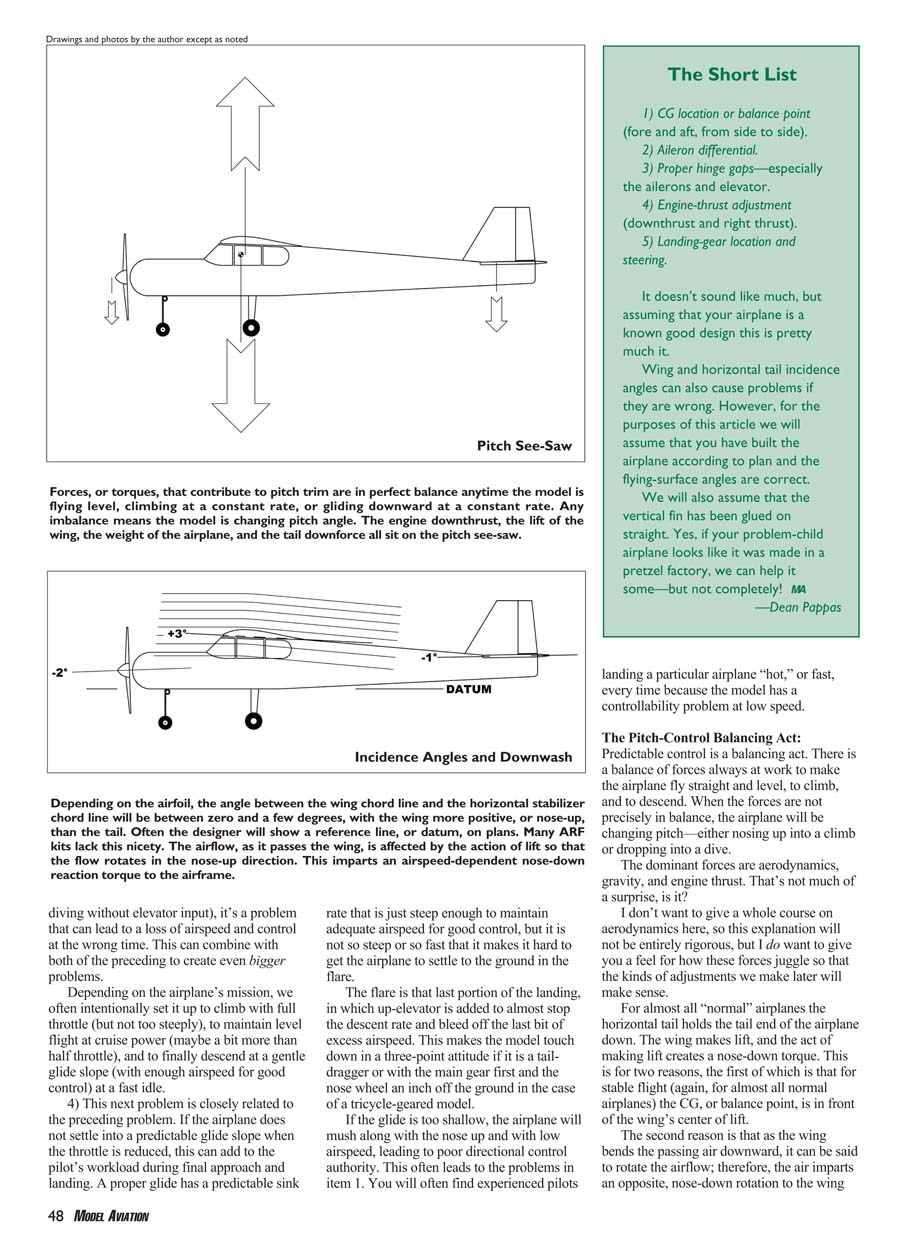
Predictable control is a balancing act. There is a balance of forces always at work to make the airplane fly straight and level, to climb, and to descend. When the forces are not precisely in balance, the airplane will be changing pitch—either nosing up into a climb or dropping into a dive.
The dominant forces are aerodynamics, gravity, and engine thrust.
For almost all "normal" airplanes the horizontal tail holds the tail end of the airplane down. The wing makes lift, and the act of making lift creates a nose-down torque. This is for two reasons:
- For stable flight the CG, or balance point, is in front of the wing's center of lift.
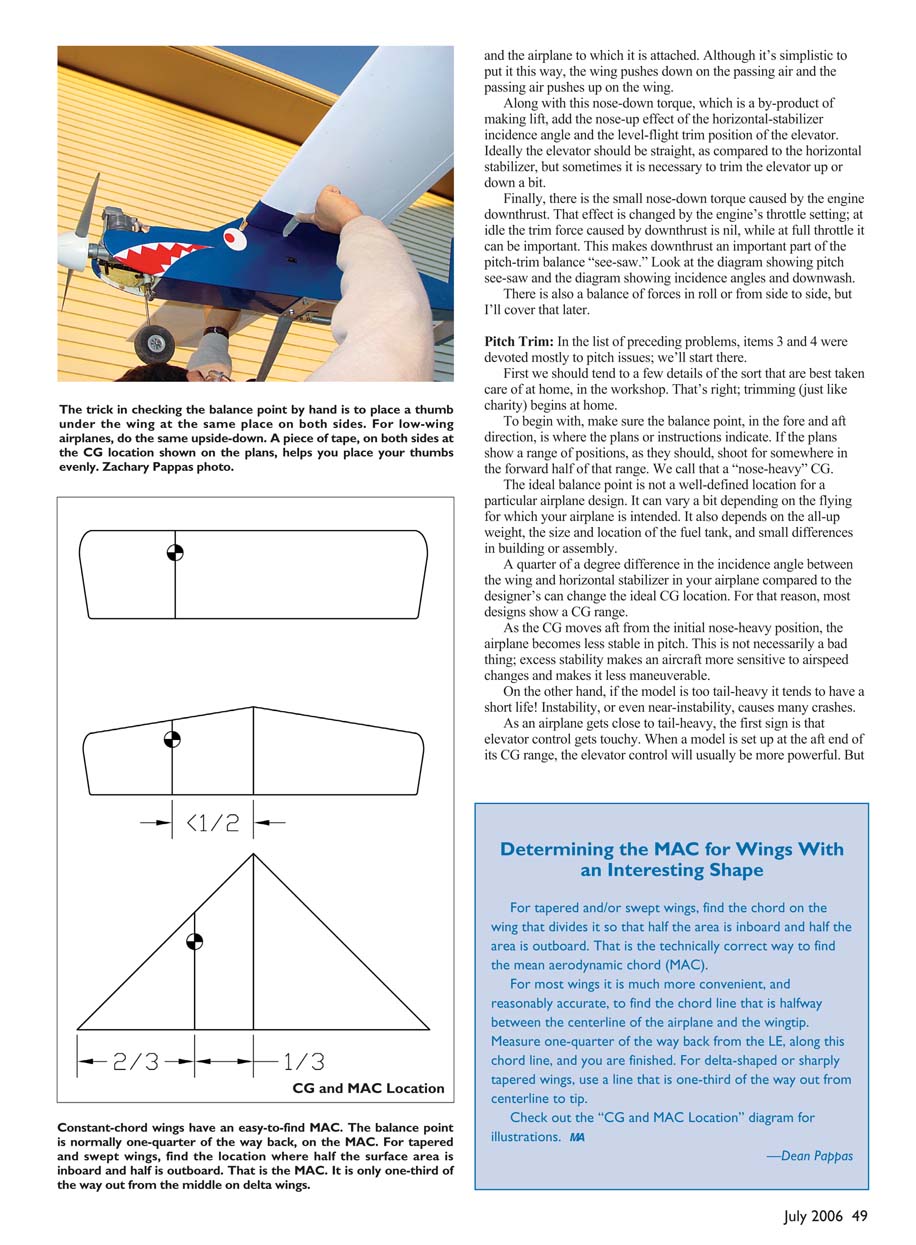
- As the wing bends and directs air downward, the passing air is rotated, which imparts an opposite, nose-down rotation to the wing and the airplane to which it is attached.
Along with this nose-down torque, add the nose-up effect of the horizontal-stabilizer incidence angle and the level-flight trim position of the elevator. Ideally the elevator should be straight compared to the horizontal stabilizer, but sometimes it is necessary to trim the elevator up or down a bit.
Finally, there is a small nose-down torque caused by engine downthrust. That effect changes with throttle setting; at idle the trim force caused by downthrust is nil, while at full throttle it can be important. This makes downthrust an important part of the pitch-trim balance "see-saw."
There is also a balance of forces in roll, or side to side, but that will be covered later.
Pitch Trim: Start at Home
First, tend to a few details that are best taken care of in the workshop. That’s right; trimming (just like charity) begins at home.
- Make sure the balance point, fore and aft, is where the plans or instructions indicate. If the plans show a range of positions, as they should, shoot for somewhere in the forward half of that range. We call that a "nose-heavy" CG.
- The ideal balance point is not a single precise location for a particular airplane design. It can vary depending on the intended flying, the all-up weight, the size and location of the fuel tank, and small differences in building or assembly. A quarter of a degree difference in incidence angle between the wing and horizontal stabilizer compared to the designer's can change the ideal CG location. For that reason, most designs show a CG range.
- As the CG moves aft from the initial nose-heavy position, the airplane becomes less stable in pitch. Excess stability can make an aircraft more sensitive to airspeed changes and less maneuverable; too far aft and instability or near-instability causes many crashes.
- As an airplane gets close to tail-heavy, the first sign is that elevator control gets touchy. When a model is set up at the aft end of its CG range, the elevator control will usually be more powerful. If it gets jumpy, or the elevator trim feels inconsistent, you are flirting with tail-heaviness.
- For advanced sport airplanes with semisymmetrical or symmetrical airfoils, inverted flight gives important clues: if it takes too much down-elevator to fly inverted, the model is likely nose-heavy. If it takes no down-elevator or even climbs sometimes, it is definitely tail-heavy.
If your airplane always seems to run out of elevator authority when it comes time to flare for landing, it could be a sign of nose-heaviness, though other causes are possible.
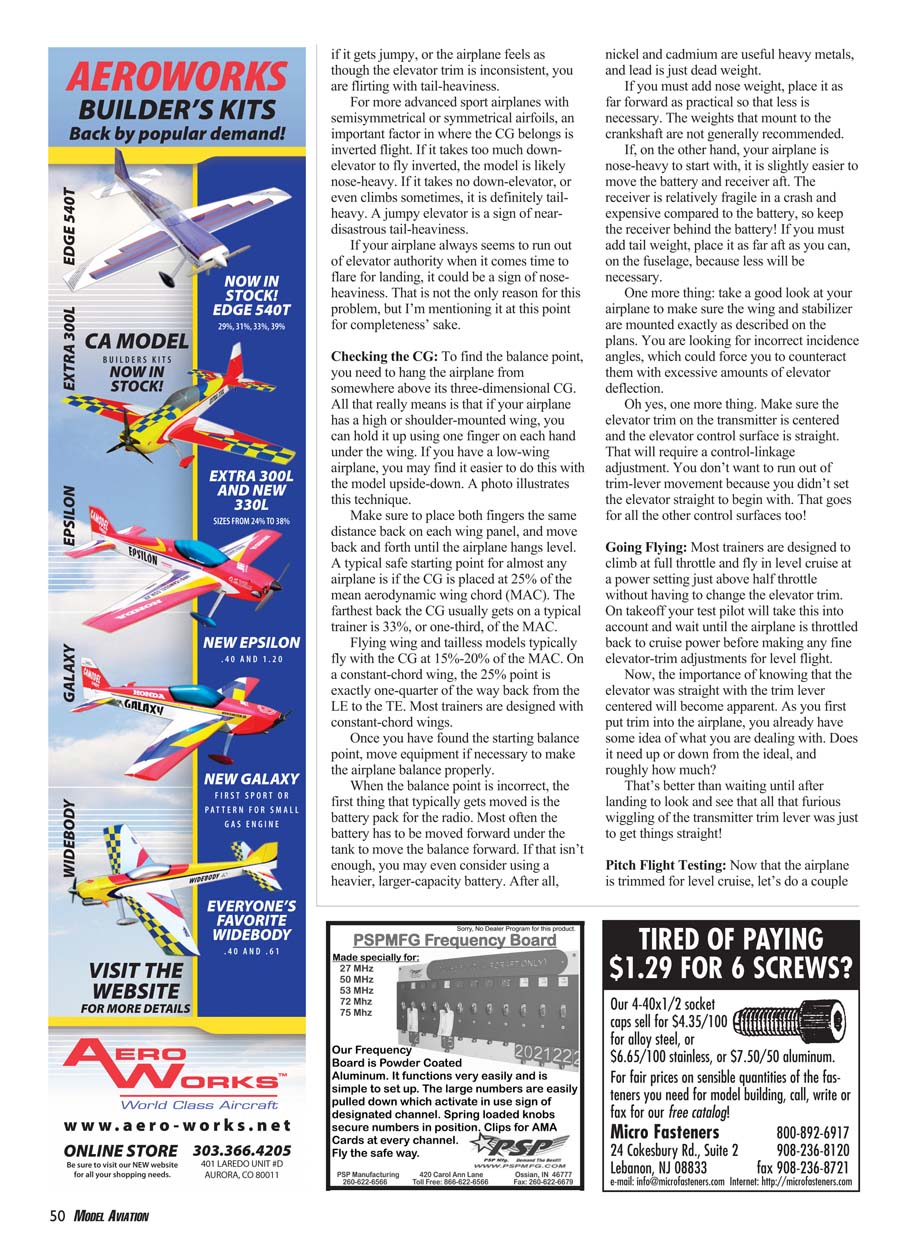
Constant-chord wings have an easy-to-find MAC. The balance point is normally one-quarter of the way back on the MAC. For tapered and swept wings, find the location where half the surface area is inboard and half is outboard. That is the MAC. It is only one-third of the way out from the middle on delta wings.
Determining the MAC for Wings With an Interesting Shape
For tapered and/or swept wings, find the chord on the wing that divides it so that half the area is inboard and half is outboard. That is the technically correct way to find the mean aerodynamic chord (MAC).
For most wings it is much more convenient, and reasonably accurate, to find the chord line that is halfway between the centerline of the airplane and the wingtip. Measure one-quarter of the way back from the leading edge (LE), along this chord line, and you are finished. For delta-shaped or sharply tapered wings, use a line that is one-third of the way out from centerline to tip.
(See the CG and MAC Location diagram for illustrations.)
Checking the CG
To find the balance point, you need to hang the airplane from somewhere above its three-dimensional CG. All that really means is that if your airplane has a high or shoulder-mounted wing, you can hold it up using one finger on each hand under the wing. If you have a low-wing airplane, it may be easier to do this with the model upside-down.
- Place both fingers the same distance back on each wing panel, and move back and forth until the airplane hangs level.
- A typical safe starting point for almost any airplane is the CG at 25% of the MAC. The farthest back the CG usually gets on a typical trainer is 33% (one-third) of the MAC.
- Flying wing and tailless models typically fly with the CG at 15%–20% of the MAC. On a constant-chord wing, the 25% point is exactly one-quarter of the way back from the LE to the trailing edge (TE).
- Once you have found the starting balance point, move equipment if necessary to make the airplane balance properly. Most often the battery pack for the radio is moved forward under the tank to move the balance forward. If that isn't enough, consider a heavier, larger-capacity battery.
- If you must add nose weight, place it as far forward as practical so that less is necessary. Weights that mount to the crankshaft are not generally recommended.
- If the airplane is nose-heavy, it is slightly easier to move the battery and receiver aft. Keep the receiver behind the battery since the receiver is relatively fragile and more expensive than the battery. If you must add tail weight, place it as far aft as you can on the fuselage.
- Take a good look at your airplane to make sure the wing and stabilizer are mounted exactly as described on the plans. Incorrect incidence angles could force you to counteract them with excessive elevator deflection.
- Make sure the elevator trim on the transmitter is centered and the elevator control surface is straight. That will require a control-linkage adjustment. You don't want to run out of trim-lever movement because you didn't set the elevator straight to begin with. That goes for all the other control surfaces too.
Going Flying
Most trainers are designed to climb at full throttle and fly level at cruise at a power setting just above half throttle without having to change the elevator trim. On takeoff your test pilot should take this into account and wait until the airplane is throttled back to cruise power before making any elevator-trim adjustments for level flight.
Knowing that the elevator was straight with the trim lever centered will become important. As you first put trim into the airplane, you already have some idea of what you are dealing with: does it need up or down from the ideal, and roughly how much? That's better than waiting until after landing to find out that all that furious wiggling of the transmitter trim lever was just to get things straight!
Pitch Flight Testing
Now that the airplane is trimmed for level cruise, do a couple of simple tests.
- Full-throttle climb test
- Smoothly advance the throttle to full. Without making elevator corrections, but still keeping the wings level with minimal, smooth aileron control inputs, watch the climb that results.
- Is the climb too shallow and fast? This might be ideal for an advanced sport airplane, but for a trainer you want a solid climb with adequate airspeed.
- Is the climb too steep? Watch to see if the climb is so steep that the airspeed decays.
- Has aileron control become sloppy? Is it difficult to promptly correct for wind? If so, that is a sign the airspeed is too low because of the steepness of the climb.
- Low-throttle glide test
- Set up a straight and level pass, parallel to the runway and roughly 100 feet up. Trim for cruise power level flight and with your hand off the elevator stick, quickly reduce the power to one or two "clicks" above a dead idle just before the airplane passes you. This is roughly the throttle setting used for final approach.
- Watch the glide slope that results, keeping the wings level but making no elevator corrections. Does the model settle into a nice glide angle or does it come down like a space shuttle?
- If the glide slope is too shallow and the airplane wallows along near a stall, the ailerons may get sluggish and directional control will be poor. Sometimes poor aileron control feels like a time lag between when the aileron control is applied and when the model actually starts to roll. It will get better if you push the nose down a tiny bit. That's another hint the glide slope is too shallow.
Now assemble what you have observed and make a change to the setup. If the model has insufficient downthrust, the elevator would have to be trimmed level or slightly down for level flight compared to where it would be with the correct downthrust. Alternatively, the airplane would have to be nose-heavy.
If the airplane needs more downthrust, at full power it will climb too steeply because the nose-up engine thrust is great. It will also glide too steeply when the nose-up engine thrust is missing and the down-trim or nose-heaviness takes over.
It is also possible that the airplane climbs too steeply under full power and glides okay or a little steep if the model is nose-heavy. That means it is overly stable in pitch and responds to the added airspeed by trying to climb too much.
You can look at the elevator trim to help distinguish these cases. If the elevator is trimmed up for level flight (even a bit), this is a hint that the airplane is nose-heavy and the aerodynamic trim was necessary to counteract it.
Which Pitch Adjustment to Make?
- If the climb or glide is too steep and the elevator trim is up:
- Move the CG back approximately one-quarter inch, retrim for cruise power level flight, and repeat the full-throttle climb and low-throttle glide tests.
- If the elevator trim is still up, move the CG back another quarter inch and retrim, repeating until the elevator trim is level or close.
- If you have to move the CG back far enough that down-elevator trim becomes excessive, consider adding downthrust (or making small thrustline changes) rather than moving the CG any farther aft.
- The goal is to obtain the desired climb and glide behavior without making the airplane overly tail‑heavy, which can degrade low-speed control and safety.
—Dean Pappas
Transcribed from original scans by AI. Minor OCR errors may remain.

